SKU: 111761000
cactus succulent soil

cactus succulent soil Buy Cactus and succulent Soil Mix? ✓ Fast shipping – Sybotanica

Sale price$20.34 Regular price$22.60
Save 10%

Pay in installments of $5.65 with ShopPay, AfterPay and Klarna

Shipping Estimate
USA
  • USA
  • CAN

Ships within 48 hours · Estimated delivery Sep 9 - Sep 14

Promo Codes Available:

For Your Every Summer RSVP, with Code: SUMMER15

Description

cactus succulent soil Buy Cactus and succulent Soil Mix? ✓ Fast shipping – SybotanicaThis SYBASoil mix can contain live worms! How to Use the Cacti & Succulent Soil Mix Using the mix is easy! Start with removing as much of the old soil as possible. Gently squeeze the pot while holding it sideways to loosen up the plant. Run the roots under lukewarm tap water to remove the last pieces and bits. Also, remove any dead foliage that may still be on the plant using scissors. Now your plant is ready for its fresh Cacti & Succulent soil. Add

 This SYBASoil mix can contain live worms! 

How to Use the Cacti & Succulent Soil Mix

Using the mix is easy! Start with removing as much of the old soil as possible. Gently squeeze the pot while holding it sideways to loosen up the plant. Run the roots under lukewarm tap water to remove the last pieces and bits.

Also, remove any dead foliage that may still be on the plant using scissors. Now your plant is ready for its fresh Cacti & Succulent soil. Add a small layer of Cacti & Succulent mix at the bottom of the pot.

Place the plant in the pot, and slowly add Cacti & Succulent soil to the sides to fill it up. Make sure that the point where the roots meet the plant is just buried under the Cacti & Succulent soil.

Lightly pat the Cacti & Succulent mix down into the pot. Make sure to water the Cacti & Succulent mix thoroughly after repotting, as this helps settle the mix and roots down.

Why the Cacti & Succulent Mix Works

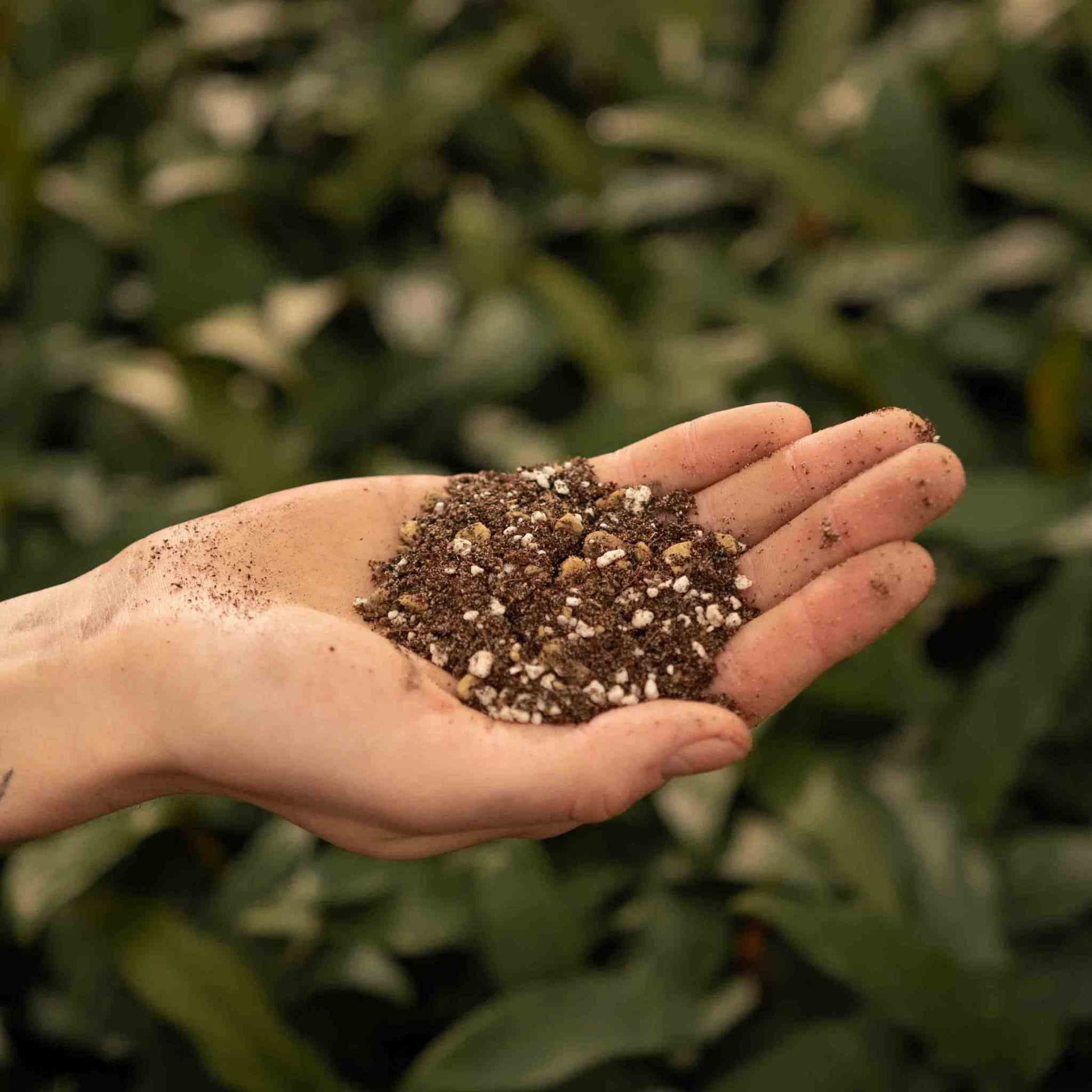
Gritty, airy, and well-draining are the main characteristics of this mix. To avoid overwatering there is a great amount of perlite, pumice and horticultural sand. This prevents root rot. The nutrients are designed to support the root, stem and leaf growth of your plant.

    The Original Habitat of the Cacti & Succulent Plants

    Most cacti & succulent-type plants originate from dry, desert locations. These habitats have long dry seasons and little nutrients in the water. Both types of plants use their leaves and body to store water for these periods. The desert locations are usually sandy and rocky and drain quickly. This Cacti & Succulent mix mimics that environment.

    How to Care for Cacti & Succulent Plants

    Cacti & succulents cover many thousands of species. Water the cacti & succulent mix once every 2 weeks during the hotter period (spring and summer) and once every month during the colder period (autumn and winter). Only fertilise during the hotter period with specialized cacti & succulent fertiliser.

    Our cacti & succulent mix contains nutrients for at least 180 days, so no need to add fertiliser until a new hotter period has arrived. For some succulents, you will need to water them more often. A great tip for succulents is that when the leaves get soft to the touch they can use a drink.

    Be sure to completely wet the cacti & succulent mix when watering, a common misconception is that you should water only a little every time. Imagine a cactus in the desert, once it does get water from rainfall, it will be completely drenched for a while. Give your plant the time to suck up some water into the cacti & succulent mix.

    Cacti & succulents prefer a large amount of sunlight and can handle a few hours of sun, depending on the species.

    Making an Open Terrarium

    An open terrarium requires specialized soil to thrive, the biggest risk is the rotting roots of succulents and cacti. Use our Cacti & Succulent Mix to get a head start.

    Aloe Vera Soil | Sansevieria Soil | Yucca Soil | ZZ Plant Soil | Agave Soil

      Shipping Notes
      • Free Standard Shipping on $100+ Orders to the USA.
      • Except Preorder products are shipped in 48 hours.
      • Delivery to the USA:
      1. Standard Shipping : 3-10 business days
      • If time is of the essence, please consider selecting expedited delivery for faster service.
      Exchange/Return Notes
      • We offer a 30-day return/exchange service after receiving.
      • Final sale items are not eligible for returns or exchanges.
      • To process your return/exchange, please contact us at [email protected]
      • Please click here for more details>>> Return & Exchange Policy
      SKU: 111761000

      Discover Niche Categories That Outsell cactus succulent soil

      Top-Converting Item to Boost Your Average Order

      4.2 ★★★★★
      Based on 30 reviews
      Sort
      Highest Rating
      Newest First
      Oldest First
      Product Reviews
      A
      Verified Purchase
      Amazon Customer
      Grantham, US
      ★★★★★ 5
      Another fine Piece
      As with Bowlbys' other works, this classic furthers the hypothesis of negative emotional influence on the continued development of humans as we integrate with our social environments. I liked it...in fact, liked all of Bowlbys' writings.
      WAS THIS REVIEW HELPFUL?YesReportShare
      Reviewed in the United States on September 12, 2013
      F
      Verified Purchase
      fatimah
      Pawtucket, US
      ★★★★★ 5
      Five Stars
      A MUST HAVE BOOK FOR anyone interested in parenting! or have kids.
      WAS THIS REVIEW HELPFUL?YesReportShare
      Reviewed in the United States on March 20, 2015
      N
      Ng Wai Yin
      Lowell, US
      ★★★★★ 4
      A Groundbreaking Classic on Young Child Development
      Format: Paperback
      This first volume of John Bowlby's trilogy on Attachment and Loss expands and builds upon an article he published in 1958 in the International Journal of Psycho-Analysis titled "The Nature of the Child's Tie to His Mother", which is perhaps a more telling title than that of the book itself. Attachment, as a technical term in behavioural biology, is first used in describing instinctive mother-following behaviours of young mammals and birds (first observed and reported in delightful accounts by the Austrian ethologist Konrad Lorenz in the 1930's). By comparing data collected during and after the Second World War by childcare workers and researchers in U.K. and North America, Bowlby found a striking common pattern of distressed behaviours among young children between the ages of one and three when separated from mother for an extended period: first in Protest, then Despair and finally Detachment - a psychopathological state when a child becomes socially uninitiated and withdrawn, even to his returning mother. Bowlby then postulates that physical proximity to a mother-figure is essential to a child's development of cognitive capacities, especially during a sensitive period around six months to two years after birth. Attachment behaviours, like those of young mammals and birds, are present in the human baby too. This has since led to a blossoming of research activities in development psychology and psychoanalysis, as well as neurophysiology recently, which supplies much fresh evidence about the young brain and its phenomenal maturing in the first two years. Attachment theory has since contributed significantly to understanding of our own selves, informed the age-old philosophical debate on nature or nurture, and brought our attention to fundamental issues in child-rearing such as sensitive periods of development, the difference between attachment (conducive to security) and dependence (symptomatic of insecurity), the distinction between anxiety from separation and fear of the unfamiliar, etc. This new edition is a timely reprint of a classic account of attachment theory as formulated by the originator. While primarily an academic work, with a few chapters deemed more for an academic jury (about Freud and instinctive behaviours, etc.), it is mostly very readable, and certainly captivating to those with access to young babies, of whose behaviours are given an enlightening perspective. This volume focuses on attachment, with subsequent volumes on its loss in temporary and permanent terms respectively.
      WAS THIS REVIEW HELPFUL?YesReportShare
      Reviewed in the United States on September 4, 2003
      G
      Verified Purchase
      guy
      Alexandria, US
      ★★★★★ 5
      A Psychological Classic
      Format: Paperback
      This is one of the volumes in John Bowlby's triology addressing the concept of "attachment". It is considered a "classic" on the topic.
      WAS THIS REVIEW HELPFUL?YesReportShare
      Reviewed in the United States on May 18, 2015
      E
      Verified Purchase
      EliteConcurrency
      Pawtucket, US
      ★★★★★ 5
      Five Stars
      Format: Paperback
      Great book!
      WAS THIS REVIEW HELPFUL?YesReportShare
      Reviewed in the United States on August 13, 2016

      recommand products