Shipping Estimate
USA
- USA
- CAN
- USA
- CAN
Ships within 48 hours · Estimated delivery Jul 8 - Jul 13
 Promo Codes Available:
For Your Every Summer RSVP, with Code: SUMMER15
Description
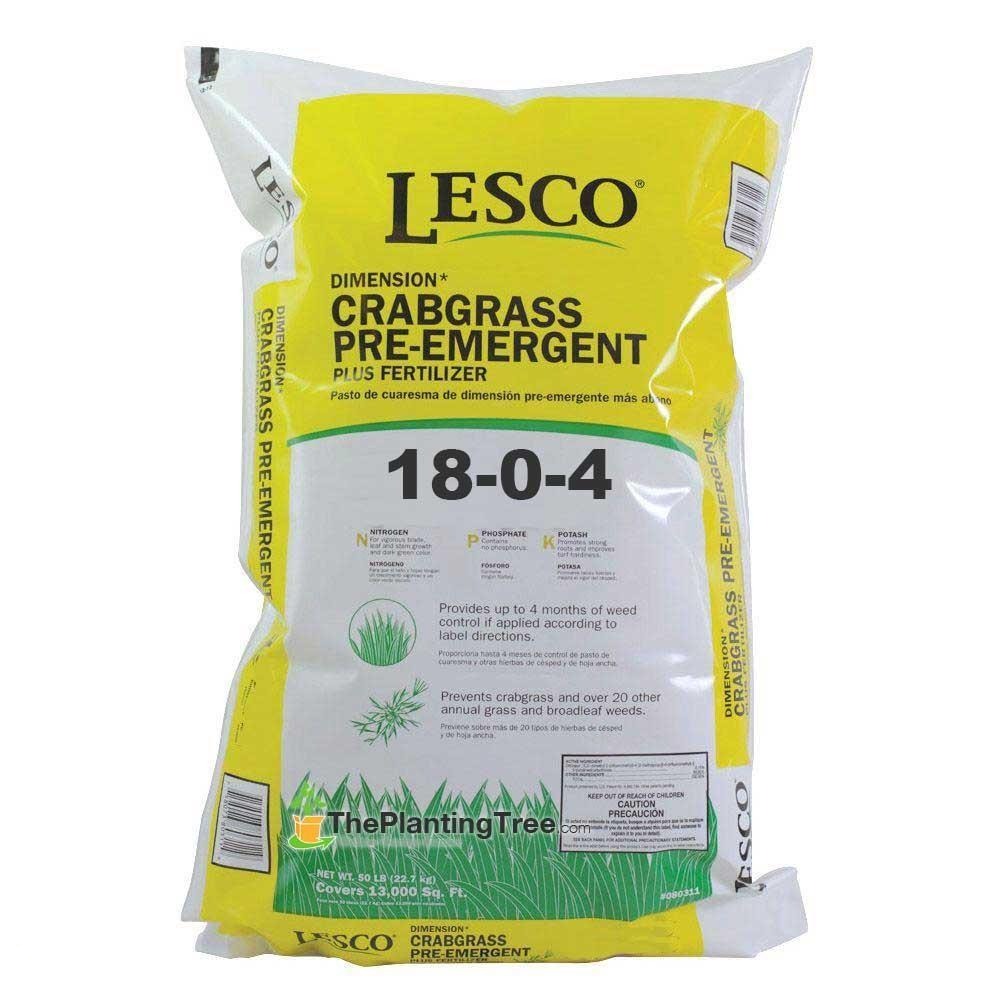
lockup herbicide Lesco Fertilizer Plus Herbicide 18-0-4Lesco's Dimension 0. 15% with Fertilizer provides superior control of crabgrass, annual grasses, and broadleaf weeds in established lawns and ornamentals turfs. This product will not harm nearby established ornamentals when used according to the label. (Please see Spec Sheet) Suggested use of 2 applications starting in January and then again in Early March. With the use of Dimension, Dimension will provide reach back on any germinated crabgrass within
Lesco's Dimension 0.15% with Fertilizer provides superior control of crabgrass, annual grasses, and broadleaf weeds in established lawns and ornamentals turfs. This product will not harm nearby established ornamentals when used according to the label. (Please see Spec Sheet)
Suggested use of 2 applications starting in January and then again in Early March. With the use of Dimension, Dimension will provide reach back on any germinated crabgrass within the first tiller stage.
Recommend for: Tall Fescue, Ryegrass, Bluegrass, Bahiagrass, Bermudagrass, Buffalograss, Carpetgrass, Centipedegrass, St. Augustinegrass, Zoysiagrass
Dimension 18-0-4 Specification Sheet - (Download)
Dimension Label - (Download)
Pre-Emergent Application Timing Tips
Directions
CAUTION
KEEP OUT OF REACH OF CHILDREN
APPLICATION DIRECTIONS - Control of Crabgrass Pre-emergence and Early Post-emergence Control This product provides "pre-emergence" control of crabgrass (including the large, smooth, and southern species) when applied prior to the emergence of crabgrass from the ground in established lawns and ornamental turfs.
It can also provide "early post-emergence" control of crabgrass during the early stages of crabgrass growth after the crabgrass has emerged from the ground. However, it is often difficult to see the very small, early stages of crabgrass in well-established lawns and ornamental turfs.
Post-emergence crabgrass control will be obtained only when this product is applied prior to the tillering of crabgrass, which generally corresponds to the time when you can first easily see the crabgrass plants in the lawn or turf. So the practical benefit of this product's additional, early post-emergence activity is that (compared to strictly pre-emergence crabgrass products), Dimension controls crabgrass prior to and up to 4 weeks after germination.
Application Frequency and Timing - This product may be applied as a single application, as a split application, or as a sequential application for crabgrass control in the spring, summer, or fall. DO NOT apply more than 7.65 lb of this product per 1,000 sq ft per application, and no more than 22.95 lb of this product per 1,000 sq ft per year.
Spring Applications
For single applications made in the spring or early summer, this product should be applied at the appropriate rate corresponding to one of the three control programs listed in Table 1 below, depending on the user's location, the turfgrass mowing height, and whether the use is considered to be pre-emergence or early post-emergence at the time of the application.
The duration of residual weed control provided by this product is directly related to the total rate applied, but will vary somewhat depending on weather, weed pressure, turfgrass competitiveness, and the user's location within a region.
Use Program #1 for pre-emergence control at sites where the turfgrass is cut high (e.g., homeowner lawns). This program provides 3-5 months of pre-emergence crabgrass control. This program should not be used for early post-emergence crabgrass control.
Use Program #2 for pre-emergence control at sites where (a) turfgrass is cut low (e.g., golf fairways), and (b) turfgrass maintenance or weed control has not been conducted during the previous year. This program provides 4-6 months of pre-emergence crabgrass control. This program may also be used for early post-emergence control at sites where turfgrass is cut high (e.g., homeowner lawns).
Use Program #3 for pre-emergence control at sites where (a) turfgrass is cut low (e.g., golf fairways) and (b) turf maintenance or weed control has not been conducted during the previous year. This program provides 4-6 months of pre-emergence crabgrass control.
This program may also be used for early post-emergence control at sites where turfgrass is cut low (e.g., golf fairways). Subsequent, sequential pre- and/or post-emergence applications should be made where longer periods of control are desired. Where split fertilizer applications are recommended, the rates in Table 1 may be split across two applications made 6-10 weeks apart and prior to crabgrass emergence.
Table 1: Recommended Single Application Use Rates*
|
PROGRAM |
#1 |
#2 |
#3 |
|
USE REGION |
Pre-emergence |
Pre-emergence |
Pre-emergence |
|
North |
1.91 lb/1,000 sqft |
2.75 lb/1,000 sqft |
3.82 lb/1,000 sqft |
|
Transition |
2.75 lb/1,000 sqft |
3.82 lb/1,000 sqft |
5.66 lb/1,000 sqft |
|
South |
3.82 lb/1,000 sqft |
5.66 lb/1,000 sqft |
7.65 lb/1,000 sqft |
|
Coastal South |
5.66 lb/1,000 sqft |
7.65 lb/1,000 sqft |
7.65 lb/1,000 sqft |
Spreader Settings
Spring Application
Used as directed for crabgrass control in the spring, this product will also control (at the "Program 3" rates) the following weeds when applied prior to their emergence: barnyardgrass ryegrass (annual & perennial) bluegrass (annual) smutgrass crowfootgrass lespedeza (common) foxtail (yellow & green)* oxalis (buttercup, creeping & yellow woodsorrel)
Fall Applications
Used as directed for late summer or early fall use, for crabgrass control through the early part of the next spring, this product will also control (at the "Program 3" rates) the following weeds when applied prior to their emergence: bluegrass (annual) geranium (Carolina) bittercress parsley-piert chickweed pineappleweed henbit shepherd’s purse
APPLICATION EQUIPMENT AND INSTRUCTIONS
Apply this product with drop or rotary spreaders designed to apply granular herbicides. Avoid the use of spreaders that would apply this product in narrow rows or concentrated bands. Before each application, calibrate the spreader according to the equipment manufacturer's directions for adjusting the spreader settings such that the spreader delivers the appropriate application rate recommended above.
Apply this product uniformly over the lawn or ornamental turf area. A more uniform application can be made by spreading half of the required amount over the area and then applying the remaining half at a right angle to the previous direction. Avoid streaking, skips, or overlaps during application. Check equipment frequently to ensure equipment is functioning properly and applying uniform distribution of granules.
STORAGE AND DISPOSAL
Do not contaminate water, food, or feed by storage or disposal. PESTICIDE STORAGE: Store this product only in its original container in a dry, cool, secured storage area. PESTICIDE DISPOSAL: Wastes resulting from the use of this product that cannot be used or chemically reprocessed should be disposed of in a landfill approved for pesticide disposal or in accordance with applicable Federal, State or local procedures. Or call [1-800- CLEANUP] for disposal instructions.
Never place unused product down any indoor or outdoor drain. CONTAINER DISPOSAL: Nonrefillable container. Do not reuse or refill this container. Completely empty bag into application equipment. Then offer for recycling if available or dispose of empty bag in a sanitary landfill or by incineration or, if allowed by state and local authorities, by burning. If burned, stay out of smoke. SPILL: In case of spill, sweep up material and dispose of material according to "Product Disposal" directions listed above.
Check out our Lesco 24-2-11
For additional options, be sure to browse our Lesco Lawn Products and Lawn Care collections.
Shipping Notes
- Free Standard Shipping on $100+ Orders to the USA.
- Except Preorder products are shipped in 48 hours.
- Delivery to the USA:
- Standard Shipping : 3-10 business days
- If time is of the essence, please consider selecting expedited delivery for faster service.
Exchange/Return Notes
- We offer a 30-day return/exchange service after receiving.
- Final sale items are not eligible for returns or exchanges.
- To process your return/exchange, please contact us at [email protected]
- Please click here for more details>>> Return & Exchange Policy