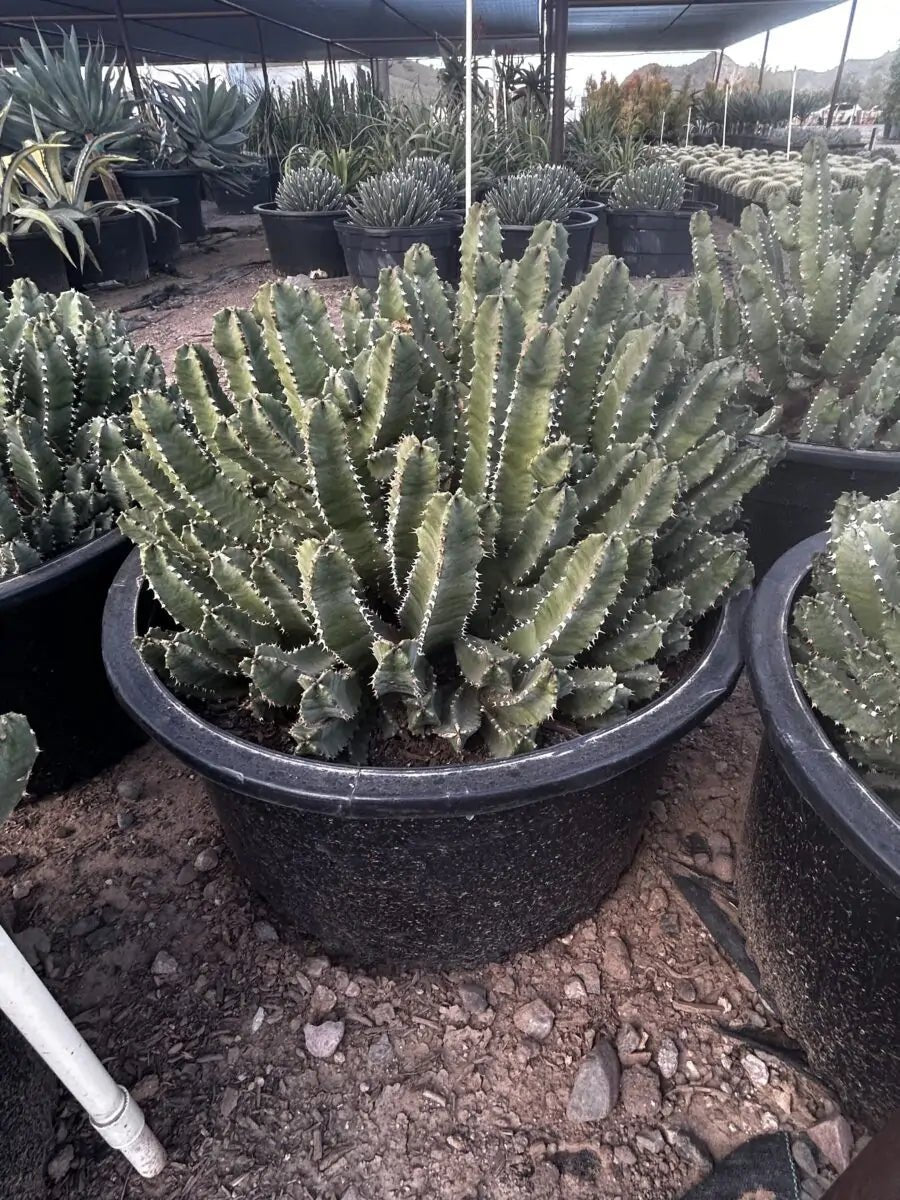
SKU: 17342108066
succulent nursery phoenix

succulent nursery phoenix Buy Moroccan Mound Phoenix, AZ | Euphorbia resinifera

Sale price$19.43 Regular price$21.59
Save 10%

Pay in installments of $5.40 with ShopPay, AfterPay and Klarna

Shipping Estimate
USA
  • USA
  • CAN

Ships within 48 hours · Estimated delivery Jul 19 - Jul 24

Promo Codes Available:

For Your Every Summer RSVP, with Code: SUMMER15

Description

succulent nursery phoenix Buy Moroccan Mound Phoenix, AZ | Euphorbia resiniferaPhoenix's Toughest Mounding Succulent Moroccan Mound Euphorbia resinifera, known as the Moroccan Mound, is one of the hardiest and most maintenance free succulents you can plant in the Phoenix Valley. Native to the rocky hillsides of Morocco, this dense, cushion forming Euphorbia grows into neat, architectural mounds of four sided blue green stems studded with short spines. It's virtually indestructible in Arizona heat thriving in full sun, reflected

Phoenix's Toughest Mounding Succulent — Moroccan Mound

Euphorbia resinifera, known as the Moroccan Mound, is one of the hardiest and most maintenance-free succulents you can plant in the Phoenix Valley. Native to the rocky hillsides of Morocco, this dense, cushion-forming Euphorbia grows into neat, architectural mounds of four-sided blue-green stems studded with short spines. It's virtually indestructible in Arizona heat — thriving in full sun, reflected heat, rocky soil, and extreme drought with zero fuss. Whether you're filling a Scottsdale rock garden, anchoring a Mesa xeriscape bed, edging a Chandler walkway, or covering a Gilbert slope, Moroccan Mound delivers year-round structure on almost no water.

Moroccan Mound Plant Details

Attribute Detail
Scientific Name Euphorbia resinifera
Common Names Moroccan Mound, Resin Spurge
Mature Height 12–18 inches (individual mound); clumps grow wider over time
Mature Width 18–24 inches per mound; spreads to 3–4 feet as a clump
Growth Rate Moderate — fills in steadily, forming dense mounds within 2–3 years
Sun Full sun (6+ hrs). Handles reflected heat from walls and pavement.
Water Very low once established. Extremely drought-tolerant.
USDA Zones 9–11 (Phoenix is Zone 9b–10a)
Soil Well-draining. Thrives in Arizona caliche soils with minimal amendment.
Foliage Evergreen — blue-green four-sided columnar stems year-round
Bloom Small yellow to orange flowers at stem tips in spring

Moroccan Mound Uses in Phoenix Landscapes

Rock Garden & Xeriscape Ground Cover

Moroccan Mound's dense, cushion-like growth habit makes it an ideal ground cover for rock gardens and gravel beds. Plant in groups among decomposed granite and desert boulders for a naturalistic mounding effect. Over time, individual mounds merge into a continuous carpet of blue-green columns. Pairs beautifully with Agave, Aloe, and other Euphorbias for a layered desert garden.

Slope & Erosion Control

Moroccan Mound excels on slopes and hillsides where its spreading, mounding habit stabilizes soil while requiring almost no irrigation. Plant 18–24 inches apart on gentle to moderate slopes in Scottsdale, Paradise Valley, and Fountain Hills landscapes for a maintenance-free slope solution.

Border & Edging Plant

Line walkways, driveways, and patio edges with Moroccan Mound for a tidy, architectural border. The mounding form stays neat without pruning, and the short spines add subtle texture without being dangerous. Space 18–24 inches apart for a continuous low hedge effect in Tempe, Mesa, and Peoria landscapes.

Pool-Friendly & Low-Maintenance Beds

Moroccan Mound's compact growth, no leaf drop, and minimal water needs make it perfect near pools, courtyards, and HOA-maintained areas. It stays tidy year-round with virtually zero maintenance — no pruning, no deadheading, no pest issues.

Best Time to Plant Moroccan Mound in Phoenix

Fall (October–November) is the ideal planting window. Warm soil encourages root establishment while cooler air reduces transplant stress. Spring (February–April) is the second-best option. Moroccan Mound can actually be planted year-round in Phoenix — it's one of the few succulents tough enough to transplant even in summer with modest extra watering.

How to Plant Moroccan Mound

  1. Dig wide, not deep — hole should be 2–3x the root ball width, same depth
  2. Check for caliche — break through any hardpan layer to ensure drainage
  3. Backfill with native soil — Moroccan Mound tolerates poor soil; minimal amendment needed
  4. Spacing — 18–24 inches apart for ground cover; 24–30 inches for individual mounds
  5. Water basin — build a shallow 2-inch ring around the plant for the first few months
  6. Mulch — 1–2 inches of gravel mulch; avoid organic mulch which retains too much moisture

Watering Moroccan Mound in Phoenix

First Year Watering Schedule

Weeks 1–2: Every 3–4 days, deep and slow. Month 1–2: Every 5–7 days. Month 3–6: Every 10–14 days (every 7–10 days in peak summer). After Year 1: Every 14–21 days in summer; monthly or less in winter.

Drip Irrigation

Place one 0.5–1 GPH emitter 8–12 inches from the mound center. Moroccan Mound is extremely rot-resistant compared to many succulents but still prefers to dry out between waterings. Established plants can survive on rainfall alone in most years.

How fast does Moroccan Mound grow in Phoenix?
Moroccan Mound grows at a moderate pace, forming a dense 18–24 inch mound within 2–3 years. It continues to spread slowly outward over time, with mature clumps reaching 3–4 feet wide.

Is Moroccan Mound drought-tolerant once established?
Extremely — it's one of the most drought-tolerant succulents available. Established plants can survive on rainfall alone in Phoenix and go months without supplemental irrigation.

Is Moroccan Mound toxic?
Yes — like all Euphorbias, it produces a milky white latex sap that can severely irritate skin and eyes. Wear gloves and eye protection when handling or pruning. The sap of Euphorbia resinifera contains resiniferatoxin, one of the most potent irritants in the plant kingdom.

Can Moroccan Mound handle full Phoenix summer sun?
Absolutely — it's built for intense heat and sun. It handles reflected heat from walls, driveways, and pool decks without any sunburn or stress.

Does Moroccan Mound spread aggressively?
No. It spreads slowly and predictably by offsetting from the base. It's easy to contain and won't take over your garden. Simply remove any unwanted offsets if it grows beyond its allotted space.

You May Also Like

Gopher Plant — Another tough Euphorbia with blue-green foliage for a complementary mounding accent.
Firestick Euphorbia — Bright coral-red stick succulent for dramatic color contrast.
Blue Elf Aloe — Compact blue-green aloe rosettes that pair well with Moroccan Mound's columnar texture.
Ghost Aloe — Pale blue-white aloe for cool-toned contrast in desert beds.
Dragon Toes Agave — Small textured agave for a complementary accent alongside mounding Euphorbias.

How Many Moroccan Mound Do I Need?

Moroccan Mound spreads into broad cushions (18 to 24 inches per mound, merging to 3 to 4 feet over time), so for a rock garden carpet or slope cover space plants about 2 feet on center and let them knit together. Use the coverage table below to estimate counts, then round up for full slopes.

Area to cover Spacing Plants needed
50 sq ft 2 ft o.c. 13
100 sq ft 2 ft o.c. 25
200 sq ft 2 ft o.c. 50

For single architectural mounds or a tidy border, space 24 to 30 inches apart instead so each cushion keeps its clean dome shape.

Moroccan Mound Season-by-Season in Phoenix

  • Spring (Feb–Apr): Small yellow to orange flowers ring the stem tips and growth picks up. A strong second planting window as soil warms.
  • Summer (May–Sep): Built for it. Shrugs off full sun and reflected heat from walls and pool decks with no sunburn, and rides out the monsoon without rot thanks to its loose, gritty-soil preference. Among the few succulents tough enough to plant even mid-summer with a little extra water.
  • Fall (Oct–Nov): The ideal planting season: warm soil plus mild air give the fastest establishment.
  • Winter (Dec–Jan): Holds its blue-green structure year-round. It is hardier than most Euphorbias but still best protected when nights dip below about 25°F; keep it dry through cold, wet spells.

At a Glance

✔ Heat-Loving (Reflected-Heat Tolerant)   ✔ Drought-Tolerant   ✔ Evergreen   ✔ Pool-Friendly (Low-Litter)   ✔ Low-Maintenance   ✔ Deer & Rabbit-Resistant

Plant It With

  • Gopher Plant: another tough blue-green Euphorbia that echoes the mounding texture.
  • Firestick Euphorbia: coral-red stick form for dramatic color against the blue mounds.
  • Candelilla: slim wax-stem Euphorbia that adds vertical contrast in the same bed.
  • Desert Spoon: silver spherical accent that rises above the low cushions.

Is Moroccan Mound Right for Your Yard?

Moroccan Mound is one of the most foolproof choices for full-sun Phoenix yards: it wants 6-plus hours of sun, drains happily in caliche with little amendment, and asks for almost no water once rooted, making it ideal for rock gardens, slopes, and low borders. Not a fit if your spot is shaded or stays soggy. Note the sap contains resiniferatoxin, an extremely potent skin and eye irritant, so always wear gloves and eye protection and keep it away from high-traffic, kid, and pet zones.

Shipping Notes
  • Free Standard Shipping on $100+ Orders to the USA.
  • Except Preorder products are shipped in 48 hours.
  • Delivery to the USA:
  1. Standard Shipping : 3-10 business days
  • If time is of the essence, please consider selecting expedited delivery for faster service.
Exchange/Return Notes
  • We offer a 30-day return/exchange service after receiving.
  • Final sale items are not eligible for returns or exchanges.
  • To process your return/exchange, please contact us at [email protected]
  • Please click here for more details>>> Return & Exchange Policy
SKU: 17342108066

Discover Niche Categories That Outsell succulent nursery phoenix

Top-Converting Item to Boost Your Average Order

4.7 ★★★★★
Based on 13 reviews
Sort
Highest Rating
Newest First
Oldest First
Product Reviews
P
Verified Purchase
Preacher of Prose
Chelsea, US
★★★★★ 5
🏜️ Arrakis. Dune. Desert Planet.
Format: Paperback, Format: Paperback
Earlier this year, I decided to actively stop doom scrolling. With the help of Opal to limit my access to social media on my phone, I had a ton of time to kill. I didn't want to go back to playing video games, I have probably played enough video games for two lifetimes, and I could only spend so much time job hunting, so I decided to give reading a real shot. Truth is, I never enjoyed reading as a kid. It always felt like homework, like something forced, and that took all the fun out of it. So why did I pick Dune? I really enjoyed the movies by Denis Villeneuve, and something about the book pulled me in. At that point, I could not tell if I chose Dune or if Dune chose me. 📖 Now onto the actual review. 🚨 Spoiler Alert 🚨 “The mystery of Dune is not a problem to solve, but a reality to experience.” Dune feels less like a book and more like entering a world that already exists. Published in 1965 by Chilton, a company better known for auto repair manuals, it is packed with politics, philosophy, religion, ecology, prophecy, drugs, hallucinogenics, and deep world building. Following Paul Atreides (protagonist) from royal heir to outcast to leader of the Fremen to emperor felt like going through a transformation alongside him. I found myself learning about resilience, how to navigate a future you can see coming but cannot avoid, and what it really means to lead. Each chapter gave me something to think about. Even more, Dune feels very relevant today given our current political climate. Power, manipulation, religion, and control over resources are all central themes, and they hit differently when you look at the world around you. 💡 Pro tip for reading Dune Frank Herbert does not hold your hand. He drops you into a world filled with esoteric technology, unfamiliar terminology, and a culture with its own rules. It can feel overwhelming at first, but do not get discouraged if you do not understand everything right away. Let the world unfold as you go. I ended up reading the first three books in the series, Dune, Dune Messiah, and Children of Dune, and then went back to re-read Dune. This review is based on that second read, and it is amazing how much more you pick up the second time through. What also helped was reading the graphic novels alongside the book. They do not include every detail, but they stay faithful to the story and help bring the world to life visually. Also, if you have not watched the recent movies directed by Denis Villeneuve, they are worth checking out. I saw them before reading, and they helped me better understand the characters and major plot points.
WAS THIS REVIEW HELPFUL?YesReportShare
Reviewed in the United States on May 14, 2026
C
Verified Purchase
Chrissy
Waukegan, US
★★★★★ 5
I highly recommend it to all readers
Format: Mass Market Paperback
Dune A book review by Nathan Poulson Written by Frank Herbert in 1959, “Dune” is an epic adventure of political betrayal, ecological brinkmanship, and messianic deliverance. It won science fiction’s highest awards—the Hugo and the Nebula—and went on to sell more than twelve million copies during Herbert’s lifetime. The mantel piece of sci-fi, Star Wars, owes many of its’ widely popular ideas to Dune. To this day, it is still acclaimed by readers and critics alike as a “science-fiction masterpiece”. I highly recommend it to all readers, as I believe it will put a new perspective on things, deepen your understanding, and excite you to the edge of your seat. Dune follows the 15 year old boy Paul Atriedies and his mother, Jessica Atriedies in the very distant future. He is an only child of the duke of the Royal house of Atriedies. The house is given the stewardship over the desert planet of Arrakis or “Dune”, which controls the most valuable resource in the universe, the spice. On the planet where water is more valuable than gold, desert sand worms that are bigger than spaceships, life is lived to the extreme. With the spice comes a longer life span, increased perception, and in some cases prediction of the future, but at the cost of being highly addictive. The Harkonens, a noble house that previously owned the planet is intent on revenge and recapturing the spice. The spacing guild, which relies on the spice for navigating their spacecraft, is also intent on preventing anyone restricting or destroying their monopoly on space travel. Paul finds himself thrown into the mystery of Dune and its fierce natives, the Fremen. They think he is the savior their prophecy speaks of - is he destined to be the great preserver of their world or a false prophet to be purged? With multiple factions fighting, deceiving, and pulling strings, you never know quite what to expect in this awesome futuristic battleground. One side I really like about Dune is that it is not just a distant sci-fi to be enjoyed, but a book to learn and understand from. I really enjoy the themes Herbert establishes in the plot; one of them including the danger of entrusting too much power to a super being. Although his themes might be very serious and almost depressing, I admire that he has the courage to end the story based in reality, instead of a unrealistic Hollywood ending with no depth. Although the plot was very engaging, at some times the writing style really dragged things down. This can be a real turn off for even patient readers as Frank ambles around in unimportant details describing made up words and the very boring thought process of the characters. This is the one thing that made this otherwise a perfect book. Even though I thought the plot was almost pulling me down, somehow I still enjoyed it through the few sparks of almost perfect harmony when the style actually worked for the story. What makes Dune so special is the pure atmosphere. You can really tell that Frank put in a lot of effort into his fictional world and society. Even though the story is set in another universe, the planets, the characters, and the motives seem very real. He had the worlds built before he set the plot on them; you can see he studied Greek and Near East history extensively to make this book really come to life. Most books have characters that you can easily relate to. With Dune, it is a little bit harder to do that. In it, you have a story that instead of a personal account, it is more like a “retelling” and it is sometimes a little harder to relate to the feelings and values of the characters. My favorite character Paul is the most distant character for most of the book. Most of this isolation comes from the fact that people look to him as an idol, even though he still has human flaws. Throughout the book Paul is the character with the most burdens, and in constant pressure that he doesn’t measure up to other’s expectation of him. “They think they have a God, but I am only a man”. In reality he is a character we can all reflect from, he just has some layers in his personality that you have to peel away to really get to the core. This book is near from perfect, but it still hits home. Frank Herbert has done a difficult thing that combines ancient myths and stories with laser guns and mind control. He was the first one to do it, and the last to do it so well. Even without its deeper meanings, this is still a great read to just casually absorb. I cannot explain to you how amazing this book really is; so experience it yourself and pick up a copy, you will be surprised to what it has to offer.
WAS THIS REVIEW HELPFUL?YesReportShare
Reviewed in the United States on December 15, 2015
A
Verified Purchase
Amazon Customer
Waukegan, US
★★★★★ 4
‘Dune’ Paved the Way for Surfer Proverbs and ‘Star Wars’ Alike
Format: Kindle
A Bene Gesserit proverb: “When religion and politics travel in the same cart, the riders believe nothing can stand in their way.” I have to be honest, as a contemporary consumer of sci-fi film, small screen works and books, Frank Herbert’s 1965 Dune starts out slow. To be clear, I’m talking about the first half of some 800 pages. The reason why I stuck it out, though, is because I know the saga gets better as it continues (with Children of Dune being arguably the favorite). Known as one of the original sci-fi novels, I approached it like I would any classic piece of literature. And you know what? I’d put Dune in my personal cannon of classic lit because of it’s heavy influence on sci-fi … everything. That’s right, not even Star Wars would exist without Dune. Herbert, a (sometimes struggling) freelance writer with a passion for ecology and a streak of utopian futurism, wrote Dune when he was almost 40 years old. At the time, sci-fi readers generally liked their stories short but this paperback was almost 900 pages. Not surprising, Dune wasn’t an overnight success but it’s popularity grew in the 1970s and 1980s. Dune is set in a dry, distant future, where warring noble houses are kept in line by an interstellar empire. The noble duke Leto (heir apparent Paul Atreides’ father), head of the House Atreides, is forced to move his household from their perfectly good home planet to the desert planet of Arrakis (also known as Dune). The climate on Dune is practically inhabitable to the layman. Water is so scarce that whenever its inhabitants go outside, they must wear stillsuits, which capture body moisture and recycle it for drinking (it’s beyond nasty). In a nutshell, the whole thing is a classic you killed my father and I’m going to get revenge coming of age story. Everything else revolves around the hot commodity on Arrakis, which is basically a very powerful and desired drug: Spice (melange). This cinnamon-scented substance is made from excretions of killer 1,000-foot sand worms (yes, I had a lot of Tremors flashbacks reading this book), gas, then exposure to the sun — but to mine it is very dangerous because said worms don’t like noise. At all. The drug is crazy addictive but it’s also everywhere in small doses, so everyone that lives on or visits the planet has to stay, or else suffer fatal dopesickness. For empathic people, it helps explore the limits of personal identity and the mind’s relationship to the body. Daily use extends the lifespan by hundreds of years. Paul’s intellectual state (already Jedi-like due to his Bene Gesserit training) is heightened by the spice, causing some pretty spot-on nuggets of wisdom. Fear is a mind-killer. “Fear is the little death that brings total obliteration. I will face my fear I will permit it to pass over me and through me. And when it has gone past me I will turn to see fear’s path. Where the fear has gone there will be nothing. Only I will remain,” Paul reminds his mother at one point. While commentary on fear is serious and quite important to ponder, I’m reminded of the advice from the late Patrick Swayze’s character in Point Break: “Fear causes hesitation. And hesitation causes your greatest fear to come true.” By 1984 we had our very own Dune movie, directed by David Lynch (I’ve yet to see it but to be fair Lynch didn’t even like the cut that was released). Critics say an even better Dune movie came out later: Star Wars. Desert planets, evil emperors, a boy with a destiny, warring noble houses and a princess guarding spice — all things borrowed from Dune. There are mental Jedi powers like the Bene Gesserit, and even moisture farming like the Freman. Academics have written entire doctoral thesis on the topic. What’s next? Well, I’m waiting for the new Dune feature film to come out (prob not until late 2020), directed by Dennis Villeneuve. A feat that’s proven difficult today due to the original book’s heavy influence on so many well-established sci-fi classics like Star Wars. Consequently, it’s been rumored difficult to get the screenplay right. But in July 2019, Herbert’s son Brian (who co-wrote prequels to the Dune saga after his father’s death) said he’s seen and is pleased with draft four of the screenplay … in the meantime, I’m reading Dune Messiah. And drinking a tall glass of ice water.
WAS THIS REVIEW HELPFUL?YesReportShare
Reviewed in the United States on April 13, 2020
L
Verified Purchase
LastRanger
Fort Morgan, US
★★★★★ 5
The Spice of Spices
Format: Kindle
Royal intrigue, infighting among the various "Houses" of the Galactic Empire and The Spacing Guild that controls all space travel through the use of the "spice" Melange. And the only source of all Melange is on Arrakis, the planet known as Dune. At the heart of the story is young Paul Atreides son of Duke Leto and his "formal" concubine Lady Jessica. The Atreides are the ruling House on planet Caladan, a planet rich in water. But the Emperor has other plans for them; in a plot hatched between the Emperor and House Harkonnen, the Atreides House will be transferred to planet Arrakis and there, set up for failure. In this complex, finely crafted novel author Frank Herbert proves himself to be a master story teller. Filled with intricate plans, betrayals and hidden "plans within plans" this amazing novel will have you on the edge of your seat. Published in 1965 Dune went on to win both the Hugo and Nebula awards for best novel in 1966. Followed by 5 sequels and several follow up novels by Frank's son Brian, this is probably one of the best selling series of all time. In the first novel, Dune, Paul and his mother Lady Jessica, a member of the Bene Gesserit Sisterhood, find themselves betrayed and alone in the desert. With Harkonnen agents hunting them and wild desert Fremen lurking in the shadows, the odds of survival are against them. I don't want to go to far into the details of the story line, that's been covered pretty well by other reviewers and this novel is something you need to experience for yourself. If you've read it before then you need no introduction. If this is your first read then go into it like I did, cold and not knowing what to expect. Herbert's writing is amazingly detailed and rich with hidden elements, his descriptive passages make you feel like you're on Arrakis. For insights on Dune's natural history, including it's geology, ecology and biology of the sand-worms read Appendix 1. In Appendix's 2 & 3 you get background on the various religions and the history of the Bene Gesserit's. Herbert provides an extensive glossary for unfamiliar terms and a break down of the various Houses of the Empire. All this supplemental material gives you some idea how much planing and forethought went into the writing of this novel. You may notice some similarity between Dune's Fremen society and our own Middle Eastern cultures, I'm sure this is not accidental and Herbert's research was extensive. Paul's greatest fear was that he could end up leading the Fremen on some kind of religious "jihad" that would sweep through the Empire and cost millions of lives. Whether you're reading Dune for the first time or just revisiting an old friend, this is a novel you don't want to miss. Like reading "20 Thousand Leagues Under the Sea" or "Lord of the Rings" you can't go wrong in reading a classic and Dune is not only a classic, it's The Classic science fiction novel. I had no technical or formatting problems with this Kindle edition. Last Ranger
WAS THIS REVIEW HELPFUL?YesReportShare
Reviewed in the United States on September 1, 2014
K
Verified Purchase
Kaan Vural
Battle Creek, US
★★★★★ 5
A Fair and Balanced Review from an Unashamed Fan
Frank Herbert's Dune is simultaneously one of the most sublime and frustrating works of literature ever produced. I gave this novel a 5/5 rating outright for two reasons: it's my favorite novel, one I never tire of re-reading; and it's a book that should be read at least once by anyone interested in science fiction, fantasy, history, political science, economics, mysticism, or narrative. Regardless of whether or not someone actually enjoys Dune, every reader can glean something from it. That said, were it not for the latter two points, I would likely give this novel a lower rating, and here's why: Dune sacrifices storytelling for story. What in the name of Thor am I talking about? Let me explain. The world-building of Dune is outstanding, and I mean, REALLY outstanding. Tolkien can't hold a candle to Herbert's work in this regard - sure, he came up with a number of artificial languages, but from a narrative perspective that's actually one of the less productive things you can do to flesh out a setting. In Dune, every story element has relevance and connection to every other story element. The political reality of the galaxy depends on economic power, which is derived from trade, which is made possible by the Spacing Guild, who uses the spice, which exists only on Arrakis, whose administration depends upon the political climate. Paul's character is related to the mystical aspects of the story, but also brings relevance to the ecological and historical aspects. And so on, and so on. There isn't a loose thread here, no equivalent of the Fellowship of the Ring's Barrow-wights; nothing here could be removed from the whole package without substantially diminishing it. Tapping into all of these fundamental spheres of thought and creativity gives Dune the feeling of being a real history, and it gives the reader the feeling they're witnessing a change in the axis of civilization - something more subtly epic than big battles, of which we only get one (and an indirectly described one at that). That said, because Herbert is so dedicated to giving us as much material to work with as he can, in many instances this novel misses out on what might have been effective dramatic elements. An important plot point early on in the book is the supposed presence of a traitor in the midst of the Atreides, a traitor who will make the Harkonnen plot possible. Ordinarily I wouldn't mention this for spoiler concerns, but the novel basically comes out and tells you who the traitor is from the beginning, a while before it even comes into play in the events of the story. The reason this is problematic is because in a story which is so dependent upon political intrigue, it makes the decisions of the characters more powerful when we share in the mystery of the information around them. Another narrative problem is Paul himself. Though he is unquestionably the central character of the story as well as its protagonist, Paul starts off as a precocious fifteen-year-old and ends as a major player in galactic politics. In other words, he starts of as unrelatable and becomes less relatable as time goes by. In fact, several of my friends told me they stopped reading after a while because they didn't like Paul. This is an entirely fair criticism. In fact, the only character with whom a reader could form a true emotional connection would be Paul's mother, the Lady Jessica, whose problems are much more grounded in humanity. Now Paul's nature is basically vital to the fabric of the story, so it would diminish the story's complexity for him to become a more human character; but Dune would undoubtedly have been an easier reading experience had the novel chosen to focus on Jessica. This should give you a taste of what I mean. Dune isn't a novel that really engages a reader on an emotional level; because it reads so much like a history, it engages you on intellectual and thematic levels - but again, not emotionally. This is still my favorite novel, because measured against the standards of what it's trying to accomplish it succeeds beautifully; but potential readers should know what sort of undertaking they're facing when they pick this up.
WAS THIS REVIEW HELPFUL?YesReportShare
Reviewed in the United States on June 27, 2011

recommand products