Pay in installments of $7.49 with
 ,
,
 and
and

Shipping Estimate
USA
- USA
- CAN
- USA
- CAN
Ships within 48 hours · Estimated delivery Aug 17 - Aug 22
 Promo Codes Available:
For Your Every Summer RSVP, with Code: SUMMER15
Description
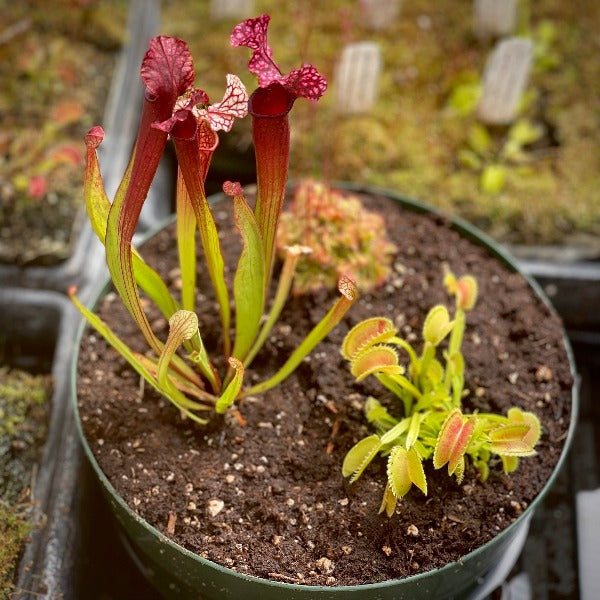
plant pots for carnivorous plants 3 Plant Beginner's Bog KitThis is a great kit to make your very own container planting of a few different kinds of temperate carnivorous plants. These plants will enjoy being grown outdoors, in many areas and will catch tons of flies, yellow jackets, and gnats. Our kit is great if you are new to carnivorous plants, want a fun planter for your garden, or just want to get planty! And we will ship this kit for free! If you order this kit in the summer, its best to place it in
This is a great kit to make your very own container planting of a few different kinds of temperate carnivorous plants. These plants will enjoy being grown outdoors, in many areas and will catch tons of flies, yellow jackets, and gnats. Our kit is great if you are new to carnivorous plants, want a fun planter for your garden, or just want to get planty! And we will ship this kit for free!
If you order this kit in the summer, it’s best to place it in full morning sun outside, where it will be protected from the afternoon sun a bit, just to reduce the shock to the plants. By the next year, they’ll be fully acclimated and will not need as much protection.
We send you an 8x6 inch plastic pot, XX-large water saucer, our peat moss and perlite mix (premixed), a little long-fibered sphagnum moss to cover holes on the bottom of the pot, and a selection of temperate plants. The plants we send vary by month depending on what we have available but in general, you will receive:
One Venus Flytrap (Dionaea), one American Pitcher Plant (Sarracenia), and one Sundew (Drosera). We send you plants either potted or in plugs based on availability. We cannot customize these collections.
Daniela will walk you through building your own bog and care instructions in this video:
Care Instructions:
Growth Habit: Venus flytraps are low-growing bog plants native to North and South Carolina. These plants grow their traps, modified leaves, from a rhizome that spreads over time. The traps will die back frequently all year, have high leaf turnover, and many new traps will grow throughout the spring and summer. In spring, the traps grow, often low to the ground and small. In summer, they grow their best traps, taller and more prominent. As Fall comes on, the traps start to die back, growing lower to the ground and smaller, and by winter, the plant will be dormant, with many or all of the traps gone, but the rhizome remains healthy and intact throughout winter dormancy even if you cannot see any traps growing.
Sarracenia will grow tall modified leaves, pitchers, that vary greatly in size and shape by the hybrid or species of Sarracenia. Each plant grows many pitchers from the rhizome in the soil over the spring, summer and fall. These are temperate plants like Venus flytraps, growing actively in the warm sunny months of the year and dying back to the rhizome in winter.
Drosera are found all over the world in many different forms, they have sticky leaves that catch small flying bugs. They have high leaf turnover, dying back frequently but growing lots of new leaves. Many of the temperate Drosera sent in this kit will die back to a hibernaculum in the soil in winter.
Sun: Full sun. These plants require lots of direct sun to grow and produce leaves. In many areas, they can be grown outdoors in full sun. If you live in a very hot AND very dry place like Arizona or Sacramento, for example, you will want to grow your plants in full morning sun with protection from the afternoon sun or under 30% shade cloth. It is common for several leaves to "burn" and die back when you first place your plant into the sun; your plant is acclimating to your conditions, and in most cases, new leaves will soon grow and fully acclimated. Thead can be grown indoors and on extremely sunny windowsills that receive all-day sun, but they will require a grow light in most circumstances due to the amount of light the plant needs. Grow lights should be 6-12” from the light depending on the light and a 10-12 hour day. These plants generally are not a good candidate for a terrarium as they need intense light and good airflow. Grow outdoors if possible for best results.
Water: Always keep them in a saucer with a few inches of distilled, rainwater, or reverse osmosis water. Never let them dry out, especially in the hot summer months. These are bog plants that prefer water-logged conditions unless you live somewhere both very hot AND extremely humid, like Alabama. In that case, let the water tray dry out for a day or two between refills. Always use distilled, reverse osmosis, or rainwater only. These plants are especially sensitive to their water quality, and giving them mineral and salt-free water is very important. In winter, when the plants are dormant, you can let them dry out a bit between rain storms, but do not let the soil get so dry that it pulls away from the edges of the pots. Be sure to supplement water as needed in between rains in winter.
Temperature and Dormancy: These are warm-temperate plants, meaning they need warm summers and chilly winters. They should be grown outdoors year-round in areas with mild winters. They thrive in temperatures ranging from 20 degrees - 90F degrees and can take a brief freeze or high-temperature spike up to 105F degrees for a short period. If nighttime temps drop below 20 but rise again during the day above 40, your plant will be fine outside.
If you live in an area with very cold winters, where nighttime temperatures drop below 20 degrees for sustained periods, you have three options for providing them with winter dormancy: the garage method, mulching in, or the fridge method. Dormancy is triggered by a combination of exposure to shorter photo-periods and cooler temperatures in the 40-60's F. While you can skip a dormancy period once or twice, in the long term, your plant will begin to do poorly and will eventually die if you skip this crucial period.
The garage method: Bring your plant indoors to a sunny windowsill in an unheated room or garage, where the nighttime temperatures will dip down to 50-60F. Keep it well watered during this period, do not let it dry out, and put it outside again when the outside nighttime temperatures increase consistently above 20F.
The mulch method: Mulch them very, very well outdoors. Pack at least four inches of mulch on top of the plants and all around the sides to prevent winds from chilling them and freezing the roots. You can also dig the pots into the ground and then mulch heavily on top.
The fridge method: remove the plants from pots, gently clean the roots of soil, wrap the roots in a bit of damp long-fibered New Zealand sphagnum moss, place the plants in a resealable bag, and put the bag into the refrigerator. Leave them in the fridge from October to February, periodically checking on them to ensure they are still moist and not growing mold or fungus. Pot them back up in February. You can vary the timing to align with your outside nighttime temperatures so that your plants can come out of dormancy when it is safe to place them back outside. You can leave them in the fridge for an extended period if you have very long winters.
Soil and Repotting: We prefer a mix of four-part fertilizer-free peat moss to one-part perlite. You can add our pre-made mix to your order here. Repot, dividing out plants and refreshing the peat and perlite, every 3 years in January or winter.
Feeding and Fertilizer: These plants will catch plenty of food when grown outdoors. When grown indoors, they will significantly benefit from fertilizing, a foliar fertilizer, and feeding the traps. Plants grown outdoors will appreciate a foliar feed as well. Apply MaxSea fertilizer once per month to the foliage only. Dilute 1/4 teaspoon of MaxSea into one gallon of water and then apply to the leaves with a mister bottle. If you would like to feed the traps of your flytrap, it is recommended that you use live prey, as the traps usually require continued movement from their food to stimulate the complete absorption process. They will often open too soon if fed inert foods and do not absorb nutrients. We recommend live mealworms, which are available from any pet store. After digestion, Venus flytraps open back up, leaving the exoskeleton of their prey. They have liquified and absorbed the contents of the insect, but the exoskeleton remains. This does not need to be removed. Traps often die back after a big meal; new ones will grow, and the plant benefits greatly from the nutrients!
More Information: For further information on dormancy, repotting, dividing, and more, check out our website, or our YouTube channel.
Shipping Notes
- Free Standard Shipping on $100+ Orders to the USA.
- Except Preorder products are shipped in 48 hours.
- Delivery to the USA:
- Standard Shipping : 3-10 business days
- If time is of the essence, please consider selecting expedited delivery for faster service.
Exchange/Return Notes
- We offer a 30-day return/exchange service after receiving.
- Final sale items are not eligible for returns or exchanges.
- To process your return/exchange, please contact us at [email protected]
- Please click here for more details>>> Return & Exchange Policy