SKU: 23929708352
white lilies.

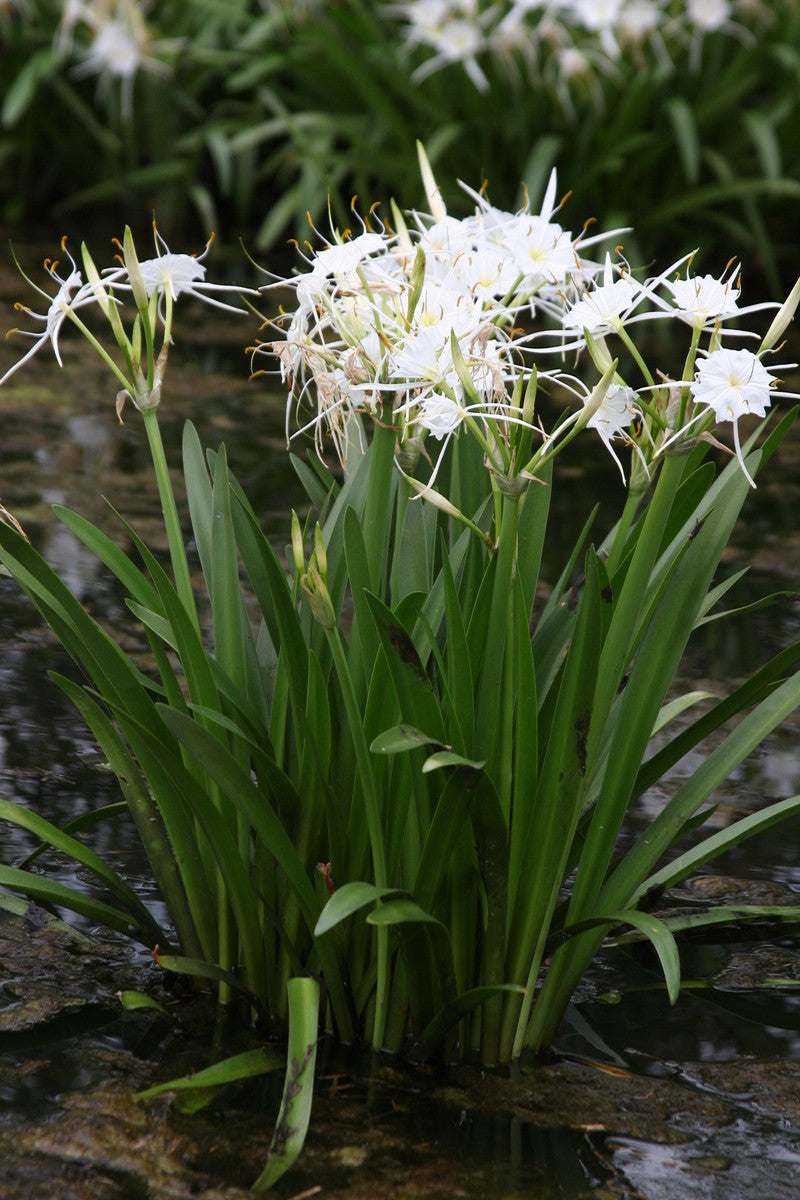
white lilies. Hymenocallis liriosme (native) - "Texas Spider Lily"

Sale price$18.05 Regular price$20.05
Save 10%

Pay in installments of $5.01 with ShopPay, AfterPay and Klarna

Shipping Estimate
USA
  • USA
  • CAN

Ships within 48 hours · Estimated delivery Oct 10 - Oct 15

Promo Codes Available:

For Your Every Summer RSVP, with Code: SUMMER15

Description

white lilies. Hymenocallis liriosme (native) - "Texas Spider Lily"This native lily is also known as the "Texas Spider Lily." Every April, these spidery white blooms begin to appear in wetland areas across Texas and the Southeastern United States. They make large clumps and showy displays in settings that are often too hostile to other bulbs and plants. The flowers fade as we head into May, but the show is well worth it! They produce multiple softball size blooms atop strong stalks amid dark green foliage. In pond

This native lily is also known as the "Texas Spider Lily." Every April, these spidery white blooms begin to appear in wetland areas across Texas and the Southeastern United States. They make large clumps and showy displays in settings that are often too hostile to other bulbs and plants. The flowers fade as we head into May, but the show is well worth it! They produce multiple softball-size blooms atop strong stalks amid dark green foliage. In pond areas, they look like islands of white color!

We can start with a lot of things to say about the "Texas Spider lily", but let's just start with that it is one-of-a-kind and one of the only natives we readily grow and promote. As gardeners, we are always looking for something to make our garden beautiful yet connected to our environment as well. The "Texas Spider lily" offers a unique opportunity to satisfy both of those goals. As a native though, we want to be very clear on something. Natives like to be in specific conditions.

WARNING: Yes, we have this above, but we want your bulbs to be successful for you and this is extremely important! Please note that the native habitat for this bulb is an environment in which it is extremely wet in the spring, and dry in the summer. Some examples of this would be fields that have standing water in the spring but dry out in the summer, spillways from lakes or ponds that over flow in the spring but don't in the summer, stream banks that are high in the spring and low in the summer, bar ditches that collect water in the spring off the side of a road, etc. The bulbs are smaller than what you would expect for the amount of blooms they eventually put out once they are mature. We have them circling the farm ponds at the Southern Bulb Company farm. In August, these ponds are lower and dry around the banks...the bulbs love it, and bloom in standing water in April when the ponds are high.

Appearance: When the "Texas Spider lily" blooms, the white "spiders" sit on tall, narrow stems. The dark green stems usually stand about 2 feet tall, but they can grow up to 3 feet tall depending on the conditions. The blooms usually appear in April, and the white blooms cluster to create a softball-size clump. The Hymenocallis liriosme is distinguished from other varieties by the yellow center deep in the bloom's center. The "Texas Spider lily" has a light sweet fragrance.

Resilient: The "Texas Spider lily" is a hardy plant that can grow in zones 8-10. This bulb needs to be planted in an area that is extremely wet in the spring and dry in the summer. WARNING: Native flowers and bulbs can be hard to sometimes adapt to modern landscapes. Please note that the native habitat for this bulb is an environment in which it is extremely wet in the spring, and dry in the summer.

Uses for this Bulb: Some examples of this would be fields that have standing water in the spring but dry out in the summer, spillways from lakes or ponds that over flow in the spring but don't in the summer, stream banks that are high in the spring and low in the summer, bar ditches that collect water in the spring off the side of a road, etc.

Urban examples of use for this water loving flower include detention areas required for commercial construction, natural drainage areas that need native plants and aren't easily mowed, or areas that have clean water requirements and needs plants to help filter the water before it drains off site.

The bulbs are smaller than what you would expect for the amount of blooms they eventually put out once they are mature. We have them circling the farm ponds at the Southern Bulb Company farm. In August, these ponds are lower and dry around the banks...the bulbs love it, and bloom in standing water in April when the ponds are high.

Native and History: This bulb is a native Texas bulb. It can endure the tough weather that Texas has to offer especially the hot dry summer in full sun. We have an early historical account of this bulb in the State of Texas. In the early to mid-1800's, explorer Jean Louis Berlandier, a Swiss-French botanist, charted the plants of Mexico, an area that included sections of present-day Texas. In his journal he describes a scene where his expedition party that hiked from San Antonio to Rusk, TX found itself surrounded by knee-high white lilies. Many believe these flowers were the white spidery blooms of Hymenocallis liriosme. Berlandier wrote of many interesting aspects of life in Texas in the mid 1850's, such as foot long fresh water prawns from the rivers taken to open markets in San Antonio in wooden wheel barrows. Alas, abundant foot long fresh water prawns in Texas rivers can no longer be found. However, the botanical displays of these white spider lilies have persisted and can still be enjoyed today! Drive county roads in April, and you could find yourself in the middle of these spectacular beauties. We're excited to offer them to our customers!

You will receive small to medium bulbs in this special offer. The bulbs were harvested from our wet spring soil so be prepared for them to look this way. The best thing that you can do is to plant them as soon as possible in conditions similar to their native environment - somewhere wet right now that will be dry this summer. We know that this means digging in the mud, but you are doing this for the bulbs and for the beautiful stand that you will have in the future!

If we are sold out, contact our office to be put on a waiting list for the Texas Spider Lily! You can email us at [email protected] or call us at 1-888-285-2486.

Shipping Notes
  • Free Standard Shipping on $100+ Orders to the USA.
  • Except Preorder products are shipped in 48 hours.
  • Delivery to the USA:
  1. Standard Shipping : 3-10 business days
  • If time is of the essence, please consider selecting expedited delivery for faster service.
Exchange/Return Notes
  • We offer a 30-day return/exchange service after receiving.
  • Final sale items are not eligible for returns or exchanges.
  • To process your return/exchange, please contact us at [email protected]
  • Please click here for more details>>> Return & Exchange Policy
SKU: 23929708352

Discover Niche Categories That Outsell white lilies.

Top-Converting Item to Boost Your Average Order

4.0 ★★★★★
Based on 20 reviews
Sort
Highest Rating
Newest First
Oldest First
Product Reviews
M
Verified Purchase
Mark H
Whiting, US
★★★★★ 5
Excellent!
Format: Hardcover
This is an excellent and judicious commentary by a leading New Testament scholar. Very readable, very helpful.
WAS THIS REVIEW HELPFUL?YesReportShare
Reviewed in the United States on March 21, 2026
N
Verified Purchase
Nicky Pendleton
Lexington, US
★★★★★ 5
Best Comentary for the layman/bible teacher
Format: Hardcover
The PNTC comentaries never dissapoint, they are the very best comentarys that i have found for those who do not read greek and may have a bit of bible college.. they are technical but not too technical, in depth but not too much. and you can always trust the General Editor DA Carson... i have several other comentary series but this is the best and all of them are rated very highly by the experts..
WAS THIS REVIEW HELPFUL?YesReportShare
Reviewed in the United States on November 22, 2023
A
Verified Purchase
Amazon Customer
Lexington, US
★★★★★ 5
Very thorough Commentary
I would rank this among the best commentaries I have read on 1 and 2 Timothy and Titus. A nice balabnce between academic and pastoral discussions.
WAS THIS REVIEW HELPFUL?YesReportShare
Reviewed in the United States on July 28, 2022
M
Marie
Los Angeles, US
★★★★★ 5
Concise yet thorough treatment of the difficult passages.
Format: Hardcover, Format: Hardcover
Excellent, balanced, thorough treatment of the pastoral epistles. Highly recommended. Note: Customer 7 above is incorrect in stating that Yarbrough doesn’t reference or quote Hubner on 1 Tim 2:12. You will find Hubner on pages 175 and 176.
WAS THIS REVIEW HELPFUL?YesReportShare
Reviewed in the United States on February 28, 2025
B
Bill Muehlenberg
Fort Morgan, US
★★★★★ 5
Another welcome Pillar commentary
Format: Hardcover
The newest volume in the excellent Pillar New Testament Commentary series is another first-rate effort. The American New Testament professor has already done a very good commentary on 1-3 John (BECNT, 2008). His newest commentary adds to a now rather impressive line-up of Pillar commentaries. As to the Pastorals, the four most important and substantial commentaries from a basically conservative, evangelical stance over the past few decades have been these: 1992: George Knight (NIGTC – 500 pages) 2000: Jerome Quinn and William Wacker (ECC – 900 pages) 2000: William Mounce (WBC – 640 pages) 2006: Philip Towner (NICNT – 900 pages) Mention should also be made of two other commentaries. One is the 1999 volume by I. Howard Marshall (with Philip Towner) in the ICC series. It is also 900 pages and looks to be outstanding. But I do not own it (the ICC series is SO expensive), so I cannot comment further on it. Another is the shorter, 300+ page work by Gordon Fee (NIBC, 1984) which can also be added to any list of highly recommended volumes on the Pastorals. Now we have Yarbrough to join these important works. He provides us with a very workable, informed and detailed examination of the Pastoral Epistles. He spends 95 of his 600 pages on introductory matters. As to authorship, it has become somewhat trendy of late to deny Pauline authorship. Even some conservatives have gone in this direction Yarbrough offers ten pages on this, and affirms the traditional stance, saying: “For eighteen centuries, Pauline authorship was never doubted by the churches’ intellectual leaders; even in the last two centuries, many have doubted the doubters.” As to the commentary proper, one tends to first head to well-known, contentious, difficult, or important passages. So let me reflect on a few of these. One of the most hotly debated passages in the Pastorals of course has to do with the matter of women in leadership. Paul covers this in several places, but the most crucial passage is 1 Timothy 2:11-15. This is certainly a difficult passage in many respects, and one that is hotly debated. The two main camps on this have been the complementarians, who argue that men and women are equal in worth and status, but have differing, hierarchical roles, and the egalitarians, who argue that women can fully serve in church leadership positions. This debate has been going on for quite some time now. Because all of 1 Tim. 2 must be considered here (dealing as it does with propriety in public worship), Yarbrough has a lengthy general discussion about these issues first. He then devotes another 20 pages to the actual contentious passage. He offers a “qualified complementarian reading” on all this. Egalitarians may not fully agree, but they should appreciate his careful and gracious exegesis here. And of course he has written on this elsewhere, as in his chapter in the important volume edited by Kostenberger and Schreiner: Women in the Church, 3rd ed. (Crossway, 1995, 2016). Another issue that can be rather difficult to understand and deal with concerns those who “have suffered shipwreck with regard to the faith. Among them are Hymenaeus and Alexander, whom I have handed over to Satan to be taught not to blaspheme” (1 Tim 1:18-20). Paul says something similar in 1 Cor. 5. Says Yarbrough, “From these two passages it may be inferred that in grave cases of ethical or doctrinal lapse, and perhaps drawing on Job 2:6, Satan was viewed as ‘God’s agent in judicial administration.’ Whereas congregations would normally have prayed for one another, there were evidently cases where petition would shift from divine protection to divine discipline (with Satan as God’s agent). Sometimes harsh measures are required to wake people up (see 2 Thess. 3:10-14).” Since discussions about overseers are found in all three epistles, both Paul and Yarbrough spend much time on the topic. In one of the passages he makes this remark: “In sum, ‘the overseer is to be’ introduces more than a random wish list for the pastorally inclined do-gooder. It points to a quality and depth of godliness that are indiscernible for the magnitude and gravity of pastoral labor that Paul models, expects of Timothy, and hopes to see replicated in generations to come at Ephesus and beyond.” Two more issues that can be contentious for some is found in 1 Tim. 5:23: “Stop drinking only water, and use a little wine because of your stomach and your frequent illnesses.” Some teetotallers try to argue that this is not actual wine, but watered down grape juice. And some of the health and wealth gospellers insist that no faith-filled believer should ever get sick. Yarbrough gives short shrift to both of these ideas. Another famous passage dealing with wealth is 1 Tim. 6:6-10 which speaks of false teachers and the love of money. Yarbrough affirms the biblical balance Paul seeks to present here: “Birth and death both illustrate the tenuous relation between life and material goods. Paul wants to relativize (not trivialize or eliminate) the importance of earthly acquisitions, since he observes people tempted to enlist God in their material quest. . . . It is important to note that this is not an adoption of an ideal of Hellenistic philosophy. Nor is it an endorsement of poverty. . . . If God does grant wealth, and if a believer has not sold his or her soul to acquire it, Paul will later give directions for its proper utilization (see on vv. 17-19 below).” Other matters could be mentioned here. But all up this is a very competent and usable commentary, one that will stand the test of time. It offers careful exegesis and helpful theological insights. It is a very welcome addition to the Pillar series. The PNTC series really has become one of the premier sets for evangelicals and those who want the best of biblical scholarship and careful exegesis.
WAS THIS REVIEW HELPFUL?YesReportShare
Reviewed in the United States on November 11, 2018

recommand products