SKU: 29078696922
trellis for plant support

trellis for plant support Trellis Netting

Sale price$25.70 Regular price$28.56
Save 10%

Pay in installments of $7.14 with ShopPay, AfterPay and Klarna

Shipping Estimate
USA
  • USA
  • CAN

Ships within 48 hours · Estimated delivery Jul 24 - Jul 29

Promo Codes Available:

For Your Every Summer RSVP, with Code: SUMMER15

Description

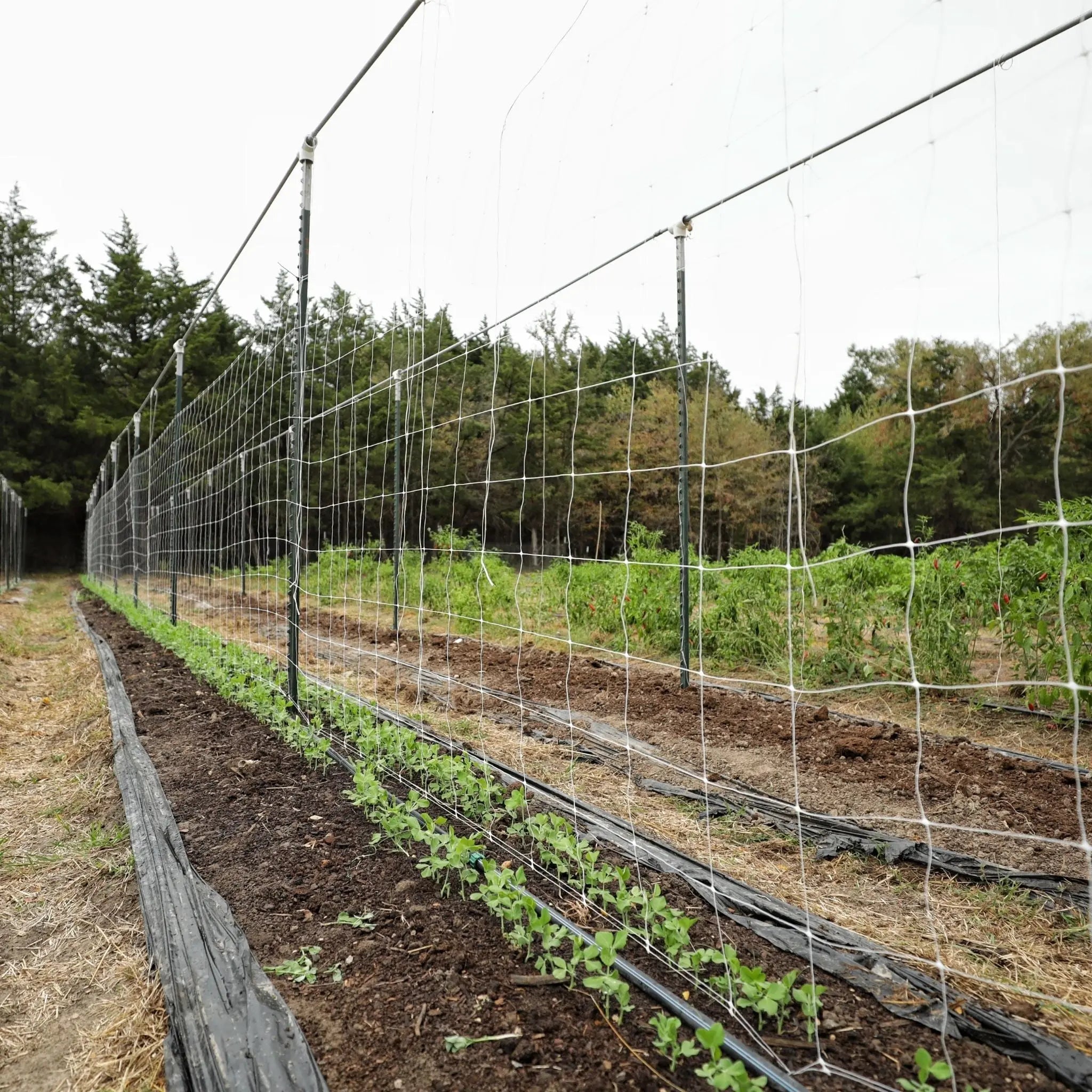
trellis for plant support Trellis NettingTrellis Netting for Cutting Flowers and Vines This durable, lightweight polypropylene trellis netting is perfect for supporting vegetables, training stems for cut flowers, and tall vines, allowing more airflow and sunlight to reach the plants. This space saving 6" mesh net is available in 3', 4', 6' widths. Get better yields and raise healthier plants using this UV stabilized, chemical resistant trellis netting. You can also use this trellis net

Trellis Netting for Cutting Flowers and Vines

This durable, lightweight polypropylene trellis netting is perfect for supporting vegetables, training stems for cut flowers, and tall vines, allowing more airflow and sunlight to reach the plants. This space-saving 6" mesh net is available in 3', 4', 6' widths. Get better yields and raise healthier plants using this UV-stabilized, chemical-resistant trellis netting. You can also use this trellis net horizontally for long-stem flowers such as dahlias, zinnias, and the like. Keep peas and pole beans supported with horizontal netting. Reduce blemishes on fruit and grow straighter flower stems with supportive trellis netting.

Note:  It is imperative to keep the netting taut as birds can become entangled in the loose mesh. 

Key Features

  • Supports crops for better airflow and sun penetration 
  • Perfect for supporting long-stem cut flowers for straighter stems
  • Flexible, tear-resistant
  • UV-stabilized
  • Helps better utilize garden/greenhouse space
  • Made of durable polypropylene
  • Works perfectly with vine clips
  • Better yields and crop success
  • Creates easier working area for better weed management
  • Reusable season after season
  • Mesh size approx. 6"x 7"
  • Netting thickness- 8g/sqm

HOW DO YOU INSTALL FLOWER NETTING?

Netting can be installed both vertically and horizontally depending on the need. Both are very simple, straightforward processes. 

Vertical Trellis Installation:

To install netting vertically, insert support posts down your rows at approximately every 20'. Next, attach the net to the support posts using string or twine. We suggest that you snake a support cable such as metal wire or other strong cord or string through the netting at the top to support the net. Tie or clip your plants to the trellis netting as they grow and begin climbing. Some plants have tendrils that will tie themselves to the netting.

This style of installation is also used for vining crops in the vegetable garden or market farm. Vegetables and fruits like peas, cucumbers, and tomatoes all benefit from support as they grow.

Horizontal Trellis Installation: 

Install garden trellis net horizontally for cut flowers. Use several layers close together. First, start by putting four wood or metal supports into the ground. Install the first two posts at equal width with your netting (i.e. 3' apart, 4' apart, 6' apart). The second set of posts should be installed 6'-20' wider. The height of the posts would depend on what you are growing.

Next, screw or bolt wooden cross bars between posts 1 and 2, and between posts 3 and 4 at the different heights that you will space your layers of trellis support at. The heights will depend on how tall your plants will grow. Typically this would be at 12", 24" and 36" from the ground.

After that step, attach the trellis netting to the cross bars by wrapping them around the crossbar and then tying string or zip ties around the net and crossbars to hold it in place. 

Finally, unroll the lightweight polypropylene trellis support netting and attach it to the cross bars between posts 3 and 4. You can continue the row by putting support posts, and cross bars every 20' apart and making the layer as long as you want. Then do the next layer the same way.

Want more information about trellis netting? Check out this helpful article.

Shipping Notes
  • Free Standard Shipping on $100+ Orders to the USA.
  • Except Preorder products are shipped in 48 hours.
  • Delivery to the USA:
  1. Standard Shipping : 3-10 business days
  • If time is of the essence, please consider selecting expedited delivery for faster service.
Exchange/Return Notes
  • We offer a 30-day return/exchange service after receiving.
  • Final sale items are not eligible for returns or exchanges.
  • To process your return/exchange, please contact us at [email protected]
  • Please click here for more details>>> Return & Exchange Policy
SKU: 29078696922

Discover Niche Categories That Outsell trellis for plant support

Top-Converting Item to Boost Your Average Order

4.0 ★★★★★
Based on 16 reviews
Sort
Highest Rating
Newest First
Oldest First
Product Reviews
W
William Nutter
Phoenix, US
★★★★★ 5
Who knew? Right?
Format: Kindle
Alexander the Great is one of the most prominent figures in ancient history, known for his military conquests and political prowess. Born in 356 BCE in Pella, the ancient capital of Macedonia, Alexander was the son of King Philip II and Queen Olympia. From an early age, Alexander was groomed for leadership and given a rigorous education in military strategy, politics, and philosophy under the tutelage of Aristotle. When Alexander was only 20 years old, he succeeded his father as king of Macedonia. Immediately upon taking the throne, he set his sights on expanding his empire. In 334 BCE, Alexander led an army of approximately 35,000 soldiers across the Hellespont, a narrow strait that separates Europe and Asia. This marked the beginning of his campaign to conquer the Persian Empire. Over the course of the next decade, Alexander achieved a series of stunning victories on the battlefield. He defeated the Persian king Darius III at the Battle of Issus in 333 BCE, and again at the Battle of Gaugamela in 331 BCE. He then continued his conquests into Central Asia and India, where he faced fierce resistance from local armies and encountered new cultures and religions. Despite facing numerous challenges and setbacks, Alexander was a brilliant military strategist who was able to adapt to changing circumstances and inspire his troops to victory. He was known for leading his soldiers from the front, and he fought alongside them in many battles. His leadership style earned him the loyalty and admiration of his soldiers, who were willing to follow him to the ends of the earth. In addition to his military conquests, Alexander was also a skilled politician and diplomat. He understood the importance of winning over the hearts and minds of the people he conquered, and he adopted many of the customs and traditions of the cultures he encountered. He also founded several new cities, including Alexandria in Egypt, which became a major center of learning and culture in the ancient world. Despite his many successes, Alexander's life was cut tragically short. He died in 323 BCE at the age of 32, possibly from malaria or poisoning. His death left a power vacuum in his empire, which led to a period of instability and conflict known as the Wars of the Diadochi. Today, Alexander is remembered as one of the greatest military commanders in history. His conquests had a profound impact on the ancient world, spreading Greek culture and Hellenistic ideas throughout the Mediterranean and Near East. His legacy also lives on in the many cities he founded, which served as centers of trade, commerce, and learning for centuries to come. Alexander the Great was a remarkable leader who left an indelible mark on history. He was a brilliant military strategist, a skilled politician, and a charismatic leader who inspired loyalty and devotion from his soldiers. His legacy continues to be felt today, and his story serves as a reminder of the power of human ambition, courage, and determination.
WAS THIS REVIEW HELPFUL?YesReportShare
Reviewed in the United States on April 13, 2023
V
Verified Purchase
Virginia Jennings
Los Angeles, US
★★★★★ 1
Disappointing
Format: Paperback
Disappointing
WAS THIS REVIEW HELPFUL?YesReportShare
Reviewed in the United States on March 8, 2025
J
Verified Purchase
Jaren
Birmingham, US
★★★★★ 5
Being “Othered” is Real
Format: Kindle
Sky Full of Elephants opens with a haunting and unforgettable image: all the white people walking silently into bodies of water. That beginning alone tells you this is not a book that will play it safe. It is bold, layered, and deeply intentional. The writing is beautiful and the story forces readers to confront what Black history truly is: American history. The novel doesn’t just imagine a world; it holds up a mirror to the one we’ve lived in and the one we’re still shaping. It explores identity, belonging, grief, and survival in a way that feels both speculative and painfully real. As someone who grew up attending predominantly white schools, I connected deeply with Sidney’s experiences. Being “othered” (constantly reminded that you are different, that you don’t quite belong) leaves marks that follow you long after childhood ends. Some of the moments Sidney endures felt painfully familiar, and I found myself reflecting on my own younger self while reading. What struck me most, though, was reading this story as a mother. I have a biracial daughter, and her experience has been very different. She has never been made to feel like she doesn’t belong. She has never been othered. She has always been rooted in her Black identity, primarily raised by her Black mother, surrounded by family who affirm her. Even after I remarried and joined a Black family, she was embraced fully, never questioned, never treated as “less than,” never made to feel separate. Reading Sidney’s journey made me profoundly grateful that my daughter’s story has unfolded differently. It also reminded me how much environment, affirmation, and community matter in shaping a child’s sense of self. Sky Full of Elephants is more than a speculative novel. It is a meditation on race, memory, and belonging. It asks hard questions about America while honoring the fullness and complexity of Black identity. This book lingers with you. It sparks reflection. It opens conversations. And for me, it felt both personal and powerful.
WAS THIS REVIEW HELPFUL?YesReportShare
Reviewed in the United States on February 14, 2026
S
Verified Purchase
S. Donaldson
Port Orchard, US
★★★★★ 4
Good Read!
Format: Audiobook
I read this along with my son and his girlfriend in a family “book club”. We had a good discussion about the ending, as we each had differing perspectives, but that was fun! The book was really interesting, and the characters were so well defined and deeply moving. Good read, but the ending left us a little confused.
WAS THIS REVIEW HELPFUL?YesReportShare
Reviewed in the United States on March 16, 2026
K
Verified Purchase
Katherine Ross
San Leandro, US
★★★★★ 5
Thought provoking
Format: Kindle
Sky Full of Elephants is a work of speculative fiction that begins with the premise that the white population of the United States has been wiped out. Starting a year after “the event” and following Charlie, a man who spent 20 years in prison due to a cowardly lie, and his resentful, biracial 19 year old daughter, who witnessed her only known family drown themselves, it is at its core a quest for identity in its many forms and how trauma can co-opt that search. In rating and reviewing this book, I’m aware that my lens as a Gen-X, cis-het, white woman, will have a differing view from others’ lived experiences. In reading other reviews, I definitely saw points that I didn’t consider, which I hope is the main point of the book. I do think, as a work of speculative fiction, that it does require the suspension of disbelief from the get go. It is a philosophical “what if” that Mr. Campbell invites the reader to consider. Intrigued by the premise, I was drawn into the story due to Mr. Campbell’s lyrical writing style. The narrative had a rhythmical flow to it that supported the world building and characterizations. I found Charlie to be a very sympathetic character, rebuilding a life shattered by lies in a new world and confronted with the daughter he never had a chance to know. Sydney, Charlie’s daughter, was more of a struggle to empathize with. While her feelings were justified and understandable, her growth throughout the novel was erratic. As the story has an ambiguous ending, perhaps her character will continue to improve. For supporting cast, the grumpy pilot Sailor and his nonbinary child, Zu, offer a counterpoint to Charlie and Sidney’s emerging relationship. The king and queen of Alabama and the thriving town of Mobile were well fleshed out. The Walkers and Sidney’s Aunt Agatha in Orange Beach represented those who were lost in their own way, either due to clinging to their former proximity to whiteness or to the religious biases they were raised with. I found the Walkers to be the most tragic of all. The questions of identity throughout the story are what kept be invested throughout. Are we defined by the color of our skin, our behaviors, the groups we belong to, the choices we make? Are others more valuable or worthy who don’t suffer the same things we do? Does there have to be those that are “lesser” to make us feel whole? As a trauma survivor with C-PTSD, I struggle with my own issues of identity and worthiness, and as a former Special Education teacher, I’ve been witness to that struggle in others. I have never understood or accepted the idea of White Supremacy or Christian Supremacy or any of the myriad ways that humanity continues to other each of us. In reality, there is no “us” or “them” only”we”. Charlie questions who he is as a Black man in the US, a convict, a teacher, a father, and ultimately a fixer and healer. Sidney grapples with her biracial otherness, her wealthy upbringing and sheltered life, the trauma of abandonment, and the lies that her life was built on. The ethical question of the machine at the epicenter of the event adds another layer to the story. While the effects of the first usage were unintended, once they were known is it right to continue to fix it and use it again? Can healing a part of collectiveness that harms or destroys another part ultimately be worth the cost? The world and its people are broken and desperately need healing. But just like the question of eugenics, what of value is lost when specific traits are universally stripped away? And who gets the to decide what is of value anyway? The ambiguity of the ending doesn’t answer the question entirely of what happens when the machine is repaired, but Charlie’s ability to fix things leads me hopeful. Personally, I cared enough about these characters to be interested in a sequel.
WAS THIS REVIEW HELPFUL?YesReportShare
Reviewed in the United States on February 24, 2026

recommand products