Pay in installments of $6.38 with
 ,
,
 and
and

Shipping Estimate
USA
- USA
- CAN
- USA
- CAN
Ships within 48 hours · Estimated delivery Oct 28 - Nov 2
 Promo Codes Available:
For Your Every Summer RSVP, with Code: SUMMER15
Description
anthurium bonplandii Anthurium bonplandii variegataAnthurium bonplandii variegata Anthurium bonplandii variegata grows as a broad birds nest style rosette with firm, leathery leaves. Its pale markings can appear as fine marbling, larger sectors or uneven cream to yellow green patches across the blade. The base species, Anthurium bonplandii, is native to tropical South America, where it grows as a subshrub or epiphyte in wet tropical habitats. Variegata is used for the cultivated variegated form. The
Anthurium bonplandii variegata
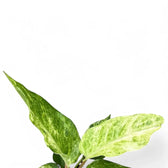
Anthurium bonplandii variegata grows as a broad bird’s-nest-style rosette with firm, leathery leaves. Its pale markings can appear as fine marbling, larger sectors or uneven cream to yellow-green patches across the blade.
The base species, Anthurium bonplandii, is native to tropical South America, where it grows as a subshrub or epiphyte in wet tropical habitats. “Variegata” is used for the cultivated variegated form. The plant grows from a crown-forming rosette, with pale markings that differ from leaf to leaf.
Established plants can become broad, with large leathery leaves depending on age, warmth, light and root space. At maturity, the plant may produce typical Anthurium spathes and spadices. Indoors, the variegated leaves are usually more noticeable than the flowers.
Pale sections contain less chlorophyll than green tissue. Greener parts of the leaf do more of the photosynthesis, so large pale areas can mark faster under heat, direct sun, drought stress or root stress.
Variegated rosette traits
- Growth habit: Crown-forming, bird’s-nest-style Anthurium with a broad rosette.
- Leaves: Thick, leathery blades with a firm surface and central midrib.
- Mature size: Established plants can become broad, with large leaves depending on growing conditions.
- Variegation: Irregular cream, yellow-green or pale sectors that differ from leaf to leaf.
- Flowers: Established plants may produce typical Anthurium inflorescences.
Anthurium bonplandii variegata care
- Light: Bright, filtered light is best; direct sun can mark the pale sections.
- Watering: Water when the upper part of the mix has dried, keeping moisture steady.
- Substrate: Use a chunky Anthurium mix with bark, coco chips and pumice or perlite.
- Temperature: Keep it warm, around 18–28 °C, with steady conditions.
- Root zone: Use a free-draining pot and let the mix breathe between waterings.
- Humidity: Moderate to high humidity supports steady leaf development.
- Feeding: Feed lightly; slower or stressed variegated growth responds better to gentle feeding.
- Repotting: Repot when the mix breaks down or roots fill the pot.
Care for pale variegation
- Pale areas have less chlorophyll than green tissue.
- Green parts of the leaf carry most of the photosynthesis.
- The pale pattern comes from the leaf tissue; stronger light will not create extra variegation.
- Harsh sun, heat stress and irregular watering can mark pale sections faster.
- Leaves with very large pale areas can be weaker than greener leaves.
Problems on variegated leaves
- Browning on pale sections: Often follows direct sun, heat or drought stress.
- Yellowing lower leaves: Usually points to wet, poorly aerated substrate.
- Soft crown or base: Check the roots immediately.
- Very pale or weak growth: Steady filtered light and even care help pale leaves develop with less marking.
- Distorted new leaves: Check for pests in the crown.
Safety for pets and children
Keep Anthurium bonplandii variegata away from pets and children. Like other Anthuriums, it contains calcium oxalate crystals; plant material can irritate the mouth and throat if ingested, and sap may irritate skin or eyes.
Name background
The genus Anthurium refers to the flower and its tail-like spadix. The epithet bonplandii honours Aimé Bonpland.
Shipping Notes
- Free Standard Shipping on $100+ Orders to the USA.
- Except Preorder products are shipped in 48 hours.
- Delivery to the USA:
- Standard Shipping : 3-10 business days
- If time is of the essence, please consider selecting expedited delivery for faster service.
Exchange/Return Notes
- We offer a 30-day return/exchange service after receiving.
- Final sale items are not eligible for returns or exchanges.
- To process your return/exchange, please contact us at [email protected]
- Please click here for more details>>> Return & Exchange Policy