SKU: 3068645931
planting creeping jenny in pots

planting creeping jenny in pots Creeping Jenny

Sale price$25.87 Regular price$28.74
Save 10%

Pay in installments of $7.18 with ShopPay, AfterPay and Klarna

Shipping Estimate
USA
  • USA
  • CAN

Ships within 48 hours · Estimated delivery Oct 22 - Oct 27

Promo Codes Available:

For Your Every Summer RSVP, with Code: SUMMER15

Description

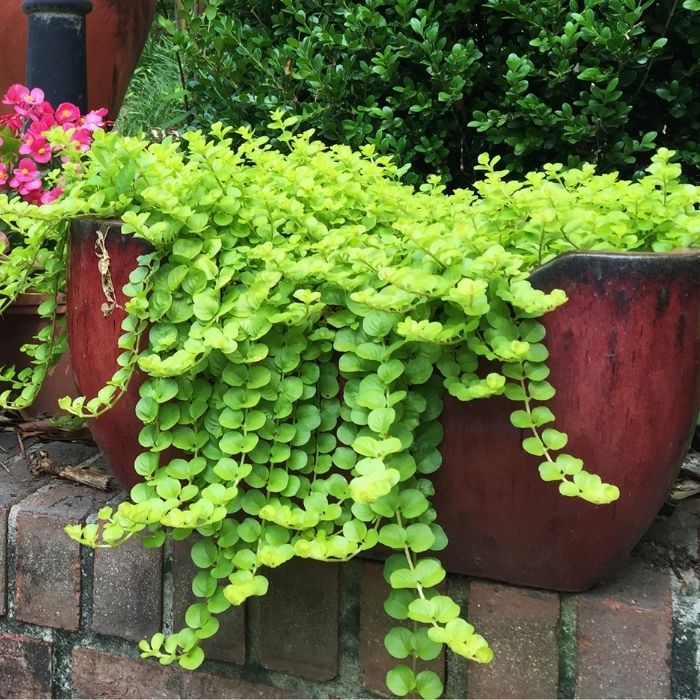
planting creeping jenny in pots Creeping JennyBright Chartreuse Foliage That Instantly Lifts a Planting Creeping Jenny is one of those plants that can change the whole feel of a container or garden bed almost immediately. Its round, golden chartreuse leaves bring brightness, contrast, and a soft, flowing texture that helps darker foliage and flowers stand out. Whether it is tucked into a mixed planter or woven along the front edge of a bed, it adds a fresh, energized look that feels clean and

Bright Chartreuse Foliage That Instantly Lifts a Planting

Creeping Jenny is one of those plants that can change the whole feel of a container or garden bed almost immediately. Its round, golden-chartreuse leaves bring brightness, contrast, and a soft, flowing texture that helps darker foliage and flowers stand out. Whether it is tucked into a mixed planter or woven along the front edge of a bed, it adds a fresh, energized look that feels clean and intentional. The trailing stems also help create visual movement, which keeps a planting from feeling static or flat.

That bright foliage is the main reason gardeners reach for Creeping Jenny again and again. It does not need large flowers to make an impact because the foliage itself does the visual work. In sunnier conditions, the leaves often stay a brighter gold, while in part shade they can shift toward a softer chartreuse. That flexibility makes it useful in many different design styles, from bold summer containers to softer perennial borders and moisture-loving garden spaces.

A Natural Spiller for Porch Pots, Hanging Baskets, and Mixed Containers

Creeping Jenny is one of the easiest spiller plants to use because it naturally drapes and trails over the edge of a pot without looking stiff or forced. In mixed containers, it helps soften rims, connect the planting together, and create that finished layered look people want. It pairs especially well with upright thriller plants and mounded fillers, giving the arrangement the kind of balance that makes it feel fuller and more professionally planted. Even a simple planter can look more complete once Creeping Jenny starts to spill.

That trailing habit makes it especially useful for gardeners who want strong design payoff without overcomplicating the planting. It works in porch pots, patio containers, window boxes, and hanging baskets, and it plays well with a wide range of flower colors. Because the foliage is bright but not overwhelming, it can easily bridge purples, pinks, whites, blues, and deeper greens. For container gardening, it is one of those dependable plants that gives color, texture, and movement all at once.

Fast-Spreading Groundcover for Moist Beds and Soft Edges

Beyond containers, Creeping Jenny is also a very effective low groundcover. It stays close to the soil, usually only a few inches tall, but spreads readily and forms a soft carpet of foliage that can brighten the front of a bed or fill bare spaces between larger plants. It is especially useful where you want something that feels loose and natural rather than upright and formal. Along stone edges, pathways, retaining walls, and moist borders, it creates a trailing, flowing look that helps the whole planting feel more connected.

Its spreading habit is a major advantage when used thoughtfully. Creeping Jenny can quickly fill in open soil, soften the edge of a path, or weave through a mixed planting in a way that feels relaxed and layered. It is especially happy in soil that stays evenly moist, so it often performs very well in rain-friendly areas, moist borders, and richer garden beds. Gardeners should still place it carefully, though, because in favorable conditions it can spread enthusiastically and may need occasional trimming to stay in bounds.

Easy Color and Texture With Simple Ongoing Care

Creeping Jenny is appealing because it adds a lot of visual value with minimal maintenance. It performs best in moist, well-drained soil and appreciates steady watering, especially while establishing and when grown in containers. In the right spot, it fills in quickly and keeps its bright trailing look with only occasional trimming. Small yellow flowers may appear in summer, but the real appeal lies in the foliage and how it trails, spills, and brightens the planting over time.

Its biggest care note is simply understanding its vigor. In containers, that fast growth is usually a plus because it helps the planting look fuller sooner. In beds, it may need some shaping or trimming to keep it from moving too far into neighboring plants. That does not make it difficult to grow. It just means it performs best when gardeners use it with intention. For homeowners who want a bright groundcover or spiller that earns its keep quickly, Creeping Jenny is one of the easiest plants to put to work.

Shipping Notes
  • Free Standard Shipping on $100+ Orders to the USA.
  • Except Preorder products are shipped in 48 hours.
  • Delivery to the USA:
  1. Standard Shipping : 3-10 business days
  • If time is of the essence, please consider selecting expedited delivery for faster service.
Exchange/Return Notes
  • We offer a 30-day return/exchange service after receiving.
  • Final sale items are not eligible for returns or exchanges.
  • To process your return/exchange, please contact us at [email protected]
  • Please click here for more details>>> Return & Exchange Policy
SKU: 3068645931

Discover Niche Categories That Outsell planting creeping jenny in pots

Top-Converting Item to Boost Your Average Order

4.7 ★★★★★
Based on 15 reviews
Sort
Highest Rating
Newest First
Oldest First
Product Reviews
S
Verified Purchase
Snorting Horses
Cuba, US
★★★★★ 5
A Slim Book with a Big Message
The book is an attempt, Keller writes, to connect a person's Christian faith with the desire to help people in need and do justice in all aspects of one's life. He is writing for four groups of people, he says. These are: -- Those, especially the young, who are active in volunteering and want to help the poor but their concern does not affect how they spend money or plan their careers. -- Those who don't see, as Jonathan Edwards said, that when the Spirit enables us to understand what Christ has done for us, "the result is a life poured out in deeds of justice and compassion for the poor." -- Younger evangelicals who have expanded their mission to include social justice along with evangelism. -- People like the atheist Christopher Hitchins who believe that religion "poisons everything." This book, Keller writes, is for "the orthodox (Christian) to see how central to the Scripture's message is justice for the poor and marginalized. I also want to challenge those who do not believe in Christianity to see the Bible not as a repressive text, but as the basis for the modern understanding of human rights." Keller spends the early parts of his book discussing how justice for the poor, the immigrant, the widow and orphan was central to the concept of mercy (in Hebrew, chesedh), justice (mishpat) and righteousness (tzadeqah). Mercy has to do with aligning our attitude with that of a merciful God. Justice is aligning our actions -- equitable dealings with people -- with a just God's. Righteousness in the Hebrew context has more to do with right relationships than obeying a set of rules, as modern Christians often think of it. Someone who is "right with God (is) therefore committed to putting right all other relationships in life." (Alec Motyer) Righteousness is "day to day living in which a person conducts all relationships in family and society with fairness.While tzadeqah is primarily about being in a right relationship with God, the righteous life that results is profoundly social. (See Job 29:12-17, 31-13-28. Keller details the Hebrew law's provision for exercising justice. These are: -- Shemitta, or release. The practice of the Sabbath year, every seventh year releasing people from debts or servitude. Deut. 15:1-2 -- Gleanings. The practice of not harvesting fields to their borders. Keller suggests that modern businesses could imitate this practice by not maximizing profits, thus giving price relief to their customers, and not paying workers the lowest possible wages. Leviticus 19:9-10, 23:22 -- Tithing for the priests and the upkeep of the temple. Every third year the tithe was put in public storehouses for the poor, "the aliens, the fatherless, and the widows." Deut. 14:28-29. This makes me think that churches should practice this in some form by systematically committing a portion of its receipts to serving the poor and needy. -- Year of Jubilee. The practice of every 49th or 50th year of forgiving debts and returning land to its ancestral owner. Leviticus 25:10, 23, 27:21. These practices helped meet the needs of the poor and helped prevent permanent cycles of poverty. The three causes of poverty, according to the Law are oppression, calamity and personal moral failure. The biblical emphasis is usually on the larger structural factors -- corruption, oppressive economic systems and natural disasters. The exercise of justice, however, never distinguishes between the three. That is, no matter why a person is poor, the righteous person should care for him. Well, that's the Old Testament,, some might say. But Jesus showed the same concern for the poor and disadvantaged, if not more so. His response to John in Matthew 11:4-5, and the beginning of his ministry in Luke 4. As Eugene Peterson writes in The Message, the Word became flesh and moved into the neighborhood. He identified himself with the poor and showed special concern for children, aliens, women. Jesus and the prophets all "leveled the charge that while the people attended worship, observed all religious regulations and took pride in their biblical knowledge, nevertheless they took advantage of the weak and vulnerable." Vulnerable people need three levels of help -- relief, development and social reform. Relief is the immediate problem (paying the rent, for instance); development is to help then move beyond dependency (job training); social reform is correcting systemic injustice (redlining).Social reform likely requires the creation of extra-church or parachurch organizations. Churches also can partner with existing organizations or churches that operate in vulnerable populations. Evangelism and social justice "should exist in an asymmetrical, inseparable relationship. Evangelism is the most basic and radical ministry possible to a human being ... not because the spiritual is more important than the physical, but because the eternal is more important than the temporal. If there is a God, and if life with him for eternity is based on having a saving relationship with him, then the most loving thing anyone can do for one's neighbor is help him or her to a saving faith in that God, Keller writes. Doing justice is inseparably connected to preaching grace. One way is that the gospel produces a concern for the poor. The other is that deeds of justice gain credibility for the preaching of the gospel. This book is a slim one that carries a heavy message. It challenges us comfortable churchgoers to examine our community and ask whether we are of any importance to the wider community. If our "church" ceased to exist, would anyone miss us? What are we doing in obedience to God's commands to serve the poor, the widow, the orphan, the prisoner, the hungry? There is a lot here to reflect on and for a small group(s) to discuss and apply. Unfortunately, I contacted the publisher and there is no accompanying study guide. Keller is pastor of Redeemer Presbyterian Church in New York City.
WAS THIS REVIEW HELPFUL?YesReportShare
Reviewed in the United States on October 12, 2011
C
Verified Purchase
Consumer
Lexington, US
★★★★★ 4
Four Stars
Format: Paperback
Interestin.
WAS THIS REVIEW HELPFUL?YesReportShare
Reviewed in the United States on November 15, 2017
C
Verified Purchase
Cheyenne Harmon
Phoenix, US
★★★★★ 5
Taste good
These are great
WAS THIS REVIEW HELPFUL?YesReportShare
Reviewed in the United States on March 28, 2026
B
Verified Purchase
Brynlee123
Boise, US
★★★★★ 5
Good.
These work really well. Price is great. My kids have not complained about the taste or any issues with chewing them. No sleep issues or grogginess upon waking.
WAS THIS REVIEW HELPFUL?YesReportShare
Reviewed in the United States on May 7, 2025
J
Justine
San Leandro, US
★★★★★ 5
Great product. Works well and tastes good too!
I purchased this melatonin for my five year old. Not only is she a terrible sleeper she’s extremely particular about how things taste. This product works wonderfully, and tastes great too! It works quickly to help my child fall asleep, within 10 minutes, and now they are able to sleep through the night without any issues. I highly recommend this product for parents looking for a natural way to help their child sleep better.
WAS THIS REVIEW HELPFUL?YesReportShare
Reviewed in the United States on August 6, 2024

recommand products