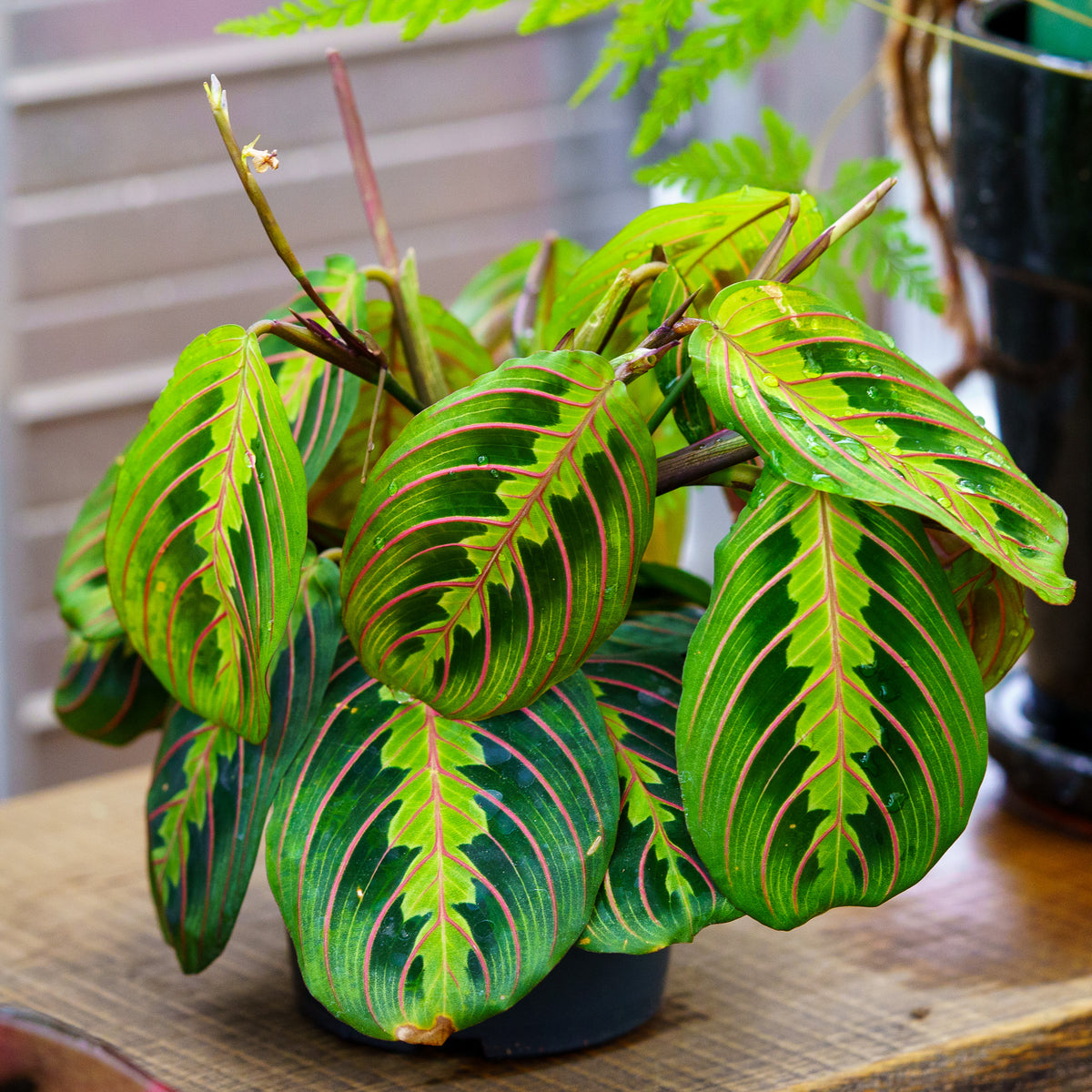
green prayer plant maranta Prayer Plant – Plant Detectives
SKU: 31033890513
green prayer plant maranta

green prayer plant maranta Prayer Plant – Plant Detectives

Sale price$23.20 Regular price$25.78
Save 10%

Shipping Estimate
USA
  • USA
  • CAN

Ships within 48 hours · Estimated delivery Jul 8 - Jul 13

Promo Codes Available:

For Your Every Summer RSVP, with Code: SUMMER15

Description

green prayer plant maranta Prayer Plant – Plant DetectivesPrayer Plant (Maranta leuconeura) Prayer Plant (Maranta leuconeura) is a classic indoor foliage plant grown for its patterned leaves and the gentle daily movement that gives it the name. The leaves lie flat during the day, then lift and fold upward in the evening, adding a subtle rhythm that makes it feel alive in a room. Rich green foliage is often marked with contrasting veins and decorative blotches, creating a collected, curated look even when the

Prayer Plant (Maranta leuconeura)

Prayer Plant (Maranta leuconeura) is a classic indoor foliage plant grown for its patterned leaves and the gentle daily movement that gives it the name. The leaves lie flat during the day, then lift and fold upward in the evening, adding a subtle rhythm that makes it feel alive in a room. Rich green foliage is often marked with contrasting veins and decorative blotches, creating a collected, curated look even when the plant is small. With a low, spreading habit and a soft trailing form over time, Prayer Plant works as an easy focal point on shelves, side tables, and plant stands while still pairing well with other houseplants.

Distinctive Features

The standout feature is the leaf movement, which is especially noticeable in consistent indoor conditions and adds a fun, interactive quality to everyday plant care. Leaves have a smooth, velvety look with strong patterning that reads well from across a room and looks best in bright, indirect light. The plant naturally grows outward rather than upward, making it ideal for low planters, shallow bowls, and hanging baskets where stems can drape. It is a strong choice for plant lovers who want bold foliage without needing high light or constant fuss, as long as moisture and humidity are kept steady.

Growing Conditions

  • Light: Bright, indirect light is best; tolerates medium light, but avoid direct sun that can scorch leaves.
  • Soil: Loose, well-drained indoor potting mix with added perlite or bark for airflow.
  • Water: Keep evenly moist, letting the top inch of soil dry slightly before watering again; do not let it sit in water.
  • Humidity: Medium to high humidity helps keep leaf edges clean; use a humidifier or pebble tray if air is dry.
  • Temperature: Prefers 65 to 80 F; protect from cold drafts and sudden temperature swings.
  • USDA Hardiness Zones: 11 to 12 outdoors; grown as an indoor houseplant in colder regions.
  • Habit: Low, spreading, and trailing foliage plant.
  • Mature Size: About 8 to 12 inches tall with a spread of 12 to 24 inches or more over time.

Ideal Uses

  • Focal Point: Use the patterned foliage as a standout feature on a table, shelf, or plant stand.
  • Hanging Basket: Let stems trail for a soft, cascading look in bright corners.
  • Bathroom Planting: A great fit for bright bathrooms where humidity supports clean leaf edges.
  • Bedroom and Office Greenery: Adds a calm, decorative presence in spaces with steady indirect light.
  • Mixed Houseplant Groupings: Pair with solid-leaf plants to make the leaf pattern pop.

Low Maintenance Care

  • Watering Routine: Water thoroughly, then drain excess; consistent moisture is key, especially in spring and summer.
  • Humidity Support: Increase humidity in winter or heated rooms to reduce browning on leaf tips.
  • Feeding: Feed lightly every 4 to 6 weeks in spring and summer with a balanced houseplant fertilizer at half strength.
  • Pruning: Pinch stems to encourage fuller growth and trim leggy runners to keep the plant dense.
  • Repotting: Repot every 1 to 2 years or when roots fill the pot; refresh soil to keep growth strong.
  • General Note: If leaves curl or look dull, check moisture first, then humidity and light levels.

Why Choose Prayer Plant?

  • Interactive Leaf Movement: Leaves lift and fold in the evening, adding a daily ritual to your plant collection.
  • Decorative Foliage: Patterned leaves provide year-round indoor interest without relying on blooms.
  • Great for Indirect Light: Thrives in bright indoor spaces without direct sun.
  • Compact, Trailing Habit: Fits shelves and small spaces, then gently drapes as it matures.
  • Design-Friendly Texture: Works in modern, cozy, and collected interiors as a clean foliage statement.

If you want a houseplant with patterned leaves, gentle nightly movement, and a compact trailing form, Prayer Plant delivers year-round interest with approachable care.

Shipping Notes
  • Free Standard Shipping on $100+ Orders to the USA.
  • Except Preorder products are shipped in 48 hours.
  • Delivery to the USA:
  1. Standard Shipping : 3-10 business days
  • If time is of the essence, please consider selecting expedited delivery for faster service.
Exchange/Return Notes
  • We offer a 30-day return/exchange service after receiving.
  • Final sale items are not eligible for returns or exchanges.
  • To process your return/exchange, please contact us at [email protected]
  • Please click here for more details>>> Return & Exchange Policy
SKU: 31033890513

Discover Niche Categories That Outsell green prayer plant maranta

Top-Converting Item to Boost Your Average Order

4.5 ★★★★★
Based on 1295 reviews
Sort
Highest Rating
Newest First
Oldest First
Product Reviews
D
Verified Purchase
DennyC
Los Angeles, US
★★★★★ 5
The Unalterable Truth
Format: Paperback
The publisher's description of this book claims that there would be a severe reaction within American society due to the facts Professor Stannard brought to light. There was, unfortunately yet not unexpectedly, not much of a response to the horrifying truths revealed in his compelling narrative on the fate of the Western Hemisphere's indigenous people. Most Americans simply do not seem to care whether their nation's history, from the moment Columbus set foot in "The New World" and claimed that the people he encountered would make good slaves to the immediate present, is bathed in copious amounts of indigenous people's blood. The European's behavior when they were unleashed upon the unsuspecting Native Americans reveals not only their homicidal nature and destructive approach to a relatively pristine world; but their unfathomably horrid and continuous attempts to keep the destruction and death going. Extermination was the name of the game and even a cursory glance at the American newspapers of the nineteenth century reveals a national psychology which leaves one in a vast and endless state of confusion and disbelief. But it's all true. The phrase, "The Final Solution" was coined by nineteenth century Americans, not Hitler's Germany. Tens of millions perished, an eternal food source, the buffalo herds, were almost rendered extinct and while all this was occurring the people of Africa were chained to their masters' bidding. The people of Iraq understand. So do the Vietnamese and now the Syrians and many, many, many more. Of course, on publication Dr. Stannard was labeled a crank for mostly revealing that American "exceptionalism" is merely a high falootin' excuse for mass death and destruction.
WAS THIS REVIEW HELPFUL?YesReportShare
Reviewed in the United States on August 27, 2017
C
Verified Purchase
C Rasmussen MD, MS
West Palm Beach, US
★★★★★ 5
Horrifying but it is a must read
Format: Paperback
This book should be required reading for all high-school students rather than the friendly history books that treat Columbus as a hero. This man was a murderous psychopath. Strong words but after reading this powerful text you will agree. I am ashamed at what these monsters from Spain, and England and elsewhere did soon after Columbus "discovered" the Americas. And all of the sacred knowledge lost. Everything the Mayans wrote down was burned. Knowledge from prehistory--all gone. All of the knowledge from prehistory the Indians in the Amazon basin held, all of the technology on agriculture, building, medicine, sacred knowledge, and much more gone. And for what? I cannot tell you how powerful this book is. I cannot get it out of my head. If you think black lives matter well, sorry folks indigenous Indians of the New World MATTER MORE. They should be rioting for compensation from Spain and England. Oh, I forgot, nobody's left to riot. It was a complete deliberate genocide killing perhaps 80 million paleo-indians from the 15th century on. And they are still killing the rest of them in Mesoamerica and esp. the Amazon where oil and mineral companies are murdering the remainder. And nobody seems to care! Read this book and learn the truth finally.
WAS THIS REVIEW HELPFUL?YesReportShare
Reviewed in the United States on September 19, 2020
L
Verified Purchase
Leric ashe
Lake Worth, US
★★★★★ 5
In 600yrs. , life itself, is elusive
Format: Paperback
American Holocaust or books related to the Native American should be required reading. The carnage or genocide, on the inflicted erased thousands of years of culture. We have lost so much which makes us, all less. Hispaniola, had a population of 8,000,00, in 1496. By 1535 they were extinct. Equivalent to N.Y. city today. Spanish and British. One looking for gold, the latter imposing European values, to steal land. But what was most fascinating, the religious hypocrisy. To kill, enslave, torture in the name of God. Who snatches babies from their mother, and feeds them to dogs, hanging natives from a gibber, and burned alive, brand enslaved women's faces every time they are resold ? The British and Spanish were the "Very ministers of Hell".
WAS THIS REVIEW HELPFUL?YesReportShare
Reviewed in the United States on November 19, 2023
T
Verified Purchase
Tameka Hanford
Belleville, US
★★★★★ 5
Academic / Thought-Provoking
Format: Paperback
They Were Her Property: White Women as Slave Owners in the American South is a powerful, eye-opening work that challenges long-held assumptions about slavery and gender in American history. Stephanie E. Jones-Rogers thoroughly dismantles the myth that white women were passive or marginal participants in the institution of slavery. Through meticulous research and extensive use of primary sources, including legal records, letters, and testimonies from formerly enslaved people—the book reveals that many white women were active, knowledgeable, and often brutal slave owners in their own right. What makes this book especially compelling is how it centers the voices and experiences of enslaved people to expose the economic, legal, and physical power white women wielded. Jones-Rogers shows that white women not only benefited from slavery but also enforced it, defended it, and used it to build wealth and social status. The writing is clear, authoritative, and accessible, making complex historical arguments understandable without oversimplifying them. This book is an essential read for anyone studying American history, slavery, race, or gender. It forces readers to confront uncomfortable truths and rethink narratives that have long softened or excused the role of white women in slavery. They Were Her Property is both academically rigorous and deeply impactful—a necessary contribution to honest historical understanding.
WAS THIS REVIEW HELPFUL?YesReportShare
Reviewed in the United States on December 16, 2025
E
Verified Purchase
Eric Hobart
Lowell, US
★★★★★ 5
Remarkable analysis of slaveholding women in Antebellum America
Format: Paperback
Stephanie Jones-Rogers has provided us with a book that looks at the South's "peculiar institution" through a very different lens - the slaveholders/slaveowners, but this analysis looks at women that owned slaves, thus opening up a new avenue of study that I hadn't previously seen. Jones-Rogers offers a well written account that is rich in historical details. She demonstrates through vivid historical evidence that the women that owned enslaved people were primarily driven by economic motives, and that these women were just as demanding and could be just as harsh as the "typical" slaveowner image that has been crafted over the years. The book is organized thematically, and each chapter demonstrates the economic motivation behind slave ownership. The reader is offered views of everything from young children becoming slave owners when their parents "gifted" them an enslaved person, and how these young girls were taught that this was "property" that could be used as desired to how these female slaveholders would sell their slaves to meet their economic goals. All told, this is a fascinating book that uncovers a long ignored slice of Antebellum American history that makes the historiographical literature of pre-Civil War history much richer.
WAS THIS REVIEW HELPFUL?YesReportShare
Reviewed in the United States on June 4, 2021

recommand products