SKU: 32990520196
connecticut wildflower seeds

connecticut wildflower seeds Northeast Wildflower Seed Mix for USDA Zones 3 to 8 4 oz

Sale price$26.29 Regular price$29.21
Save 10%

Pay in installments of $7.30 with ShopPay, AfterPay and Klarna

Shipping Estimate
USA
  • USA
  • CAN

Ships within 48 hours · Estimated delivery Jul 25 - Jul 30

Promo Codes Available:

For Your Every Summer RSVP, with Code: SUMMER15

Description

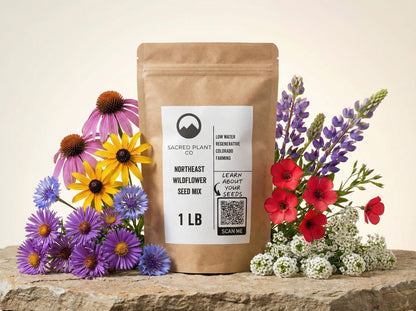
connecticut wildflower seeds Northeast Wildflower Seed Mix for USDA Zones 3 to 8 4 ozNortheast Wildflower Seed Mix for USDA Zones 3 to 8 Bring a season long sweep of color to a cold climate landscape. We built this cold hardy wildflower seed mix for the Northeast, including Connecticut, New York, Pennsylvania, and the surrounding region, across USDA Zones 3 to 8. It is made for cool springs, humid summers, and the swing of a Northeastern autumn, blending fast annuals with biennials and perennials so the planting looks striking from

🌼 Northeast Wildflower Seed Mix for USDA Zones 3 to 8

Bring a season-long sweep of color to a cold-climate landscape. We built this cold-hardy wildflower seed mix for the Northeast, including Connecticut, New York, Pennsylvania, and the surrounding region, across USDA Zones 3 to 8. It is made for cool springs, humid summers, and the swing of a Northeastern autumn, blending fast annuals with biennials and perennials so the planting looks striking from year one and gets better every season. These are quality, US-grown seeds, non-GMO, chemical-free, and never artificially coated.

🌸 Expect a layered display that runs 36 to 48 inches tall: scarlet flax and corn poppy against tall blue cornflower, perennial lupine, rocket larkspur, gayfeather, and New England aster, with golden coreopsis and black-eyed Susan, warm Siberian wallflower, and crisp white baby's breath, Shasta daisy, and sweet alyssum threaded throughout. With roughly 30 percent annuals for first-season color and 70 percent biennials and perennials for staying power, the color keeps coming as the stand fills in. New to sowing a meadow? Our How to Grow Wildflowers from Seed guide walks you through it step by step.

🌻 Meadows & garden beds
Scatter for a natural, layered meadow or a diverse, long-blooming border.
🐝 Pollinator habitat
A continuous, nectar-rich bloom cycle that supports bees, butterflies, and beneficial insects.
🌾 Restoration plantings
Diverse, hardy species that work well for meadows and roadside restoration.
❄️ Fall dormant seeding
Sow before frost and let winter cold-stratify the seed for a strong spring.

Planting in a different climate? Reach for our Southwest Wildflower Mix for hot, dry, low-elevation gardens, or our Mountain Wildflower Mix for high-elevation Western landscapes.

🌱 From the Sacred Plant Co Farm. Sacred Plant Co is a soil-first farm. Our own farm in Colorado earned a groundbreaking Haney Soil Health Score of 25.4, a number that surpasses the soil biology measured in pristine forest land. That score is the heart of who we are. We believe healthier soil grows more complex, more resilient plants, and that philosophy is the standard behind everything we grow and everything we carry.

Product Specifications

Detail Specification
Common Name Northeast Wildflower Mix
Botanical Composition Multi-species blend (19 wildflower species)
Format Wildflower seed mix (annuals, biennials, and perennials)
Available Weights 1/2 oz, 1 oz, 2 oz, 4 oz, 1/2 lb, 1 lb
Mature Height 36 to 48 inches
Recommended Region USDA Zones 3 to 8 across the Northeast (CT, NY, PA and beyond)
Bloom Composition About 30% annuals, 70% biennials and perennials
Grade Non-GMO, untreated (chemical-free, uncoated)
Seed Purity 95 to 99 percent
Germination / Viability 70 to 95 percent
Testing Status Seed purity and germination tested, per lot
Country of Origin USA

Full Seed Mix Composition

  • 17% Baby's Breath, Annual (Gypsophila elegans)
  • 13% Wallflower, Siberian (Erysimum allionii)
  • 12% Scarlet Flax (Linum grandiflorum)
  • 11% Lance-Leaved Coreopsis (Coreopsis lanceolata)
  • 7% Cornflower, Tall Blue (Centaurea cyanus)
  • 7% Purple Coneflower (Echinacea purpurea)
  • 7% Lupine, Perennial (Lupinus perennis)
  • 4% Shasta Daisy (Leucanthemum superbum)
  • 4% Corn Poppy, Mixed (Papaver rhoeas)
  • 3% Sweet William Pinks (Dianthus barbatus)
  • 3% Rocket Larkspur (Delphinium ajacis)
  • 3% Indian Blanket (Gaillardia pulchella)
  • 2% Snapdragon (Antirrhinum majus)
  • 2% Gayfeather (Liatris spicata)
  • 2% Catchfly (Silene armeria)
  • 1% Hairy Beardtongue (Penstemon hirsutus)
  • 1% Black-eyed Susan (Rudbeckia hirta)
  • 0.5% New England Aster (Symphyotrichum novae-angliae)
  • 0.5% Sweet Alyssum, Tall White (Lobularia maritima)

🌱 How to Plant

Prepare your site by clearing debris and loosening the soil so seed makes good contact with bare ground. Broadcast the seed evenly, rake lightly, and press it into the soil. Bury seed no more than 1/4 inch deep, then keep the soil moist until germination.

Seeding rate

1/4 lb covers 625 to 1,250 sq ft, or 1 lb covers 2,500 to 5,000 sq ft. For a natural, meadow-like look, use the lower end. For balanced color and pollinator activity, use the middle of the range. For a full, lush display, choose the upper end.

Best time to plant: early spring as the ground thaws, or as a late-fall sowing before the first frost, which gives the seed natural cold stratification over winter for stronger spring germination.

Safety & Responsible Use

This is a horticultural seed mix for planting and ornamental use, not for human or animal consumption. A few species in the blend, including Perennial Lupine and Rocket Larkspur, can be harmful if eaten, so we suggest keeping the seeds and growing plants out of reach of children, pets, and grazing animals. Wash your hands after sowing, and store unused seed in a cool, dry place away from food.

These statements have not been evaluated by the Food and Drug Administration. This product is not intended to diagnose, treat, cure, or prevent any disease. For guidance specific to your situation, consult a qualified professional.

🌼 Our 100% Money-Back Guarantee

Our policy is simple: if you aren't happy, send it back and receive a full refund. Anytime, for any reason.

Frequently Asked Questions

Which regions and USDA zones is this seed mix made for?

We built this cold-hardy blend for the Northeast, including Connecticut, New York, Pennsylvania, and the surrounding region, across USDA Zones 3 to 8. It is at home in cool springs, humid summers, and the swing of a Northeastern autumn, so the annuals, biennials, and perennials in the mix establish well and come back stronger each year. It also performs nicely across much of the upper Midwest.

Will these wildflowers bloom the first year?

Yes. About 30 percent of the mix is fast annuals that bring color in the very first season, while the remaining 70 percent is biennials and perennials that return and expand in the years that follow. You get a striking display from year one, and the stand deepens and fills in over time.

When should I plant in the Northeast, and how much seed do I need?

Plant in early spring as the ground thaws, or in late fall before the first frost. A fall sowing gives the seed natural cold stratification over winter, which sets up strong spring germination. For coverage, 1/4 lb covers 625 to 1,250 square feet and 1 lb covers 2,500 to 5,000 square feet. Use the lower end of the rate for a natural, meadow-like look, the middle for balanced color and pollinator activity, and the upper end for a full, lush floral display.

Are these seeds treated or GMO, and what if I am not happy with them?

Every batch is non-GMO, chemical-free, and never artificially coated, just clean seed selected for purity of 95 to 99 percent and tested for germination at 70 to 95 percent, so you know exactly what is going in the ground. That same transparency runs through our 100% money-back guarantee. Our policy is simple: if you aren't happy, send it back and receive a full refund. Anytime, for any reason.

Shipping Notes
  • Free Standard Shipping on $100+ Orders to the USA.
  • Except Preorder products are shipped in 48 hours.
  • Delivery to the USA:
  1. Standard Shipping : 3-10 business days
  • If time is of the essence, please consider selecting expedited delivery for faster service.
Exchange/Return Notes
  • We offer a 30-day return/exchange service after receiving.
  • Final sale items are not eligible for returns or exchanges.
  • To process your return/exchange, please contact us at [email protected]
  • Please click here for more details>>> Return & Exchange Policy
SKU: 32990520196

Discover Niche Categories That Outsell connecticut wildflower seeds

Top-Converting Item to Boost Your Average Order

4.0 ★★★★★
Based on 19 reviews
Sort
Highest Rating
Newest First
Oldest First
Product Reviews
D
Verified Purchase
david h.
Alexandria, US
★★★★★ 5
recommend this seller
Format: Paperback
great product, great seller
WAS THIS REVIEW HELPFUL?YesReportShare
Reviewed in the United States on March 4, 2026
F
Verified Purchase
fitzalling
Whiting, US
★★★★★ 5
Globalization greatly increases leverage over opponents
I'm trying to learn more about China. This book was referenced in a book I read by U.S. General Spalding entitled "War Without Rules." The book was written by two Chinese PLA colonels and published in 1999 so it's about a quarter century old. According to General Spalding the book has been read and considered within the U.S. military. I have the paperback and it's 193 pages, not including a short afterword and some information on the authors' backgrounds. It reads fairly well although I did encounter a few places where I wasn't entirely sure what the book was trying to say. I don't know if this was due to translation challenges or it was just me. I got through the book fairly quickly. My main takeaway was that globalization has offers a potential opponent many more levers to influence the actions of others than simply resorting to kinetic (bombs and bullets) warfare. Economic warfare is certainly possible and in the colonels' view has been resorted to by the West against Asian targets. They view George Soros as a financial terrorist who wreaked havoc on Asian economies in 1998. They describe Soros as a soldier in the wars of tomorrow. Page 191. The inspiration for the book was the First Gulf War. The lesson that the colonels drew from this war was that it was inadvisable to fight the U.S. in a straight-up kinetic war. Finding other ways to fight the U.S. was mandatory. As I write this in January 2024 I wonder if the Chinese military will follow the colonels or if they will resort to traditional kinetic means of fighting if their leadership decides to take Taiwan. On page 120 they describe the new model of warfare as combining the battlefield and non-battlefield exemplified by Schwarzkopf and Soros and Bin Laden and some Chinese that I don't recognize. As they say on page 120 "This then is our real hand of cards." The book also cites a number of Chinese theorists on war, which I think I useful. I've read fairly widely, but my reading has been focused in the West. Also, the authors look at international bodies and how China might use them against the U.S. On page 164 the book argues that warfare is changing from "bloody massacre" and finding expression in "information warfare, financial warfare, and trade warfare". Look at the U.S. response to Russia's invasion of Ukraine. The colonels' thoughts are worthy of consideration. On page 110 the book observes "continuous coverage by the modern media which very much strengthens the effects of terrorism." If the topic interests you, I recommend the book. The book may be 25 years old, but its message is timely.
WAS THIS REVIEW HELPFUL?YesReportShare
Reviewed in the United States on January 9, 2024
A
Verified Purchase
Albert
Dallas, US
★★★★★ 4
Intriguing Challenges and Overblown Rhetoric
This is a useful book to read. The principles of warfare advocated by Sun Tzu say that you must know both yourself and your enemy. This book shows that modern American society is known by the Chinese military. As an exercise in cultural self-understanding alone, reading it pays dividends. However, the topic is strategy. The words used can be relatively confusing at times, not quite embodying the meaning given to them by the authors. Unlimited...but within limits. Unrestricted...but following rules. It can be a bit of a struggle to follow their train of thought and understand their meaning (especially with the writing style, which lacks clarity or organization). Despite this I think it is worth struggling with, and especially with a broad overview of some of the argument to assist. Such a board overview follows. The main point: the United States is prone to think in a manner which intrinsically restricts the conduct of warfare to only a formal military domain; thus it abstracts military action from its location in social domains (politics, economy, information, etc). This fits rather well. We like things to be formulas or mechanistic. We also like to abstract them away into separate ("rigidly distinct") boxes which have no interaction. And so, the military is responsible for military problems and better stay far from anything approaching politics! However, as the authors reveal, this leads to an inability to conduct grander strategy in warfare. So instead: "unrestricted" warfare is to have strategy incorporate considerations (and interactions) within various domains, not only the military domain. Basically it is a rejection of the post-Westphalian concept of the nation-state as the supreme (and exclusive) kind of agent in strategy. This is good. The post-Westphalian idea of the nation-state may be useful in certain contexts and for certain purposes, but it is NOT the comprehensive reality of the universe. To treat it as such is to be blind to much of reality, and to live in a fantasy world. Does North Korea really care that it is "unrecognized" as a nation by us? Nope. Because the nation-state idea simply doesn't describe the order in which NK exists, so much as it describes the order in which Germany exists. This is all well and good. But is it truly revolutionary or new? I don't think so. Clausewitz himself writes that there is no military situation abstracted from the political situation, and politics (in this sense) involves much more than just inter-governmental relations. Rather, I think that we can treat this as a corrective against modern American oversimplifications and reductions, and thus as a "return" to older concepts of strategy and statesmanship. Indeed, they even imitate and follow Clausewitz's guidance on method for determining a theory of warfare which is inductive/a posteriori, rather than deductive/a priori. Unfortunately, the one "modern" example of a war they have to analyze is the Gulf War, and so they relentlessly analyze it alone, perhaps leading to imbalance. And here is where the rhetoric is overblown. This is no "master plan" to destroy America (false advertising). It's not even really new concepts. Rather, it is a (very) forceful reminder against the false (and harmful) modernist sentiments that prevail in America's mode of conducting warfare. In reference to false understandings, the authors actually accuse Americans of "touching the elephant" - an allusion to the tale of "blind men and the elephant" (although this allusion is not made clear in the text, and so is confusing if you have not heard of the tale). It is a parable about believing one has the absolute truth, while only having a limited perspective. Perhaps the authors also touch the elephant in a few ways (bias for helicopters without empirical evidence, a near-religious adoration of the golden ratio, etc.). There's a final point of balance that is perhaps needed. It is easy to either dismiss the Chinese critiques of American society ("we don't worship tech") or take them too seriously ("tech is evil"). Either reaction is problematic. Instead we need to understand that just as in some other areas, there is a rhetorical/political purpose at play. America is being made fun of (which means that the critiques are both based in reality, but also somewhat biased for the sake of local humor). Technology is not evil, and technology is not God. So we need to learn to avoid seeing technological advancement as a replacement for people (this is the error the authors would like to point out). This doesn't mean avoiding technological advancement. There are many lessons to be learned from this book. I'd advise it for all military officers to read. However, I also would advise to temper the expectations and reframe the reader's conception of what the book is: it is an exercise in recovery of some older strategic concepts, not a revolutionary approach to destroying the United States. Get past and ignore the rhetoric and advertising, and take the lessons where they make valid points about where we can be short-sighted in our mindset. But don't discount those lessons because of the wild rhetoric and advertising which surround them. Doing this, you will profit.
WAS THIS REVIEW HELPFUL?YesReportShare
Reviewed in the United States on September 1, 2022
C
Verified Purchase
CliffB
Houston, US
★★★★★ 5
China’s Global Strategic Approach.
Provides an excellent understanding of China’s strategy approach — which should be occurs by now, but isn’t. Its style is probably to Asian to be appreciated by most Americans — who have never studied the classic Asian way of war — and never been to war in Asia. If interested in this subject, start with Sun Tzu, and try to think like about strategy the way the Chinese understand it.
WAS THIS REVIEW HELPFUL?YesReportShare
Reviewed in the United States on February 3, 2026
T
Verified Purchase
Tim
Phoenix, US
★★★★★ 5
Why China is winning
Format: Hardcover
Should be mandatory reading for all men from 17 and up see why they’re going to overtake the USA unless we get our act in gear
WAS THIS REVIEW HELPFUL?YesReportShare
Reviewed in the United States on May 29, 2026

recommand products