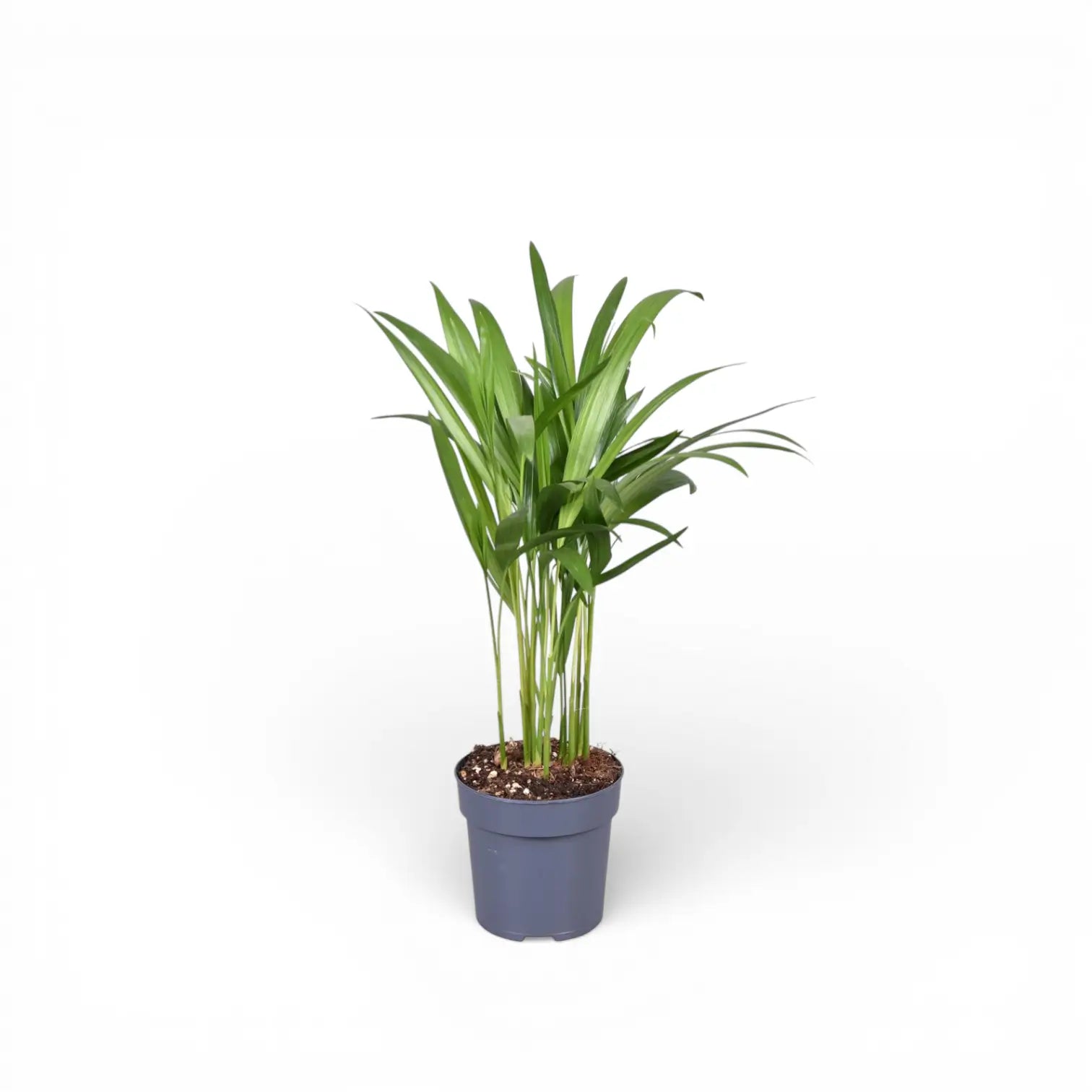
SKU: 33669575928
areca palm common

areca palm common Chrysalidocarpus lutescens

Sale price$25.92 Regular price$28.80
Save 10%

Pay in installments of $7.20 with ShopPay, AfterPay and Klarna

Shipping Estimate
USA
  • USA
  • CAN

Ships within 48 hours · Estimated delivery Oct 28 - Nov 2

Promo Codes Available:

For Your Every Summer RSVP, with Code: SUMMER15

Description

areca palm common Chrysalidocarpus lutescensChrysalidocarpus lutescens Chrysalidocarpus lutescens, still widely known under the synonym Dypsis lutescens, is a clustering palm with upright cane like stems and long, arching feather leaves. Several stems rise from the base, creating a soft, fountain shaped crown with yellow green petioles and narrow leaflets arranged along each frond. Indoors, this palm develops slowly into a broad, leafy specimen with a layered vertical outline. As the stems

Chrysalidocarpus lutescens

Chrysalidocarpus lutescens, still widely known under the synonym Dypsis lutescens, is a clustering palm with upright cane-like stems and long, arching feather leaves. Several stems rise from the base, creating a soft, fountain-shaped crown with yellow-green petioles and narrow leaflets arranged along each frond.

Indoors, this palm develops slowly into a broad, leafy specimen with a layered vertical outline. As the stems mature, they become more defined, while the fronds keep the crown airy, layered, and finely textured.

Golden cane palm details

  • Golden cane palm forming grouped yellow-green stems
  • Arching pinnate fronds with many narrow green leaflets
  • Yellow-green leaf stalks and midribs give the plant its warm tone
  • Can form a sizeable indoor floor plant over time
  • Rarely flowers indoors; mature outdoor plants may produce yellow flowers and small fruits

Eastern Madagascar origin and clumping growth

Chrysalidocarpus lutescens is native to Madagascar and belongs to the palm family, Arecaceae. In habitat and tropical cultivation it can grow as a shrub-like or tree-like palm, with multiple stems forming a broad clump. Indoors, its final shape depends on light, root space, and steady watering.

Each stem grows from a central crown. Fully brown fronds can be removed at the base, while green fronds should stay in place so the palm retains enough leaf area for new fronds. New fronds emerge from the growing points and gradually open into the palm’s feathered canopy.

Because this palm forms a clump, uneven growth is normal: some canes may sit lower while newer stems fill the centre. Turn the pot occasionally so the crown develops evenly, and keep the leaf bases open enough for inspection because pests often settle where the fronds meet the stems.

Keeping Chrysalidocarpus lutescens evenly leafy

  • Light: Use a bright, indirect position. Gentle morning or late afternoon sun suits acclimated plants, while strong midday sun behind glass can scorch fronds.
  • Watering: Keep the substrate evenly lightly moist during active growth, then let the upper layer dry before watering again. Avoid cold, saturated soil.
  • Substrate: Use an airy, well-drained palm or houseplant mix with mineral drainage material to keep the root zone open.
  • Temperature: Keep the palm warm, ideally above 18 °C, and avoid cold draughts or temperatures below about 15 °C.
  • Humidity: Average to moderate indoor humidity is workable, although very dry heated air can crisp leaflet tips. Use a humidifier where winter air becomes persistently dry.
  • Feeding: Use a low-strength fertiliser in spring and summer. Too much feed can show as yellowing or salt stress on leaflet tips.
  • Repotting: Move up one pot size when roots have filled the container, often after 2–3 years. Avoid oversized pots that keep the mix wet for too long.
  • Pruning: Remove only fully spent fronds. Cutting green fronds reduces the palm’s active leaf area.
  • Leaf cleaning: Wipe dusty leaflets gently or rinse the fronds with lukewarm water so the narrow leaflets can receive light evenly.

Frond, cane and pest checks

  • Brown tips: Often linked to dry air, irregular watering, salt build-up, or old leaf age. Check moisture pattern and flush the substrate if fertiliser salts have built up.
  • Yellowing fronds: Can follow overwatering, poor drainage, low light, nutrient imbalance, or natural ageing of older leaves. Check the root zone before feeding.
  • Mites or scale insects: Fine stippling, webbing, sticky residue, or bumps on stems and leaf bases need early inspection and treatment.
  • Collapsed stems: Soft bases usually point to root or crown stress from persistently wet, cool conditions.

Pet-safe palm status

ASPCA treats the areca palm, Chrysalidocarpus lutescens, as non-toxic to cats and dogs. Sensitive pets may still get mild stomach upset from chewing the fronds.

Accepted name and synonym note

Chrysalidocarpus lutescens H.Wendl. is the accepted botanical name for this Arecaceae species. Dypsis lutescens remains a common synonym in horticulture. The genus name refers to chrysalis-like fruits, while lutescens means turning yellow, matching the yellow tones in the flowers, stems, and leaflet midribs.

Chrysalidocarpus lutescens grows into golden cane clusters with airy fronds and a full upright palm outline.

Shipping Notes
  • Free Standard Shipping on $100+ Orders to the USA.
  • Except Preorder products are shipped in 48 hours.
  • Delivery to the USA:
  1. Standard Shipping : 3-10 business days
  • If time is of the essence, please consider selecting expedited delivery for faster service.
Exchange/Return Notes
  • We offer a 30-day return/exchange service after receiving.
  • Final sale items are not eligible for returns or exchanges.
  • To process your return/exchange, please contact us at [email protected]
  • Please click here for more details>>> Return & Exchange Policy
SKU: 33669575928

Discover Niche Categories That Outsell areca palm common

Top-Converting Item to Boost Your Average Order

4.9 ★★★★★
Based on 19 reviews
Sort
Highest Rating
Newest First
Oldest First
Product Reviews
M
Verified Purchase
M Arneson
Houston, US
★★★★★ 4
Funny and scary, but with a bit of reassurance
Format: Kindle
Reassuring and disturbing at the same time, this book exposes the flaws and risks of AI, while pointing out the weaknesses that make it incapable of taking over the world. The examples of AI foolishness entertain and startle. AI's missteps and errors and the real harm they cause provide a warning that is easier to absorb when leavened with the humor. So what happens if I end this review with a bit of AI-generated predictive texting? Here goes: This is a story out of India and I am not sure if I can make it to the wrong email address. Please let me know if you have any questions. I look forward to hearing from you.
WAS THIS REVIEW HELPFUL?YesReportShare
Reviewed in the United States on December 1, 2019
R
Verified Purchase
Randy Hayes
Lexington, US
★★★★★ 5
Hilarious and Informative
Format: Kindle
This book was a major hit with me - it had me in hysterics at several points while teaching me a lot about machine learning and neural networks on a deep level.
WAS THIS REVIEW HELPFUL?YesReportShare
Reviewed in the United States on April 5, 2026
O
Verified Purchase
Odysseus at home
Whiting, US
★★★★★ 5
An adorable book
Format: Paperback
This is an adorable book. I bought it because I needed to know more about AI, and this exemplar seemed perfect to me. And it was. I had already read several books on AI, dozens in fact, and let's say this is one of the best. First: the tone (the author is very nice); secondly, the drawings (always adding clarity), and thirdly, the scope (it covers all the main topics, including ethical and technological issues). The problem with books on AI is that some authors begin to talk on AI in a very effective manner, but then, before you realize, they start pontificating on all the evils that it brings with it, and the perverse people behind the scene trying to kidnap your soul (or your money). Believe me, I tremble every time I read on AI because I know what possibly is going to happen after the first fifty pages. This is not the case. Janelle Shane goes to the point, shows you the magic, and the limits of this pervasive science, without painting the horror movie some others make you watch. Highly recommended for all those interested in passing a couple of days of good reading on AI topics, learning on them, and enjoying a very entertaining author. Five brilliant stars.
WAS THIS REVIEW HELPFUL?YesReportShare
Reviewed in the United States on October 13, 2023
K
Verified Purchase
Kelson Vibber
Port Orchard, US
★★★★★ 5
A fun, accessible introduction to how AI works...and how it sometimes doesn't!
Format: Hardcover
Still relevant despite recent advances in AI-generated imagery and text, because the new systems still work on the same principles as the ones that were around three years ago. They just have a lot more data and processing power. This also means they have the same limitations and blind spots. What was it trained on? *How* was it trained? (This is the most obvious way human bias can leak into an AI model.) How well is the goal specified? And of course, did the AI actually latch onto relevant details, or did it notice that all the training pictures labeled sheep had green fields and blue skies, and completely ignore the actual sheep? These are things to keep in mind as we enter the landscape of generative AI tools like ChatGPT: You can train an LLM to write a book review, and it'll give you a great piece of text that *reads* like a book review -- but it's not going to have actually evaluated the book. For that, you'd have to train *another* AI to categorize books as good, bad, interesting, dull, and so on. But even that can only be as good as its training data. (I don't remember whether the classic phrase "garbage in, garbage out" is used anywhere in the book, but it still applies today!)
WAS THIS REVIEW HELPFUL?YesReportShare
Reviewed in the United States on April 1, 2023
T
Verified Purchase
Tero
Bozeman, US
★★★★★ 4
If you want a book on the details of AI without math and statistics, this is it
Format: Paperback
I had this book a year or two back and then sold a lot of books as they piled up. After that I read a good number of books on AI. Of those, Ethan Mollick's book Co-Intelligence is best for the user end. But then there was still the issue of how do they do it? If you want to understand the process how AI works, there are a few books like this. Melanie Mitchell tends to focus on pictures. When you read ANY of these book, you will come to a page where you think "this makes no sense." You get there because the way AI chops up information and stores it in "cells" and then processes in stages (deep learining, hidden layers) is not how we think. They are not brains, though the neural network has some similarity to ours. You will simply need to finish the book. This one or the one you bought. Then read another one, if needed. It will make a lot of sense if you finish the book. Then you just generalize where you are at. I am never going to write Python or get deeply involved in tha manner. I am quite familiar with the free vesrions and I am able to check what summaries I get from AI. I will also keep up with the language part of it. AI does not study grammar the way we do. It looks for patterns in millions of examples. I have since 2023 gone through most of the 20 dollar range books. This one is the best.
WAS THIS REVIEW HELPFUL?YesReportShare
Reviewed in the United States on April 1, 2026

recommand products