SKU: 35140314474
mermaid tail succulent near me

mermaid tail succulent near me Mermaid Tail Cactus

Sale price$22.82 Regular price$25.36
Save 10%

Pay in installments of $6.34 with ShopPay, AfterPay and Klarna

Shipping Estimate
USA
  • USA
  • CAN

Ships within 48 hours · Estimated delivery Jul 24 - Jul 29

Promo Codes Available:

For Your Every Summer RSVP, with Code: SUMMER15

Description

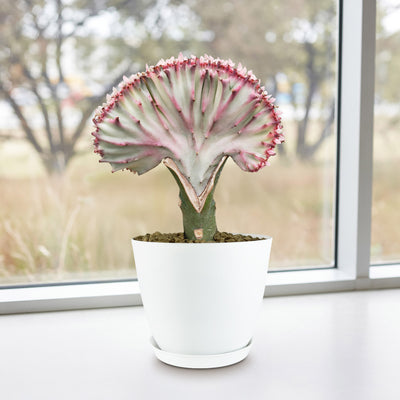
mermaid tail succulent near me Mermaid Tail CactusThe Mermaid Tail Cactus, known as Euphorbia lactea Cristata Grafted, is a rare, eye catching succulent prized for its wave like crested form that resembles a mermaid's tail rising from the sea. This sculptural plant is widely adored for its surreal, fan shaped growth and bold ridges, making it a standout in succulent arrangements and a favorite among collectors. Its dramatic silhouette and ease of care have made it a must have in modern indoor gardens

The Mermaid Tail Cactus, known as Euphorbia lactea Cristata Grafted, is a rare, eye-catching succulent prized for its wave-like crested form that resembles a mermaid's tail rising from the sea. This sculptural plant is widely adored for its surreal, fan-shaped growth and bold ridges, making it a standout in succulent arrangements and a favorite among collectors. Its dramatic silhouette and ease of care have made it a must-have in modern indoor gardens and novelty plant displays.

It is a grafting combination of the Euphorbia lactea, a columnar cactus-like succulent, and the Euphorbia cristata, which has a crested growth form. This combination creates a visually stunning and captivating plant that is highly sought after by succulent enthusiasts. 

Native to tropical regions of India and Sri Lanka, the species Euphorbia lactea naturally grows as a tall, branching succulent with angular, spiny stems.

The crested mutation, however, develops when the plant’s growing tip fans out into a ruffled crest, giving it its mermaid tail-like appearance.

Since this form is not self-supporting in most cases, grafting is necessary to ensure the plant remains healthy and upright.

The distinctive feature of the Mermaid Tail Cactus is its undulating, ridged crest, often colored in varying shades of blue-green, gray, or silvery green, and sometimes outlined with soft pink or purple tones. The edges may appear wavy or jagged, resembling ocean coral or the gentle curve of a mermaid’s tail fin. Its waxy surface and abstract shape make it feel both whimsical and futuristic.

The mature Mermaid Tail Cacti typically reach 14 inches tall and wide, depending on the vigor of the rootstock and environmental conditions. Their compact size and upright form make them ideal for containers, windowsills, or decorative pots where they can be admired as a living sculpture. They grow slowly and retain their form well, requiring very little maintenance to stay attractive.

The blooms of Mermaid tail cactus are usually short-lived and yellow-green in color, but are rare in cultivation, especially for young or newly grafted plants. Most growers value the plant more for its shape and color than for its flowering potential.

The regular has a crested growth form naturally; the grafted version is created through the process of grafting, where the crest is grafted onto the stem of the Euphorbia lactea. This grafting process results in a more pronounced and defined crested growth pattern.   

When and How to Water Your Mermaid Tail Cactus

Mermaid Tail Cactus is drought-tolerant and requires infrequent watering. It's best to water thoroughly when the soil is completely dry, allowing excess water to drain away to prevent root rot. Overwatering is a common issue with succulents, so it's better to err on the side of underwatering. Your Mermaid tail cactus should be watered every 10–14 days during the growing season, and every 4–5 weeks during dormancy.

From March to September, during the growing season, water your Mermaid Tail Cactus once every 10 to 14 days, depending on temperature and light exposure. The grafted crest benefits from deep, infrequent watering, just enough to soak the soil, then allow it to dry completely. Consistent overwatering can lead to root or graft rot, so err on the side of underwatering.

From October to February, during the dormant season, reduce watering to once every 4 to 5 weeks. Since growth slows in cooler months, the plant uses minimal moisture. Only water when the soil is completely dry and the stem begins to show slight wrinkling.

Light Requirements - Where to Place Your Mermaid Tail Cactus

When grown indoors, place your Mermaid Tail Cactus near a south- or west-facing window where it can get 6 to 8 hours of bright, indirect sunlight. If light is too low,

 it may become pale or leggy. Supplemental grow lights can be used in low-light homes.

When grown outdoors, it can tolerate partial to full sun but should be gradually acclimated to avoid sun scorch, especially in very hot climates.

Place it where it receives at least 6 hours of light per day for best shape and color. Morning sun with afternoon shade is ideal in regions with harsh sunlight.

Optimal Soil & Fertilizer Needs

The mermaid cactus prefers sandy, well-drained soil and should be fertilized once a year in spring. Planet Desert's specialized cactus potting soil: Soil cactus mix blend 1 gal 4 qt cacti succulent dirt compost growing media includes an organic substrate with mycorrhizae to help with the growth of a healthy root system to help your succulents thrive.

When it comes to fertilizing your Euphorbia lactea grafted, use a minimal amount of NPK fertilizer for about (5-10-5) once a year in spring to support healthy crest development. In the dormant season, avoid fertilizing altogether as the plant is not actively using nutrients.

Hardiness Zones & More

In the United States, your Mermaid tail cactus is mostly an indoor plant, but if you live in southern Florida or Hawaii, then you can cultivate it outdoors in USDA zones 10-11.

In terms of humidity, the Euphorbia lactea grafted plant is adaptable and can tolerate a range of humidity levels.

 However, it generally prefers a drier environment with lower humidity. It's important to provide good air circulation around the plant to prevent any issues with excess moisture or humidity-related diseases.

How to Grow Your Mermaid Cactus Best Indoors 

Mermaid cacti thrive best indoors in a warm environment with temperatures ranging between 70-80°F during the day and slightly cooler temperatures at night. They also prefer high humidity levels, so consider placing a humidifier near the plant or misting it regularly to create a more tropical atmosphere. Additionally, ensure the cactus receives plenty of bright, indirect sunlight to promote healthy growth.

Wildlife - Mermaid Tail Cactus Attracts the Following Friendly Pollinators

The Mermaid Tail Cactus attracts a variety of pollinators such as bees, butterflies, and hummingbirds with its vibrant blooms. These friendly visitors help to ensure the continued health and reproduction of the cactus through pollination.

Butterflies
Bees
Hummingbirds
Lady Bugs
Multi Pollinators
Other Birds

According to ASPCA, the Mermaid Tail Cactus is mildly toxic to humans and pets if ingested. The plant's sap, which is milky and white, can cause skin and eye irritation in humans and is mildly toxic to pets, potentially leading to mouth and stomach irritation and vomiting.

How to Propagate Your Mermaid Tail Cactus

The propagation of your Euphorbia lactea Cristata Grafted is done by cutting from the crest and grafting it onto a compatible rootstock such as Euphorbia neriifolia or Euphorbia canariensis. Use a sterilized knife to remove a healthy portion of the crest, let it callous over for several days, and then graft it onto the new rootstock using strong ties or grafting wax to secure it until fusion occurs. This method requires precision and care, making it best for experienced growers.

Key Takeaways

  1. The Mermaid Tail Cactus gets its name from its sculpted, crested form that resembles the flowing tail of a mermaid or ocean coral.
  2. It is not a true cactus but a grafted succulent, combining the fan-shaped crest of Euphorbia lactea with the rootstock of another Euphorbia species for support and longevity.
  3. Its unusual, wavy texture and colorful margins—often tinged with pink or lavender—make it look like a living piece of art.
  4. This Mermaid cactus plant is drought-tolerant and thrives on neglect, needing very little water and doing well in bright indoor spots.

The Bottom Line

Overall, the Mermaid Tail Cactus (Euphorbia lactea Cristata Grafted) is a fascinating, wave-like succulent that brings structure, uniqueness, and minimal maintenance to any indoor or outdoor space. Its crested form is sculptural and artistic, making it a favorite among collectors and modern gardeners. With proper light, sparse watering, and protection from cold and excess moisture, this plant thrives with very little effort and adds a surreal, underwater-like element to succulent displays.

Shipping Notes
  • Free Standard Shipping on $100+ Orders to the USA.
  • Except Preorder products are shipped in 48 hours.
  • Delivery to the USA:
  1. Standard Shipping : 3-10 business days
  • If time is of the essence, please consider selecting expedited delivery for faster service.
Exchange/Return Notes
  • We offer a 30-day return/exchange service after receiving.
  • Final sale items are not eligible for returns or exchanges.
  • To process your return/exchange, please contact us at [email protected]
  • Please click here for more details>>> Return & Exchange Policy
SKU: 35140314474

Discover Niche Categories That Outsell mermaid tail succulent near me

Top-Converting Item to Boost Your Average Order

4.7 ★★★★★
Based on 19 reviews
Sort
Highest Rating
Newest First
Oldest First
Product Reviews
D
Verified Purchase
Desmond Yuen
Cuba, US
★★★★★ 5
The past is the future? Focus on the big picture
Format: Hardcover
This book isn’t just about economics; it also takes a captivating look at history. Written in a style similar to his previous book, "Big Debt Crises," Ray presents history in cycles. To make things easier to grasp, he added some helpful features: passages are bolded for a quick read, and a red dot marks principles that are considered timeless and universal truths. I really appreciate the QUICK-READ option. It’s so easy to overlook key points in a long book, but the bolded sections help me focus. For example, one universal truth is, "Throughout time, the formula for success has been a system in which well-educated people operating civilly with each other, come up with innovations, receive funding through capital markets, and own the means by which their innovation..." The book is divided into three parts: How the world works, How it has worked over the last 500 years, and the Future. The first part explores the rise and fall of empires. The second offers an in-depth look at the Dutch Empire, the British Empire, the United States, and China. The last part looks ahead at what’s to come. The appendix even includes a computer-generated power score for 11 world-leading countries. I haven’t finished the entire book yet, but after reading some chapters, I can say Ray did a fantastic job condensing 500 years of history into an accessible, engaging format. The graphs also help clarify his points. It answered many questions I had, like how pandemics have impacted the world. Instead of flipping through multiple books to find answers, I can find everything I need here. What I also really appreciate is Ray’s honesty. He doesn’t shy away from tough issues. If he's not an expert on something, he clearly states where he learned it from. He’s straightforward, sincere, and speaks his mind. Even if you do not believe that history will repeat itself, you will still enjoy reading this book.
WAS THIS REVIEW HELPFUL?YesReportShare
Reviewed in the United States on December 1, 2021
K
Verified Purchase
Kindle Customer
Port Orchard, US
★★★★★ 5
Phenomenal book, one major criticism
Format: Kindle
Great book. Dalio does a remarkable job seeing the bigger picture and providing confidence through historical events/ever repeating cycles that you can predict at a high level what is coming next for a given country or the world and plan accordingly. The corkscrew of evolution analogy is a perfect one, where the human race has up and down cycles but always trends up longer term thanks to technological innovation. My one criticism is he speaks out of both sides of his mouth in one instance, presumably because he doesn’t want to upset any high ranking politicians or leaders he may be friends with, which I found to be disappointing. On the one hand, he notes at the start of the book that no two democracies have waged war with each other, wars have only been fought between dictators/police states and democracies or just dictators/police states. Then later on when discussing China, he all but excuses and rationalizes their increasingly authoritarian state, as seen by Xi crowning himself leader until death and abolishing the precedent of 2 5 year term limits as of 2018. He blesses the Chinese approach of a few rulers knowing what’s best for all, as if those rulers are acting in the broader interest of Chinese people, and that’s an acceptable alternative to democratic rule. He cites the recent video game ban as having merit or at least being understandable, suggesting that he thinks the ends can justify the means. All the while there’s no mention of the atrocities of Mao under this authoritarian type of rule, no mention of the Muslim genocide going on now, the suppression of free speech and jailings and beating and murders of those that oppose the current regime, no mention of internet censorship, etc. To bring the criticism full circle, he doesn’t link his first point on wars and authoritarians always being involved in them, with the fact that China is an authoritarian state and therefore it’s rise threatens the free world and human progress. Ironically, he does correctly acknowledge China’s opening up to market and establishment of capitalist principles for rocketing them toward the US in terms of power, while refuses to critique the political system despite its history of failings, violence and pain. Russia invading Ukraine couldn’t drive this point (ie the civil or political system being as important as the economic system to the long term success of a country and world peace) home any harder.
WAS THIS REVIEW HELPFUL?YesReportShare
Reviewed in the United States on March 12, 2022
H
Verified Purchase
Harold Hall
Boise, US
★★★★★ 5
Can be effectively used as a working tool for the predictor (not just for investments)
Format: Hardcover
This is one of the best works on the declining economy and US, associated possible revolution/civil war and later major power war, that is presented in a clear, convincing and replicable way. Kudos to Dalio!! More importantly, the contents of the book can be used to predict upcoming events rather than just perceiving the world on fire with several likely upcoming breakouts (e.g., war with China over Taiwan, the likely loss of our reserve currency, the unsustainable and uncontrollable burgeoning national debt which grows by a trillion USD every 100 days). The author makes a valid case that significant events are moving very rapidly and, for the rest of the 2020s, things are going to get a whole lot worse for the non-elites in our society. Of note, the book was actually written in 2020, published the next year, which then allows the readership now in 2025 to verify the accuracy the observations and predictions. Right on target!
WAS THIS REVIEW HELPFUL?YesReportShare
Reviewed in the United States on June 4, 2025
P
Verified Purchase
Peter Ganavazos
Chelsea, US
★★★★★ 5
Great book for understanding how the world works!
Format: Hardcover, Format: Hardcover
Dalio has a unique perspective on the topic of the changing world order. He is a successful businessman who has spent his career analyzing economic trends and patterns, and this book is a culmination of his findings. His writing is clear and concise, making complex economic concepts easy to understand. One of the best features of the book is its organization. The book is broken down into 14 chapters, each focusing on a different aspect of the changing world order. Dalio starts with the big picture, examining the major forces driving the changing world order, before delving into the specifics of each major empire, including the Dutch, British, American, Chinese, Soviet, and Japanese empires. Ultimately, he brings everything full circle by discussing the changing world order today and what the future may hold. Another great aspect of the book is the way that Dalio weaves history and economics together. He doesn't just present economic theories in a vacuum; he uses real-world examples to show how they have played out over time. For example, in Chapter 5, he discusses the Great Depression and how it shaped the changing world order in the 1930s and 1940s. He also uses the rise of populism in Chapter 7 to illustrate how economic inequality can lead to political instability. Overall, I would highly recommend "The Changing World Order" to any intelligent human interested in economics, history, or politics. This book is a must-read for anyone who wants to understand the forces shaping our world today and what the future may hold. As Dalio himself puts it, "understanding how the world works is essential if you want to accomplish your goals and live a fulfilling life." Here are some key takeaways from the book: The changing world order is driven by three major forces: the changing relative powers of countries, the changing relative productivity of countries, and the changing values of countries. The rise and fall of empires is a natural part of the changing world order. Each empire has its own unique characteristics, but they all follow a similar pattern of rise, peak, and decline. The post-World War II order was built on the idea of free trade and cooperation between nations. However, this order is now under threat due to rising nationalism and protectionism. China is currently on the rise and is likely to become the world's dominant economic power in the coming decades. However, although this rise is not guaranteed, and there are many challenges that China will need to overcome, the US needs to step up its game on several fronts to compete. The future of the world order is uncertain, but there are a few things we can say with some degree of certainty. For example, the rise of automation and artificial intelligence is a hot topic today likely to have a major impact on the global economy in the coming years. Overall, "The Changing World Order" is a well-written and informative book that is sure to appeal to a wide range of readers. Whether you're a history buff, an economics nerd, or just someone who wants to better understand the world we live in, this book is well worth your time. As Dalio himself says, "The more you know, the more you'll understand, and the more you'll be able to make informed decisions about your own life." Five stars from me, give it a read!
WAS THIS REVIEW HELPFUL?YesReportShare
Reviewed in the United States on May 9, 2023
J
Verified Purchase
Jayme
Charlottesville, US
★★★★★ 5
10/10 Recommend
Format: Hardcover
I took Jeffrey Sachs's Globalization class on EDX Academy and somehow stumbled upon this book in between class and finding books around the subject. I watched his youtube video that generalizes the book and was blown away by how my current class I was taking aligned with it. This book is an easy read, and especially for those who aren't well-versed about world history and world economics. I will admit that I do love history, and am learning economics, so this book was a beautiful way merge all these timelines together. The book breaks down and summarizes key points in world history and economics to make points to get the message across each chapter. Font size is great! Might even be considered larger compared to other books. The only thing I wish this book provided was thicker paper in the physical book itself, especially for the hardcover version. If Ray Dahlio ever comes out with a special edition of this with a higher quality paper, I would gladly purchase it for my collection.
WAS THIS REVIEW HELPFUL?YesReportShare
Reviewed in the United States on March 2, 2025

recommand products