Pay in installments of $6.94 with
 ,
,
 and
and

Shipping Estimate
USA
- USA
- CAN
- USA
- CAN
Ships within 48 hours · Estimated delivery Aug 26 - Aug 31
 Promo Codes Available:
For Your Every Summer RSVP, with Code: SUMMER15
Description
bonsai paulownia tree PaulowniaPaulownia Pavlovnia Princess Tree (Paulownia tormentosa) Ornamental Flowering Tree Empress Trees Deciduous Foxglove Tree Perennial Height 40 ft Paulownia is a genus of 7 to 17 species of hardwood trees and currently placed in its own family Paulowniaceae, and is the fastest growing tree in the world. The genus, originally Pavlovnia but now usually spelled Paulownia, was named in honour of Anna Paulowna, queen consort of The Netherlands (17951865), and
Paulownia - Pavlovnia Princess Tree (Paulownia tormentosa) Ornamental Flowering Tree Empress Trees Deciduous Foxglove Tree
Perennial
Height 40 ft
Paulownia is a genus of 7 to 17 species of hardwood trees and currently placed in its own family Paulowniaceae, and is the fastest growing tree in the world. The genus, originally Pavlovnia but now usually spelled Paulownia, was named in honour of Anna Paulowna, queen consort of The Netherlands (1795–1865), and daughter of Tsar Paul I of Russia. It is also called 'Princess Tree' or 'Empress Tree' for the same reason. Paulownia trees are present in much of China, south to northern Laos and Vietnam, and have been cultivated elsewhere in eastern Asia, notably in Japan and Korea for years.
Paulownia was introduced to North America in 1844 from Europe and Asia as an exotic ornamental tree. Its fruits, actually botanically capsules, were also used as packaging material for goods shipped from East Asia to North America, leading to Paulownia groves where they were dumped near major ports. The tree has not persisted prominently in US gardens, in part due to its overwintering brown fruits that some consider ugly. Some authorities consider the genus an invasive species, but in Europe, where it is also grown in gardens, it is not regarded as invasive.
Paulownia trees, usually begins to produce seed after 8 or 10 years - there are nearly 3 million seeds per pound, and as many as 20 million tiny seeds per tree per year; easily grown in average, medium, well-drained soils in full sun. Prefers sandy loam with good drainage. Tolerates a wide range of soils including poor, dry ones, but dislikes unamended heavy clay soils. Tolerates light shade, but is generally intolerant of shady conditions.
Paulownia is an upright to spreading deciduous tree that typically grows to 40 ft tall with a rounded crown, and can grow to maturity in under 10 years. Paulownias may be grown as non-flowering foliage plants by administering annual hard dormant season prunings. Tree forms may be pollarded (annually prune branches back to the trunk) and shrub forms may be coppiced (annually prune stems to the ground). Such hard dormant season prunings encourage the development of much larger leaves (up to 24 in long) at the expense of the spring flowers. Can also be grown in containers as a foliage plant.
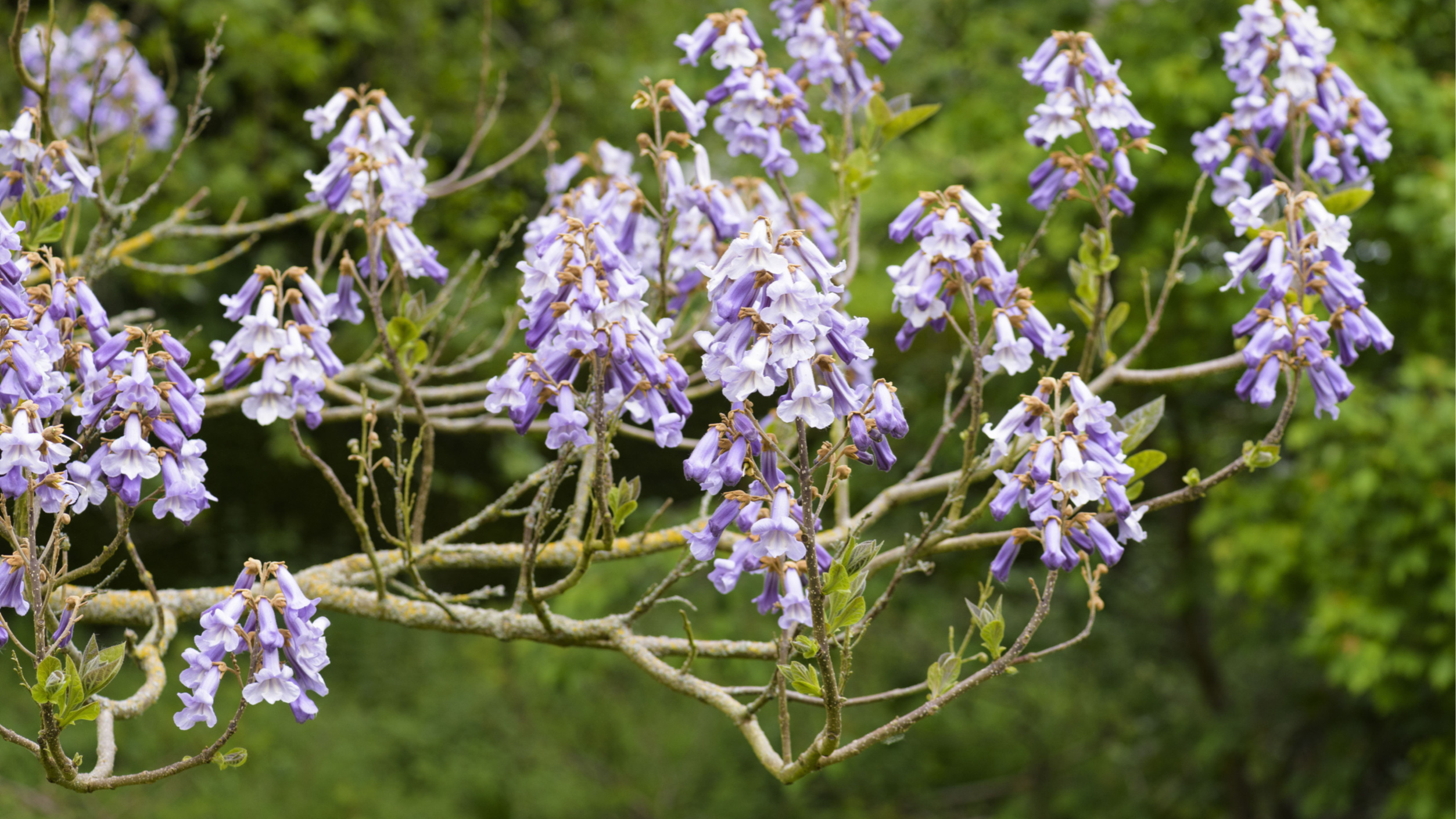
Typically, Paulownia are primarily grown for its profuse spring foxglove-like blooms of fragrant, tubular, funnel-shaped, pinkish-lavender flowers (to 2in long) with interior dark purple spotting and creamy yellow striping flowers, in clusters (to 14 in long) before the large catalpa-like ovate, green leaves (to 5 to 12in long) that are lightly hairy above and densely hairy beneath.
The bloom aroma is reminiscent of vanilla; flowers are edible and are a great addition to salads. The flowers are followed by oval, woody, dehiscent seed capsules that emerge sticky green and ripen to brown in fall, at which point they split open releasing abundant winged seeds. Blooms on old wood; buds form in the summer for the following spring bloom. Overwintering flower buds are ornamentally attractive, but may be damaged in very cold winters, particularly when temperatures dip below 0 F. Best sited in locations protected from strong winds. There is no fall color.
Paulownia wood is commercially valuable in Japan. Paulownia wood is used for boat building and surfboards as it produces strong, lightweight timber, great for firewood, with an even higher strength to weight ratio than balsa wood. Paulownia has been widely planted in North America, from Montreal to Florida and west to Missouri and Texas, and has also been planted in some Pacific States. The tree is moderately cold hardy and has naturalized principally in the East and South.
- Full sun
- Well draining soil
- Note: seeds require light in order to germinate.
- Sow at any time of the year
- Start seeds indoors: sow on the surface of well draining soil without covering. Sow in trays/pots of good seed compost in a propagator or warm place to maintain an optimum temperature of 65-70F (18-20C)
- NOTE: maintaining a moist environment during germination and initial seedling development is important.
- Wait until the plants average 6 in tall and then do the first thinning. But don't wait too long - postponing the thinning leads to small spindly plants. Thinning is necessary for proper seedling growth. Do the thinning by hand, leaving the most vigorous seedlings intact. At first, thin seedlings to about 100 plants/sq yd. When they are 12 in high, thin them to 20 to 50 seedlings/sq yd. They normally can be kept at this density if you are producing one-year-old seedlings or root stocks for out-planting the following year. If you plan to develop 2 year old plants, thin the beds to 10 seedlings/sq yd.
- Germination usually takes 21 to 60 days.
- At the beginning of fall, reduce the watering schedule and let the plant bed dry between watering.
- OR direct sow: moisten the outdoor bed and then seed at about 1 level tsp/sq yd. Scatter the seed by hand on a windless day. Maintaining a moist environment during germination and initial seedling development is important. The small seeds on the soil surface can support only one attempt at rooting, so the microenvironment surrounding them is critical. Desiccation even for short periods can be fatal during the root's early development. Emerging roots can dry out even between irrigations during afternoons with high temperatures and low relative humidities.
- Use a straw mulch or a covering over the bed to maintain adequate moisture.
- You can maintain the proper environment, while avoiding problems, by covering the nursery bed with a spun-bonded polyester or nylon canvas; this covering suspended above the bed, lets light (necessary for paulownia seed germination) filter through while alleviating the adverse effects of excess water and wind. The covering disperses incoming water droplets, letting only a fine mist reach the soil surface, and provides a warm, moist and undisturbed environment for germination. Light-weight cotton or cheesecloth can also be used to cover the beds, but the synthetic material is much less expensive and is readily available.
- Don't let the covering contact the soil because the plants will grow through the cover and you will damage the seedlings when you remove it. To avoid this contact, you can suspend the covering over the soil surface by a series of arched wires placed along the bed's centre line; you can attach it to a wooden frame surrounding the plant bed, or you can spread a very small amount of straw over the soil. Remove the covering when the seedlings are 2 inches tall.
- Continue watering, keeping the soil moist but not saturated. Proper control of seedling density is critical for producing vigorous planting stock. Wait until the plants average 6 in tall and then do the thinning. Refer to thinning above.
- Harvest: the best time for seed collecting is early September. Gather the pods after they ripen - but before they open; pods should be predominantly brown. Allow the pods to air dry - put them in burlap bags and gently crush the contents. The seed can be easily separated from the heavier trash by hand or with a blower. Place the seeds in cold storage at a temperature of 38° to 40° F for maximum longevity. They may be stored dry in sealed containers or stratified between moist layers of a mixture of sand and peat. Stratification seems to reduce the very high light requirement that fresh seed exhibit, and may shorten the germination time. Both methods allow you to store seeds for as long as 4 years before germination declines sharply.
- Select your planting site keeping in mind fast growth and height. A
- Seed Count: 10
Shipping Notes
- Free Standard Shipping on $100+ Orders to the USA.
- Except Preorder products are shipped in 48 hours.
- Delivery to the USA:
- Standard Shipping : 3-10 business days
- If time is of the essence, please consider selecting expedited delivery for faster service.
Exchange/Return Notes
- We offer a 30-day return/exchange service after receiving.
- Final sale items are not eligible for returns or exchanges.
- To process your return/exchange, please contact us at [email protected]
- Please click here for more details>>> Return & Exchange Policy