SKU: 35631712569
white flower seed

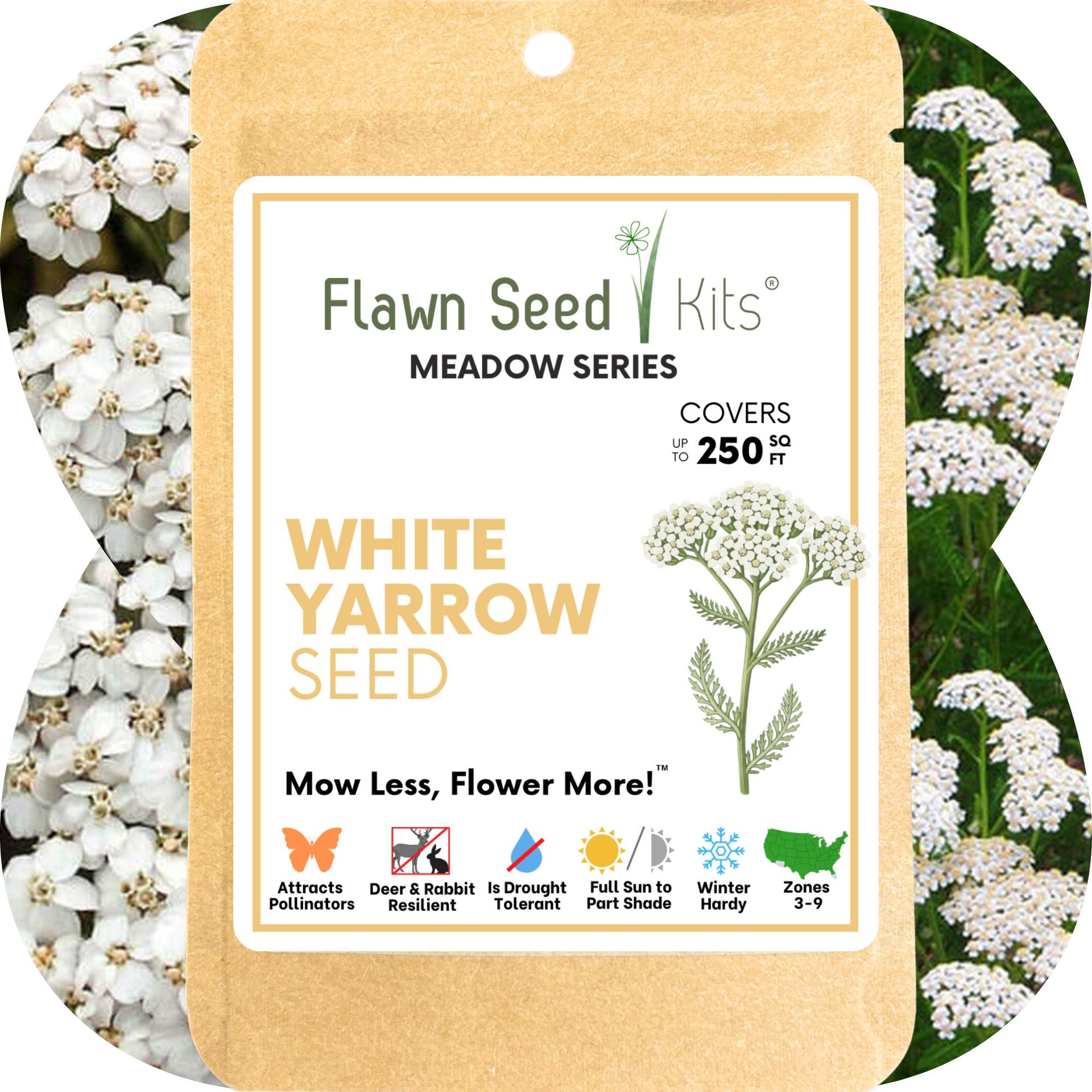
white flower seed Yaak Yarrow 'Turf-Type' Seed, 1000 sq ft .14 oz

Sale price$18.75 Regular price$20.83
Save 10%

Shipping Estimate
USA
  • USA
  • CAN

Ships within 48 hours · Estimated delivery Jul 14 - Jul 19

Promo Codes Available:

For Your Every Summer RSVP, with Code: SUMMER15

Description

white flower seed Yaak Yarrow 'Turf-Type' Seed, 1000 sq ft .14 ozOur Meadow Series varieties are great for areas with low foot traffic that don't require mowing and are intended to be seeded over bare soil. If you want to add Yarrow to your Flawn, check out a dwarf variety called Yaak Yarrow. Non GMO White Yarrow Achillea millefolium seed in compostable Kraft pouch. A beautiful addition to a flowering lawn if you are okay with letting it grow at about one foot tall. It is highly attractive to pollinators. If you

Our Meadow Series varieties are great for areas with low foot traffic that don't require mowing and are intended to be seeded over bare soil. If you want to add Yarrow to your Flawn, check out a dwarf variety called Yaak Yarrow.

Non-GMO White Yarrow Achillea millefolium seed in compostable Kraft pouch. A beautiful addition to a flowering lawn if you are okay with letting it grow at about one foot tall. It is highly attractive to pollinators. If you are planning on mowing your Flawn at about 4-6", the yarrow will survive but likely not flower. It is best for low-traffic areas that are mowed only a few times per year and left to grow taller. Grows great in sandy, well-drained soils.

Spreading seeds by hand is a learned art and must be done carefully to ensure even application and complete coverage. These seeds are extremely small and difficult to spread evenly by hand. Hand application often leads to clumping and over-seeding. For best results, use a bulking agent or carrier such as compost, sand, or sawdust. Our Easy Spread Shakers and our Easy Spread Bulk Containers include organic compost and soil builders to help spread the seeds easily.

USDA Hardiness Zones: 3-9
Height: 6-12" (with blooms)
Bloom/Period: Yes, late spring into late summer
Sunlight: Full sun to part shade
Soil: Grows well in sand, silt, and loam.
Drought Tolerance: High
Maintenance Needs: Low
Pairs Well With: Fine Fescue (Low Mow) Grass, Clovers, Self-Heal, Creeping Thyme, Sweet Alyssum, English Mixed Daisy
  • How To Start Your Flowering Lawn Journey -- No need to remove grass; simply mow existing grass very short, spread the flowering lawn seed evenly, water, and watch it grow!
  • Better For Your Family & The Environment -- Our specialty flowering lawn seed is kid and pet friendly. It attracts beneficial pollinators while reducing your property's carbon footprint!
  • Reduce Maintenance Costs -- White Yarrow is a nitrogen fixer that replaces lawn fertilizers and reduces the need to mow. Once your flowering lawn is established, it won't require watering, except in periods of extended drought.
  • Pure Flower Seeds -- Unlike other brands, Flawn Seed doesn't use grass seed fillers. Our specialty seed contains White Yarrow Seed. Flowering seeds have longer germination periods and mature slower than grasses. Mature flowering lawns with many blooms can take up to 6-24 months to fully establish, especially in thicker grass lawns that have been heavily fertilized in the past.
  • What To Expect When Using Flawn Seed -- With regular watering, White Yarrow will germinate in 2-4 weeks, and plants will be small for the first couple of months. After the first or second growing season, it will bloom white flowers about 6-12” tall from June to August, creating a vital nectar and pollen source for our friendly pollinators. Watering regularly after seeding and through dry periods is critical for success.

Seeding Information:

When to Seed: Spring, late summer, or early fall when rains are frequent and temperatures are moderate. Do not seed if a frost is forecast. Can also be dormant seeded on frozen ground.

Site Preparation: Mow at .5-1", remove clippings and rake any additional thatch. The soil must be visible and loosened up before seeding or seed will likely not grow.

Watering: Lightly water after seeding to start germination process. Prevent soil from completely drying out for a period of 1-2 weeks, then water as needed if seedlings start wilting.

Mowing: Maintain a height of 3" for the first year. This prevents the grass and any weeds from crowding out the baby Flawn seedlings.

Fertilizer: For lawns that have not been fertilized recently it may be beneficial to apply a low nitrogen organic fertilizer 2-3 months after seeding such as a 8-0-4 or similar.

Weed Control: It is best to remove excessive weeds by hand or natural methods before seeding. After seeding, remove unwanted weeds as desired. WARNING: Do not broadcast apply weed killers as they will kill the plants.

Not seeing the information you're looking for? Please email us

Shipping Notes
  • Free Standard Shipping on $100+ Orders to the USA.
  • Except Preorder products are shipped in 48 hours.
  • Delivery to the USA:
  1. Standard Shipping : 3-10 business days
  • If time is of the essence, please consider selecting expedited delivery for faster service.
Exchange/Return Notes
  • We offer a 30-day return/exchange service after receiving.
  • Final sale items are not eligible for returns or exchanges.
  • To process your return/exchange, please contact us at [email protected]
  • Please click here for more details>>> Return & Exchange Policy
SKU: 35631712569

Discover Niche Categories That Outsell white flower seed

Top-Converting Item to Boost Your Average Order

4.2 ★★★★★
Based on 1801 reviews
Sort
Highest Rating
Newest First
Oldest First
Product Reviews
T
Verified Purchase
Tim Beaudet
Birmingham, US
★★★★★ 4
More Theory than Actionable Advice on Game Design
Format: Paperback
Not a bad book, but not what I expected going in. I read this for a bookclub like event on twitch. I thought there was going to be actionable advice. Like 'do X to make Y feel". The introduction points out that the book is not about the emotional feelings a player receives from games, and this is true. The book DOES provide a language for discussing game design at a more academic level. It is about the theory of how a game feels, and while I didn't agree with everything Steve wrote it was easy enough to follow the thoughts.
WAS THIS REVIEW HELPFUL?YesReportShare
Reviewed in the United States on June 16, 2025
A
Verified Purchase
asldkfjoewe
Lake Worth, US
★★★★★ 5
MUST HAVE for game devs
Format: Paperback
Fantastic book about the theories of what makes a game feel good and fun to play. I'd be doing the author a disservice if I attempted to explain it myself, just purchase the book and read it for yourself. Written very well and easy to understand even while going into very complex and intricate explanations. I'd say that this is a must have for any game developer. Hell, even for those who are just interested in learning more about games.
WAS THIS REVIEW HELPFUL?YesReportShare
Reviewed in the United States on May 17, 2017
D
Verified Purchase
Daniel
Dallas, US
★★★★★ 5
A must have
Format: Paperback
If you're into game development and design you'll definitely need to have this wisdom
WAS THIS REVIEW HELPFUL?YesReportShare
Reviewed in the United States on June 21, 2023
G
Verified Purchase
Grimrott
Pawtucket, US
★★★★★ 5
Good for your smart friends who like games
Format: Paperback
Got this for a friend I flipped through it before I gave it to them I didn't understand what it was but they seem pretty happy to get it
WAS THIS REVIEW HELPFUL?YesReportShare
Reviewed in the United States on June 13, 2020
A
Verified Purchase
Anne Mills
Pawtucket, US
★★★★★ 5
Great Reading, Mind Opening
Format: Kindle
This is a terrifically interesting and entertaining book, which presented me with at least two blockbuster ideas that changed the way I think about the past. I'll get to those in a minute, but first a few general points. Charles Mann is a science journalist:who seems to specialize in BIG topics. His 2005 book ("1491", which argues that the pre-Columbian population of the Americas was much larger and more sophisticated than generally assumed), was very well received. I enjoyed it so much, and thought it so valuable a book, that I was very anxious to read "1493". "1493" lived up to my (high) expectations. Mann is remarkable writer, with an extraordinary ability to present very complex facts and ideas in way that's not just accessible to the lay reader, it's fun for the lay reader. This isn't to say that the book isn't carefully researched -- the text is followed by almost 100 pages of footnotes, and throughout he cites and acknowledges the scientists and others from whom he has drawn information. It's just that Mann manages to combine a myriad of facts and hypotheses into a compelling narrative. And he often puts this in very concrete terms, focussing on individual people, commodities or events. It adds up to a fascinating read. It is also a very important one, with implications for the future as well as about the past. Mann's subject in this book is the Columbian Exchange, the sudden movement of plants, microbes, animals and people between the eastern and western hemispheres after Columbus' voyage to the Americas in 1492. A well known effect of this was the eastern hemisphere adoption of western hemisphere foods (tomatoes, potatoes, chocolate, coffee, and on and on). Another effect that's only been recently come to be widely understood is the devastating impact on the pre-Columbian population of the Americas; as many as 80% died in the epidemics that followed the introduction of diseases to which they had no immunity. But the population die-off and the exchange of plant species are not the only effects of the Columbian Exchange. Mann's book explores the myriad ways in which the Exchange -- globablization -- has shaped the world of today. Two things I learned from the book struck me particularly. First, like most Americans of my generation (older) I learned in school that the colonization of the Americas was carried out by white people, who moved into a largely uninhabited continent. "1491" took care of the uninhabited: "1493" takes care of the white. Mann says that from 1500 to 1840, about 3.4 million white Europeans emigrated to the Americas. Over the same period, about 11.7 million captive Africans were sent to the Americas. Except for New England, much of the United States and most of Latin American was far more black than white. (And probably in 1840 still more Indian/Native American than anything else). The racial balance changed as white immigration ramped up and as millions upon millions of blacks died too young, but the picture of early America looks very different to me now. Secondly, Mann discussed at length the 19th century ecological disaster that engulfed China. I had always assumed that the floods that killed so many millions in China had always happened, and were the result of geography. There have indeed always been floods, but their severity and human cost grew logarithmically in the 19th century. New crops led to more food and to rising population growth, and at the same time to more potential cash crops, increasing the pressure on existing land holdings, and leading to vast land clearances. That made the floods far worse when they came, undermining the political structure and compounding China's problems. This was interesting not just a light on the past, but as a warning signal for the future. The review is already too long, so, to sum it up: Great book!! Read it!! Give it to friends and family!!
WAS THIS REVIEW HELPFUL?YesReportShare
Reviewed in the United States on December 6, 2013

recommand products