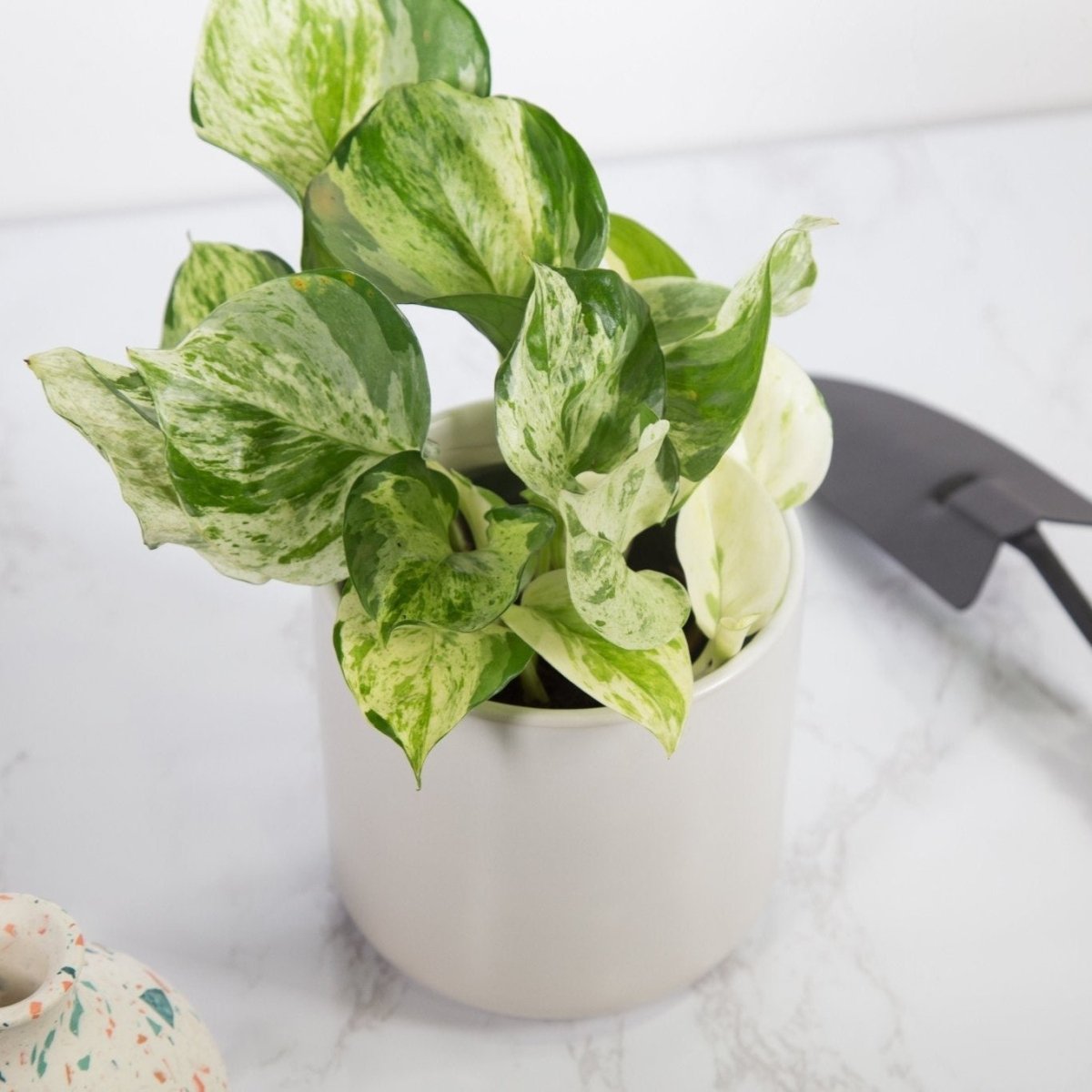
pothos happy leaf Pothos Manjula – 4.5" Potted Rare Variegated Epipremnum | Rare Indoor Plant | Easy-Care Houseplant
SKU: 36211691077
pothos happy leaf

pothos happy leaf Pothos Manjula – 4.5" Potted Rare Variegated Epipremnum | Rare Indoor Plant | Easy-Care Houseplant

Sale price$23.70 Regular price$26.33
Save 10%

Shipping Estimate
USA
  • USA
  • CAN

Ships within 48 hours · Estimated delivery Jul 8 - Jul 13

Promo Codes Available:

For Your Every Summer RSVP, with Code: SUMMER15

Description

pothos happy leaf Pothos Manjula – 4.5" Potted Rare Variegated Epipremnum | Rare Indoor Plant | Easy-Care HouseplantElevate Your Space with the Manjula Pothos Epipremnum aureum Manjula is a collectors dream and a beginners delight. Each leaf presents a living watercolor of creamy white, pale green, and deep emerald, telling a story of refined elegance. Slow growing and stable in its variegation, this rare cultivar brings enduring beauty and effortless sophistication to any shelf, hanging basket, or tabletop. Plant Profile Botanical Name: Epipremnum aureum Manjula

Elevate Your Space with the Manjula® Pothos

Epipremnum aureum ‘Manjula’ is a collector’s dream and a beginner’s delight. Each leaf presents a living watercolor of creamy white, pale green, and deep emerald, telling a story of refined elegance. Slow-growing and stable in its variegation, this rare cultivar brings enduring beauty and effortless sophistication to any shelf, hanging basket, or tabletop.


Plant Profile

  • Botanical Name: Epipremnum aureum ‘Manjula’
  • Common Name: Manjula® Pothos
  • Family: Araceae
  • Native Range: Hybrid selection (parental species from Southeast Asia)
  • Mature Size: 8–12″ vine length per month under ideal conditions

Care & Cultivation

  • Light: Prefers medium to bright, indirect light. Enhanced brightness intensifies cream-white variegation; tolerates lower light with slightly slower growth.
  • Water: Water when the top 1–2″ of soil dries. Well-draining mix is essential—overwatering invites root rot.
  • Humidity: Thrives at 40–75% RH. Average home humidity is usually sufficient.
  • Temperature: 65–85 °F (18–29 °C); avoid exposure below 60 °F.
  • Soil: Use a loose, aerated potting blend (peat, orchid bark, perlite) for optimal root health.
  • Fertilizer: Feed every 4–6 weeks in spring and summer with a balanced liquid fertilizer (e.g., 20-20-20 NPK).
  • Pruning: Trim back leggy growth and remove any discolored foliage to maintain compact form.
  • Propagation: Root 4–6″ stem cuttings in water or directly into moist substrate; new roots appear within 2–3 weeks.
  • Pests & Problems: Monitor for mealybugs, spider mites, and scale. Wipe leaves with insecticidal soap at first signs of infestation.
  • Toxicity: Contains calcium oxalate crystals—keep out of reach of children and pets.

Why You’ll Love Manjula® Pothos

With its artful variegation and slow, steady growth habit, Manjula® Pothos is perfect for styling curated plant displays or gifting to special someone. Its unique color patterns ensure that every leaf is a miniature masterpiece, while its hardy nature makes it a low-stress addition to your indoor garden.


Fun Fact

This patented cultivar originated in India and is celebrated for maintaining consistent variegation even under moderate light—an uncommon trait among premium Pothos varieties.


Ready for More Expert Tips?

Explore our Pothos Care Guide for in-depth advice on lighting, watering, and propagation to keep your Manjula® Pothos thriving.

Shipping Notes
  • Free Standard Shipping on $100+ Orders to the USA.
  • Except Preorder products are shipped in 48 hours.
  • Delivery to the USA:
  1. Standard Shipping : 3-10 business days
  • If time is of the essence, please consider selecting expedited delivery for faster service.
Exchange/Return Notes
  • We offer a 30-day return/exchange service after receiving.
  • Final sale items are not eligible for returns or exchanges.
  • To process your return/exchange, please contact us at [email protected]
  • Please click here for more details>>> Return & Exchange Policy
SKU: 36211691077

Discover Niche Categories That Outsell pothos happy leaf

Top-Converting Item to Boost Your Average Order

4.2 ★★★★★
Based on 2163 reviews
Sort
Highest Rating
Newest First
Oldest First
Product Reviews
E
Verified Purchase
Eric Hobart
Phoenix, US
★★★★★ 5
Remarkable analysis of slaveholding women in Antebellum America
Format: Paperback
Stephanie Jones-Rogers has provided us with a book that looks at the South's "peculiar institution" through a very different lens - the slaveholders/slaveowners, but this analysis looks at women that owned slaves, thus opening up a new avenue of study that I hadn't previously seen. Jones-Rogers offers a well written account that is rich in historical details. She demonstrates through vivid historical evidence that the women that owned enslaved people were primarily driven by economic motives, and that these women were just as demanding and could be just as harsh as the "typical" slaveowner image that has been crafted over the years. The book is organized thematically, and each chapter demonstrates the economic motivation behind slave ownership. The reader is offered views of everything from young children becoming slave owners when their parents "gifted" them an enslaved person, and how these young girls were taught that this was "property" that could be used as desired to how these female slaveholders would sell their slaves to meet their economic goals. All told, this is a fascinating book that uncovers a long ignored slice of Antebellum American history that makes the historiographical literature of pre-Civil War history much richer.
WAS THIS REVIEW HELPFUL?YesReportShare
Reviewed in the United States on June 4, 2021
B
Verified Purchase
Becca
Port Orchard, US
★★★★★ 5
Poignant, truthful look at women as powerful, business-savvy, yet brutal slave owners
Format: Paperback
Women slave owners were the norm in the South, not the exception. They increased in numbers, stature, and power while the men were off fighting the Civil War. Women often owned the slaves, not the men and knew how to sign prenuptial agreements back then to insure they kept all their property (including slaves) upon divorce or death of their spouse. They traded and bought and sold slaves with business savvy that most men envied. And they could be just as brutal towards their slaves. Ironically, it was the ownership of other people that empowered these women to not be bound to their husbands.
WAS THIS REVIEW HELPFUL?YesReportShare
Reviewed in the United States on January 26, 2025
B
Verified Purchase
Brown David
Omaha, US
★★★★★ 4
Good history, but not fun, engaging in popular literature.
Format: Paperback
The author is a very competent historian, and proves her points. She does so by stating each thesis and then reciting an exceedingly long string of supporting examples. Rinse and repeat. This is high quality, academic style history, but it’s not very engaging as popular literature. No one’s going to say “I couldn’t put it down.” That being said - I liked it! I learned a lot. Thanks.
WAS THIS REVIEW HELPFUL?YesReportShare
Reviewed in the United States on March 1, 2023
T
Verified Purchase
Tsukiko Brown
Los Angeles, US
★★★★★ 5
Should be required
Format: Paperback
In my opinion, this book should be required reading in high school/college history classes. It’s so important to learn accurate history when it comes to slavery and this book does that. White women played a larger role than we are taught. Please give this a read!
WAS THIS REVIEW HELPFUL?YesReportShare
Reviewed in the United States on October 23, 2025
S
Verified Purchase
shaleah newmam
Dallas, US
★★★★★ 5
No regets
Format: Paperback
This was a good book to read! In school you only learn the male prospective during slavery! I know feel I can say white woman played a major role during slavery times. I like that fact that the Author put in the information to where we can go srwcah and read for ourselves. The visuals where an added touch. I feel like because alot of women of that time couldn't write so alot of information was missing. I feel like this is a must read.
WAS THIS REVIEW HELPFUL?YesReportShare
Reviewed in the United States on April 9, 2025

recommand products