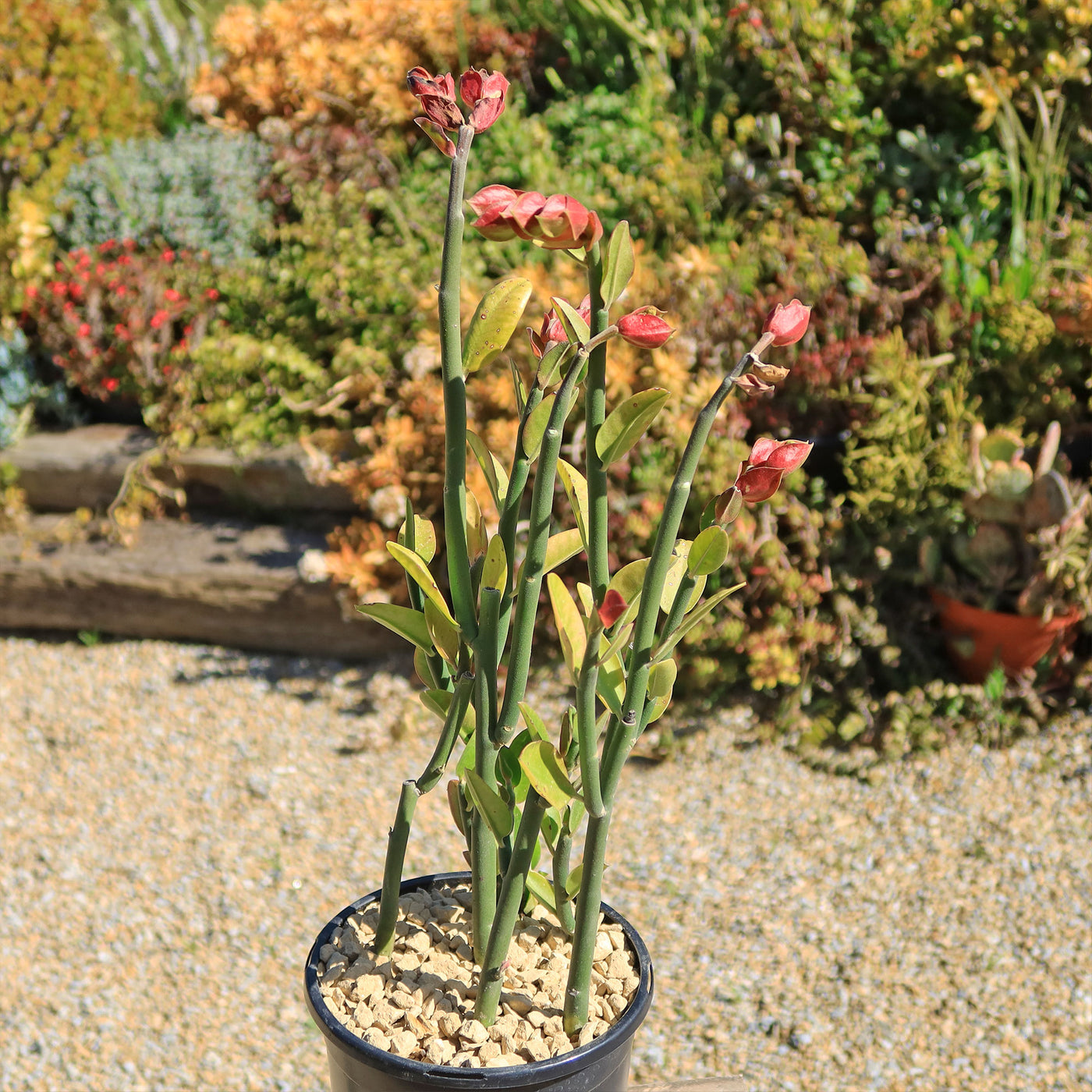
SKU: 37299843774
lady slipper plant succulent

lady slipper plant succulent Tall Slipper Plant ‘Pedilanthus bracteatus’

Sale price$20.01 Regular price$22.23
Save 10%

Shipping Estimate
USA
  • USA
  • CAN

Ships within 48 hours · Estimated delivery Jul 11 - Jul 16

Promo Codes Available:

For Your Every Summer RSVP, with Code: SUMMER15

Description

lady slipper plant succulent Tall Slipper Plant ‘Pedilanthus bracteatus’Introducing the Pedilanthus bracteatus, known as tall slipper plant, which is a unique and eye catching plant native to Mexico and Central America. The scientific name comes from the Greek words 'pedil' meaning 'shoe' and 'anthos' meaning 'flower', referring to the shoe shaped flower structures and the species' epithet meaning 'bearing bracts'. The Pedilanthus bracteatus is also referred to by other common names such as lady slipper plant, Candelilla,

Introducing the Pedilanthus bracteatus, known as tall slipper plant, which is a unique and eye-catching plant native to Mexico and Central America. The scientific name comes from the Greek words 'pedil' meaning 'shoe' and 'anthos' meaning 'flower', referring to the shoe-shaped flower structures and the species' epithet meaning 'bearing bracts'.  

The Pedilanthus bracteatus is also referred to by other common names such as lady slipper plant, Candelilla, Slipper flower, slipper spurge, and Zigzag Plant due to the shape of its flowers and the zigzag pattern of its stems. 


The Pedilanthus bracteatus, a succuent plant in the genus Euphorbia, and the name has been reclassified multiple times.

The current treatment is to include it with Euphorbia
bracteata, naming it Euphorbia bracteata until it's more widely recognized.

It does not have thorns and can be used as a
poolside plant.

The upright slipper succulent plant can grow up to 6 feet tall and has narrow cylindrical light green stems and ovate leaves.

It has a thick mid-vein near branch tips and sparsely hairy vegetative parts, with a prominent mid-vein on the lower surface of the woody root crown. The stems of the slipper plant are thick, and leafless before flowering, and have a zigzag or accordion-like growth pattern, adding to its visual appeal. 

The Pedilanthus bracteatus blooms during the late spring to early fall with small, tubular slipper flowers that are typically red or orange in color. The curiously shaped red cyathia (flower structures with separate male and female parts) are enclosed in rounded reddish-pink bracts near the branch tips. These flowers have a unique shape that resembles a slipper or shoe, hence the plant's common name slipper plant. The flowers are arranged in clusters at the ends of the stems, creating a beautiful display when they bloom. 

In terms of propagation, the tall slipper plant can be propagated through stem cuttings. Simply take a healthy stem cutting from longer stems, allow it to dry for a few days to form a callus, and then plant it in well-draining soil. With proper care and conditions, the cutting will develop new growth.  

Watering Needs 

When it comes to watering the Pedilanthus bracteatus, it's important to strike a balance. This plant prefers a moderate watering routine. You don't want to overwater it, as it is susceptible to root rot, but you also don't want to let it dry out completely. 

A good rule of thumb is to water the slipper plant when the top inch or so of the soil feels dry to the touch. This ensures that the roots have enough moisture without sitting in wet soil for too long. In the spring and summer, during the growing season, you may need to water it more frequently. In the cooler months, you can reduce the frequency of watering. 

Remember, it's always better to underwater than overwater the slipper plant. If in doubt, it's safer to wait a bit longer between waterings than to risk causing root rot. 

Pro Tip

Instead of using regular tap water that has chlorine, you can try using filtered or distilled water. This can help prevent the buildup of minerals in the soil, which can sometimes affect the plant's health. It's like giving your slipper plant a refreshing treatment. Just make sure the water is at room temperature before you give it a drink

Light Requirements 

When growing indoors, this tall slipper plant Pedilanthus bracteatus generally prefers bright, indirect light. Find a spot near a window where it can receive plenty of filtered sunlight throughout the day. Avoid placing it in direct sunlight, as this can scorch its leaves. If you notice the plant leaning towards the light source, rotate it occasionally to promote even growth. 

For outdoor cultivation, your Pedilanthus bracteatus can thrive in partial shade to full sun for at least 4-6 hours a day, depending on your climate. In areas with hot summers, providing some afternoon shade can help protect the plant from intense sunlight. Just make sure it still receives a few hours of direct sunlight each day to support healthy growth and flowering. 

Remember that each environment is unique, so it's important to observe your tall slipper plant and adjust its placement accordingly. If you notice the leaves turning pale or yellow, they might be getting too much direct sunlight. On the other hand, if the plant becomes leggy or doesn't produce flowers, it might need more light. 

Optimal Soil & Fertilizer Needs 

The Pedilanthus bracteatus favors very airy, sandy soil that drains well. Planting them in ordinary soil will result in compacted roots, stunted growth, and most likely root rot. Instead, make or buy a well-draining potting mix, or ideally use our specialized potting mix, opens in a new tabGo to soil cactus mix blend 1 gal 4 qt cacti succulent dirt compost growing media that contains 5 natural substrates and mycorrhizae to promote the development of a strong root system that helps your lady slipper succulent to thrive. 

As for fertilizer, the slipper plant doesn't require a lot of feeding. Once a year in the spring, during the active growing season, you can use a balanced (5-10-5), water-soluble NPK fertilizer diluted to half strength. During the cooler months, when the plant is in its dormant phase, you can reduce or even stop fertilizing altogether. It's important not to over-fertilize, as it can lead to salt buildup in the soil, which can harm the plant. 

Remember to always follow the instructions on the fertilizer packaging and adjust the frequency and strength based on the specific needs of your slipper plant. It's also a good idea to water the plant before applying fertilizer to avoid any potential root burn. 

Hardiness Zones & More 

When you are growing your Pedilanthus bracteatus indoors, it can thrive in average room temperatures between 60°F to 75°F. It can tolerate slightly cooler temperatures, but it's best to avoid extreme cold drafts or sudden temperature fluctuations. As for humidity, the slipper plant can handle average indoor humidity levels, but it appreciates a slightly higher humidity. You can increase humidity by placing a tray of water near the plant or using a humidifier. 

For outdoor cultivation, it is typically hardy in USDA hardiness zones 9 to 11. These zones generally have mild to warm climates with minimal frost or freezing temperatures. In colder regions, it's best to grow the slipper plant as a potted plant that can be brought indoors during the winter months. If you live in a drier climate, you can mist the plant occasionally or place it in a location with higher humidity, such as near a water feature or in a greenhouse. 

Final Thoughts 

Overall, the tall slipper plant (Pedilanthus bracteatus) is a fascinating and visually appealing succulent. It's loved for its slipper-shaped flowers, the plant reaches about 6 feet tall and 3 ft wide. With its thick, succulent stems and beautiful red or orange tubular flowers, it adds a touch of visual appeal to any space. Taking care of the slipper plant is relatively easy, as it prefers well-draining soil, moderate sunlight, and infrequent watering. Whether grown indoors or outdoors, this plant is sure to add a touch of beauty and intrigue to any space. 

Shipping Notes
  • Free Standard Shipping on $100+ Orders to the USA.
  • Except Preorder products are shipped in 48 hours.
  • Delivery to the USA:
  1. Standard Shipping : 3-10 business days
  • If time is of the essence, please consider selecting expedited delivery for faster service.
Exchange/Return Notes
  • We offer a 30-day return/exchange service after receiving.
  • Final sale items are not eligible for returns or exchanges.
  • To process your return/exchange, please contact us at [email protected]
  • Please click here for more details>>> Return & Exchange Policy
SKU: 37299843774

Discover Niche Categories That Outsell lady slipper plant succulent

Top-Converting Item to Boost Your Average Order

4.5 ★★★★★
Based on 1161 reviews
Sort
Highest Rating
Newest First
Oldest First
Product Reviews
K
Kirsten
Chelsea, US
★★★★★ 5
Holds a decent amount of jewelry!
Color: Carbonized Brown, Color: Carbonized Brown
I was quite impressed with this little jewelry box. Although it is on the smaller side, it utilizes every bit of the storage space available really well. I’d ultimately love to get a bigger armoire- as it is, this jewelry box contains what I wear most often, but I have a larger collection than this particular jewelry box can hold- my plan is to find a larger jewelry armoire that resembles what my mother had because I loved that one and then passed this one down to my daughter who loves it. For its size, it does absolutely hold a lot. I definitely underestimated how much it would hold. I love that there are drawers and well. I would love to see the ring area hinged so that I don’t have to reposition it when I’m done grabbing my rings, I think it’s a really cool, unique way to approach that particular area. I love that every little bit at this jewelry box is designed to have utility. I hate wasting space and time and I love good organization so it’s been really nice being able to pack as much as I can in there. The top opens up to space for earrings and other miscellaneous items. There are both open and more structured components. And the space for bracelets rotates, which is really nice- I didn’t realize that it rotated and I was a little bit worried that I was gonna constantly knock things down while I was reaching through or something. There is lots of room inside both doors for necklaces, and it fits a lot more than I thought it would. The wood stain is a really pretty kind of ashy natural stain- the sort of grey tint is really nice and it’s gorgeous. I’m not a huge fan of mirrors as far as the front goes, but I do have an artist in house who is really good at coming up with stuff for this, just a little ways to put art in your every day, so I’ll probably have her paint over. The jewelry box also doesn’t take much space up at all. While I am looking for something with a little bit larger footprint, I don’t necessarily want to waste a bunch of real estate in the meantime so I’m really pleased with how compact it is. This is a great little jewelry box - as I mentioned it doesn’t house all of my jewelry, but that’s because my collection is mostly heirloom and I don’t want to take it out from where it is right now. If it were larger, I would probably do so but for now it just houses my everyday items and a little bit extra. I think it’s great and I’m super happy with it!
WAS THIS REVIEW HELPFUL?YesReportShare
Reviewed in the United States on March 17, 2026
X
Verified Purchase
0x00000000:00000000
Houston, US
★★★★★ 5
Excellent book, possibly currently unique in coverage of latest ideas
This book is possibly currently unique in its coverage of the latest ideas in the field of deep learning -- and it is a very convenient and good survey of fundamental concepts (linear algebra, optimization, performance metrics, activation function types), different network types (multi-layer perceptron, convolutional neural networks, and recurrent neural networks), practical considerations (data set, training and validation, implementation), and applications (comments on existing real-world/commercial uses). The final 235 pages of the content portion of the book is dedicated to topics in "Deep Learning Research", and these topics are truly at the current frontier. Another reviewer said that one could gain the same knowledge of cutting-edge research by reading all of the latest papers (from academia and industry), but the "research" section of this book offers the following: Selection of the most notable research by the very experienced authors of the book, and collection of similar research in to a broader discussion of themes, and the additional insights. The book covers very advanced and new ideas currently being explored, and it is very nice to be able to have a consistent and coherent presentation of all of those ideas. However, the book is also packed with valuable observations and pointers about more basic aspects of deep learning implementations and practices -- and such commentary is in depth and includes substantial analysis and mathematical derivation (in an intuitive presentation that often includes graphs illustrating the phenomenon). As someone with an intermediate level of knowledge and experience of neural networks, I am really grateful for this book, because seems like the ideal resource for learning cutting-edge ideas and practices, with context. The book has excellent scope and depth, and I am confident that anyone with a solid background in linear algebra, calculus, statistics, and general machine learning, and basic neural networks (multi-layer perceptrons) will find this book to be very exciting and perhaps unique in its ability to take the reader to the next level and a new frontier. I was personally excited to learn about the idea of representing the dependencies of intermediate quantities by directed graphs, and how this can be used to perform calculations for recurrent neural networks efficiently. And I think the long chapter on recurrent neural networks is very helpful. Having said all of this, I think only people with significant working knowledge and experience with neural networks and mathematics -- people whose academic or professional focus has been neural networks for at least a year or two -- would benefit from this book. This book answers a lot of the deeper questions that one is likely to have while developing a solid understanding of the fundamentals, and that's one of the book's tremendous values, but this book assumes an understanding of the fundamentals (but does briskly cover the basics). I think this book is a perfect follow-up book for the excellent book "Neural Network Design (2nd edition)" by Hagan, Demuth, Beale, and de Jesus, and I highly recommend the latter for gaining the solid background needed to have a thrilling experience with the "Deep Learning" book. In summary, I am very glad this "Deep Learning" book was written, and I think the "Deep Learning" book will be a great benefit to a lot of people, and to the evolution of the field.
WAS THIS REVIEW HELPFUL?YesReportShare
Reviewed in the United States on April 18, 2017
Z
Verified Purchase
Zygerian99
Carnegie, US
★★★★★ 5
The definitive guide to becoming a researcher in the field
Format: Hardcover
This is not a coding book. I see a lot of negative reviews around the expectation that this book would teach the reader how to quickly build machine learning systems and write code. This book is not for that audience. If you just want to build applications, don't worry about how deep learning works. It's akin to needing to understand how an engine works just to drive a car. If you are looking for a coding resource, try: https://www.amazon.com/Hands-Machine-Learning-Scikit-Learn-TensorFlow/dp/1492032646/ref=sr_1_4?keywords=machine+learning+tensorflow&qid=1579608765&sr=8-4 . And even with that book, the material still goes far beyond what you need - use it as a light reference. I bought this book as an aspiring machine learning researcher, and towards that end, it is the best resource available in print (still true as of 2020). For instance: The first 5 chapters are timeless. These are things that were mostly established 20 or 30 years ago and beyond and are mostly STEM fundamentals at this point. There are whole textbooks dedicated to each of those chapters, but the authors provide a quick refresher and overview of probably 80% of what you'll encounter in deep learning. If you haven't previously learned each of these subtopics, you'll probably want to study them individually since they are the key to innovating (linear algebra, probability & stats, numerical computation, machine learning fundamentals). Chapters 6 thru 9 are the foundation of deep learning. We're about 12 years into seeing rapid change in the deep learning space, yet all of these principles and techniques still hold (many recent innovations are still relying on Convolutional models in 2020, which is the most layered/complex topics in those chapters). Therefore, I'd wager that these chapters are also fairly stable knowledge that is worth internalizing if you want to be deeply involved in the future of machine learning. Chapters after 9 are mostly experimental topics, and many of them are already the wrong strategies for optimal results. But there are interesting ideas in here that you'll often encounter in the wild, so it's good exposure to various topics. But probably not worth much of your time. And lastly, there is good history in here from people who know the space intimately. It's a good way to piece together the developments and learn the lexicon of deep learning so you can have intelligent conversation with experts.
WAS THIS REVIEW HELPFUL?YesReportShare
Reviewed in the United States on January 21, 2020
S
Verified Purchase
Shannon
Lake Worth, US
★★★★★ 5
The best DL/ML book I have ever seen!!
Format: Hardcover
Fantastic deep-learning book! The logic is very easy to follow, but the content is very thorough when it comes to explaining the theories behind it, making it perfect for beginners as well as math and CS students. The best DL/ML book I have ever seen!!
WAS THIS REVIEW HELPFUL?YesReportShare
Reviewed in the United States on November 30, 2025
W
Verified Purchase
William P Ross
Louisville, US
★★★★★ 5
Comprehensive Look At An Incredibly Complex Topic
Format: Hardcover
Deep Learning is an advanced book with great explanations and details. There is a heavy math focus with the book's beginning chapters detailing the necessary linear algebra and probability that one will need to understand deep learning. I liked that the author's chose to cover only the parts of these subjects which are relevant to deep learning. There are many interesting philosophical sections in the book as well. Just about when I was feeling overwhelmed with the complexity of the mathematics the authors take a step back and cover the foundations of deep learning such as borrowing concepts from human learning. There was an interesting dicussion about the early studies done on the vision of cat's and monkey's in the 1970s. The text covers the entire history of deep learning and the bibliography is hundreds of sources. It is clear this is the most comprehensive text available about deep learning. For anybody interested in this topic this book is a mandatory read. There are sections about machine learning as well, which makes sense because deep learning is a subset of machine learning. These sections focused on the machine learning concepts which are most relevant to deep learning. The book was well organized and divided into three parts which cover mathematics related to deep learning, typical deep learning techniques, and then more experiment learning techniques. Often the author's state when a technique works well or when it does not, and which types of data works best for the technique. Just a warning, the math in this book is highly complex. It requires a lot of work to go through this book, but the effort will be well rewarded.
WAS THIS REVIEW HELPFUL?YesReportShare
Reviewed in the United States on March 15, 2017

recommand products