Shipping Estimate
USA
- USA
- CAN
- USA
- CAN
Ships within 48 hours · Estimated delivery Jul 12 - Jul 17
 Promo Codes Available:
For Your Every Summer RSVP, with Code: SUMMER15
Description
wild flower seeds california California Wild Lawn Seed MixA low grow, low water, low maintenance, fire wise, wildflower and native grass lawn that supports pollinators. Inspired by the super bloom meadows of California, we developed this as an alternative to traditional lawns. Unlike non native turf grass (with its high water requirements and low ecological value), our California Wild Lawn provides: Native grasses and wildflowers comprising a low stature meadow that you can actually walk on. Infrequent
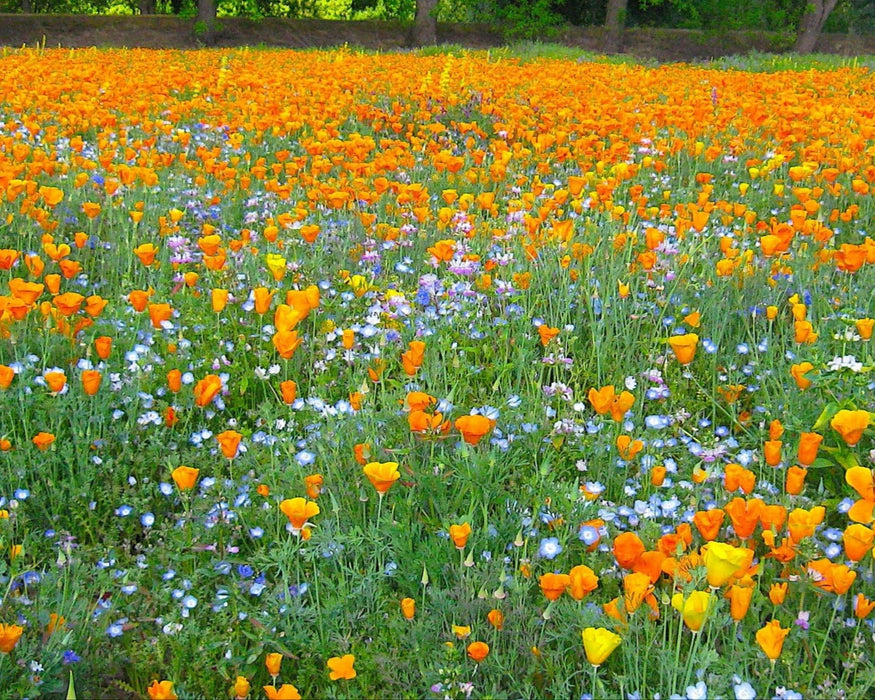
A low-grow, low-water, low-maintenance, fire-wise, wildflower and native grass lawn that supports pollinators.
Inspired by the super-bloom meadows of California, we developed this as an alternative to traditional lawns.
Unlike non-native turf grass (with its high-water requirements and low ecological value), our California Wild Lawn provides:
- Native grasses and wildflowers comprising a low-stature meadow that you can actually walk on.
- Infrequent mowing. Cut the lawn low at the beginning of the summer dry season to eliminate combustible biomass, in periods of abundant rainfall, let it grow lush with flowers.
- A water-smart ground cover that does not require irrigation beyond initial establishment -- in the event of a drought, just mow it low and let it remain dormant. Life will spring back when natural rains return.
- A dazzling color display that feeds native bees, butterflies, and songbirds, and richly textured native grass that resemble a wild grassland.
Mix Composition:
Re-Seeding Annual Wildflowers (49%): California Goldfields (Lasthenia californica), Five Spot (Nemophila maculata), Red Maids (Calandrinia ciliata), Farewell to Spring (Clarkia amoena), Tomcat Clover (Trifolium wildenovii), Tidy Tips (Layia platyglossa), Chinese Houses (Collinsia heterophylla), Bird’s Eye (Gilia tricolor), Bicolor Lupine (Lupinus bicolor), California Bluebell (Phacelia campanularia), Dwarf California Poppy (Eschscholzia caespitosa), Foothill Clover (Trifolium ciliolatum), Maiden Clover (Trifolium microcephalum), Baby Blue Eyes (Nemophila menziesii), Owl’s Clover (Castilleja exserta), Goldfields (Lasthenia glabrata)
Perennial Wildflowers (6%): Springbank Clover (Trifolium wormskioldii), Perennial California Poppy (Eschscholzia californica var. Martima), turf-type Western yarrow (Achillea millefolium ‘Yaak’)
Native Grasses (55%): Seashore Bentgrass (Agrostis pallens), Three Week Fescue (Festuca microstachys), Idaho Fescue (Festuca idahoensis), Molate Red Fescue (Festuca rubra ‘Molate’), California Oatgrass (Danthonia californica), Western Fescue (Festuca occidentalis), Prairie Junegrass (Koeleria macrantha)
Appropriate Range: This mix is well adapted to most locations from Southern Oregon through Southern California, at elevations ranging from sea-level to about 3,000 feet, and areas with an average of 10 or more inches of annual precipitation. (Note this mix will do okay in dry areas, such as the southern San Joaquin Valley, but may need supplemental irrigation for establishment).
Butterfly Host Plants: The various plants in this mix are likely caterpillar host plants for the following butterflies: Springbank Clover, Maiden Clover, Foothill Clover and Tomcat Clover: western cloudywing (Thorybes diversus), Queen Alexandra’s sulphur (Colias alexandra), Shasta blue (Plebejus shasta), greenish blue (Plebejus saepiolus), Chinese Houses, Owl’s Clover, and Farewell to Spring: Pacific green sphinx moth (Proserpinus lucidus), Grasses: sandhill skipper (Polites sabuleti), roadside skipper (Amblyscirtes vialis), Sonora skipper (Polites sonora), Linsey’s skipper (Hesperia lindseyi), western branded skipper (Hesperia colorado).
Establishment Recommendations: This mix is best established from Autumn through late Winter in most locations, but can be started at other times with supplemental irrigation during initial establishment. (If established with supplemental irrigation, watering should be discontinued at the beginning of the next rainy season).
Seed should be surface-scattered directly onto well-prepared bare-ground. Existing lawns can be removed and replaced with this mix by using a sod-cutter, herbicides, or by smothering with tarps or cardboard. Please see our basic site preparation guidelines here for an overview. Note that new planting sites (where there previously was no lawn) should be largely free of competing weed seed such as cheatgrass and may need several seasons of preparation to create a clean seed bed.
Maintenance and Fire Notes: While the species in this seed mix are relatively low stature, in conditions with excellent soil fertility and moisture, the mature flowering canopy can reach more that 18-inches in height. Selective cutting with secateurs, a scythe, or string trimmer can manage height expectations during the growing season.
Note that while this wild lawn is great alternative to traditional lawns and can tolerate occasional foot traffic, it is not as durable as non-native turf grass. We do not recommend this mix for high-traffic areas, including areas with significant pet activity.
Natural California grasslands largely go dormant in summer with the onset of the dry season. To reduce fire-risk, we recommend cutting down the wild lawn after flowering, and before the lawn completely dries out. (Mowing to about 4-inches is ideal, and rough cutting with a scythe is an excellent, wildlife-friendly option). The mowed biomass should be either cut and bagged, or raked up and removed from the site. (Note that to preserve small invertebrate life in the lawn clippings, the mowed material can be composted in a safe nearby location and occasionally watered to reduce combustibility and enhance composting efficiency.
This list is informed by fire-wise native plant guidelines developed by the Fire Safe Council of San Diego, the Fire Safe Council for Monterey County, the Resource Conservation District of Santa Cruz County, and the City of Anaheim Fire & Rescue. We have intentionally selected plants for their low-fire risk benefits.
With sufficient heat and dry conditions however, any landscape plants are combustible. For this reason, we recommend consulting fire-wise resources for maintaining a defensible space near structures. Core principles to consider include reducing vegetation immediately adjacent to homes and buildings, and maintaining vertical spacing between ground vegetation and the lower canopy of trees and shrubs so that ground-based fires cannot jump to low-hanging tree branches.
Note that by cutting your lawn after flowering, you increase the potential for your wildflowers to reseed themselves. However, some native wildflowers naturally decline in abundance over time. To increase the abundance of your favorite flowers, your wild lawn can be periodically (every few years) mowed low to the ground re-seeded with select wildflower species.
Seed Mix Weight: 1-pound (enough to cover about 800 to 1000 square feet).
Shipping Notes
- Free Standard Shipping on $100+ Orders to the USA.
- Except Preorder products are shipped in 48 hours.
- Delivery to the USA:
- Standard Shipping : 3-10 business days
- If time is of the essence, please consider selecting expedited delivery for faster service.
Exchange/Return Notes
- We offer a 30-day return/exchange service after receiving.
- Final sale items are not eligible for returns or exchanges.
- To process your return/exchange, please contact us at [email protected]
- Please click here for more details>>> Return & Exchange Policy