Pay in installments of $5.93 with
 ,
,
 and
and

Shipping Estimate
USA
- USA
- CAN
- USA
- CAN
Ships within 48 hours · Estimated delivery Oct 27 - Nov 1
 Promo Codes Available:
For Your Every Summer RSVP, with Code: SUMMER15
Description
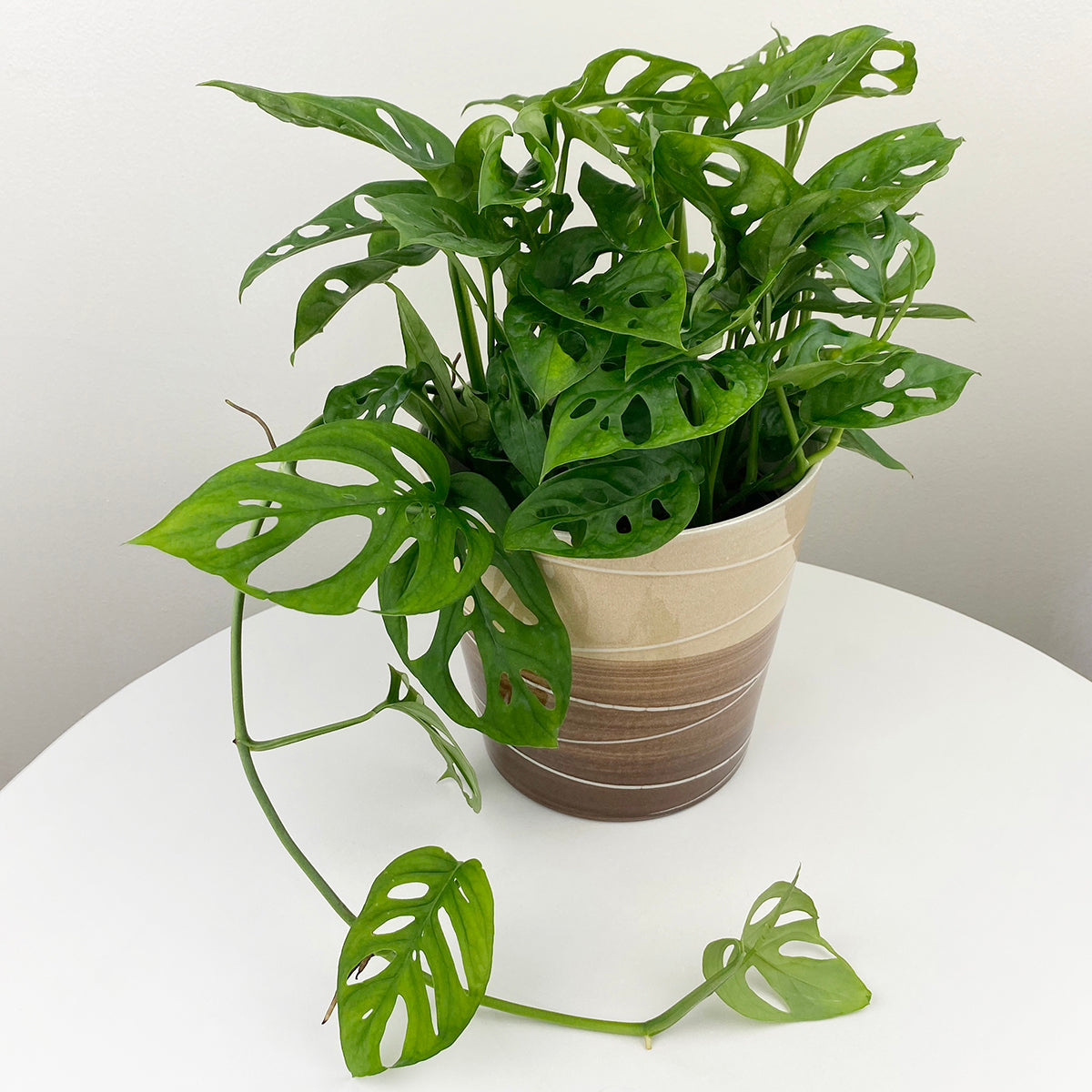
swiss cheese plant flower power Swiss Cheese Monstera Adansonii Houseplant Nursery 4"With its popularity growing exceptionally fast, we are happy to offer the Swiss Cheese Plant, also called Monstera adansonii. This is a very easy to grow houseplant with exotic, eye catching foliage. Each mature leaf displays multiple oval holes, called fenestrations. These holes are theorized to allow sun and water through to the lower leaves in tropical environments and help the leaves stand up to forceful wind. Swiss Cheese Plant is meant to climb
With its popularity growing exceptionally fast, we are happy to offer the Swiss Cheese Plant, also called Monstera adansonii. This is a very easy-to-grow houseplant with exotic, eye-catching foliage. Each mature leaf displays multiple oval holes, called fenestrations. These holes are theorized to allow sun and water through to the lower leaves in tropical environments and help the leaves stand up to forceful wind. Swiss Cheese Plant is meant to climb and when given a trellis or pole, it will reward you with larger leaves as the plant grows taller. Alternatively, when not climbing, the plant reverts to a more vine-like growth, sending out thin branches that look beautiful cascading from a hanging basket or draping over tables and windowsills. This plant prefers a fast draining soil mix, bright, indirect light and plenty of humidity.
There is much confusion about Monstera adansonii and Monstera obliqua. Obliqua’s leaves are very thin and 90% of the leaf surface is holes. Adansonii’s leaves are thicker with holes that cover about 50% of the leaf surface. Obliqua is extremely rare. Adansonii is often called M. obliqua but they are not the same species.
There is much confusion about Monstera adansonii and Monstera obliqua. Obliqua’s leaves are very thin and 90% of the leaf surface is holes. Adansonii’s leaves are thicker with holes that cover about 50% of the leaf surface. Obliqua is extremely rare. Adansonii is often called M. obliqua but they are not the same species.
Shipping Notes
- Free Standard Shipping on $100+ Orders to the USA.
- Except Preorder products are shipped in 48 hours.
- Delivery to the USA:
- Standard Shipping : 3-10 business days
- If time is of the essence, please consider selecting expedited delivery for faster service.
Exchange/Return Notes
- We offer a 30-day return/exchange service after receiving.
- Final sale items are not eligible for returns or exchanges.
- To process your return/exchange, please contact us at [email protected]
- Please click here for more details>>> Return & Exchange Policy
4.5 ★★★★★
Based on 12 reviews
Sort
Product Reviews
★★★★★ 5
Great product
Size: 30 Count (Pack of 4)
Only just received, so I haven't had the chance to test them. So far they are compatible with my skin and easy to use.
WAS THIS REVIEW HELPFUL?YesReportShare
Reviewed in the United States on April 27, 2026
★★★★★ 3
Buyer beware. For your sake read my review please.
Size: 30 Count (Pack of 4)
I loved the smell which can be kind off setting especially if unscented. However the love kind of stopped there. The size of the wipe it self was not much than one of those wipes you get at the BBQ store with dinner. I do not wear foundation or heavy makeup however I had to use 3 wipes each time before I felt my skin was clean. I was excited to have the different issues of my skin dealt with as far as anti-aging, pore refining etc but there was not a single bit of difference between the wipes other than the scent which again was very spa like and pleasant. Easy to like. Small wipe. Need several. By the time you add up the added cost of the extra towels each day and I could have purchased a much higher quality product. I don't forget to look at reviews very often, but this time they sounded so positive and I went ahead and purchased. Sorry I ever did but glad I didn't order two or three due to the sale on them.
WAS THIS REVIEW HELPFUL?YesReportShare
Reviewed in the United States on April 7, 2026
★★★★★ 5
Great for sensitive skin!
Size: 30 Count (Pack of 4)
Works really well. No burn. I have very sensitive skin and these have been great. Not overpowering.
WAS THIS REVIEW HELPFUL?YesReportShare
Reviewed in the United States on April 7, 2026
★★★★★ 5
Very nice product
Size: 30 Count (Pack of 4)
I absolutely love these facial wipes. I used the Pore Refining pack first and noticed a change in my pores after about a week of use. I'm over 60 and as we age our pores start to get a little bigger and this wipe closed them up. I'm very pleased with this facial wipe. They are small, so I use a different facial wipe to get make up off then use the Pore Refining wipe to go over my face again. I haven't used the other three types of wipes you get in this 4-pack, but look forward to see any results from them.
WAS THIS REVIEW HELPFUL?YesReportShare
Reviewed in the United States on February 14, 2026
★★★★★ 5
Indispensable!
Scent: Unscented, Size: 25 Count (Pack of 4)
I love these so much that they are part of my monthly subscribe-and-save program. They have absolutely no scent, which is great, because too many products are over-perfumed. They take off all of my makeup gently. There is no stinging or drying sensation. The cloths are well-sized and the package stays shut when not in use- the cloths do not dry out. After I use a couple of these each night to take my makeup off, I follow up with a gentle, moisturizing facial cleanser. My skin is soft, clean, and happy. I highly recommend these!
WAS THIS REVIEW HELPFUL?YesReportShare
Reviewed in the United States on March 6, 2020