Pay in installments of $5.13 with
 ,
,
 and
and

Shipping Estimate
USA
- USA
- CAN
- USA
- CAN
Ships within 48 hours · Estimated delivery Oct 28 - Nov 2
 Promo Codes Available:
For Your Every Summer RSVP, with Code: SUMMER15
Description
sundew plant care indoor Drosera capensis 'narrow leaf' PottedIf you have been thinking about growing carnivorous plants but don't know where to start, look no further than Drosera capensis. These plants are easy to grow, rewarding and will grow in a variety of conditions. They will thrive indoors in full sun, on a windowsill or under lights. They will also do well outside in lots of sun and are cold hardy down to 40 degrees reliably. They will even take a brief freeze with the leaves dying back but the plants
If you have been thinking about growing carnivorous plants but don't know where to start, look no further than Drosera capensis. These plants are easy to grow, rewarding and will grow in a variety of conditions. They will thrive indoors in full sun, on a windowsill or under lights. They will also do well outside in lots of sun and are cold hardy down to 40 degrees reliably. They will even take a brief freeze with the leaves dying back but the plants regrowing readily from the roots in spring.
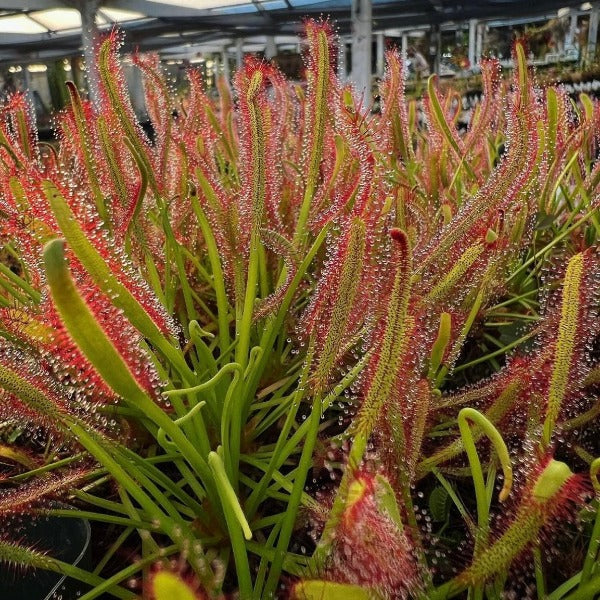
This is the most typical form of Drosera capensis; the leaves are thin and delicate looking with red tentacles tipped in mucilage. The pink flowers unfurl off of long, arching scapes. Cape Sundews catch many gnats, fruit flies and occasionally house flies.
The plants we are shipping are about 2-4” tall.
Please note: shipping can be hard on the sticky dew covering the leaves so your plant may arrive without dew. It can take a few weeks for the plant to produce more dew, if after four weeks it has not produced dew, you may need to increase light.
Care Instructions
Growth Habit: Drosera capensis are small, bushy plants that grow about 6” tall at maturity, although some forms can be slightly larger. Capensis spread readily by dropping seeds from their abundant flowers in their pots, which do not need to be pollinated. As they grow, their leaves die back, starting from the base of the plant and moving up. The leaves die back and can be cut off. The stem will thicken and be black or brown. Sometimes larger, older plants will flop over and grow sideways as they age, growing taller and taller with new leaves emerging from the top of the plant. Capensis can regrow from the roots quite readily, so if your crown dies, keep nurturing it, and you should see new growth. These plants have a high leaf turnover, meaning their leaves die back frequently, but new leaves grow just as fast.
Sun: Full sun. Grow indoors on a sunny windowsill, in a terrarium under lights, or outdoors. If grown indoors, Drosera will require full sun to produce their sticky dew, so be sure to place them in a window where they will receive direct sunlight for most of the day. If grown under lights, keep your grow lights on a 10 to 12-hour day length and hang your grow lights 6 to 10 inches above the plants on the quality of your lights. Grown outdoors, these plants will enjoy a great deal of sun. If you live somewhere extremely hot, for example, Arizona, you will want to protect them from the Full intensity of the afternoon sunlight. You can either grow them in morning sun only, or use shade cloth to help protect them in these very hot areas. These plants may be more colorful and smaller when grown outdoors because the light is more intense. You can expect a few leaves to burn back when you first place your plant outdoors in the sun, and if you receive your plant in the summer, it is a good idea to slowly acclimate it to the sunlight over a day or two. Even in less sunny seasons, areas, or with acclimation, you can still expect to see some burned leaves when first placed outside. This is normal, and new leaves will grow that are more adjusted to the sun. In winter, when grown in sunlight, indoors or outdoors, it is very normal for color to fade from red varieties due to less sun. IF YOUR SUNDEW IS NOT PRODUCING DEW, IT MOST LIKELY NEEDS MORE SUNLIGHT. It can also take a few weeks after shipping for dew to generate.
Water: Always sitting in a few inches of distilled, rain, or reverse osmosis water. These plants always prefer to have their roots wet and can have their pots sitting in a deep saucer of water all the time.
Temperature and Dormancy: Drosera capensis tolerate a wide range of temperatures but will be happiest in 40 - 80 degrees. They can take temperatures from freezing to 100 degrees but only for short periods and can grow back from the roots after a freeze if the daytime temperatures increase above 40. Drosera capensis do not need a dormancy but will die back or slow growth in winter depending on the conditions they are exposed to. If exposed to freezes, they will die back. And many will slow their growth or grow smaller in winter. Drosera capensis does need a nighttime drop in temperatures of 10-20 degrees; if you’d like to grow this in a tropical zone, we recommend the ‘Alba’ cultivar as it can tolerate no nighttime drop in temperature.
Soil and Repotting: We prefer a mix of four-part fertilizer-free peat moss to one-part perlite. You can add our pre-made mix to your order here. You do not need to repot your plant when you receive it from us for at least a year, and we recommend against it during the spring-summer months. Repot Drosera every 1-3 years. Avoid placing in excessively large pots; size up only a few inches at a time. Soil can also develop a swampy smell, especially right after shipping, when the plant is wrapped in plastic and sealed. This is normal; these plants grow naturally in bogs and swampy conditions, and peat moss can develop a bit of an anaerobic smell, but this does not indicate a problem with the soil.
Feeding and Fertilizer: Drosera catch small insects like fungus gnats and fruit flies in their sticky dew. They can catch bigger prey like houseflies or crane flies and can slowly curl their leaves around these larger bugs to make better contact. Over time, their leaves will produce enzymes to digest the nutrients from the bug, absorbing them through their leaves, leaving only the exoskeleton on their sticky leaves. There’s no need to remove these as they often serve as a lure to other insects looking for an easy meal. When grown outdoors, they will catch plenty of food. When grown indoors, they will significantly benefit from a foliar fertilizer. Plants grown outdoors will appreciate a foliar feed as well. Apply MaxSea fertilizer once per month to the foliage only. Dilute 1/4 teaspoon of MaxSea into one gallon of water with a mister bottle or a watering can. Watch as the Drosera slowly curl their leaves after a foliar fertilizer application!
More Information: For further information on dormancy, repotting, growing from seed, and more, check out our website or our YouTube channel.
Shipping Notes
- Free Standard Shipping on $100+ Orders to the USA.
- Except Preorder products are shipped in 48 hours.
- Delivery to the USA:
- Standard Shipping : 3-10 business days
- If time is of the essence, please consider selecting expedited delivery for faster service.
Exchange/Return Notes
- We offer a 30-day return/exchange service after receiving.
- Final sale items are not eligible for returns or exchanges.
- To process your return/exchange, please contact us at [email protected]
- Please click here for more details>>> Return & Exchange Policy