SKU: 48754174329
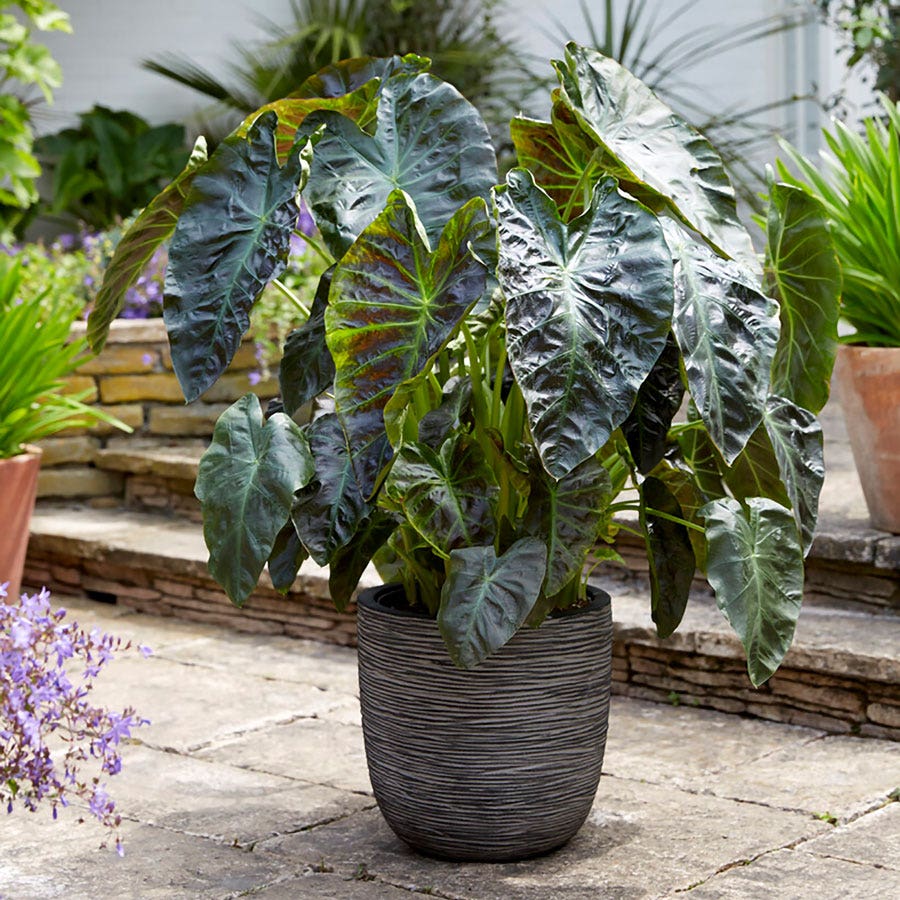
elephant ears plant in pot

elephant ears plant in pot Colocasia Royal Hawaiian® Aloha Elephant Ear Bulb

Sale price$22.97 Regular price$25.52
Save 10%

Pay in installments of $6.38 with ShopPay, AfterPay and Klarna

Shipping Estimate
USA
  • USA
  • CAN

Ships within 48 hours · Estimated delivery Jul 18 - Jul 23

Promo Codes Available:

For Your Every Summer RSVP, with Code: SUMMER15

Description

elephant ears plant in pot Colocasia Royal Hawaiian® Aloha Elephant Ear BulbColocasia Royal Hawaiian Aloha Elephant Ear is a robust, vigorous plant with an exceptionally dense overall habit and a mature size of 32 to 44 inches tall. A tropical head turner, Aloha offers bold color and texture to the summer garden. Its large, glossy, heart shaped leaves emerge dark olive green but rapidly become dark purple black with contrasting spring green veins. A Colocasia esculenta variety, commonly referred to as elephant ear or taro,

Colocasia Royal Hawaiian® Aloha Elephant Ear is a robust, vigorous plant with an exceptionally dense overall habit and a mature size of 32 to 44 inches tall. A tropical head-turner, Aloha offers bold color and texture to the summer garden. Its large, glossy, heart-shaped leaves emerge dark olive-green but rapidly become dark purple-black with contrasting spring green veins.

A Colocasia esculenta variety, commonly referred to as elephant ear or taro, Aloha is a tuberous rooted, frost-tender perennial (Zones 8-12) with a tidy, upright, clumping growth habit. This plant is an excellent choice for pond edges, rain gardens, and even areas with standing water. But it may best be grown in a large planter in cooler climates or where growth needs to be contained. Whether planted solo for its dramatic foliage or used in mass plantings to highlight vibrant flowers, Aloha adds a tropical flair to any garden.

Once established, Aloha elephant ear requires minimal care but must remain consistently moist. It prefers sunny to partially shady locations and fertile, rich soil. In hot summer climates, providing afternoon shade can protect it from stress. This deer-resistant plant is both practical and ornamental.

Plant Aloha elephant ear's 9- to 11-inch bulb (rhizome) in mid-spring, spacing them 18 to 24 inches apart and burying them 2 to 4 inches deep once soil and air temperatures consistently reach 60°F or higher. In colder climates, lift the bulbs in fall, store them in a dry location with the temperature at 50°F, and replant in spring after all threat of frost has passed.

Shipping Notes
  • Free Standard Shipping on $100+ Orders to the USA.
  • Except Preorder products are shipped in 48 hours.
  • Delivery to the USA:
  1. Standard Shipping : 3-10 business days
  • If time is of the essence, please consider selecting expedited delivery for faster service.
Exchange/Return Notes
  • We offer a 30-day return/exchange service after receiving.
  • Final sale items are not eligible for returns or exchanges.
  • To process your return/exchange, please contact us at [email protected]
  • Please click here for more details>>> Return & Exchange Policy
SKU: 48754174329

Discover Niche Categories That Outsell elephant ears plant in pot

Top-Converting Item to Boost Your Average Order

4.2 ★★★★★
Based on 19 reviews
Sort
Highest Rating
Newest First
Oldest First
Product Reviews
J
Verified Purchase
John Moore
Carnegie, US
★★★★★ 5
Guided tour through a difficult work
Format: Paperback
For the non-expert reader of Plato, this is a very good text for working through Timaeus. Actually, it may be useful to expert readers as well, but I wouldn't know about that, being firmly situated in the non-expert camp. Though some scholars may take exception to certain parts of Cornford's translation and interpretation, for those of us trying to get through it for the first time and on our own, this is still an exceptional guide. By the way, for an alternative translation and interpretation, the reader may want to check out Kalkavage's translation (Focus Philosophical Library), it is very good (I would rate it 5 stars also) and has some extremely helpful appendices for understanding references to music, astronomy, and geometry.
WAS THIS REVIEW HELPFUL?YesReportShare
Reviewed in the United States on January 6, 2013
R
Verified Purchase
Reviewer from San Ramon
Louisville, US
★★★★★ 5
Cornford's Plato Cosmology/Timaeus
Format: Paperback
This is an excellent and invaluable reference book for Plato's Timaeus. If you are reading Timaeus you MUST have this book. It contains line-by-line commentary, and also, most valuable, some very helpful illustrations (example: illustration of the human body as Timaeus explained it). I would, however, balance this book with other books that attempt to place Timaeus within the rest of Plato's works. I recommend, for example, Peter Kalkavage's Timaeus. There, he attempts to link Timaeus and Republic.
WAS THIS REVIEW HELPFUL?YesReportShare
Reviewed in the United States on February 8, 2011
W
Verified Purchase
Wilbur F. Pierce
Charlottesville, US
★★★★★ 5
An Excellent Choice
Format: Paperback
Excellent introduction, notes and translation.
WAS THIS REVIEW HELPFUL?YesReportShare
Reviewed in the United States on June 8, 2017
D
Verified Purchase
David Lemberg
Carnegie, US
★★★★★ 5
Five Stars
Format: Paperback
Professor Cornford's translation with running commentary is definitive.
WAS THIS REVIEW HELPFUL?YesReportShare
Reviewed in the United States on November 5, 2015
J
Jordan Bell
Grantham, US
★★★★★ 5
Plato's dialogue about the physical world
Format: Paperback
The two biggest topics in the Timaeus are astronomy and the elements of bodies, which are constructed using triangles and the tetrahedron, octahedron, icosahedron, and cube. I would like to see a translation of the Timaeus that uses it as a way to introduce all the astronomy that appears in the dialogue. Introducing the astronomy does not mean just talking in words about spheres or the zodiac or the ecliptic, but actually explaining how these were used by astronomers. Cornford has much to say, but to someone who has not learned any Greek astronomy his commentary will be opaque and hard to use. I didn't know the astronomy well enough to readily understand Cornford's explanations. I plan to learn more classical Greek astronomy, perhaps using Evans' , and then read Waterfield's translation of the Timaeus . Before reading this you should have read the Republic and know some classical Greek natural philosophy, mathematics, and astronomy. Although Cornford's commentary makes the dialogue staccato, I am glad for it because I wouldn't otherwise have understood much of what Plato says. The Timaeus and the Parmenides are the two dialogues of Plato that one needs commentary to understand; the Parmenides demands the commentary because so much of what is happening depends on the original language, and the Timaeus demands the commentary because of all the things the reader is supposed to be familiar with. The following is a list of topics I kept while reading the dialogue: theory of Forms 27d-28a, 51a-52a; harmonics 35b-36b; time 37c-38e, 39b-e; vision 45b-46c, 67c-68d; space 52b; surfaces 53c; weight 62d-63e; sound 67a-67c; physiology 70c-79e, 80d-86a; antiperistasis 79e-80c.
WAS THIS REVIEW HELPFUL?YesReportShare
Reviewed in the United States on December 12, 2015

recommand products