SKU: 52701764046
coco coir moss pole

coco coir moss pole Moss Pole for Monstera

Sale price$24.72 Regular price$27.47
Save 10%

Pay in installments of $6.87 with ShopPay, AfterPay and Klarna

Shipping Estimate
USA
  • USA
  • CAN

Ships within 48 hours · Estimated delivery Jul 22 - Jul 27

Promo Codes Available:

For Your Every Summer RSVP, with Code: SUMMER15

Description

coco coir moss pole Moss Pole for MonsteraEnhance Plant Growth with a Unique Self Watering Moss Pole Our Moss Pole offers an innovative plant support system designed to help your climbing plants thrive. Featuring a patented self watering funnel design, this pole keeps the coco coir moist for extended periods, ensuring your plants aerial roots have constant access to water and nutrients. Perfect for both indoor and outdoor use, this moss pole is an essential tool for training plants like

Enhance Plant Growth with a Unique Self-Watering Moss Pole

Our Moss Pole offers an innovative plant support system designed to help your climbing plants thrive. Featuring a patented self-watering funnel design, this pole keeps the coco coir moist for extended periods, ensuring your plants’ aerial roots have constant access to water and nutrients. Perfect for both indoor and outdoor use, this moss pole is an essential tool for training plants like Monstera, Pothos, Ivy, and other climbing varieties to grow upward, mimicking their natural growth patterns.

The Moss Pole is crafted from premium natural coco coir, which facilitates water absorption and creates an ideal environment for root growth. The extendable design allows you to adjust the height as your plants grow, providing continuous support and encouraging vertical growth. The moss pole also features a high-quality wood stake treated with natural mineral oil, offering durability and protection against mold and rot, making it the top choice for plant enthusiasts.

Why Choose Our Moss Pole?

  • Self-Watering System: The unique funnel design keeps the coco coir moist, ensuring efficient water and nutrient uptake for healthy plant growth.
  • Extendable Design: Easily adjust the pole's height as your plants grow, providing the perfect climbing support throughout their development.
  • Premium Materials: Made from natural coco coir and treated wood, this moss pole mimics the plant’s native environment, promoting healthy growth.
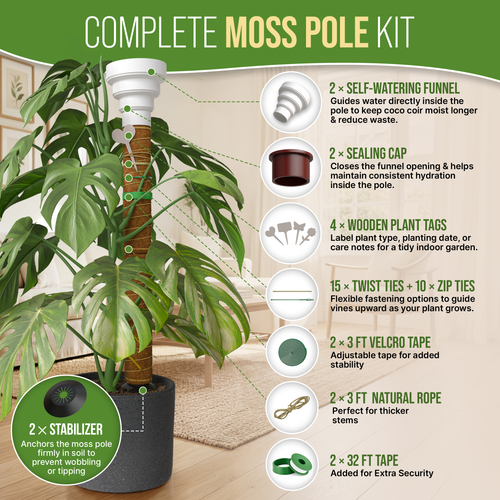
  • Complete Support Kit: Includes twist ties, zip ties, Velcro straps, stabilizers, and plant tags to secure and support your plants effectively.
  • Durable and Mold-Protected: The wood stake is treated for exceptional durability, protecting it from mold and rot for long-lasting use.

With our Moss Pole, your climbing plants will receive the essential support they need to grow vigorously, bringing the beauty of nature into your home or garden.


Shipping Notes
  • Free Standard Shipping on $100+ Orders to the USA.
  • Except Preorder products are shipped in 48 hours.
  • Delivery to the USA:
  1. Standard Shipping : 3-10 business days
  • If time is of the essence, please consider selecting expedited delivery for faster service.
Exchange/Return Notes
  • We offer a 30-day return/exchange service after receiving.
  • Final sale items are not eligible for returns or exchanges.
  • To process your return/exchange, please contact us at [email protected]
  • Please click here for more details>>> Return & Exchange Policy
SKU: 52701764046

Discover Niche Categories That Outsell coco coir moss pole

Top-Converting Item to Boost Your Average Order

4.7 ★★★★★
Based on 14 reviews
Sort
Highest Rating
Newest First
Oldest First
Product Reviews
M
Verified Purchase
Marianne Mountain Dawn Scofield
Lowell, US
★★★★★ 5
Wonderful History Lessons
I ordered this book to use for a college paper I was writing and found it fascinating. I enjoyed the content and learned much from it. The history is written in a manner that for those people that either don't read much or don't like to read (yes, there are a few people out there), it will draw you in and make you question the history lessons we suffered through in high school.
WAS THIS REVIEW HELPFUL?YesReportShare
Reviewed in the United States on January 11, 2013
A
Verified Purchase
Amazon Customer
Grantham, US
★★★★★ 5
Excellent and Eye Opening
Where but in America could white men kill 2,ooo,ooo people to prove they are more civilized ?
WAS THIS REVIEW HELPFUL?YesReportShare
Reviewed in the United States on March 16, 2017
K
Verified Purchase
Ken Kardash
Chelsea, US
★★★★★ 4
Rediscovering America
This is an eye-opening, scholarly rebuttal to common perceptions about native American society before and after the European invasion. Ronald Wright makes no secret of his bias in favor of the people who were here first; in fact, he enhances the impact of what for many will be new information by presenting this extraordinary history from the point of view of the conquered. He also makes clear how large a part of the conquest was due to immune system rather than military deficiencies: if smallpox and other diseases had not done killed most of the native population, the facts recounted here suggest that history, particularly in South America, may have evolved quite differently. In undertaking the massive task of recounting the invasion of all of the Americas, some selectivity is inevitable. Wright has chosen to focus on the story of five distinct native groups: Aztec, Maya, Inca, Cherokee and Iroquois. He then arbitrarily subdivides the story into three consecutive time periods: Conquest, Resistance and Rebirth. After the physical and political annihilation recounted in the first two sections, the title of the third may seem overly optimistic, particularly for the Guatemalan Maya. However, the concluding tone is more conciliatory and hopeful than mournful, particularly in the Afterword that updates matters to 2005, 13 years after the original publication date. The astounding amount of research involved in producing this admittedly selective overview is well-indexed and annotated. My only quibble is that Wright, obviously an expert in the field of native culture, sometimes borders on the compulsive in matters of linguistic authenticity. I did not buy this book to learn ancient native languages, let alone their pronunciation, and at times I found the inclusion of such trivia distracted from rather than enhanced the otherwise convincing scholarship. This obsession with accuracy is commendable, but after getting it out of his system in the Author's note, his amazing narrative would have been no less compelling if he stuck to the language of his contemporary audience. Also, for an author who has settled in British Columbia, it is strangely disappointing that the rich history of the Pacific Northwest coastal natives was not among those he chose to examine. I had read Charles Mann's "1491" prior to this book and found it primed my interest in the subject; both are excellent introductions to the reality of pre-Columbian American societies, but Stolen Continents provides more of a historical context for what has become of them.
WAS THIS REVIEW HELPFUL?YesReportShare
Reviewed in the United States on October 13, 2008
I
Verified Purchase
Irving Dozier
New York, US
★★★★★ 5
... true things that really went on to know very great
Format: Hardcover
lots of true things that really went on to know very great book
WAS THIS REVIEW HELPFUL?YesReportShare
Reviewed in the United States on October 13, 2016
A
A. Jimenez
Boise, US
★★★★★ 3
Well intentioned but ignorant
It's clear that this author is well intentioned. He betrays his own ignorance in trying to justify why his book only addreses certain native nations, however. The author indicates that the book did not address the native peoples of the Caribbean because they are extinct. To state that the Taino and Carib are extinct is at best extremely ignorant and at worst racist. The Taino and Carib are very much alive. To begin with, there is a reservation of Carib Indians on the island of Dominica. These native people have retained their language and culture. Further, there is a Taino Revival movement happening throughout the major Antilles especially in the Dominican Republic, Puerto Rico and Cuba. It has been scientifically proven via DNA analysis that these people are of partial and in some cases total native descent. The Taino language is being heard and taught again in the Caribbean and Taino culture has always been an integral part of the the customs and culture of the major Antilles. It is very unfortunate to know that even this author is ultimately just another white guy bent on ignoring " incovenient truths ".
WAS THIS REVIEW HELPFUL?YesReportShare
Reviewed in the United States on September 25, 2012

recommand products