Pay in installments of $6.00 with
 ,
 and

Shipping Estimate
USA
- USA
- CAN
- USA
- CAN
Ships within 48 hours · Estimated delivery Oct 26 - Oct 31
 Promo Codes Available:
For Your Every Summer RSVP, with Code: SUMMER15
Description
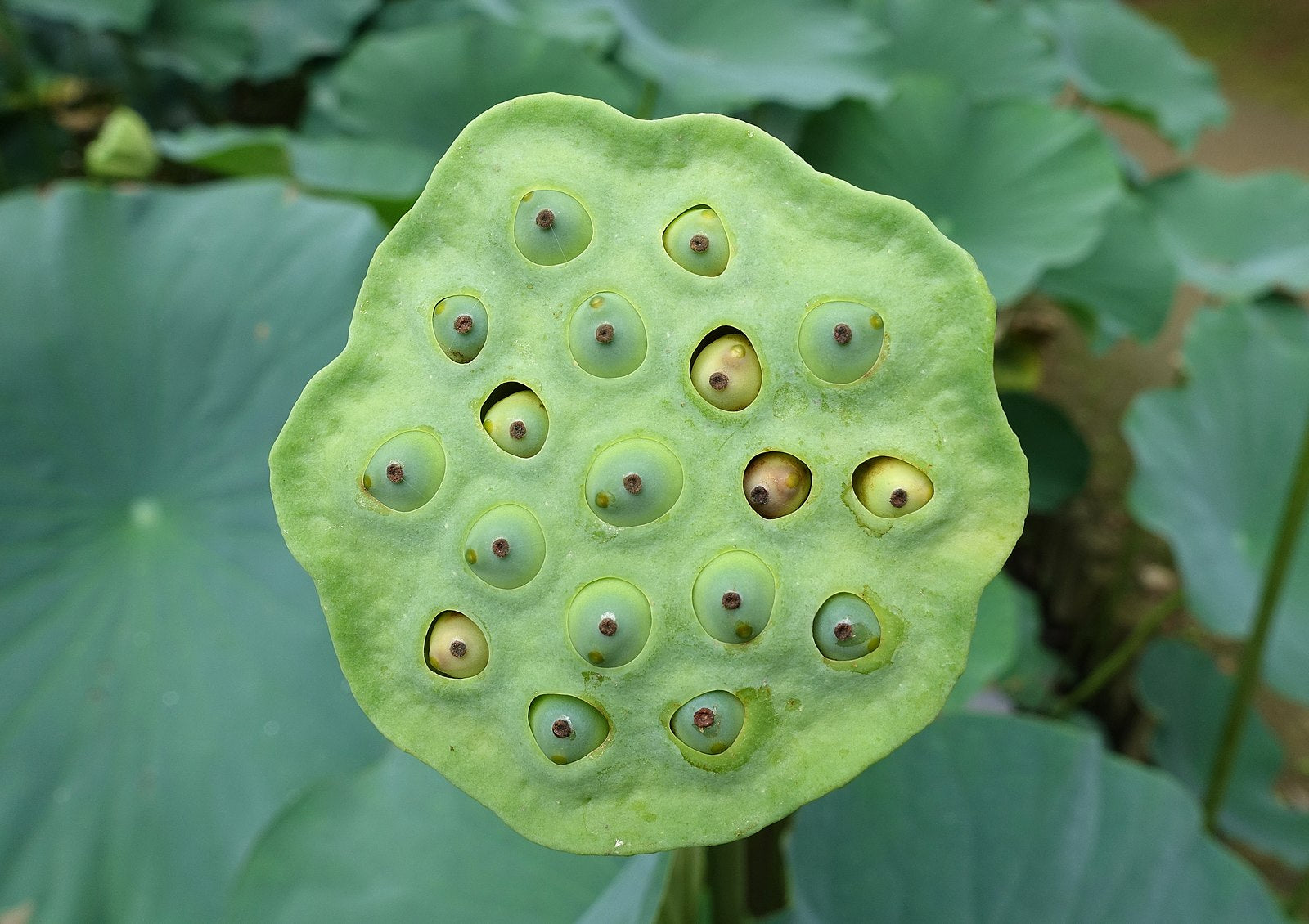
lotus seed flower Sacred Lotus – Experimental Farm Network Seed StoreNelumbo nucifera Origin: India Improvement status: Unknown Seeds per packet: ~10 BOTANICAL SAMPLE NOT GERMINATION TESTED Life cycle: Perennial Sacred lotus, also called Laxmi lotus, Indian lotus, or just lotus, is a spectacular aquatic perennial often cultivated for its serene beauty, but it is also a nutritional powerhouse with delicious and enormous roots and seeds. The leaves, stems, and flowers are also consumed, though to a lesser extent. Seeds
Nelumbo nucifera
Origin: India
Improvement status: Unknown
Seeds per packet: ~10
BOTANICAL SAMPLE - NOT GERMINATION TESTED
Life cycle: Perennial
Sacred lotus, also called Laxmi lotus, Indian lotus, or just lotus, is a spectacular aquatic perennial often cultivated for its serene beauty, but it is also a nutritional powerhouse with delicious and enormous roots and seeds. The leaves, stems, and flowers are also consumed, though to a lesser extent. Seeds can remain viable for an unbelievably long time — one seed from a dry lakebed in China germinated at the age of 1,300 years! — so many Chinese people consider it a symbol of longevity. It also has the rare capability (among plants) of regulating the temperature of its flowers within a narrow range. One study in Australia found that lotus flowers maintained a temperature of 86-95 °F even as the surrounding air temperature dropped to 50 degrees! Scientists suspect this trait may have evolved to attract cold-blooded insect pollinators (the eastern North American native skunk cabbage is one of few other plants with a similar thermoregulatory ability).
Humans have cultivated sacred lotus for its edible seeds and roots for at least 3,000 years, and cultivars have been developed specifically for seed production, rhizome production, and beauty, so there's a huge amount of diversity across the species. Some ornamental varieties have been bred to have thousands of petals per flower (in fact, one Japanese variety called "ohmi myoren," which means "strange lotus," can have up to 5,000 petals, a world record for any flower). As of 2005, China had 740,000 acres of lotus production, most of it taking place in managed farming systems with ponds or flooded paddies, as with rice. It is often grown in rotation with rice and vegetables, or cultivated with a form of aquaculture in which aquatic animals like fish, shrimp, crayfish, or crabs, are also produced, an efficient use of water and a good way to fertilize the lotus plants.
A unique and fine fabric called lotus silk can be made from the plant's fibers, but this is only done on a large scale at Inle Lake in Burma and at Siem Reap in Cambodia. A weaver near Hanoi, Vietnam, introduced the practice there in 2017. The thread is used for weaving special monastic robes for Buddhist statuary. It's believed the lotus silk weaving practice was invented by an ethnic Intha woman named Sa Oo in the Burmese village of Kyaingkhan in the early 1900s. While the practice went briefly extinct with her death, relatives Tun Yee and Ohn Kyi revived it and started a cooperative to modernize and systematize the tiny industry.
The species has a massive range, believed to be due at least in part to historic human introductions, but it is nevertheless considered native to these areas at this point. It is found in India and Sri Lanka, across East Asia north to Russia's Amur region, and across Southeast Asia to New Guinea as well as eastern Australia; there are even isolated populations around the Caspian Sea. While often confused with water lilies (Nymphaeaceae), it is a distinct family (Nelumbonaceae) with only one other extant member, Nelumbo lutea, which is a smaller, yellow-flowering species native to North America (it was once widely used by indigenous people as a food source, and is believed to have spread similarly, but there seems to have been less domestication or selection for larger seed size and root size, unlike in Nelumbo nucifera).
There's so much more to say about this miraculous plant, but we'll leave it to you to do your own research. Suffice it to say: this is one extraordinary being.
Our seed was imported from India by the good folks at Sheffield's Seed Company in Locke, NY.
GROWING NOTES: The crowd-writers of Wikipedia have done an excellent job summarizing some key information about sacred lotus cultivation, which we will reproduce below. The one key fact it doesn't mention is that when attempting to start seed, you'll need to carefully file through the seed coat so water can reach the seed. Soak in warm water, changing the water twice a day, and continuing this until the seed begins to sprout. Sow in pots 1/2" deep and then submerge completely in fresh water, Allow water to just cover the pod, and raise water level as the plants grow. Change water often to ensure it doesn't go stagnant.
From Wikipedia:
The sacred lotus grows in water up to 2.5 m (8 ft) deep. The minimum water depth is about 30 cm (12 in). In colder climates, such a low water level, which heats up more quickly, is helpful for better growth and flowering. Lotus germinates at temperatures above 13 °C (55 °F). Most varieties are not cold-hardy [though some are hardy down to USDA Zone 5!]. In the growing season from April to September (northern hemisphere), the average daytime temperature needed is 23 to 27 °C (73 to 81 °F). In regions with low light levels in winter, the sacred lotus has a period of dormancy. The tubers are not cold-resistant but can resist temperatures below 0 °C (32 °F) if they are covered with an insulating cover of water or soil. During winter time, the roots have to be stored at a frost-free place.
The sacred lotus requires a nutrient-rich loamy soil. In the beginning of the summer period (from March until May in the northern hemisphere), a small part of rhizome with at least one eye is either planted in ponds or directly into a flooded field. There are several other propagation ways via seeds or buds. Furthermore, tissue culture is a promising propagation method for the future to produce high volumes of uniform, true-to-type, disease-free materials.
The first step of the cultivation is to plough the dry field. One round of manure is applied after ten days, before flooding the field. To support a quick initial growth, the water level is relatively low and increases when plants grow. Then a maximum of approximately 4,000 per hectare (1,600/acre) with grid spacing of 1.2 by 2 metres (3 ft 11 in × 6 ft 7 in) are used to plant directly into the mud 10–15 cm (3+7⁄8–5+7⁄8 in) below the soil surface.
The stolon is ready to harvest two to three months after planting. It must be harvested before flowering. Harvesting the stolon is done by manual labor. For this step, the field is not drained. The stolon is pulled out of the water by pulling and shaking the young leaves in the shallow water.
The first leaves and flowers can be harvested three months after planting. Flowers can be picked every two days during summer and every three days during the colder season. Four months after planting, the production of flowers has its climax. The harvest of flowers is usually done by hand for three to four months.
Seeds and seed pods can be harvested when they turn black four to eight months after planting. After sun drying for two to three days, they are processed by mechanical tools to separate seed coats and embryos.
The rhizomes mature to a suitable stage for eating in approximately six to nine months. Early varieties are harvested in July until September and late varieties from October until March, after the ponds or fields are drained. The large, starch rich rhizomes are easy to dig out of the drained soil. In small-scale production, they are harvested by hand using fork-like tools. In Japan and on bigger farms manual labour harvesting is fully replaced by machines.
Shipping Notes
- Free Standard Shipping on $100+ Orders to the USA.
- Except Preorder products are shipped in 48 hours.
- Delivery to the USA:
- Standard Shipping : 3-10 business days
- If time is of the essence, please consider selecting expedited delivery for faster service.
Exchange/Return Notes
- We offer a 30-day return/exchange service after receiving.
- Final sale items are not eligible for returns or exchanges.
- To process your return/exchange, please contact us at [email protected]
- Please click here for more details>>> Return & Exchange Policy