SKU: 61331496512
companion plant seeds

companion plant seeds Companion Plant Seed Collection

Sale price$23.02 Regular price$25.58
Save 10%

Pay in installments of $6.39 with ShopPay, AfterPay and Klarna

Shipping Estimate
USA
  • USA
  • CAN

Ships within 48 hours · Estimated delivery Sep 21 - Sep 26

Promo Codes Available:

For Your Every Summer RSVP, with Code: SUMMER15

Description

companion plant seeds Companion Plant Seed CollectionCompanion planting is the technique of growing different plants together for mutual benefits like pest control, attracting pollinators and improving soil. Over the years, many customers have asked us for information about companion planting and requested a collection of seed varieties to grow as companion plants. We chose 9 of our favorite companion plants and think you'll see a big difference with these flowers and herbs growing in your garden! Here

Companion planting is the technique of growing different plants together for mutual benefits like pest control, attracting pollinators and improving soil. Over the years, many customers have asked us for information about companion planting and requested a collection of seed varieties to grow as companion plants.

We chose 9 of our favorite companion plants and think you'll see a big difference with these flowers and herbs growing in your garden! Here are the 9 varieties in the collection and some of their benefits:

Cempasúchil / Tall Mexican Marigold (Tagetes erecta) - Marigolds have long been known to be a great companion plant to tomatoes and they are beneficial to grow around other vegetables too. The two main benefits of marigold are aroma and bloom. The distinct aroma of marigolds deters pests and the blooms attract beneficial insects like pollinators. The blooms of this tall variety are very large and bloom in deep orange and yellow.

Origin: We were given the parent seed of these marigolds by a friend from Mexico whose family has grown and saved them for generations in their gardens in the state of Chiapas. (Approximately 30 seeds per packet)

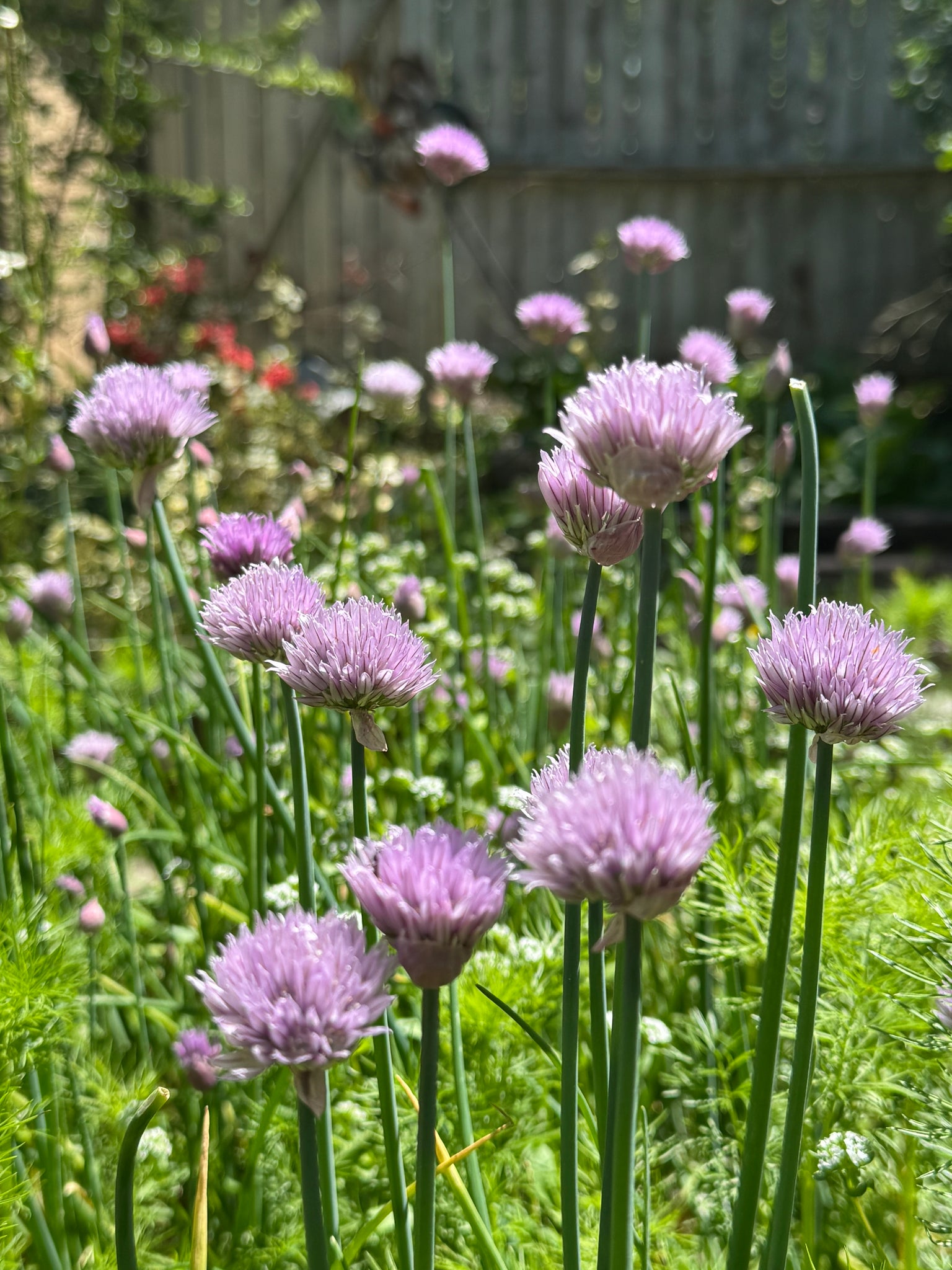
Chives (Allium schoenoprasum) - Chives are perennial and grow back year after year. The greens sprout early in the growing season and we love to add them to pretty much any meal. Chives are a fantastic companion plant repelling pests like aphids, carrot flies, and Japanese beetles, while improving the growth and flavor of neighbors. A recent study by NC State University also showed that honey bees have a strong preference for chive nectar so the beautiful purple blooms will certainly bring the pollinators to your garden. 

Origin: Grandma has a patch of chives that have been growing for at least 40 years at our childhood home. Those chives provided the parent seed for the chives in our catalog. (Approximately 50 seeds per packet)

Nasturtium (Tropaeolum majus) - Nasturtiums are excellent companion plants, acting as trap crops for aphids, attracting beneficial pollinators (like hoverflies), deterring pests (like cabbage loopers), and improving the flavor/growth of vegetables like cucumbers, squash, tomatoes, beans, and brassicas (broccoli, kale), while also serving as a living mulch. The entire plant (seeds, flowers foliage) is edible and has a wonderful peppery flavor. 

Origin: We collected the parent seed of our nasturtiums from plants at a rest stop off the A8 highway in France near Monaco. Nasturtiums grow wild along the Mediterranean coast and over the years we have had some wonderful new colors emerge from the original parent seed. (Approximately 30 seeds per packet)

Calendula (Calendula officinalis) - Calendula is a fantastic companion plant that deters pests like aphids and whiteflies while attracting beneficial insects (bees, ladybugs, lacewings) and pollinators, making it great with tomatoes, peppers, cucumbers, beans, brassicas (kale, lettuce, broccoli), and squash, creating a diverse, pest-resistant garden ecosystem. It adds color and can be interplanted throughout veggie beds for season-long benefits. Calendula petal are edible and are frequently used to make natural body care products like salves and soaps.

Origin: The parent seed of our calendula came from the garden of a friend in Prescott, Arizona and from seeds we saved in Turin, Italy at Chiesa di Santa Maria del Monte dei Cappuccini. (Approximately 50 seeds per packet)

Borage (Borago officinalis) -Borage is a fantastic companion for tomatoes, squash, cabbage, and strawberries, repelling pests like hornworms, attracting vital pollinators like bee and butterflies. Borage's deep taproot pulls nutrients from deep soil, making it a "dynamic accumulator" that enriches topsoil when chopped and dropped. Used the leaves in fall as a green compost. Borage flowers are also edible and very tasty.

Origin: The same strain of borage has grown in our garden for 20 years. We saved the parent seed from the garden of a friend in Swannanoa, NC. (Approximately 35 seeds per packet)

Dill (Anethum graveolens) - Dill is a great companion for brassicas (cabbage, broccoli, kale), cucumbers, lettuce, and onions, as it deters pests like cabbage moths and aphids while attracting beneficial insects like ladybugs and wasps that prey on them, boosting garden health and yields. Dill is also the host plant for swallowtail butterfly caterpillars so keep an eye our for the beautiful hungry caterpillars on your dill late in the season. 

Origin: We brought the parent seed of our dill home to our garden from the farm of our cousin in Hungary, just north of Budapest. (Approximately 100 seeds per packet)

Love-lies-bleeding amaranth (Amaranthus caudatus) - Amaranth is a great companion for many plants, working well in the "Three Sisters" (corn, beans, squash) as a "fourth sister," supporting nightshades (tomatoes, peppers, eggplant) by deterring pests, and benefiting root crops (carrots, beets) by loosening soil and attracting beneficials like ladybugs. Amaranth is also a great "trap crop". Leaf cutters love chewing holes in amaranth leaves where they do little damage while leaving more tender plants alone.

Origin: In 1998, Papa was working on a farm in Ventura County, California. A friend on a farm in Ojai, just over the mountain, gave him the parent seed of both of the amaranth varieties in our catalog. She had brought the seeds from her Grandmother’s garden in Guatemala where the family had been growing and saving the seeds for generations. (Approximately 100 seeds per packet)

Tulsi / Holy Basil (Ocimum tenuiflorum) - Tulsi (Holy Basil) makes a great companion for many plants, repelling pests like aphids and mosquitoes while attracting pollinators, and it grows well with tomatoes, peppers, marigolds, mint, and other basils, benefiting from similar needs and enhancing flavor/pest control. Tulsi leaves make a wonderful tea when dried and it is an important, holy plant in Hinduism.

Origin: In 2004, well before our first child was born, we spent nearly a year traveling in SE Asia. While in Cambodia in the city of Siem Reap, we stayed in a wonderful guest house near the Temples of Ankor Wat. 

At the guesthouse, there was a beautiful courtyard and garden filled with an array of tropical plants. All types of orchids bloomed in the garden and there were many fruits like mango and banana that the hosts would harvest and serve for our breakfast.
There was a large patch of Tulsi in the courtyard and the inn keeper gave us some seeds from the plant. She was pleased by the thought of us growing the seeds from her garden in ours at home. Many years later now, the Tulsi from Cambodia still grows in our garden. (Approximately 100 seeds per packet)

Zinnia (Zinnia elegans) - Who doesn't love zinnias? Zinnias are excellent companion plants, boosting vegetable gardens by attracting pollinators (bees, butterflies) for better yields and drawing beneficial predatory insects that eat pests like aphids, while also offering vibrant color and acting as a trap crop for some pests, pairing well with tomatoes, cucumbers, squash, beans, basil, and marigolds for a beautiful, productive, and pest-resistant garden. Zinnias are an outstanding cut-flower too and our mix has a wonderful vibrant range of colors with big blooms.

Origin:  Zinnias were the first seed variety that we ever saved in 1999 when we had a beautiful little garden in the shadow of Watch Knob in Swannanoa, NC. The parent seed of our zinnias came from a dear and departed friend who had a beautiful garden in Prescott, AZ. We have collected zinnia seeds on our travels and have added strains from Thailand, France, Myanmar, Hungary, and Mexico to our mix. We also cross pollinate zinnias every year in the hope of breeding new varieties so you may see zinnias in your garden that came from our breeding efforts.  (Approximately 50 seeds per packet)

We hope you enjoy growing these 9 companion plant varieties in your garden and while each variety is wonderful in their own right, they will also be beneficial for all the other plants in your garden too!

Shipping Notes
  • Free Standard Shipping on $100+ Orders to the USA.
  • Except Preorder products are shipped in 48 hours.
  • Delivery to the USA:
  1. Standard Shipping : 3-10 business days
  • If time is of the essence, please consider selecting expedited delivery for faster service.
Exchange/Return Notes
  • We offer a 30-day return/exchange service after receiving.
  • Final sale items are not eligible for returns or exchanges.
  • To process your return/exchange, please contact us at [email protected]
  • Please click here for more details>>> Return & Exchange Policy
SKU: 61331496512

Discover Niche Categories That Outsell companion plant seeds

Top-Converting Item to Boost Your Average Order

4.5 ★★★★★
Based on 9 reviews
Sort
Highest Rating
Newest First
Oldest First
Product Reviews
L
Verified Purchase
L. Yu
Louisville, US
★★★★★ 4
pretty good banana plugs
Size: 5 Pack, Pattern Name: Banana Plugs
i bought these over 6 months ago and i just installed them to the front left and right floor standing speakers - sony ssf-7000 i have them for over 10 years hooked up to a yamaha 7.1 AVR. alot of people have had trouble installing this - one single banana plug comes in 3 parts - the bottom and top (the banana plug tip) can be unscrewed. what i did was tightened the top first (top being the tip of the banana plug) then unscrew the bottom off completely - make sure you have like 3/4" - 1" (depending on your gauge of wire) of exposed speaker wire that is straight - then thread it through the hole at the bottom up - i then rolled the exposed 3/4 - 1" exposed copper wiring into a ball that is bigger than the hole of the banana plug bottom piece so the wire doesn't fall back through where it came from. then i screwed on the top and middle piece back with the bottom piece - tightening it a bit so i know there's good contact. also make sure the tip is screwed in all the way as well as a double check. what you don't want to do is have the copper wire touch the threaded part of the bottom piece - the wire will cut off from the screwing action. i plugged it into my sony speakers and it wasn't a real snug fit - a bit too loose to feel secure - it didn't seem to go all the way in - but it fit fairly well in my receiver. my intention was to use these banana plugs with my 2 channel set up but i decided to go pre-constructed mediabridge 12 AWG speaker cable instead - those fit my 2 channel set up on my receiver and elacs really snug and secure. i tested it and it works fine. i didn't hear any loss of signal or any extraneous noise. none of my (14 awg?) wiring fell through the bottom and it sounds good. so no complaints there. i bought 5 pairs - but i find that it is an odd number to include a package - even numbered pairs would be better. anyway they seem constructed well - easy enough to install and they do work. thanks for reading
WAS THIS REVIEW HELPFUL?YesReportShare
Reviewed in the United States on September 12, 2019
A
Verified Purchase
AB
Draper, US
★★★★★ 5
High quality and robust
Size: 12 Pairs, Pattern Name: Banana Plugs
Easily the best plugs I've found at a reasonable price. Solid feeling with good quality and they look good with easy to see red/black labeling. The tips tend to unscrew too easily, but this is a non-issue when they are in use, just something you have to be careful not to lose when assembling. It's a bit tricky to spread the wire out evenly at the exact right length. If screwing the plug together is hard at all, go back and shorten how much wire you bend over the lip.
WAS THIS REVIEW HELPFUL?YesReportShare
Reviewed in the United States on June 16, 2025
W
Verified Purchase
William
Pawtucket, US
★★★★★ 5
Solid banana clips
Size: 5 Pack, Pattern Name: Banana Plugs
Ah yes, I used these solid banana plugs to convert my wires. It’s pretty easy to set up once the wire housing has been stripped and really cleans things up nicely. I haven’t had any discernable hissing, noise problems, or connection issues.
WAS THIS REVIEW HELPFUL?YesReportShare
Reviewed in the United States on May 25, 2026
L
Verified Purchase
Leyland Cypress
Massapequa, US
★★★★★ 3
Get the right wire guage
Size: 1 Count (Pack of 1), Pattern Name: Banana Plugs
I rate the banana plugs themselves 4 stars. They are everything I expected and work as advertised. It's the experience of assembly that I rate three stars. The way these work is -- you strip off the outer insullation of your wire and separate the two leads (positive and negative). Then you strip some length of insulation off the end of one of your leads, you unscrew the banana plug so that it separates into its respective base (lower) and contact (upper) halves, you slip the wire up through the base, you flare the copper strands of the wire and fold the individual strands over the very top of the base (about 1/16 of an inch) (taking care not to extend the strands over the threaded barrel of the base), then you screw the upper contact onto the lower base and voila, banana plug / wire assembly. It's not as complicated as it sounds. Go to the Monoprice website and watch their excellent instructional video. Here's the thing though. While the assembly is not complicated, it is tricky, and if you don't get your proportions right the first or second or third time, you'll have to do it over. Fist of all, if your wire guage is relatively thin, like my 16-guage speaker wire, you'll find that the entire wire, insullation and all, will slip right through the base of the plug without butting up against the bottom of the base. If this is the case, then the wire is left to sort of flop around inside the plug and that has a kind of unfinished, amateur look and feel to it, whereas if the wire butts up against the bottom of the base, it has a solid, one-piece professional look. So, to my mind, there's a sweet-spot for wire guage that works best with this plug -- not too thin and not too thick. And since Monoprice has debunked the thicker-is-better myth (the quality of the copper is the real determinant), then you should feel free to get the wire guage that fits the plug. Next -- and here's where it gets tricky -- once your copper extends beyond the top of the base, you'll need to limit this extension to about a sixteenth (no greatrer than a fourth) of an inch. Then you very delicately flare out the individual strands, in a 360- degree arc, and fold the strands over the top of the base. This takes a fair degree of manual dexterity, especially if the wire is "floating" inside the base and its travel is not stopped where the insullation meets the base. You'll have to hold the wire and base steady in the fingers of one hand, then flare out the wire strands with either your fingers or a suitable object (the working end of a ball-point pen worked for me) with the other hand. This one-sixteenth measure is important. If you extend wire strands beyond the top and over the threads of the base, you'll find that screwing the contact end onto the base is impossible and you'll need to start over. One or two strands is OK and almost unavoidable. In that case the screwing will catch but if you take a pair of pliers to it you can muscle through. By the way, you can avoid the whole mess by getting the open-screw type, which I'm sure will work just as well without any of the hassle of assembly. Like anything else, if you do it a few times to make the mistakes and learn the tricks, then it will become second nature, and if you've already done that, then my review might seem overly fussy. In that case feel free to leave comments to help other readers.
WAS THIS REVIEW HELPFUL?YesReportShare
Reviewed in the United States on October 15, 2012
J
Verified Purchase
JBDoge
Natrona Heights, US
★★★★★ 5
Wish they came with instructions...
They are cheap and work great. They plug right into my Pioneer vsx521 receiver and my Paradigm Atom monitor speakers. I wish they came with instructions, because it took me about 10 minutes to realize the bottom part unscrews in addition to the top part. Here are my instructions for installation: 1) Unscrew the bottom part of this connector (the thin metal underneath the red/black ring). 2) Make sure the Banana Plug (which may be loosely screwed into the top part of the connector) is fully tightened down 3) Strip your wire tips to 3/8 of an inch (or just slightly under) 4) Run the first newly stripped wire end through the bottom part you removed in step 1, such that the stripped end of the wire is entering through the flat end and exiting through the smaller threaded end. 5) Leave about 1/8 to 3/16 of an inch of stripped wire hanging past the exit hole. 6) As evenly spaced as possible, bend the over-hanging wire strands over the exit hole (all around it, like a hat). If done properly, the wire should not fall out if you give it a VERY GENTLE tug. 7) Screw the top metal part (with the actual banana plug) back onto the bottom part. It may be difficult if your stripped wire is hanging too low. I've used a pair of pliers to grip the bottom part of the connector while I twist the banana plug side with my hand. If done correctly, you should be able to put a lot of tension between the wire and connector without removing/damaging it. UPDATE: I just recently helped my dad install his 5.1 system without these... it sucked... This item (5 pairs of them in this case) and a good wire stripper can save you alot of pain (both physical and mental). The connectors on the back of his receiver are the kind where bare wire comes in from the side and then the connectors screw down (with a banana plug hole in the center which is where this product would come into play). I felt like a surgeon trying to get a bare wire end into the little slot, and then holding it there while I tighten the connector which is almost impossible since they are so close together... GET THESE!
WAS THIS REVIEW HELPFUL?YesReportShare
Reviewed in the United States on February 8, 2012

recommand products