Pay in installments of $6.68 with
 ,
,
 and
and

Shipping Estimate
USA
- USA
- CAN
- USA
- CAN
Ships within 48 hours · Estimated delivery Oct 20 - Oct 25
 Promo Codes Available:
For Your Every Summer RSVP, with Code: SUMMER15
Description
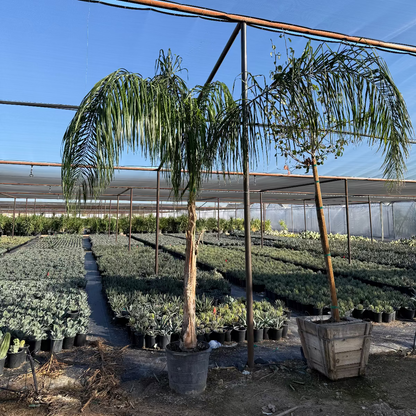
queen palm plants Buy Queen Palm Phoenix, AZ | Syagrus romanzoffianaElegant Tropical Shade for Phoenix Yards Queen Palm The Queen Palm (Syagrus romanzoffiana) is one of the most graceful and fast growing palms available for Phoenix area landscapes. With long, feathery fronds that arch elegantly from a smooth gray trunk, Queen Palms deliver instant tropical curb appeal to any property. They grow quickly to 3040 feet tall, creating welcome filtered shade in the hottest months. Whether you're framing a Scottsdale
Elegant Tropical Shade for Phoenix Yards — Queen Palm
The Queen Palm (Syagrus romanzoffiana) is one of the most graceful and fast-growing palms available for Phoenix-area landscapes. With long, feathery fronds that arch elegantly from a smooth gray trunk, Queen Palms deliver instant tropical curb appeal to any property. They grow quickly to 30–40 feet tall, creating welcome filtered shade in the hottest months. Whether you're framing a Scottsdale driveway, lining a Chandler pool deck, or adding vertical drama to a Gilbert backyard — the Queen Palm is one of the most popular choices for Valley homeowners and landscape designers alike.
Queen Palm Plant Details
| Attribute | Detail |
|---|---|
| Scientific Name | Syagrus romanzoffiana |
| Common Names | Queen Palm, Cocos Palm |
| Mature Height | 30–40 feet |
| Mature Width | 15–20 feet (canopy spread) |
| Growth Rate | Fast — 3–6 feet per year in Phoenix |
| Sun | Full sun (6+ hrs). Handles reflected heat from walls and pavement. |
| Water | Moderate. More water than most desert palms, but manageable on drip. |
| USDA Zones | 9b–11 (Phoenix is Zone 9b–10a) |
| Soil | Well-draining preferred. Adapts to Arizona caliche soils with proper planting. |
| Foliage | Evergreen — lush feathery fronds year-round |
| Fruit | Produces small orange date-like clusters in summer |
Queen Palm Uses in Phoenix Landscapes
Driveway & Entry Framing
Queen Palms are a top pick for framing driveways and front entries across Scottsdale, Mesa, and Tempe. Their tall, slender trunks and arching canopies create a stately, resort-style welcome. Plant a pair flanking the driveway entrance or line both sides at 12–15 foot intervals for a dramatic allée effect.
Pool & Patio Shade
The Queen Palm's high canopy provides dappled shade without blocking airflow — ideal for poolside comfort in Chandler and Gilbert yards. Fronds are large but don't create excessive litter compared to many broadleaf trees. Pair with low-growing Desert Spoon or Yellow Bells at the base for a layered tropical look.
Streetscape & HOA-Friendly Plantings
Many Phoenix-area HOAs approve Queen Palms for front yards because of their clean, upright form and tropical aesthetic. They work beautifully in median strips, along property lines, and in shared community spaces throughout Peoria, Glendale, and Surprise.
Best Time to Plant Queen Palm in Phoenix
Fall (October–November) is the ideal planting window for Queen Palms in Phoenix. Warm soil promotes fast root establishment while cooler air temperatures reduce transplant stress. The palm gets 6–8 months of root growth before its first full Phoenix summer. Spring (February–April) is the second-best window. Avoid planting in June–August if possible — extreme heat puts extra stress on newly transplanted palms.
How to Plant Queen Palm
- Dig wide, not deep — excavate a hole 2–3x the width of the root ball, same depth. Queen Palms don't like being planted too deep.
- Check for caliche — break through any hardpan layer to ensure good drainage. Standing water around the root ball will cause root rot.
- Backfill with native soil — a light 20% organic amendment is fine, but avoid heavy compost mixes.
- Spacing — plant 12–15 feet apart for a grouped planting; 20+ feet for individual specimens.
- Water basin — build a 3–4 inch soil ring around the root zone to direct water where it's needed.
- Mulch — apply 2–3 inches of bark or gravel mulch to retain moisture and regulate soil temperature.
Watering Queen Palm in Phoenix
First Year Watering Schedule
Queen Palms need consistent moisture during their first year. Water deeply:
- Weeks 1–2: Every 1–2 days, deep and slow (30–45 min drip cycle)
- Months 1–2: Every 3–4 days
- Months 3–6: Every 5–7 days (every 3–4 days during peak summer heat)
- After Year 1: Every 7–10 days in summer; every 2–3 weeks in winter
Drip Irrigation
Place 2–3 emitters (2 GPH each) in a ring 18–24 inches from the trunk. As the palm matures, move emitters outward to the drip line. Established Queen Palms are moderate water users — not as drought-tolerant as Mexican Fan Palms, but very manageable on a standard drip system.
How fast does Queen Palm grow in Phoenix?
Queen Palms are one of the fastest-growing palms for the Phoenix Valley, adding 3–6 feet of height per year with regular watering. Most homeowners see their palm reach 20+ feet within 4–5 years of planting a 15-gallon size.
Is Queen Palm drought tolerant?
Queen Palms are moderately drought tolerant once established — more water-dependent than Mexican Fan Palms or Mediterranean Fan Palms, but far less thirsty than most tropical trees. On a well-designed drip system, they perform beautifully in the Phoenix climate.
What's the difference between Queen Palm and Pygmy Date Palm?
Queen Palms grow to 30–40 feet and serve as full-size landscape trees, while Pygmy Date Palms max out at 8–10 feet and work best as patio or accent plants. Both are feather palms with an elegant look, but Queen Palms provide much more shade and vertical impact.
Do Queen Palms survive Phoenix summers?
Yes. Queen Palms handle Phoenix summers well as long as they receive regular deep watering. They tolerate reflected heat from walls and pavement and rarely show heat stress when properly irrigated.
Do Queen Palms drop fruit?
Yes — Queen Palms produce small orange fruit clusters in summer. The fruit is not harmful but can create litter on patios and pool decks. Regular cleanup or planting away from high-traffic hardscapes keeps this manageable.
You May Also Like
- Pygmy Date Palm — a compact feather palm for patios and small spaces, growing just 8–10 feet tall.
- Mexican Fan Palm — a towering, drought-tough fan palm that reaches 50–70 feet with minimal water.
- Mediterranean Fan Palm — a slow-growing multi-trunk palm with distinctive fan-shaped fronds, perfect for desert modern landscapes.
- Pineapple Palm — a showstopper with a unique crown shaft that resembles a pineapple, excellent for entryways.
How Many Queen Palms Do I Need?
Queen Palm is a tall feather palm with a 15 to 20 foot canopy, so it is placed as a specimen, grove, or allee rather than a hedge. Use these layouts:
- Single specimen: one palm as vertical drama in a lawn or bed, set 20 feet or more from the house and other big trees so the crown spreads freely.
- Symmetrical pair: flank a driveway or entry with two palms roughly 12 to 15 feet apart.
- Allee or grove: line a drive or property edge 12 to 15 feet on center for a resort colonnade, staggering heights in informal groves of 3 to 5.
Keep the trunk 8 to 10 feet off pool decks and patios so the summer fruit clusters and frond drop land on planting beds, not paving.
Queen Palm Season-by-Season in Phoenix
- Spring (Feb–Apr): a strong flush of new fronds and rapid height gain begin as soil warms; a good second planting window.
- Summer (May–Sep): the fastest growth of the year, with good heat and reflected-heat tolerance as long as deep water is steady. Orange fruit clusters ripen, and monsoon rain is a bonus. This palm wants more water than desert natives through the heat.
- Fall (Oct–Nov): the prime low-desert planting season; maximizes root growth before summer while the lush crown holds.
- Winter (Dec–Jan): evergreen but frost-tender, with frond burn possible below about 25 to 28°F. Most Valley winters are fine, but cover young palms on hard-freeze nights and expect established palms to push out fresh fronds in spring after a cold snap.
At a Glance
✔ Heat-Loving (Reflected-Heat Tolerant) ✔ Evergreen ✔ Shade-Providing ✔ Low-Maintenance
Plant It With
- Mexican Fan Palm: a taller, more drought-tough palm for a layered skyline behind the Queen.
- Pygmy Date Palm: a compact feather palm that echoes the form at ground level.
- Mediterranean Fan Palm: a low multi-trunk fan palm that contrasts the single smooth trunk.
- Desert Spoon: a silver, low-water understory accent for the base of the palm.
Is Queen Palm Right for Your Yard?
Queen Palm thrives in full Phoenix sun and reflected heat, grows fast for quick tropical height, and stays manageable on a standard drip system. It is not a fit if you want a low-water, plant-and-forget palm or a hard-freeze-proof one: it wants more water than desert-native palms, drops fruit that litters poolside paving, and can show frond burn in a hard Valley freeze.
Shipping Notes
- Free Standard Shipping on $100+ Orders to the USA.
- Except Preorder products are shipped in 48 hours.
- Delivery to the USA:
- Standard Shipping : 3-10 business days
- If time is of the essence, please consider selecting expedited delivery for faster service.
Exchange/Return Notes
- We offer a 30-day return/exchange service after receiving.
- Final sale items are not eligible for returns or exchanges.
- To process your return/exchange, please contact us at [email protected]
- Please click here for more details>>> Return & Exchange Policy