SKU: 65808496059
indoor plants syngonium

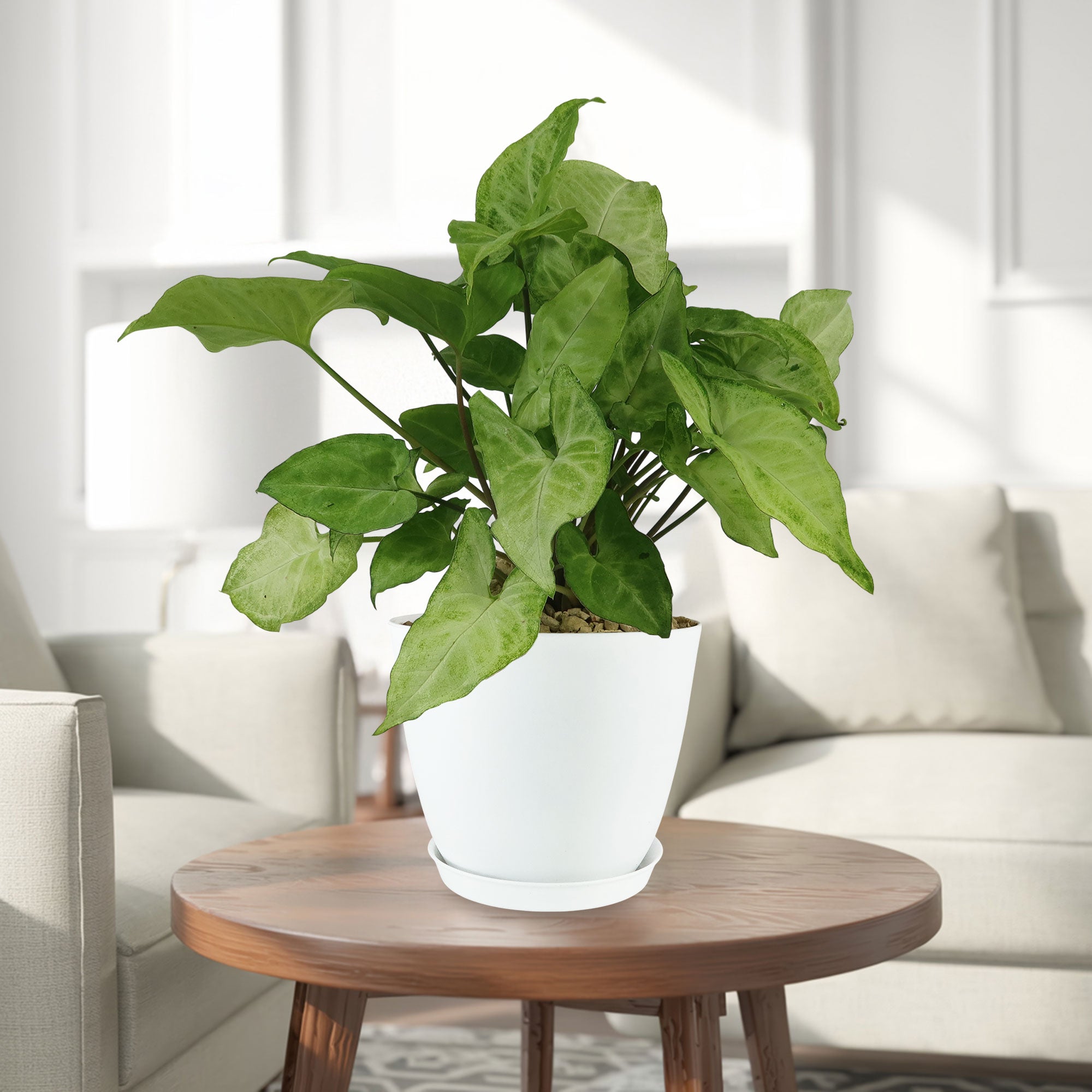
indoor plants syngonium White Butterfly Plant – Syngonium ‘White Butterfly’ 1 gal. / Light Green / With Pot

Sale price$23.97 Regular price$26.63
Save 10%

Pay in installments of $6.66 with ShopPay, AfterPay and Klarna

Shipping Estimate
USA
  • USA
  • CAN

Ships within 48 hours · Estimated delivery Jul 16 - Jul 21

Promo Codes Available:

For Your Every Summer RSVP, with Code: SUMMER15

Description

indoor plants syngonium White Butterfly Plant – Syngonium ‘White Butterfly’ 1 gal. / Light Green / With PotThe White Butterfly Plant, known as Syngonium podophyllum White Butterfly, is a popular hanging plant with arrowhead shaped leaves that are green with white veins. This plant is popular for its low maintenance and ability to thrive in indirect light, making it a great choice for indoor spaces. Native to rainforests in countries like Mexico, Costa Rica, and Brazil, the White Butterfly Plant also called the White Butterfly Arrowhead Plant, as it is the

The White Butterfly Plant, known as Syngonium podophyllum ‘White Butterfly’, is a popular hanging plant with arrowhead-shaped leaves that are green with white veins. This plant is popular for its low maintenance and ability to thrive in indirect light, making it a great choice for indoor spaces.

Native to rainforests in countries like Mexico, Costa Rica, and Brazil, the White Butterfly Plant also called the White Butterfly Arrowhead Plant, as it is the popular variety of Syngonium podophyllum a main arrowhead plant or arrowhead vine. 

The White Butterfly Plant is especially appealing for its striking leaf variegation. The leaves are primarily a creamy white or pale green, with a darker green edging that provides a unique, "butterfly" effect in appearance.

This coloration makes it an eye-catching piece in any indoor plant collection. The leaves start as arrowhead-shaped in young plants and, as they mature, develop more of a divided, lobed structure.

In its juvenile stage, it remains compact, but when allowed to climb or vine, it can reach up to 6 feet in length, with leaves spanning around 5–7 inches.

This mature size and unique foliar development lend it versatility as either a tabletop plant or a larger floor display.

Syngonium ‘White Butterfly’ blooms in clusters of small white flowers, adding a delicate touch to its lush green foliage. It is rare for Syngonium 'White Butterfly' to bloom indoors, as it typically requires specific conditions to produce flowers. However, when it does bloom, the delicate white flowers can be a pleasant surprise for plant enthusiasts.

The White Butterfly Plant brings more than just aesthetic appeal; it is also a known air purifier, capable of filtering indoor air and removing toxins such as formaldehyde, benzene, and xylene. This makes it an excellent choice for homes or offices where improved air quality is a benefit. Its natural air-cleaning abilities have earned it a place among other "clean air" plants, contributing to a healthier indoor environment. 

When and How to Water Your White Butterfly Plant

Like other Drought-tolerant plants, the Syngonium White Butterfly is an excellent choice for those who may sometimes forget to water their plants regularly. This plant can withstand periods of dry soil, but it's essential not to let it stay completely dry for extended periods. When watering, it's crucial to allow the soil to dry slightly between waterings to prevent overwatering, which can lead to root rot. A good practice is to water the Syngonium White Butterfly thoroughly when the top inch of soil feels dry to the touch. 

In the spring and summer, during the growing season, the White Butterfly plants benefit from regular watering typically 1-2 weeks. Water the plant deeply when the top inch of soil is dry, ensuring that excess water can drain out of the pot. It's essential to avoid letting the plant sit in water, as this can lead to root rot. The frequency of watering may vary depending on factors like temperature, humidity, and the size of the plant, so always check the soil moisture before watering.

In the fall and winter, during the dormant phase, reduce the frequency of watering to once a month, allowing the soil to dry out more between waterings. It's crucial to strike a balance during these periods, ensuring the plant doesn't become completely parched but also avoiding excessive moisture. Adjusting the watering schedule based on the plant's growth stage and environmental conditions will help maintain the health and vitality of the Syngonium butterfly throughout the year.

Light Requirements – Where to Place Your White Butterfly ‘Syngonium’ 

When grown indoors, this white butterfly plant prefers bright, indirect light for at least 4-6 hours a day. Placing it near a window where it can receive filtered sunlight is ideal. Direct sunlight can scorch the leaves, so it's essential to shield them from harsh rays.

If natural light is limited indoors, supplementing with artificial grow lights can help provide the necessary light intensity for the Syngonium White Butterfly to grow well.

For outdoor cultivation, the Syngonium White Butterfly thrives best in partial shade or dappled sunlight, but it can tolerate some gentle direct sunlight, ideally in the morning.

However, it’s essential to shield the plant from intense, direct afternoon sun, which can scorch its delicate leaves. An ideal outdoor spot provides a balance: morning sunlight or bright, indirect light throughout the day will support its growth and keep its foliage vibrant.

As seasons change, consider adjusting its placement to maintain this balance, ensuring it receives just enough light without risking exposure to harsh midday sun.

Optimal Soil & Fertilizer Needs 

The Syngonium White Butterfly thrives in well-draining soil that is rich in organic matter. It's essential to choose a pot with drainage holes to allow excess water to escape and avoid water accumulation at the bottom of the pot, which can be detrimental to the plant's roots. Instead, make or buy a well-draining potting mix, opens in a new tab, or ideally use our specialized potting mix that contains 5 natural substrates and mycorrhizae to promote the development of a strong root system that helps your Syngonium plant to thrive.

When it comes to fertilizing the White Butterfly Syngonium plant, a balanced NPK fertilizer can be applied during the growing season, typically in spring. Dilute the fertilizer to half or quarter strength and apply it once a year to provide the plant with essential nutrients for healthy growth. During the dormant period in fall and winter, it's best to reduce or stop fertilizing to allow the plant to rest. Always follow the instructions on the fertilizer package to avoid overfeeding, which can harm the plant's roots and overall health.

Regularly monitoring the white butterfly plant's growth and observing any signs of nutrient deficiencies can help determine the optimal fertilization schedule.

Remember to water the plant before applying fertilizer to prevent root burn and allow the nutrients to be absorbed effectively. 

Hardiness Zones & More 

When growing indoors, the Syngonium White Butterfly maintains a consistent temperature between 60-75°F for healthy growth. Avoid exposing the plant to sudden temperature fluctuations or drafts, as they can stress the plant and affect its health. Providing a stable indoor environment with moderate temperatures will help the Syngonium thrive and prevent any temperature-related issues. 

For outdoor cultivation, the white butterfly plant is typically suitable for USDA zones 10-11, which are regions with mild to warm climates. These zones generally have minimum average temperatures between 30-40°F.

If you live in a colder climate, it's best to grow the plant indoors or in a controlled environment to protect it from frost and freezing temperatures, which can damage or kill the plant. 

The White Butterfly Plants prefers moderate to high humidity levels. Indoors, especially during the drier winter months, you can increase humidity by using a humidifier, placing a pebble tray filled with water near the plant, or regularly misting the leaves. Outdoors, in regions with naturally high humidity, the plant can thrive without additional intervention. Monitoring the humidity levels and adjusting as needed will help create an environment that mimics the plant's native tropical habitat and supports its growth and well-being.

Wildlife White Butterfly Plant Attracts the Following Friendly Pollinators

The white butterfly Arrowhead Plant is a beautiful plant that not only adds charm to your space but also attracts pollinators and insects with its vibrant foliage. The unique leaves of this plant can catch the eye of beneficial insects like bees, hummingbirds, and butterflies, contributing to a healthy and balanced ecosystem in your garden or indoor space. By providing a welcoming environment for these pollinators, the butterfly Syngonium can play a role in supporting local biodiversity and promoting plant reproduction through pollination.

Butterflies
Bees
Hummingbirds
Lady Bugs
Multi Pollinators
Other Birds

According to the ASPCA, this plant is considered mildly toxic to cats, dogs, and horsesThe white butterfly is safe to touch, but it is important to wash your hands after handling the plant as some people may experience skin irritation from contact with the sap. Additionally, it is recommended to keep this plant away from pets and small children as ingestion can cause mild stomach to upset. Ingesting any part of the Syngonium plant, including leaves and stems, can lead to symptoms such as oral irritation, drooling, vomiting, and difficulty swallowing.

How to Propagate Your White Butterfly Plant

To propagate the white butterfly plant, you can use stem cuttings. Select a healthy stem with at least a few leaves and aerial roots, if possible. Cut the stem just below a node using a sharp, clean knife or scissors. Place the cutting in water or a well-draining potting mix, ensuring that at least one node is submerged or buried. Keep the cutting in a warm, humid environment with indirect light. Over time, roots will develop, and a new plant will grow from the cutting. Regularly monitor the cutting's progress, ensuring it stays moist but not waterlogged, to encourage successful propagation. 

Key Takeaways 

  1. Known for its unique arrowhead-shaped leaves, the White Butterfly Plant has creamy white and green variegation, which resembles a butterfly pattern—making it a beautiful, eye-catching addition to indoor decor.
  2. The Syngonium White Butterfly hanging plant is an effective air purifier, helping remove toxins like formaldehyde and benzene from indoor air for a healthier environment.
  3. The White Butterfly Plant can be trained as a compact table plant, or allowed to vine and climb, reaching 6 feet when mature. It’s versatile for various display options, including hanging baskets.
  4. This plant adapts well to low-to-moderate indoor light, requires only occasional watering, and thrives with minimal maintenance, making it perfect for beginners or busy plant enthusiasts.

The Bottom Line

Overall, the White Butterfly Plant (Syngonium ‘White Butterfly’) is a stunning hanging houseplant that combines beauty and ease of care. Its arrowhead-shaped, creamy white and green variegated leaves make it an attractive choice for any indoor setting, while its versatility allows it to be grown as a compact plant or a vining beauty. With optimal white butterfly Syngonium care, it thrives in moderate light and only requires occasional watering, making it ideal for beginners and seasoned plant lovers alike. Alongside its aesthetic appeal, it also purifies indoor air, enhancing both the look and feel of home or office spaces. For a low-maintenance, vibrant, and beneficial plant, the White Butterfly is an outstanding addition to any collection.

Shipping Notes
  • Free Standard Shipping on $100+ Orders to the USA.
  • Except Preorder products are shipped in 48 hours.
  • Delivery to the USA:
  1. Standard Shipping : 3-10 business days
  • If time is of the essence, please consider selecting expedited delivery for faster service.
Exchange/Return Notes
  • We offer a 30-day return/exchange service after receiving.
  • Final sale items are not eligible for returns or exchanges.
  • To process your return/exchange, please contact us at [email protected]
  • Please click here for more details>>> Return & Exchange Policy
SKU: 65808496059

Discover Niche Categories That Outsell indoor plants syngonium

Top-Converting Item to Boost Your Average Order

4.6 ★★★★★
Based on 16 reviews
Sort
Highest Rating
Newest First
Oldest First
Product Reviews
J
Verified Purchase
Jay
Fort Morgan, US
★★★★★ 5
Stylish
Color: 01-silver
Good sturdy stand for paper towels. Has small suction cups on bottom for stability. Good finish and good fit under the counter. Heavy base and not flimsy feeling. Brushed aluminum matched other appliances well.
WAS THIS REVIEW HELPFUL?YesReportShare
Reviewed in the United States on January 6, 2026
T
Verified Purchase
The product comes in multiple colors, but the function is terrible
Dallas, US
★★★★★ 5
Goodbye for the value
Color: 02-black
Great value looks wonderful very adorable
WAS THIS REVIEW HELPFUL?YesReportShare
Reviewed in the United States on May 31, 2026
J
Verified Purchase
J. Thomas Campbell
West Palm Beach, US
★★★★★ 5
David Rohl: A "Maverick" in Search of History
Format: Paperback
Recently I wrote a review of Peter Enns' book "The Evolution of Adam" in which I made a brief reference to David Rohl's "From Eden to Exile: The 5000 Year History of the People of the Bible." Several friends who read the review emailed me, curious about Rohl's book and encouraging me to follow up on Enns' book with a somewhat detailed review of From Eden to Exile. Hence...this review. From Eden to Exile is Rohl's own "follow-up" to his previous book "Pharaohs and Kings: A Biblical Quest." It's important here that I inform the reader of the following: (1) Pharaohs and Kings (in my view) is a far more compelling book than From Eden to Exile; and (2) I would strongly recommend that readers unfamiliar with Rohl read Pharaohs and Kings, prior to reading From Eden to Exile. With these thoughts in mind (and before commenting on Eden to Exile), I believe it will prove worthwhile to focus briefly on Rohl's Pharaohs and Kings prior to moving on to his second book - the two being closely related in terms of subject matter. First, it needs to be stated here at the outset that Rohl (unfortunately) has not received much in the way of either praise and/or encouragment from his fellow Egyptologists, most of whom see him as a sort of "reckless intruder" into the discipline, presenting arguments for a revised chronology (what Rohl refers to as "the New Chronology") that his critics appear to regard as little more than fanciful speculation. This is most unfortunate. Rohl's views are fully deserving of critical assessment; however, the casual (sometimes contemptuous) manner with which his views have been almost entirely dismissed hardly constitutes the "finest hour" in the discipline of ancient Egyptian studies - and this would include the oftentimes quite dismissive attitude of Kenneth A. Kitchen, an Egyptologist and conservative Christian who has written his own book on the subject:"On the Reliability of the Old Testament," Eerdmans, 2003. I clearly am no scholar on the history of ancient Egypt. On the other hand, I have been reading on the subject extensively now for more than 40 years - and this out of sheer love for the subject as opposed to academic profession. And one thing I have learned throughout this reading process is that ancient Egyptian chronology is - for a certainty - in some degree of chaos. (It's not all that difficult to locate comments to this effect from Egyptologists themselves). The standard reference guide for the chronology of ancient Egypt is based foundationally on a chronological history of the ancient pharaohs that dates all the way back to the writings of an Egyptian priest named Manetho, whose written account dates to the third century BC - not exactly what we normally consider "the latest available evidence." Furthermore, Manetho's account itself has not survived; what we do know of it is to be found in the writings of Josephus (first century AD), and the early church fathers Julius Africanus (third century AD) and Eusebius (fourth century AD). Indeed, Egyptian scholar (and conservative Christian) James K. Hoffmeier acknowledges as much in his recent book "Ancient Israel in Sinai" (Oxford, 2005) when he writes regarding Manetho's account: "It is widely acknowledged that names are garbled and that some of the dynasties are not sequential but contemporaneous, and that there are clearly legendary stories preserved... Nevertheless," he continues, "Manetho is taken seriously in historical studies." Indeed he is! Egyptologists have precious little more to go on from the ancient world other than Manetho's account. And yet it is somewhat astonishing to discover the extent to which Manetho's account has been (for the most part) dogmatized into a rigid system that appears to be unyielding. And it is against this rigid wall of Egyptological dogmatism that Rohl must butt his head. (Little wonder that he is not fondly regarded within the discipline). That being said, I would strongly caution all readers (and especially readers of the Old Testament, where a good deal of its chronology is tied directly to Manetho's modernized system) to regard this correlation - between OT chronology and Egyptian chronology - with some degree of appropriate caution. In fact, the very controversy over the date of the Exodus (13th century or 15th century) is related directly to the unbridled confusion surrounding ancient Egyptian chronology. As regards From Eden to Exile I would state the following: (1) Rohl's treatment of early Genesis (Adam to Abraham) is highly speculative and he appears to be connecting dots that were never intended to be contiguous; (2) his book takes on greater promise when he reaches the area of his own particular expertise: Joseph in Egypt. Rohl places Joseph firmly within the 12th dynasty, during the reign of pharaohs Senuseret III and Amenemhat III - and his arguments here (despite the standard protest from his fellow scholars) are highly compelling and fully deserving of something other than "we standard Egyptologists always know best!" (Quite frankly, I've reached the point where I believe a more positive - and more accurate! - understanding of ancient Egyptian chronology will have to await the work of younger scholars (and Rohl has plenty of them!) who are more willing to think outside the box by considering other possibilities. As so often happens, we must simply wait for the 'old guard' to retire so that younger scholars - with fresh ideas and a willingness to engage new evidence - can take their place.) And, finally (3); although much of From Eden to Exile is written in a style reminiscent of historical novels, this should not (in and of itself) cause the reader to think that all we have here is manufactured storyline. On the contrary (certainly beginning with Joseph), Rohl weaves his factual history into the unfolding story in such a way as to make the history not only real but filled with life and event. Furthermore, Rohl fully acknowledges in his Introduction that he will be telling a narrative story as he seeks to "fill in the gaps" where hard evidence from ancient historical sources is plain and simply unavailable. And because Rohl distances himself from any particular religious affiliation it means that both evangelicals and fundamentalists should be able to read his account to great profit, without becoming unduly disturbed by some of his conclusions (e.g., the first five chapters). Indeed, his astonishing defense of the historical integrity of the biblical account displays enormous objectivity, far surpassing (in many ways) various books on the subject that have been produced by Christian publishers throughout the past 25 years. I would like to conclude my comments here by strongly urging all evangelical OT scholars to thoroughly familiarize themselves with Rohl's writings - Pharaohs and Kings in particular. Despite his critics this book is entirely deserving of serious reflection. His defense of a 15th century date for the Exodus is (in my view...and the view of many others) highly compelling and by no means easy to dismiss. (I fully understand that most evangelical scholars opt for the later date of 1250 BC during the reign of Rameses II). One continues to wonder, however, why the reference to Rameses in Genesis 47:11 is so easily regarded as an anachronism while Exodus 1:11 somehow places one firmly within the reign of Rameses II. Or why the clear reference to 480 years in 1 Kings 6:1 is so easily dismissed as most likely merely symbolic as opposed to actual - this despite the additional support for a literal understanding of these years that one gets from Joshua 11:26. But then we already know why: standard Egyptian chronology places Rameses II in the mid-thirteenth century BC, all of which "harmonizes" so well with Exodus 1:11. Thus, ipso facto, the Exodus occurred @ 1250 BC. I find myself far more persuaded by Rohl's account of the Hyksos invasion of Egypt (very likely the Asiatic Amalakites of Exodus 17) following upon the Exodus, when Egypt was almost disemboweled and severely weakened by a God named Yahweh, then any other account of the Hyksos invasion I have ever read from any standard Egyptian historian. (By the way: a quick perusal of ten books in my own library on ancient Egypt displays an enormous amount of diversity and subjective opinion, a rather clear indication that (voices to the contrary) there is precious little overall harmony and understanding amongst the scholars themselves when dealing with numerous aspects of ancient Egypt and its pharaohs.) Perhaps all of Rohl's conclusions are entirely bogus. Nonetheless, the massive amount of information he offers the reader for serious consideration needs to be offset by responsible Egyptian historians who can demonstrate (clearly and persuasively) the error of his ways, and do so with strong and powerful evidence that will illustrate the point. (Ad hominen arguments are worthless as a retort.) I have yet to see such a detailed book (with good, solid evidence as opposed to preferred dogmatism) written in response to the growing body of historical evidence that Rohl and his staff of young investigators are busy compiling. This fact alone only raises more unsettling questions regarding the overall integrity of an Egyptian chronology that rests almost entirely and uncritically on a now lost document that dates back to several centuries before Christ. Rohl, via his own admission, is clearly outside the Christian faith...or any other faith. However, in terms of defending the historical integrity of scripture, he may well be the best friend any believer ever had. All the more, therefore, is the pity that OT scholars either have chosen to ignore him entirely...or (the more likely alternative) have never even heard of him. Hopefully...this will change in the very near future.
WAS THIS REVIEW HELPFUL?YesReportShare
Reviewed in the United States on January 21, 2012
M
Verified Purchase
Mark W. Miller
Cuba, US
★★★★★ 5
the garden was a real place, legends do have seeds of truth
Format: Paperback, Format: Paperback
very well researched and the use of multiple sources/ events used to lock in events and CHRONOLOGIES is done with a sense of going where the evidence leads, instead of trying to CREATE a narrative. it is amazing how the people and place names shift thru the various empires and then later, the legends. very interesting that the exodus event vanquishes egypt, the the hyksos/ indo europeans take over and loot upper egypt. I totally agree with shishak mistake and new chronology. I find it fascinating king Akhenaten and tut were contemporary with king david and soloman. very interesting read about etruscians/ rome and carthage being remnants of troy. I love history this was a very interesting read. but be prepared for a menagerie of languages and names.....
WAS THIS REVIEW HELPFUL?YesReportShare
Reviewed in the United States on November 7, 2020
P
Verified Purchase
Paco
Lowell, US
★★★★★ 4
Time will tell.
Format: Paperback
The New Chronology, the unorthodox historical time frame upon which this book is based, may be regarded by Professor Kitchen and other expert scholars in this field as 'one hundred per cent rubbish' but that does not prevent this book from being a very interesting and enjoyable read. As to the correctness or otherwise of the theory advanced, only time will tell.
WAS THIS REVIEW HELPFUL?YesReportShare
Reviewed in the United States on April 10, 2013

recommand products