SKU: 67195194021
is manjula pothos rare

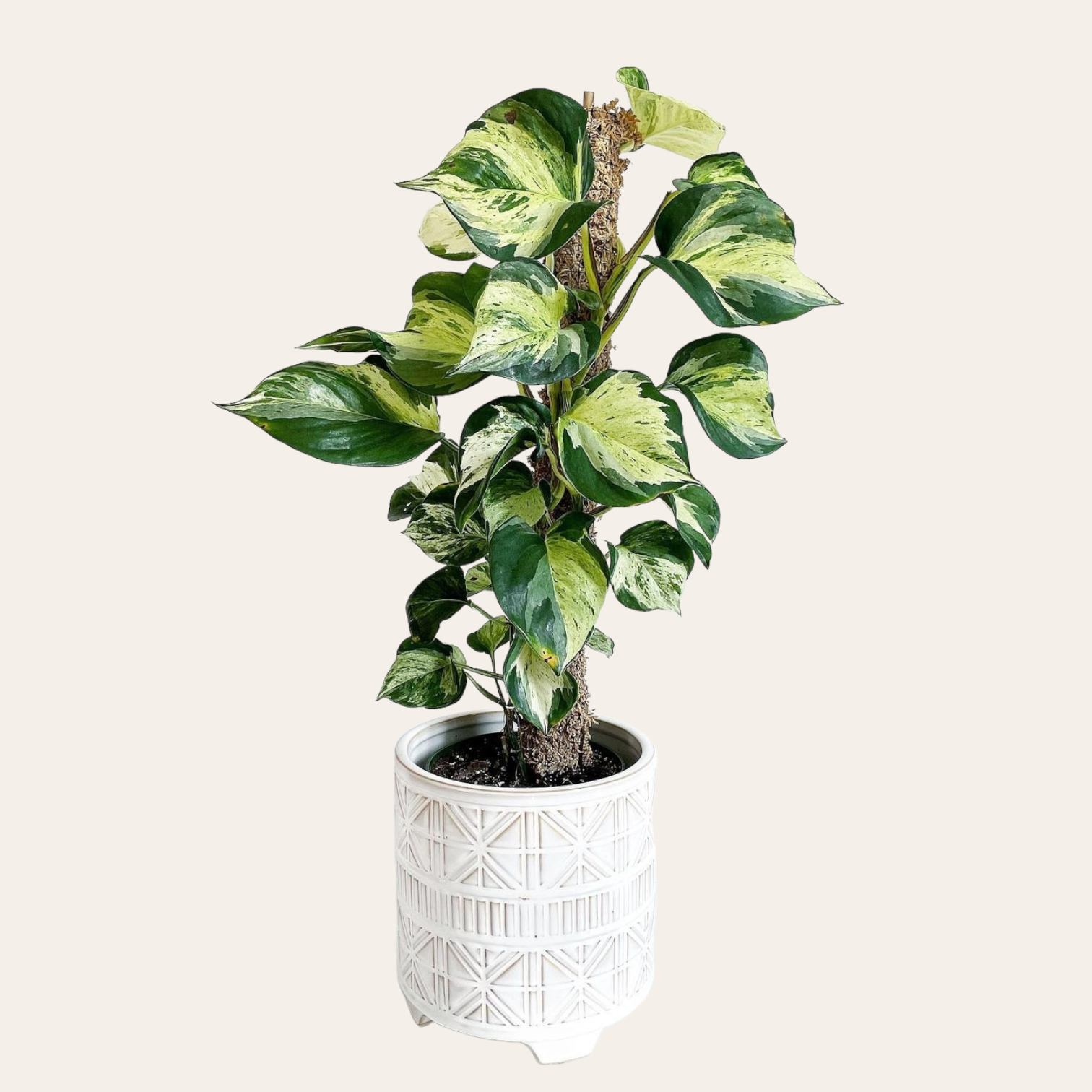
is manjula pothos rare Money Plant 'Manjula' (Happy Leaf Pothos)

Sale price$22.86 Regular price$25.40
Save 10%

Pay in installments of $6.35 with ShopPay, AfterPay and Klarna

Shipping Estimate
USA
  • USA
  • CAN

Ships within 48 hours · Estimated delivery Jul 22 - Jul 27

Promo Codes Available:

For Your Every Summer RSVP, with Code: SUMMER15

Description

is manjula pothos rare Money Plant 'Manjula' (Happy Leaf Pothos)The Money Plant 'Manjula' is a rare variegated Pothos with a provenance worth knowing: it was discovered in 2010 by Ashish Arvind Hansoti at a commercial greenhouse near Mumbai a natural branch mutation that emerged from over a thousand carefully selected parent plants, tested across 25 generations before being patented as HANSOTI14. The name Manjula is Sanskrit for beautiful or charming and the leaves earn it. Each large, heart shaped leaf is a five

The Money Plant 'Manjula' is a rare variegated Pothos with a provenance worth knowing: it was discovered in 2010 by Ashish Arvind Hansoti at a commercial greenhouse near Mumbai — a natural branch mutation that emerged from over a thousand carefully selected parent plants, tested across 25 generations before being patented as HANSOTI14. The name Manjula is Sanskrit for beautiful or charming — and the leaves earn it. Each large, heart-shaped leaf is a five-colour composition: deep green, light green, lime, cream, and silver-white, all in a softly marbled, blotched pattern unique to every leaf — with wavy, gently frilled edges that no other Pothos variety shares. Growth is compact and mounding before it trails, with short internodes that produce a denser, fuller habit than most Pothos. An Indian plant, born in Mumbai, that belongs in Indian homes.

💡 The Counterintuitive Light Rule — Too Much Bright Light Causes Reversion Most variegated plants lose their patterning in low light. Manjula is different in one specific way: excessive bright light — particularly harsh direct afternoon sun — triggers the plant to produce more chlorophyll, which overwhelms the variegation and causes new leaves to emerge completely green. The ideal is bright indirect light. In India's strong summer sun, keep well away from direct afternoon exposure. A sheer curtain or 1.5–2 m from a south-facing window is the sweet spot.
🌿 Mounding Before Trailing — What to Expect Unlike most Pothos that trail immediately, Manjula begins as a compact, mounding plant with a bushy, upright habit. As it matures it begins to trail and cascade — perfect for shelves, hanging baskets, or trained up a moss pole. The shorter internodes between leaves give it a naturally fuller, denser look than Golden or Marble Queen Pothos at every stage of growth.
☀️

Light

Medium to bright indirect light — 4–6 hours daily. An east-facing window or 1.5–2 m from a bright south or west-facing window is ideal. In low light, white and cream sections revert to green and the plant loses its multi-colour character. In harsh direct sun, the same reversion happens but also with leaf scorch on the cream sections. A grow light at 10–12 hours is excellent for maintaining vivid variegation year-round.

💧

Watering

Allow the top 3–5 cm of soil to dry before watering thoroughly — more conservative than plain Golden Pothos because the higher variegation means less chlorophyll and slower water uptake. The Manjula is prone to root rot if kept consistently moist. Water with filtered or room-temperature water and empty the saucer after watering. In winter, extend the interval to every 2–3 weeks.

💦

Humidity

40–70% — more adaptable than most collector plants, though it thrives in higher humidity. Average Indian indoor conditions are generally fine. The cream and white leaf sections are the first to show brown tips in very dry air — a pebble tray or humidifier helps in air-conditioned rooms. Do not mist the leaves; keep moisture coming from below and around rather than directly on the foliage.

🌱

Growing Media

Light, well-draining mix: 50% quality potting soil or coco coir, 30% perlite, 20% orchid bark. pH 6.0–6.5. Never dense, moisture-retentive soil alone. Repot every 1–2 years in spring, one pot size up. Do not repot into an oversized pot — excess soil holds moisture the roots cannot use and causes rot. Can also be grown in water — a clean vase with node submerged changes easily.

🌾

Feeding

Balanced liquid fertilizer at half strength once a month in spring and summer. Apply to moist soil. The high variegation makes leaves slightly more sensitive to over-fertilizing — half strength is always safer than full. Stop feeding in autumn and winter. Flush soil every 3 months to prevent salt build-up.

⚠️ Common Issues & Quick Fixes

New Leaves Coming Out All Green

Either too much direct sun (triggering excess chlorophyll production) or too little light. First, rule out direct sun exposure — move to pure indirect light. If the plant is already in indirect light, it may need more brightness. Find the middle ground: bright but filtered, and never harsh. Reversion usually corrects within a few leaf cycles once light is dialled in.

Yellow Leaves or Root Rot

Overwatering — the most common Manjula problem. Allow the top 3–5 cm to dry before each watering. If soil is persistently soggy: unpot, trim blackened roots, repot in fresh well-draining mix, and water much less going forward.

Brown Crispy Tips on White or Cream Sections

Low humidity or tap water mineral build-up. Switch to filtered water, boost humidity with a pebble tray or humidifier, and flush soil to clear salt accumulation. Move away from AC vents. Existing brown tips are permanent — trim neatly.

Leggy Growth or Long Gaps Between Leaves

Insufficient light — the plant is reaching toward the light source. Move to a brighter position. Prune leggy stems just above a leaf node; this encourages branching and a fuller habit. The cut stem can be easily rooted in water for propagation.

Spider Mites, Scale or Mealybugs

Inspect leaf undersides and stem joints regularly. Wipe with a soft damp cloth and treat with diluted neem oil or insecticidal soap every 5–7 days for 3 weeks. Maintaining humidity above 50% deters spider mites naturally.

📋 Quick Plant Profile

Botanical Name Epipremnum aureum 'Manjula' (syn. HANSOTI14)
Name Meaning Manjula = Sanskrit for "beautiful" or "charming"
Origin Story Discovered 2010 by Ashish Arvind Hansoti at a Mumbai greenhouse — a natural branch mutation; tested 25 generations before patenting
Common Names Manjula Pothos, Happy Leaf Pothos, Money Plant Manjula
Family Araceae
Signature Feature 5-colour leaf: dark green, light green, lime, cream, silver-white — every leaf unique; wavy frilled edges unlike any other Pothos
Growth Habit Mounding before trailing; compact and dense; shorter internodes than most Pothos
Light Medium to bright indirect; no direct sun; too much sun also causes reversion to green
Watering Top 3–5 cm dry; root rot prone — water less frequently than plain Pothos
Humidity 40–70%; adaptable; pebble tray helpful in AC rooms
Temperature 18°C–30°C; thrives in Indian indoor conditions year-round
Growth Rate Slower than plain Pothos — less chlorophyll = less energy for fast growth
Propagation Stem cuttings in water — easy and reliable; node must be submerged
Display Options Shelf, hanging basket, moss pole, tabletop, water vase
Ideal For Beginners and Collectors, Shelves, Hanging Baskets, Offices, Gifting
Care Level Easy to intermediate — avoid overwatering and direct sun; otherwise forgiving
Shipping Notes
  • Free Standard Shipping on $100+ Orders to the USA.
  • Except Preorder products are shipped in 48 hours.
  • Delivery to the USA:
  1. Standard Shipping : 3-10 business days
  • If time is of the essence, please consider selecting expedited delivery for faster service.
Exchange/Return Notes
  • We offer a 30-day return/exchange service after receiving.
  • Final sale items are not eligible for returns or exchanges.
  • To process your return/exchange, please contact us at [email protected]
  • Please click here for more details>>> Return & Exchange Policy
SKU: 67195194021

Discover Niche Categories That Outsell is manjula pothos rare

Top-Converting Item to Boost Your Average Order

4.8 ★★★★★
Based on 9 reviews
Sort
Highest Rating
Newest First
Oldest First
Product Reviews
J
Verified Purchase
jc
Cuba, US
★★★★★ 4
The basic set-up is relatively easy which was a big plus for me......
First let me start off by saying that I am not an audiophile. So, this review will not get into the weeds of the more complex settings this receiver is capable of. For example, the Dirac room measuring option. No way was I attempting to mess with that. Especially, after reading that some reviewers who actually have experience with Dirac found it could be confusing/difficult to set up. Besides I come from a previous Onkyo the TX-SR607 which had the AccuEQ Room Calibration similar to this receiver, so I used that instead with no issues. As far as hooking up the speakers it's pretty straight forward. If you have banana plugs, use them, seriously. I originally planned on using banana plugs but in order to save time I decided against that. But I wish I had taken the extra time to go with bananas because trying to thread the speaker wire into the speaker terminals is tedious, there not much room between the terminals and even me with my skinny fingers struggled a bit. Wish Onkyo designed their terminals side by side, but I think only Denon does that. Anyway, after all the speakers were connected (I'm currently using a 5.1.2 setup) and I connected my tv, Blu-ray player, CD player, etc., etc., I ran the AccuEQ Room Calibration, and I was good to go. I did change the some of the settings like speaker volume that AccuEQ has set but nothing major. I have noticed that I need to turn the volume up much higher on this Onkyo than on my previous one. What I mean by that is that on my previous Onkyo I would set the volume indicator at around 30-35 tops for movies. With this one it's more like 40-45, maybe how the volume is measured is different on this one. The sound is excellent for movies and music I have no complaints there. I have only tried a few of features so far like Airplay but will dig deeper into the manual (I downloaded from the internet) as time goes by. I will say as far as build quality is concerned it's not bad, but IMO my old Onkyo, a 2009 model, had the look and feel of a more expensive receiver. But it's what's inside that matters most so hopefully this one last as long as my previous Onkyo.
WAS THIS REVIEW HELPFUL?YesReportShare
Reviewed in the United States on February 22, 2024
J
Verified Purchase
JOKER
Waukegan, US
★★★★★ 1
Sound unexpectantly blasted for no reason. It malfunctioned!
I spent hours between installation and set up! I had to return it. I turned on NET (network) to play Sirius Xm and the volume was low but after a few minutes the sound turned all the way up to maximum completely on its own? This happened at least two more times. I contacted ONKYO and was told it is clearly defective and that their is no solution to correct the problem, and that I should return it immediately! I purchased the newer model and am pleased with its performance! It’s unfortunate because the first one that had the issue with the sound really played nice, but having sound change its volume so suddenly to its full capacity was not what I expected, nor felt comfortable enough to keep as I said I was told to return it, which I did! My advice here would be to purchase the newer model, which seems to be much more stable in its performance, and the quality is excellent.
WAS THIS REVIEW HELPFUL?YesReportShare
Reviewed in the United States on November 29, 2025
B
Verified Purchase
Bossman
San Leandro, US
★★★★★ 5
Absolutely Love This Receiver
The Onkyo TX‑NR7100 has completely transformed my home theater. The sound quality is rich, detailed, and powerful, and the 9.2‑channel setup gives movies and music a level of immersion I didn’t realize I was missing. Dirac Live right out of the box is a huge win — the room correction made an immediate, noticeable improvement. Setup was smooth, the interface is clean, and everything from streaming to switching inputs feels fast and reliable. It also plays perfectly with the rest of my system, and the THX certification really shows in how cinematic everything sounds. I absolutely love this receiver. It’s one of those upgrades that makes you wonder why you didn’t do it sooner.
WAS THIS REVIEW HELPFUL?YesReportShare
Reviewed in the United States on February 20, 2026
J
Verified Purchase
James Tepper
Massapequa, US
★★★★★ 5
Incredible 9.2 Surround receiver at an unbeatable price.
I may return at a future date to give a more complete review, but others that are much more knowledgeable about audio equipment than I have already done so. For me, the Onkyo (Onkyo TX-NR7100 9.2-Channel 8K/4K Network A/V Receiver) replaced a much older (2001) TX DS787 5.1 100 W Surround receiver that listed new for around $1050. I probably didn't pay quite that much but certainly something near $900. It was great for its time, perhaps even advanced with THX, Dolby, and other listening modes. But it didn't have: HDMI inputs or outputs, any BlueTooth capability, no hard wired or WiFi connectivity or basically any operating or connection modes that most all modern receivers have. This turned into a big problem with modern LED/LCD/OLED TVs, Alexa and other now common devices. I bought my new Onkyo TX-NR7100 from Amazon for $625. Other retailers (e.g.Best Buy) advertise it for up to $1200, so Amazon's price is outstanding. Set up was far more complicated (for me) than any previous receiver that I ever owned, mostly because there were a very large number of back panel input and output jacks, to and from the TV, as well as speaker outputs for 9.2 surround. Suffice it to say that once everything was connected properly (I made a few mistakes along the way), I was completely thrilled. The On Screen Display, completely accessible either from the front panel or the remote was far superior to anything I had ever seen before. Literally every operating parameter is accessible to the user. And I used most of them. It is also completely WiFi ready so my 150 Gbit home Wifi network lets it connect wirelessly and stream music error free. BlueTooth is also another way to connect almost any device to it for audio and audio/video playback if you connect the digital connections to and from a modern TV. It also speaks and listens to Alexa, although I must confess that I haven't played around with that much yet. This is already much longer than I had intended, so let it suffice to say that the Onkyo TX-NR7100 is an absolutely incredible receiver for an incredible price. I'd give it 8 stars if I could. JM TEPPER
WAS THIS REVIEW HELPFUL?YesReportShare
Reviewed in the United States on November 7, 2024
B
Verified Purchase
Brian M.
Birmingham, US
★★★★★ 5
Sounds great.
Just received my Onkyo TX-NR 7100, watched a few YouTube videos before it arrived, so set up was easy. Ran accuEQ, I am getting new front speakers so I’ll wait to run Dirac. After accuEQ, I still had to make a few adjustments, to the speaker levels and especially the sub. It set my subwoofer way too low. As of right now having no problems with Bluetooth. I’ve only listened to music so far, can’t wait to watch a movie. For now I have a 5.1.2. System, getting new fronts, the Klipsch r51-m’s will go to the rear surround and Klipsch r41-m’s will be my height speakers in a 5.1.4 system. So far loving this avr. Update 2: Just calibrated with Dirac for the 6th time. They tell you if you sit in a recliner, reclined measure with it reclined. Well I measured with the chair in its upright position. It makes a huge difference I hear the surrounds much better. Btw I listen to all channel stereo, I know audiophiles say it sucks, however I listened to 2 channel stereo for 20 years, when there was nothing else. I didn’t buy a 9 channel avr to listen to 2 channel stereo. Like Randy the cheap audio man says “ audiophiles aren’t always right. If it sounds good to you, that’s all that matters.” So try calibrating in the upright position, or if you sit on a stationary chair or couch, try positioning the mic slightly forward of your listening position. It makes a huge difference. Hope this helps, enjoy. Update: Ok bought Klipsch rp-600m speakers for the front with 52c center. 51m surrounds, 41m rear heights. Polk owm3 front heights. Why Polk? Lighter easy to hang and as height speakers they are only there for atmos. Ran Dirac live, the application does what it would take several hours to make it sound like it does, if I even could get it to sound so good. Apple TV 4K with my Hisense U8K. The google tv interface is ok, but Apple TV is faster and easier. The Onkyo 7100 is a gem, runs pretty warm but I have it out in the open. If you are going to put in a cabinet I suggest a fan. Very happy with the whole system.
WAS THIS REVIEW HELPFUL?YesReportShare
Reviewed in the United States on January 11, 2025

recommand products