SKU: 6975733597
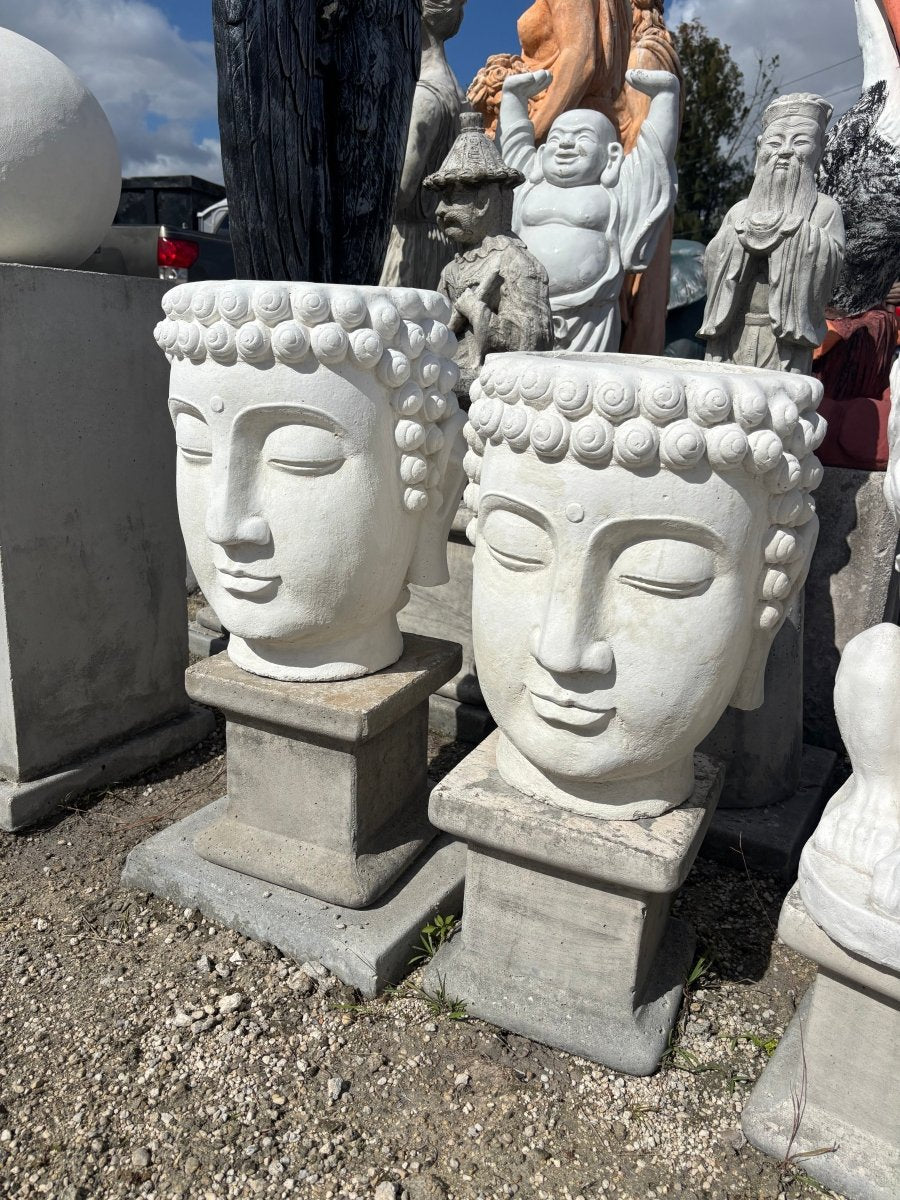
buddha face planter pot

buddha face planter pot Buddha Planter

Sale price$25.88 Regular price$28.76
Save 10%

Pay in installments of $7.19 with ShopPay, AfterPay and Klarna

Shipping Estimate
USA
  • USA
  • CAN

Ships within 48 hours · Estimated delivery Aug 15 - Aug 20

Promo Codes Available:

For Your Every Summer RSVP, with Code: SUMMER15

Description

buddha face planter pot Buddha PlanterConcrete Buddha Head Planter Modern Garden & Landscape Decor Elevate your garden or patio with our handcrafted concrete Buddha head planter. Durable all weather design, 19 tall with 9 planter cavity perfect for homeowners, landscape designers, and architectural projects. Its robust concrete construction, weighing approximately 100 pounds, endures the elements, ensuring a lasting tribute to peace and calm. With an inside diameter of 9 inches, this

Concrete Buddha Head Planter | Modern Garden & Landscape Decor

Elevate your garden or patio with our handcrafted concrete Buddha head planter. Durable all-weather design, 19″ tall with 9″ planter cavity — perfect for homeowners, landscape designers, and architectural projects. Its robust concrete construction, weighing approximately 100 pounds, endures the elements, ensuring a lasting tribute to peace and calm. With an inside diameter of 9 inches, this planter beautifully showcases your favorite flora, allowing you to create a personal oasis of peace directly in your home or garden. Elevate your outdoor aesthetics and invite tranquility into your everyday life with this captivating piece.

📐 Designer-Friendly Specs (Easy to Scan)

Specification Details
Height 19″ (imposing presence) 
Approx. Weight ~100 lbs (super stable) 
Inside Planter Diameter 9″ (planting space) 
Material Durable outdoor-grade concrete 
Finish Natural stone-like, neutral tones 
Style Sculptural Buddha head planter

These dimensions ensure the Concrete Buddha Planter offers both presence and practicality, fitting seamlessly into a variety of outdoor spaces while accommodating a wide range of plant choices.

Note (Designers): Dimensions and weight support detailed project specs — can be integrated into planting plans and renderings.

Detailed Dimensions

The Concrete Buddha Head Planter is designed to add majestic elegance to your outdoor space with its significant yet practical dimensions. Below is a closer look at its specifics:

  • Total Height: 19 inches - provides an imposing visual aspect while maintaining a balanced presence.
  • External Width: 15 inches - complements its height, offering stability and a proportional aesthetic.
  • Internal Planter Depth: 12 inches - ideal for accommodating a variety of plant species, allowing roots plenty of space for growth.
  • Concrete Thickness: 1.5 inches - ensures sturdiness and durability, protecting it against weather elements over time.

With these dimensions, the planter seamlessly merges art and utility, making it a versatile choice for enhancing the serenity and beauty of your garden. Quality materials and meticulous craftsmanship come together to create a truly timeless piece that will add a touch of zen to any outdoor space.

Handcrafted Beauty

The Concrete Buddha Head Planter is not just an ordinary garden accessory - it's a work of art. Each planter is handcrafted using traditional techniques, resulting in slight variations that make each piece unique. The intricate details of the Buddha head are carefully carved into the concrete by skilled artisans, adding character and depth to the overall design. This level of craftsmanship ensures that your planter is not only beautiful but also durable and long-lasting.

Versatile Design

The neutral tone and classic design of the Concrete Buddha Head Planter make it a versatile addition to

Our Concrete Buddha Head Planter is handcrafted with high-quality concrete, ensuring superior strength and durability. The intricate detailing of the Buddha's face adds to its artisanal appeal, making it a stunning addition to any outdoor setting.

This planter's timeless design makes it suitable for a wide range of outdoor spaces. Whether you have a modern or traditional garden, this piece can effortlessly blend in and add an element of serenity. Its neutral color also allows it to complement various plant colors and types, giving you endless possibilities to create your personal oasis.

Maintenance and Care

To maintain the beauty and longevity of your Concrete Buddha Head Planter, we recommend regular cleaning and proper care. Here are some tips to help you keep your planter looking its best:

  • Cleaning: Use a soft cloth or brush to remove any debris from the surface of the planter. You can also use a mild soap and water solution for tougher stains.
  • Protecting against weather elements: It is recommended to protect your planter from extreme weather conditions such as heavy rain, snow, or direct sunlight. This will help prevent any damage or fading over time.
  • Sealing: To ensure maximum durability, we recommend sealing your planter with a concrete sealer at least once a year.

Final Thoughts

The Concrete Buddha Head Planter combines timeless beauty and practicality, making it a must-have for those who appreciate art and tranquility. Its handcrafted design and durable construction make it a worthy investment that will enhance the aesthetics of your outdoor space for years to come. So why wait? Bring home this exquisite piece today and create your personal sanctuary of peace and calm. Whether you are an avid gardener or simply looking to add a touch of elegance to your outdoor space, the Concrete Buddha Head Planter is sure to impress. So go ahead, elevate your garden's aesthetic with this exquisite piece and bask in its serene presence. Additionally, check out our other concrete garden decor pieces like statues and fountains to complete your tranquil oasis.

Durability of Concrete Planters

Concrete planters are renowned for their durability and long-lasting properties, making them an ideal choice for outdoor gardening enthusiasts. The robust nature of concrete allows these planters to withstand various weather conditions, from the intense heat of summer to the chilly winds of winter, without suffering damage. Unlike other materials that may deteriorate quickly, concrete retains its strength and aesthetic appeal over many years. This makes concrete planters a reliable option for those looking to invest in garden accessories that offer both enduring quality and timeless beauty. Furthermore, the heavy weight of concrete helps to anchor the planter, ensuring stability even in strong winds. With proper care and maintenance, a concrete planter can serve as a steadfast centerpiece in your garden or patio, showcasing your favorite plants while maintaining its appealing appearance for decades. Upgrade your outdoor gardening experience with the Concrete Buddha Head Planter and enjoy its longevity, beauty, and versatility.

How Concrete Statuary Adds Value to Your Home

Incorporating concrete statuary in your home garden is not just about enhancing its aesthetic appeal; it's also an investment in property value. Concrete statuary, like the Buddha Head Planter, introduces a unique artistic element that can set your garden apart and create a focal point that draws attention and admiration. This aesthetic enhancement can contribute to increased curb appeal, which is a crucial factor in real estate valuation. In addition, the durability and low-maintenance nature of concrete statuary ensures that these artistic pieces remain in excellent condition over time, adding lasting value to your outdoor spaces. Whether you're looking to create an inviting atmosphere for guests or potential buyers, or simply want to establish a peaceful sanctuary for yourself, concrete statuary offers a powerful way to increase the allure and valuation of your home. Consider adding beautiful, handcrafted pieces to realize their full potential in contributing to both the beauty and financial appreciation of your property.

❓ FAQs

Q: Can this planter be used outdoors year-round?
A: Yes — the concrete is formulated to resist weather, freeze/thaw cycles, and outdoor conditions when properly cared for. (We also recommend sealing annually for longevity.)

Q: What plants work best in this planter?
A: Medium to large ornamental grasses, succulents, flowering annuals, and small shrubs all thrive here — especially with proper drainage and soil mix.

Q: Is this piece suitable for commercial projects?
A: Absolutely — its weight and scale make it ideal for high-impact landscape features in hospitality, public gardens, and design-driven projects.

Shipping Notes
  • Free Standard Shipping on $100+ Orders to the USA.
  • Except Preorder products are shipped in 48 hours.
  • Delivery to the USA:
  1. Standard Shipping : 3-10 business days
  • If time is of the essence, please consider selecting expedited delivery for faster service.
Exchange/Return Notes
  • We offer a 30-day return/exchange service after receiving.
  • Final sale items are not eligible for returns or exchanges.
  • To process your return/exchange, please contact us at [email protected]
  • Please click here for more details>>> Return & Exchange Policy
SKU: 6975733597

Discover Niche Categories That Outsell buddha face planter pot

Top-Converting Item to Boost Your Average Order

4.3 ★★★★★
Based on 13 reviews
Sort
Highest Rating
Newest First
Oldest First
Product Reviews
P
Verified Purchase
Piotr S.
Boise, US
★★★★★ 5
good quality
Format: Hardcover, Format: Hardcover
Content is top notch as always. My 5-stars go mainly to reflect print quality of the book. Text is nice and clear, binding is done in proper cloth spine binding as you would expect from hardcover edition. Ordered my book on Feb 5th, 2019 and received it on Feb 11th, 2019. The book feels solid not like to fall apart right away. No issues like those reported for "Real-Time Rendering, 4th Edition" or "Physically Based Rendering: From Theory to Implementation 3rd Edition" or "3D Math Primer for Graphics and Game Development, 2nd Edition". This one is a keeper, so sad some other CG books had to go beacuse of the quality "issues".
WAS THIS REVIEW HELPFUL?YesReportShare
Reviewed in the United States on February 13, 2019
T
Verified Purchase
Tyler aldrich
Pawtucket, US
★★★★★ 4
An Invaluable Book
Format: Hardcover, Format: Hardcover
Game Engine Architecture" by Jason Gregory has proven to be a treasure trove of knowledge, especially in the realms of lower-level computer programming and the inner workings of CPUs. The first third of the book, which I have thoroughly enjoyed, dives deep into the intricacies of memory management and concurrent programming. Gregory’s explanations are so lucid and engaging that the complex concepts of memory orders such as relaxed, release, and acquire have become clear to me, showcasing their critical roles in programming. What is particularly remarkable is how the book's first 400 pages serve not just as a guide to game engine architecture, but also stand on their own as an excellent introduction to computer science. It's a testament to the author's skill in distilling complex material into digestible content that even those without a vested interest in game development would find immense value in. However, a caveat I must mention is the book's physical heft. Its size and bulk make it somewhat unwieldy, and I learned this the hard way when it fell from my desk. The impact caused the page binding to tear away from the hard cover, which was disappointing considering the book's cost. Nevertheless, with some craftiness involving thick drawing paper and glue, I managed to repair it. If the author adds any more information to the next edition, it'd probably be best to turn this into a 2-3 volume set to manage the size. Despite this setback, the book remains an invaluable resource. Its depth and clarity are unmatched, making it a worthy addition to any tech enthusiast's library. Just be sure to handle it with care.
WAS THIS REVIEW HELPFUL?YesReportShare
Reviewed in the United States on November 11, 2023
G
Verified Purchase
ghostwriter
Chelsea, US
★★★★★ 5
Much thicker than I expected!
Format: Hardcover
This book is massive and could easily be split into two or three volumes, which is great because it covers a very deep topic. It will be a while before I read the book from cover to cover, but the few chapters I've skipped to were able to help me immediately on some problem areas in a game engine that I built last year. I would definitely recommend this to anyone interested in video game development.
WAS THIS REVIEW HELPFUL?YesReportShare
Reviewed in the United States on June 14, 2021
J
Verified Purchase
Jessica Jarrett
Lake Worth, US
★★★★★ 5
Kickstarts your knowledge of game dev
Format: Hardcover
This book hits on all cylinders, condensing decades of actionable knowledge about game development into a single source. There's a lot more to game dev than what's in this book, but this gives fantastic usable detail on many subjects and gets you oriented with and pointed in the right directions for the few it doesn't.
WAS THIS REVIEW HELPFUL?YesReportShare
Reviewed in the United States on July 1, 2021
G
Verified Purchase
gloine36
Pawtucket, US
★★★★★ 5
One of my favorite books and the inspiration for my World Regional Geography courses that I teach.
Format: Hardcover
Two decades ago when I served in the Missouri National Guard we had an extended drill weekend at Ft. Leonard Wood for a live fire artillery exercise. This was a three day drill and I remember it clearly because it was the same weekend as Princess Diana’s funeral on September 6, 1997. I had been at the local library the day before we rolled out and saw an interesting book that promised to explain why western civilization had been the one to colonize the New World and rise to ascendency over much of the world for a long period of time. That had always been an interesting question for me and one which many people do not know the answer to. I checked out the book and during some downtime I began to read. To say that the book grabbed my attention is an understatement. I started it on Friday and finished it on Saturday. My whole conception of how history had seen the rise of Western Civilization was fundamentally altered and would never be the same. At the time I thought that using Guns, Germs, and Steel as an educational tool would be a great idea. My dream of teaching history had never been realized and in 1997 seemed like it would never happen. However, history is full of strange things and in 2009 I got the chance to return to college and pick up my degrees. I began teaching American History in 2013 and was then asked to teach World Regional Geography for the Spring 2014 semester. They handed me a textbook and said, “Good luck.” As I drove back home I considered how I would teach this course and my mind recalled Jared Diamond and his Pulitzer Prize winning book. To make the story short, I built a course that used the textbook, Diamond’s book, and the National Geographic series based on the book. Obviously I take what Diamond said in Guns, Germs, and Steel seriously. I think Diamond did some outstanding work in doing three decades of research and then writing a book which to me is resonates with readers. For many years the idea that Western Civilization was superior to any other form has been the dominant world view. Diamond rejects that completely by saying Western Civilization had advantages that others did not have due to geography, or literally where it was. When you stop and think about it, why were the Europeans so superior to others for so long? Was it their race, their ideals, or what? Diamond said it was because of where they started that they developed into the world spanning civilization we know. What advantages did the Europeans have over others? They arrived with technology superior to all others, were better organized, and had the lethal gift of germs which in the Americas killed over half the population and was the biggest reason as to why the Europeans took those lands over. When Diamond explored the germ theory he realized that these germs came from contact with domesticated mammals such as horses, cows, pigs, chickens, sheep, and goats. These same mammals were what enabled Europeans to transport materials as well as have a convenient food supply and a power source such as horses pulling plows. This idea works when you look at the Americas and Australia, but not when you look at Africa and Asia. The lethality of germs did not affect the people in those regions like it did the Americas. In fact, some of the diseases in Africa killed the Europeans and prevented them for exploiting Sub-Saharan Africa for centuries. Some of these germs are now known to have come from Asia as well along with domestic animals that came from there. Many of the larger mammals Europe had were also found in Asia. In fact, some of the technology such as gunpowder came from Asia as well. Diamond acknowledged this in his book and sought to explain why Europe was able to expand while Asia did not. This is something I really stress in my class and it is something which the book and National Geographic series does not explore as deeply as it should. Diamond saw a decision made in the 15th century by a Chinese emperor as being the decisive event that altered human history. At that point China was the leading power in the world. It had a great navy, the largest country, gunpowder, advanced technology and far more people thanks to its agricultural practices than any other nation at that time. The decision by emperors in China’s Ming dynasty led to China losing its technological advantage over Europe although no one had any idea that this was happening. These decisions or orders are called Haijin. Diamond did not explore this in any depth other than to point to it and say that China’s inward looking policies which had existed for centuries were the result of its location, its geography. Its singular form of government used Haijin to build up its power at the expense of expanding China’s culture and boundaries. There is a lot here to work with, but Diamond seems to casually bring it up in the book’s epilogue. Instead he focuses heavily on the Americas where his theory of environmental determinism is the strongest. I think he gets the theory right, but in the case of Asia he needed to go deeper. Since Diamond is an ornithologist by education, and his world journey’s focused on New Guinea, I think his point of view was heavily influenced through his contact with hunter-gatherers. His theory is at its weakest in Asia and specifically China. That again reflects his preference for focusing on one type of people versus another. This does not mean his theory is wrong. It just needs expansion and I do not think Diamond will be doing that any time soon. His recent works have dealt with different ideas. Even with this glaring problem, I think this book is outstanding. It does answer the question of why Western Civilization dominated the world for the most part. For my geography class it is a wonderful tool. I focus heavily on how man domesticated two grains from the Middle East, wheat and barley, and built Western Civilization upon them. Coupled with the domestication of large mammals, the forerunners of Western Civilization spread through Europe. Geography played a huge role in why it went west and why there are so many differences between East and West on a cultural level. It also explains why there are such huge differences between North Africa and the lands to the south of the Sahara. The role of geography in shaping mankind is without a doubt the single underlying reason as to why history occurred like it did. This is really hard for students to understand because they seem to have been taught a much different concept prior to taking a geography course. Only by explaining the human-environment interaction do students begin to realize that geography caused man to make decisions which would reverberate for millennia. The people of the Middle East followed the Tigris and Euphrates rivers northwest into Anatolia and out of the desert. Man’s movement west, north, and south with the crops and animals of the Middle East were shaped by geographical barriers. Diamond points out how man overcame these barriers over time. The civilization that was able to do so developed greater technologies than others. He points to both European and Chinese naval developments in this regard. China’s need to continue to build its naval forces was negligible due to a lack of naval enemies while in Europe those enemies were often themselves as nations competed for resources and trade. Since China controlled all of its trade which was mostly internal or land based, its need for a navy was reduced. Europe surged ahead while China languished. In my classes I point to the barriers as we explore the world’s regions. I show how these barriers played such big roles. We play a board game by Avalon Hill that helps to illustrate this as well. Diamond’s book plays a big role in my class and so do his theories. I find it really helps students take the principles and ideas from the first part of the class and begin to apply them to the world regions we study. They are able to make the mental leap to the realization that the people of the world are different for many reasons, the foremost being the place in which they live more than anything else. It helps them to break down and discard the erroneous belief which many of them have regarding their place in the world. Using Diamond’s Guns, Germs, and Steel I am able to use Transformative Learning Theory to overcome the disorientating dilemma they find themselves in at the beginning of class. I could build a new class out of Diamond’s book that encompasses geography, history, and sociology if my school would let me. In fact, I could build two classes out of it. One would focus on why Western Civilization developed like it did and expanded to the Americas while the second one would focus on the development of Eastern Civilization and its failure to expand beyond Asia itself. While courses exist that dive into those ideas, they are built around history more than anything else. Few instructors use environmental determinism in explaining how early mankind developed in the places it did. The ultimate objectives of these courses would be why they developed like they did, not just their history. Diamond has written several other books such as Collapse, The Third Chimpanzee, and The World Until Yesterday. He is Professor of Geography at the University of California, Los Angeles. He has been awarded all kinds of prizes and awards for his research and work in multiple fields. I find it interesting that he began to study environmental history in his fifties which led to this book and many others. This to me is proof that you are not bound by formal rules regarding your education, but rather by using your interests coupled with the research capabilities your education has provided you new careers beckon. This book is a testament to following one’s interests and using one’s intellect. I highly recommend it to all readers. It is one of my favorite books and I have read through it multiple times.
WAS THIS REVIEW HELPFUL?YesReportShare
Reviewed in the United States on September 5, 2015

recommand products