Pay in installments of $6.11 with
 ,
,
 and
and

Shipping Estimate
USA
- USA
- CAN
- USA
- CAN
Ships within 48 hours · Estimated delivery Oct 23 - Oct 28
 Promo Codes Available:
For Your Every Summer RSVP, with Code: SUMMER15
Description
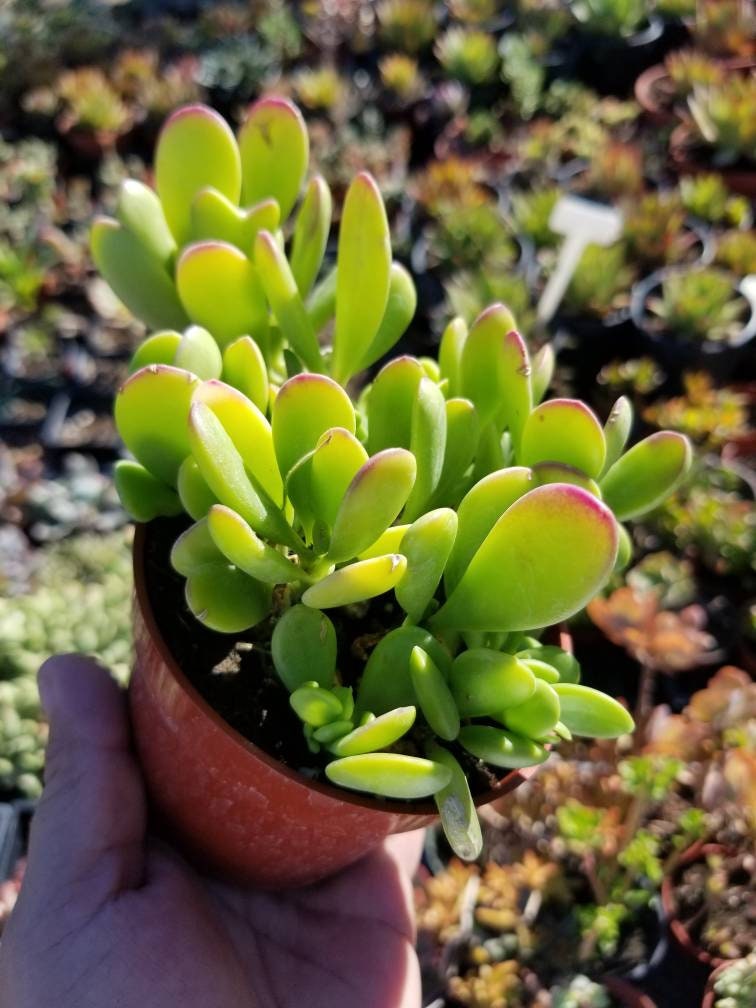
jade plant purple leaves Trailing Purple Jade* Ship Bare root (without pot and soil) Pot size is only notated for your reference. * If you are going plant your cactus or succulent in a pot, have it prepared beforehand with cactus mix soil (recommended), then water lightly. *If you going to plant it into the ground, ensure proper drainage *We Only ship Priority to ensure your Succulents plant will take between 2 to 3 days to arrive, we are not responsible for any the shipping carriers are delays.
* Ship Bare root (without pot and soil) Pot size is only notated for your reference. * If you are going plant your cactus or succulent in a pot, have it prepared beforehand with cactus mix soil (recommended), then water lightly. *If you going to plant it into the ground, ensure proper drainage *We Only ship Priority to ensure your Succulents plant will take between 2 to 3 days to arrive, we are not responsible for any the shipping carriers are delays. * My Jades have really short roots, We reefed to the gallons that are planted in the add so you can see or estimate the actual size of the plant, do not expect to receive any Jade with long roots, That's why these trees are easy to Trim and give a shape as a bonsai tree and plant them in a shallow pot. * We try to ship our succulent plants as soon as we get the order is customer responsibility to be aware of the plant arrival also customers will get a notification by email. If the customer wants to delay or change the day of the shipment please contact us as soon as possible. *We take great care in the packaging of your plants, but unfortunately the same cannot always be said in how they are handled once they leave us .*Is the customer responsibility to purchase a (Heat pack) if the Succulent plant is ship to a cold area, we usually recommended it if the whether is 35* or lower, If you are purchasing a large succulent plant please make sure you buy enough heat pack to cover the plant (1 heat pack every 12") We are not responsible for damages to the Succulent plant if is NOT enough coverage of the heat pack, and if is delay by USPS, the heat only will keep the box warm for 72 hours. https://www.etsy.com/BeautifulDesertPlant/listing/675457833/heat-pack-72-hrs?utm_source=Copy&utm_medium=ListingManager&utm_campaign=Share&utm_term=so.lmsm&share_time=158144198916 Trailing Purple Jade: Habit and Cultural Information Category: Succulent Family: Asteraceae (Sunflowers) Origin: Africa, East (Africa) Evergreen: Yes Red/Purple Foliage: Yes Flower Color: Orange Bloomtime: Fall/Winter Synonyms: [Kleinia petraea, S. jacobsonii, Hort.] Height: Prostrate Width: Spreading Exposure: Sun or Shade Summer Dry: Yes Irrigation (H2O Info): Low Water Needs Winter Hardiness: 20-25° F Senecio jacobsenii (Trailing Jade) - A succulent creeping groundcover with thick succulent stems that root along the ground with green fleshy 2-3 inch long egg-shaped leaves that overlap like shingles along the thick stems and blush an interesting purple color in winter. Never in great profusion, or with much regularity, appear the bright orange rayless composite flowers, usually in fall or winter. The flowers have that rich cheesey smell that is typical of many species of Senecio - though not really pleasant, it is not that strong and less malodorous than some other Senecio. If planted next to a wall, or in a container, the stems drape downwards as much as 4 feet. Uniquely, the leaves and the flower stand upright from the stems. Plant in full sun to light shade and give occasional water. Hardy to 20°F (some say as low as 15°F). Makes a interesting and attractive groundcover, hanging basket or window box specimen. It is a fairly easy plant to grow but resents shady cool moist conditions. In Gordon Rowley's Succulent Compositae he notes (quoting Peter Baily) that "in view of its spreading habit and its high resistance to drought [it] can be recommended for binding soil on steep banks." though Rowley also observed himself that "in succulent collections it is suitable for hanging baskets, but is rather shy blooming." Senecio jacobsenii comes from the highlands of Tanganyika, Kenya and Tanzania and was originally described in 1909 by German botanist Reinhold (Reno) Conrad Muschler (1883-1957) as Senecio petraeus but the name, determined illegitimate by Klas. Robert Elias Fries was changed in 1928 to Notonia petraea. In 1955 Gordon D. Rowley renamed this plant in honor of Hermann Johannes Heinrich Jacobsen (1898-1978) German horticulturist and botanist who specialized in succulent plants. This plant has also been called Kleinia petraea and Notoniopsis petraea and the correct name is still in debate today. The information on this page is based on research conducted about this plant in our library and from reliable online sources. We also take into consideration observations of this plant in our nursery crops, as well as of plants growing in the nursery's garden and those in other gardens we visit. We also will incorporate comments that we receive from others and welcome getting feedback from anyone who may have additional information, particularly if it includes cultural information that would aid others in growing Senecio jacobsenii.Shipping Notes
- Free Standard Shipping on $100+ Orders to the USA.
- Except Preorder products are shipped in 48 hours.
- Delivery to the USA:
- Standard Shipping : 3-10 business days
- If time is of the essence, please consider selecting expedited delivery for faster service.
Exchange/Return Notes
- We offer a 30-day return/exchange service after receiving.
- Final sale items are not eligible for returns or exchanges.
- To process your return/exchange, please contact us at [email protected]
- Please click here for more details>>> Return & Exchange Policy
4.9 ★★★★★
Based on 23 reviews
Sort
Product Reviews
★★★★★ 5
SUPERB FOR AGGRESSIVE CHEWERS
Color: Betty Bigfoot
Our Silver Lab, Theo, is a VERY aggressive chewer who loves destroying balls! We bought Barkbox Betty for Theo’s Birthday, and it was almost a week before Theo removed the cover when he discovered the ball inside and he loves it! And it’s tough design seems to be holding up! Eager to figure out if it floats!
We will definitely buy this high quality toy again!
WAS THIS REVIEW HELPFUL?YesReportShare
Reviewed in the United States on February 22, 2026
★★★★★ 4
Too hard and heavy.
Color: Fowl Play
Very cute idea but my dog was not at all interested. It’s too hard for her to chew on. She didn’t even care enough about it to rip the outside. It’s hard and heavy. I will stick with the non-super chewer bark toys. They don’t last as long, but she loves them.
WAS THIS REVIEW HELPFUL?YesReportShare
Reviewed in the United States on September 2, 2025
★★★★★ 5
Tough & fun!
Color: Betty Bigfoot
This is my puppy’s favorite toy. I’ve bought 4 in case he eventually finds a way to destroy the ball because he is a 1 year old super-chewer. That said, this ball is TOUGH! It’s taken severe abuse from our dog & we couldn’t be more satisfied.
WAS THIS REVIEW HELPFUL?YesReportShare
Reviewed in the United States on April 19, 2026
★★★★★ 1
Not as tough as they make it seem
Color: Buck Wild, Color: Buck Wild
My dog chewed it up and destroyed it in less than 4 hours. I have a GSP 8 month old. She’s definitely a super chewer but this didn’t last at all. The tail crumbled apart and she ate some of it.
WAS THIS REVIEW HELPFUL?YesReportShare
Reviewed in the United States on January 23, 2026
★★★★★ 3
This is a HEAVY Toy
Color: Buck Wild
This toy is HEAVY. Really good quality, but my dog hasn’t shown much interest. If you can find a way to get your dog to play with it, I’m sure it would last for awhile.
WAS THIS REVIEW HELPFUL?YesReportShare
Reviewed in the United States on May 25, 2026