SKU: 72159856919
pineapple plant photo

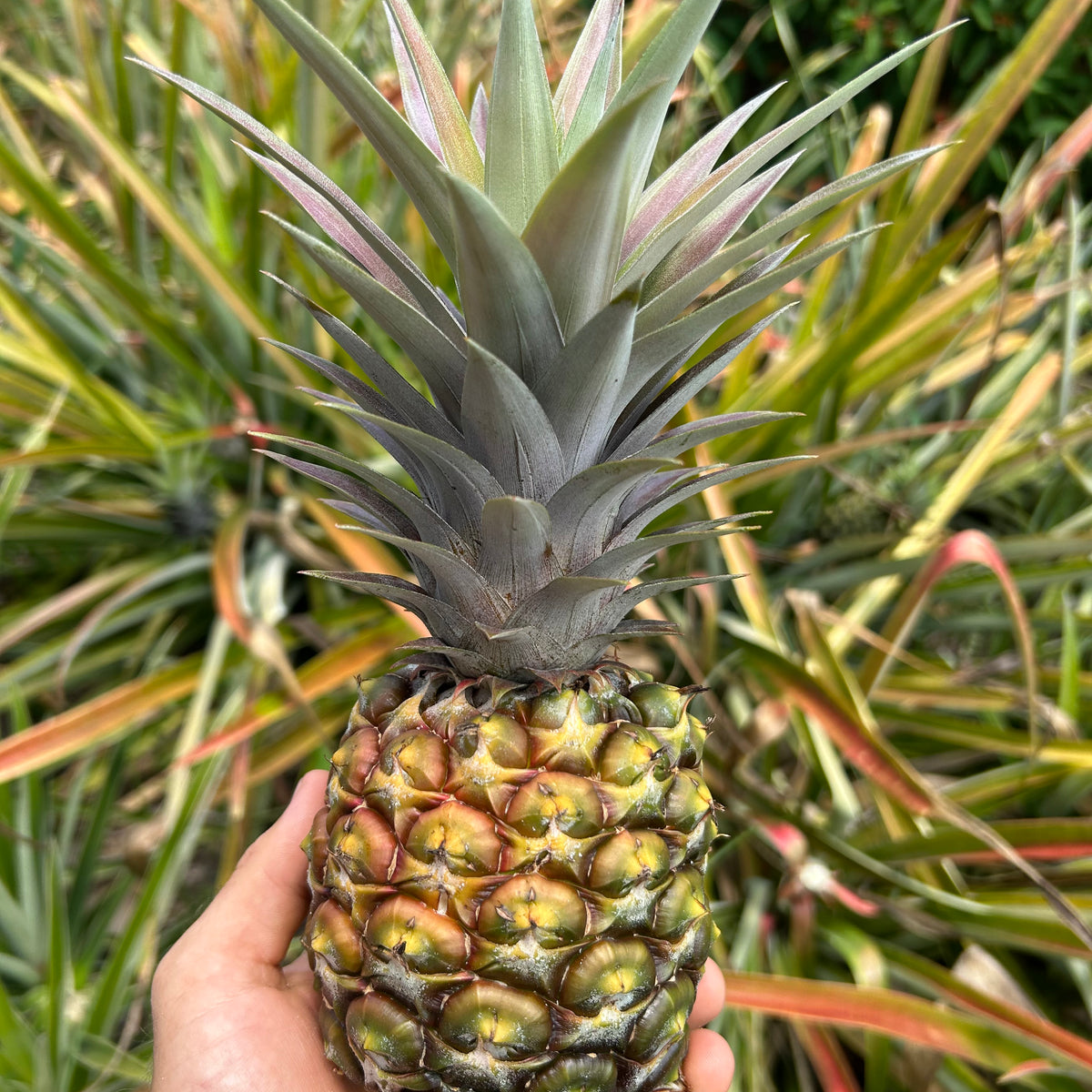
pineapple plant photo Pineapple Plant ‘Sugarloaf'

Sale price$24.17 Regular price$26.86
Save 10%

Pay in installments of $6.71 with ShopPay, AfterPay and Klarna

Shipping Estimate
USA
  • USA
  • CAN

Ships within 48 hours · Estimated delivery Oct 23 - Oct 28

Promo Codes Available:

For Your Every Summer RSVP, with Code: SUMMER15

Description

pineapple plant photo Pineapple Plant ‘Sugarloaf'A large fruit with white flesh and edible core. Very sweet and a favored variety among growers. Common in Hawaii and sometimes referred to as Kona Sugarloaf. The plant has no spines on its leaves. ________________________________________________________________________________________ Latin name Ananas comosus Pineapple plants are one of the most ubiquitous tropical fruit plants. Surprisingly, these bromeliads are in the same family as tree dwelling

A large  fruit with white flesh and edible core. Very sweet and a favored variety among growers. Common in Hawaii and sometimes referred to as ‘Kona’ Sugarloaf.  The plant has no spines on its leaves.

________________________________________________________________________________________

Latin name - Ananas comosus

Pineapple plants are one of the most ubiquitous tropical fruit plants. Surprisingly, these bromeliads are in the same family as tree-dwelling epiphytes like Spanish moss.

The fruits are familiar, highly-palatable, and fun to grow. Pineapple plants prefer well-draining, sandy/loamy soil as their primary nemesis is root-rot. Container-growing your pineapples is absolutely acceptable and they take quite well to fruiting in a pot.

Pineapple plants, although fairly low-growers, create a wide footprint with their broad leaves. Feel free to cut leaves back out of your walking paths. Commercial growers practice this method regularly with no effect on fruit production.

After about 70-80 leaves have been produced (variety-dependent), a pineapple will begin to produce it’s flowering stem. Pineapples are seedless unless grown closely with other varieties or hand-pollinated for seed production. In the wild, pineapples are primarily pollinated by hummingbirds, but zero pollination is required to yield delicious fruits.

Pineapple fruits are high in water content (86%) and provide a rich source of manganese and Vitamin C. You’re likely well-aware that pineapples are widely used in drinks, confections, fruit salads, and straight up.

A little pineapple history…

Pineapples have been cultivated for centuries in their indigenous region of Central and South America, but were not introduced in Europe until the 17th century. It’s moniker is owed to the tendency of European explorers to name any novel round fruits “apples.” 

Explorer John Smith was one of the first to utter the term “pineapple” to describe this fruit in 1624. By the late 1700’s and early 1800’s, wealthy Europeans installed greenhouses or imported pineapples for display purposes, cycling them through use as centerpieces until they began to rot.

In the 1800’s, commercial production of select cultivars like ‘Smooth Cayenne’ began. The ‘Smooth Cayenne’ cultivar achieved worldwide diaspora as it was favored for commercial growth throughout Europe, Hawaii, Australia, and Africa.

How long until my pineapple fruits?

The time from planting to harvest depends on the part of the plant you are using to propagate the pineapple. Use the guide below to set your expectations regarding harvest timeline:

-Pineapple Crowns (the top of the fruit) can produce a new crop within 12-18 months.

-Pineapple Pups/Suckers (off-shoots from the side of the plant itself) can produce a new crop within 18-24 months.

-Pineapple Slips (baby plants taken from the bottom of a pineapple fruit) can produce a new crop after about 24+ months.

When to pick pineapples…

Pineapples typically mature in the warmest months. In South Florida, harvest season rolls from June through September. You can tell your fruit is ready to pick when color change begins and the fruit begins to emit scent. Some gardeners are able to leave their pineapples on the plant until full yellow coloration; Gardeners with rodent pests should pick their fruits as soon as yellow blush appears to avoid loss of your precious fruits.

Once in a while, you may experience the glory of an off-season pineapple at Thanksgiving or Christmas-time.

_____________________________________________________________________

Size - 4’ Wide x 3’ Tall 

Noteable Characteristics - Fruits year after year, and offers more plants (via slips, pups, and crowns) year over year.

Sunlight requirements - Full or Part Sun

Cold hardy temp - Damaged below 50 F; Killed at freezing temps

Harvest Season - June, July, August (an off-season fruit once in a while)


Shipping Notes
  • Free Standard Shipping on $100+ Orders to the USA.
  • Except Preorder products are shipped in 48 hours.
  • Delivery to the USA:
  1. Standard Shipping : 3-10 business days
  • If time is of the essence, please consider selecting expedited delivery for faster service.
Exchange/Return Notes
  • We offer a 30-day return/exchange service after receiving.
  • Final sale items are not eligible for returns or exchanges.
  • To process your return/exchange, please contact us at [email protected]
  • Please click here for more details>>> Return & Exchange Policy
SKU: 72159856919

Discover Niche Categories That Outsell pineapple plant photo

Top-Converting Item to Boost Your Average Order

4.5 ★★★★★
Based on 5 reviews
Sort
Highest Rating
Newest First
Oldest First
Product Reviews
A
Verified Purchase
AlanWarner
Bozeman, US
★★★★★ 5
WHITE MOB JUSTICE
Format: Paperback
More black men were hanged in America in the twentieth century than were hanged during slavery, the author of this book Miss Amy Louise Wood does an excellent job of revealing who and what group of Americans did this whole scale hanging of black men. Many white people who participated and witnessed these hangings were your everyday run of the mill American citizens as stated on page 80-81 "As visual extensions of the lynching itself, photographs could at times assuage crowds that had missed the opportunity to witness and participate in the violence. In 1934, the posse that captured Claude Neal, accused of raping and killing a young white woman named Lola Cannidy, chose to lynch him in the woods outside Marianna, Florida, rather than bringing him to the Cannidy home, where a large crowd had gathered in anticipation of the lynching. When the waiting crowd had discovered that the mob had lynched Neal privately, they were reportedly outraged. The mob finally arrived with Neal's body in tow, and the crowd, which included Cannidy's family, took out their vengeance on the corpse, kicking and shooting it, tearing it apart, and even driving their cars over it. Neal's mutilated, nude body was then hanged on the courthouse lawn in the center of the town, and hundreds of photographs were taken. he next day, as people congregated in the square to see the body, the photographs were sold to those purportedly still incensed that the posse who lynched Neal had denied them the satisfaction and pleasure of witnessing Neal's lynching. The images acted as visual replications of the actual spectacle, offering them vicarious access to the missed thrill of the lynching. The gratification local viewers derived from the images of Neal's lynched body was directly attached to their outrage over Cannidy's rape and murder, their fears of black criminality, and their desires to assert their racial power and superiority in the face of these threats." Another interesting aspect of these mobs is the role religion played in their actions as stated on pages 67 "The performance of a lynching thus created a symbolic representation of white supremacy-a spectacle of demonic and wicked black men against a united and pure white community. That those images coincided with evangelicals' impassioned exhortations against sin gave lynching sacred force and justification. Indeed, the imprint of Protestant language and tropes on lynching rituals and defenses imbued the violence with divine sanction and made it appear familiar and recognizable to a people immersed in Christian beliefs and values. Mobs could thus conspicuously flout the law and perpetrate what otherwise would be considered aberrant and grotesque acts of sadism while considering themselves to be righteous and moral citizens." In the twentieth century the hanging of black men was a major festive event for many on looking white people as can be seen in the pictures on page 32 and also on pages 78 and 79, on page 79 you can see a young white man smiling, on pages 95 and 102 there are more pictures of gleeful white spectators, on page 192 there is crowd participation in this picture of a hanging and burning black man I thank this author for writing this very much needed book.
WAS THIS REVIEW HELPFUL?YesReportShare
Reviewed in the United States on July 6, 2015
C
Verified Purchase
Carole T Emberton
Houston, US
★★★★★ 5
A fresh take on lynching and its place in American culture.
Format: Paperback
A path-breaking study of lynching as spectacle and the meanings such events produced for the masses who attended them as well as for those who saw the photos and postcards afterwards. Wood's visual analysis of these images is impressive and cogent. Her writing is clear and accessible to a wide audience. This is cultural history at its finest!
WAS THIS REVIEW HELPFUL?YesReportShare
Reviewed in the United States on April 17, 2018
P
Verified Purchase
pat delzell
Pawtucket, US
★★★★★ 5
Great book ...disturbing subjet
Format: Paperback
This book explained the rationale for lynching! It was just what I needed for my graduate course!!
WAS THIS REVIEW HELPFUL?YesReportShare
Reviewed in the United States on July 14, 2019
B
Verified Purchase
B. Kirzner
Draper, US
★★★★★ 4
Lynchers Were Worse Than I Thought,
Format: Kindle
It was worth the time and effort to get through this book. It has opened my eyes to the scapegoating of Black victims’ as the evil ones and whites as the religious moral ones. That being said, this book was too detailed, making it slow reading. Overall, it still was and is worth reading to understand this massive projection of guilt and evil on victims, and the taking of justice into mob rule.
WAS THIS REVIEW HELPFUL?YesReportShare
Reviewed in the United States on November 8, 2021
V
Verified Purchase
V. Young
Natrona Heights, US
★★★★★ 5
great book
Format: Paperback
This book was insightful yet the stories was shocking but its a dose of reality. I like the product and its great for my library.
WAS THIS REVIEW HELPFUL?YesReportShare
Reviewed in the United States on June 3, 2014

recommand products