SKU: 73707395252
black rose succulent turning green

black rose succulent turning green Black Rose

Sale price$21.33 Regular price$23.70
Save 10%

Pay in installments of $5.92 with ShopPay, AfterPay and Klarna

Shipping Estimate
USA
  • USA
  • CAN

Ships within 48 hours · Estimated delivery Oct 28 - Nov 2

Promo Codes Available:

For Your Every Summer RSVP, with Code: SUMMER15

Description

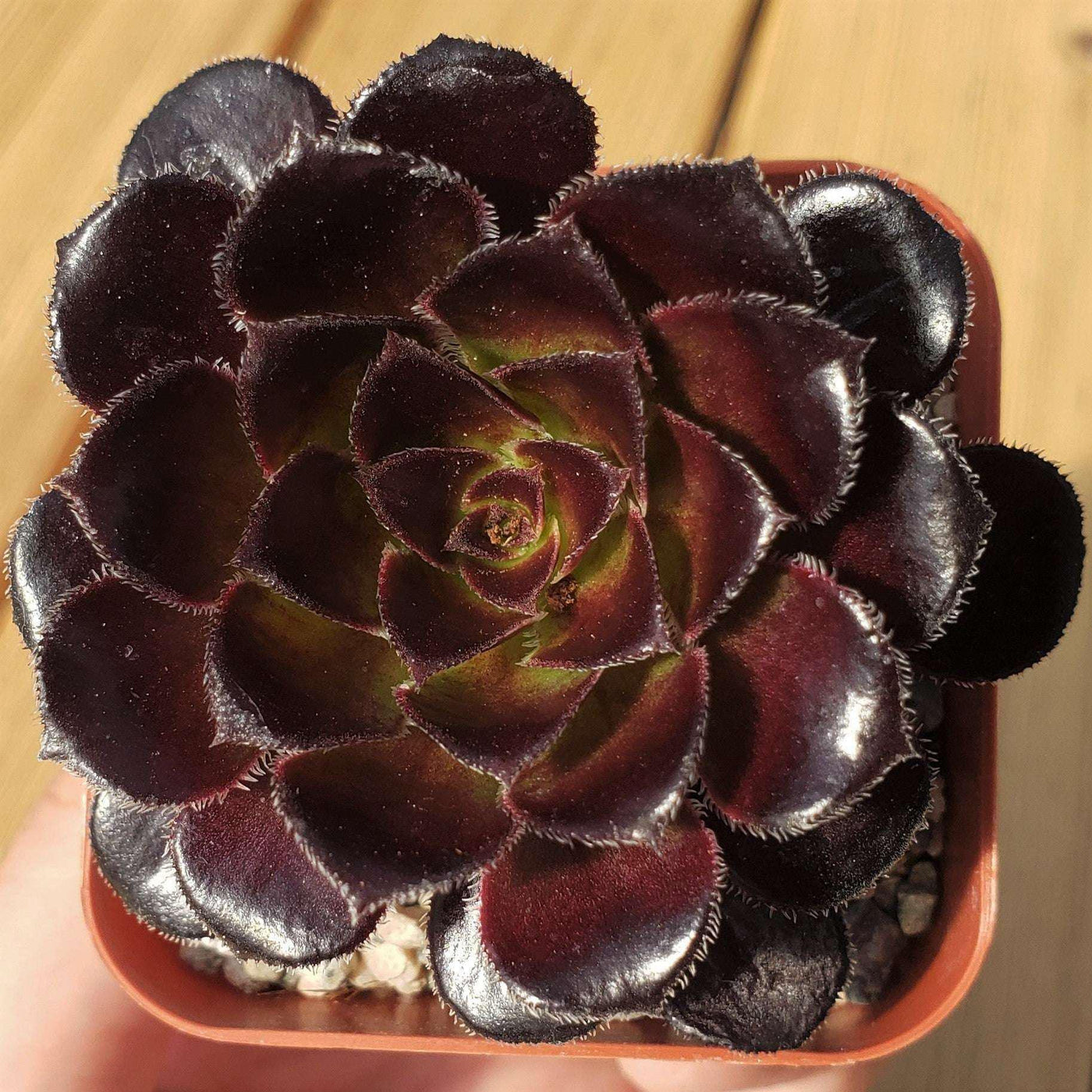
black rose succulent turning green Black RoseIntroducing the black rose, known as Aeonium Zwartkop', a beautiful variety of Aeonium arboreum. The name "Black Rose" comes from its leaves, which have a deep purple black tint that resembles roses. It is not a rose, but a succulent plant from the Crassulaceae family. The black rose Aeonium zwartkop has several other common names, such as Aeonium arboreum zwartkop, Aeonium black rose, purple crest aeonium, Aeonium 'black beauty', or tree aeonium.

Introducing the black rose, known as Aeonium Zwartkop', a beautiful variety of Aeonium arboreum. The name "Black Rose" comes from its leaves, which have a deep purple-black tint that resembles roses. It is not a rose, but a succulent plant from the Crassulaceae family.

The black rose Aeonium zwartkop has several other common names, such as Aeonium arboreum zwartkop, Aeonium black rose, purple crest aeonium, Aeonium 'black beauty', or tree aeonium. 

Hailing from the Canary Islands and reaching 5 feet in height and 3 feet in diameter at maturity, the black rose aeonium forms clumps and is sure to make a statement wherever it's planted.

When grown in full sun, the foliage takes on a deep, almost black color, which is why it's often referred to as the "Black Rose."

When grown in partial shade, the rosettes display a beautiful combination of purple-red hues with a green center. It's such a versatile plant that can add a touch of elegance and drama to any garden or succulent collection.

The flowers of Aeonium zwartkop bloom in the spring and produce clusters of small, yellow, star-shaped flowers that emerge from the center of its rosette-shaped foliage. The contrast between the dark purple-black leaves and the bright yellow flowers creates a stunning display. The flowers attract bees and other pollinators, adding life and movement to your garden.

Being a winter-growing plant, the Aeonium arboreum enters a state of dormancy during the scorching hot summer; during this time, the older leaves simply curl towards their points of growth rather than falling off entirely, giving the appearance of a black rosebud that is about to bloom. It's like a little garden masterpiece!

When and How to Water Your Black Rose  

From fall through spring, during its active growing season, Aeonium 'Black Rose' should be watered every 7–10 days, only when the top 1-2 inches of soil is completely dry. This is when the plant is most active, producing new leaves and expanding its rosettes. If under-watered during the growing season, you may notice the stems shriveling and leaves slightly puckering, but they'll quickly bounce back once hydrated.

In the summer months, when the plant enters dormancy, watering is reduced drastically to every 2–4 weeks or less. Aeonium 'Black Rose' naturally slows its growth or temporarily halts it during hot summer weather, especially in warmer zones or indoor conditions.

The plant conserves moisture during this rest period, so watering too often can lead to leaf drop or root problems. Only water if the plant begins to look overly stressed or if the soil has been dry for a prolonged time, again, always check at least two inches deep before watering.

Light Requirements - Where to Place Your Black Rose Succulent 

When growing the black rose succulent indoors, it's important to provide it with bright, indirect light for at least 4-6 hours a day. Keeping it in a well-lit area will help maintain the deep coloration of its leaves and promote healthy growth.

When grown outdoors, the black rose aeonium thrives in full sun to partial shade. In full sun, the foliage of this succulent turns almost black, which is why it's often referred to as the "Black Rose."

The intense sunlight brings out the deepest coloration in its leaves, creating a striking visual contrast. However, if you prefer a different look, placing it in partial shade will result in rosettes that display purple-reddish hues with a green center.

Remember, if your Aeonium 'Zwartkop' is exposed to too much direct sunlight and is not used to it, then there is a chance that the leaves might get damaged. It's critical to remember that during a heatwave or periods of extreme heat, your black rose succulent can get sunburned. You can protect the plant in this situation by moving it indoors or to a shaded area.

Optimal Soil & Fertilizer Needs 

The Aeonium zwartkop prefers sandy, well-drained soil, as excess moisture can promote root and stem rot. Planting them in ordinary soil will result in compacted roots, stunted growth, and most likely root rot. Instead, make or buy a well-draining potting mix, or ideally use our specialized succulent potting mix that contains 5 natural substrates and mycorrhizae to promote the development of a strong root system that helps your Aeonium succulent to thrive.

A small amount (5-10-5) of NPK fertilizer once a year in the spring will do wonders for your plant's health and growth. Using a natural fertilizer ensures that other beneficial compounds and microbes are added to the soil without the use of harsh chemicals. Show your succulent some love with awesome natural fertilizer and watch it thrive.  

Optimal Indoor Temperature & Humidity 

Aeonium 'Black Rose' thrives indoors at temperatures between 65–75°F with low to moderate humidity levels around 30–50%.

Keep your Aeonium away from cold drafts, heating vents, and sudden temperature changes. Place it near a bright window with indirect light, and ensure the space remains dry and airy to mimic its native Mediterranean-like climate.

Hardiness Zones & More

In the United States, this is mostly an indoor plant, but if you live in southern Florida or Hawaii, then you can cultivate it outdoors in USDA zones 9-12.

They are not cold- or frost-tolerant, you should plant them indoors or put them in a pot.

Move them indoors during the winter if you live outside of these regions. 

As for humidity, this succulent is adaptable and can tolerate average indoor humidity levels. However, it's important to provide good air circulation to prevent any issues with excessive moisture or stagnant air.

Wildlife - Black Rose Succulent Attracts the Following Friendly Pollinators

The Black Rose Succulent is known to attract a variety of friendly pollinators such as bees, butterflies, and hummingbirds with its vibrant blooms and sweet nectar. These pollinators play a crucial role in the plant's reproduction process by transferring pollen from one flower to another, ultimately helping the succulent thrive and produce seeds.

Butterflies
Bees
Hummingbirds
Lady Bugs
Multi Pollinators
Other Birds

According to the ASPCA, the Black Rose Succulent is non-toxic to humans and pets. It is safe to touch and is a popular choice for indoor houseplants due to its unique appearance and low maintenance requirements.

How to Propagate Your Black Rose Succulent

To propagate the black rose aeonium, one common method is through stem cutting. Simply take a healthy stem from the mature plants, making sure it is at least a few inches long. Allow the cutting to dry for a few days to form a callus, which helps prevent rotting. Then, plant the cutting in well-draining soil and keep it lightly moist until roots develop. With minimal water and full sun exposure requirements, this perennial is perfect for those looking for a low-maintenance addition to their garden or indoor space.

Key Takeaways

  1. The Black Rose Succulentis famous for its dramatic, rosette-shaped foliage in deep burgundy to nearly black hues, making it a striking focal point in any garden or collection.
  2. In late winter to early spring, mature plants produce tall stalks with clusters of bright yellow, star-shaped flowers, creating a striking contrast against the dark foliage.
  3. Aeonium ‘Zwartkop’ is highly drought-tolerant, requiring minimal watering, making it an excellent choice for xeriscaping or low-maintenance gardening.
  4. This winter-growing perennial, enters dormancy during hot summers, with older leaves curling towards growth points, resembling a black rosebud about to bloom.

Final Thoughts

Overall, the Aeonium zwartkop (black rose) is a unique and elegant succulent that can be a great addition to any indoor or outdoor space. Its dark foliage adds elegance and can be easily cared for with bright, indirect light indoors or full sun to partial shade outdoors. Keep your black rose aeonium away from cold, drafty windows and air vents if you are growing them indoors in a cold climate. The plant's distinctive black foliage or vibrant purple-reddish hues make it a standout in any garden or indoor decor. Its rosette-shaped leaves and compact growth habit add visual interest and can be a conversation starter.  

Be sure to add the ‘Aeonium arboreum ‘Zwartkop’ (black rose succulent) to your collection today and elevate the beauty of your home or garden, with this stunning-looking plant. 

Shipping Notes
  • Free Standard Shipping on $100+ Orders to the USA.
  • Except Preorder products are shipped in 48 hours.
  • Delivery to the USA:
  1. Standard Shipping : 3-10 business days
  • If time is of the essence, please consider selecting expedited delivery for faster service.
Exchange/Return Notes
  • We offer a 30-day return/exchange service after receiving.
  • Final sale items are not eligible for returns or exchanges.
  • To process your return/exchange, please contact us at [email protected]
  • Please click here for more details>>> Return & Exchange Policy
SKU: 73707395252

Discover Niche Categories That Outsell black rose succulent turning green

Top-Converting Item to Boost Your Average Order

4.5 ★★★★★
Based on 24 reviews
Sort
Highest Rating
Newest First
Oldest First
Product Reviews
S
Verified Purchase
Steve Winters
Port Orchard, US
★★★★★ 4
A Rational Approach To Examine Competing Explanations
Format: Paperback
This is the first book I have read on an investigation into the resurrection event of Jesus. I found Licona’s approach clear and easy to follow. His writing style is very structured which I found to be valuable since he this book is thorough and covers a lot of material. Each chapter Licona begins with a brief outline of what he will cover and then he summarizes his main points at the end as well. Structuring the book this way was very helpful in following Licona’s reasoning and method from beginning to end. Licona begins by laying out his approach to historical inquiry. As someone who is not a historian and unfamiliar with the specifics of how historians approach their work, I found this section very useful in setting the stage for Licona’s investigation. For example, Licona has a section on “horizons,” which he defines as our “preunderstanding.” Essentially, horizons are our own perspectives based on our personal experiences and various influences such as culture, race, political, and religious experiences, that shape how we form our judgments and what we might choose to be an acceptable claim about reality. For example, whether miracles are possible. The goal is to mitigate horizons as much as possible and look at what the evidence has to say on its own. Since the goal of the book is to arrive at a conclusion pertaining to whether Jesus rose from the dead it is important to define what is meant by “best explanation” when we weigh competing hypotheses. Licona devotes a section to set criteria for a best explanation candidate. He establishes five criteria; explanatory scope, explanatory power, plausibility, less ad hoc, and illumination. Licona utilizes this criterion in the final chapter to weigh competing hypotheses. Furthermore, the critical insight that Licona focuses on is what he refers to as the “historical bedrock.” According to Licona, the historical bedrock includes three facts that are virtually undisputed by historians. Licona states his two criteria for the facts as strongly evidenced and those which contemporary scholars unanimously regard as historical facts. He navigates through various historical details surrounding the resurrection of Jesus and narrows down to three bedrock facts; Jesus died by crucifixion, shortly after Jesus’ death his disciples had experiences that led them to believe and proclaim Jesus was resurrected and appeared to them, and Paul’s conversion after experiencing a postresurrection appearance of Jesus within a few years after the crucifixion. Licona claims that the vast majority of scholars grant these facts as historical. With the bedrock laid, now one can weigh competing hypotheses against the bedrock itself to determine which explanation the best accounts for all three facts. As one weighs any available hypotheses against the bedrock facts, the idea is that one can minimize biases and infer the best explanation as to what happened to Jesus in the first century. Ultimately, Licona concludes that the best explanation is the resurrection of Jesus as claimed by Christianity. His conclusion comes after a thorough examination of six common explanations (including the resurrection hypothesis) and showing how each fails to explain at least one of the three facts except for the resurrection hypothesis. He spends a good deal of time interacting with scholarly work on different explanations. Licona concludes that the resurrection hypothesis best accounts for the three bedrock facts as well as fulfills all five criteria for a best explanation. Overall, I thought Licona’s method is thorough and rigorous, ultimately showing that the resurrection hypothesis cannot simply be dismissed. I also found Licona to be very candid. At the end of the book he admits that he was surprised at the “very certain” level which he awards the resurrection hypothesis after applying his method. I would highly recommend this book to anyone interested in learning what can be determined about the fate of Jesus from a historical approach.
WAS THIS REVIEW HELPFUL?YesReportShare
Reviewed in the United States on October 17, 2019
C
Verified Purchase
Chris Slayton
Belleville, US
★★★★★ 5
Excellent book on the historicity of the resurrection!
Format: Paperback
There are many books devoted to the resurrection of Jesus. Licona’s book is unique in that it takes “a new historiographical approach” to the resurrection by applying the principles of secular historical analysis to the question of whether Jesus rose from the dead. In applying the historical method, Licona seeks to understand the objective truth about what happened regardless of his subjective Christian beliefs on the matter. In fact, Licona readily admits his personal bias – or “horizon” – and his desire to see the historicity of the resurrection confirmed. However, as he points out, all historians have a “horizon” of some sort, and in his research and analysis, Licona is careful – some would say too careful perhaps – to set aside his “horizon” in order to objectively consider the evidence. Licona considers a variety of historical sources pertaining to the resurrection, both biblical and extra-biblical, weighing each source on a spectrum of historicity – from “certainly not historical” to “certainly historical.” Licona seeks to find the best explanation for the evidence according to five criteria: plausibility, explanatory scope, explanatory power, less ad hoc, and illumination. After examining the evidence, Licona concludes that there are three virtually undisputed facts that he calls “historical bedrock:” (1) Jesus died by crucifixion; (2) Jesus’ disciples had experiences that led them to believe that he had been resurrected; and (3) Paul converted after experiencing what he interpreted as a post-resurrection appearance of Jesus. Licona then weighs five naturalistic hypotheses for the resurrection, demonstrating how each of these views falls short of providing the best explanation for the historical bedrock. Licona ultimately concludes that the resurrection is the only hypothesis that meets all five criteria. In other words, Jesus’ resurrection from the dead provides the best explanation of the historical bedrock, and the historian is warranted in regarding Jesus’ resurrection as an actual historical event. Licona’s historiographical approach to the resurrection produces a very strong case for the resurrection of Jesus of Nazareth. I particularly appreciated Licona’s treatment of “horizon.” Licona is transparent about his Christian beliefs, but he demonstrates a willingness to go where the evidence leads and bent over backwards to remain objective. For example, Licona does not include the empty tomb as part of the historical bedrock since many scholars dispute the empty tomb. Some would take exception to this, but I believe it actually strengthens the case for the resurrection and leaves the skeptic with very little to argue. In other words, Licona is able to make a convincing case for the resurrection without considering what many Christians consider the best evidence – the empty tomb! I found the book very helpful, but keep in mind it is an academic work, and at over 600 pages, it is not necessarily an easy read. That being said, Licona’s book is outstanding and is a “must-read” for anyone seeking to understand the historical evidence for the resurrection or seeking to counter skeptical arguments against it. This is a great book to add to your library.
WAS THIS REVIEW HELPFUL?YesReportShare
Reviewed in the United States on November 19, 2021
J
Verified Purchase
Jamie N.Campbell
Chelsea, US
★★★★★ 5
A fresh historical perspective to the Resurrection! -by Jamie D.
Format: Paperback
Although there have been countless books written about the Resurrection of Jesus Christ from a theological perspective, few have successfully tackled the Resurrection from the historical perspective. Dr. Licona has successfully done just that, applying a historical methodology to the Resurrection of Jesus Christ. In his opening chapter, Dr. Licona begins by defining what is meant by history, the methods that one employs to study history as well as the limitations that comes when one studies history. It is here that he introduces useful terms to the readers that are re-introduce in subsequent chapter. Horizon, a synonym for bias, can play a critical role in how one perceives and presents history to others. To reduce horizon, Dr. Licona believes that there are six main principles that can help an historian maintain a more objective perspective when reporting history. One of these main principles is that of “historical bedrock” a consensus of what is majorly accepted and infrequently debated. Not only is a consensus important when one considers a hypothesis but a hypothesis that has a solid explanation is important as well. For a hypothesis to have the weight of believability, it must stand up to five different criteria as well. In chapter 2, Dr. Licona then turns his attention to the subject of miracles and their role in history and successfully debunks the most common presuppositions cited by the world’s most famous skeptics against the historicity of miracles. It is in chapter 3 that Dr. Licona employs the historical method to the Resurrection of Jesus Christ by examining both biblical and extrabiblical writings spanning within 200 years of the event. Upon the review of these various writings, he assigns a rating from “unlikely, possible-minus, possible, possible-plus, highly probably, indeterminate and not useful” to determine if they contain any historical weight in its regard to the independent testimony of the Resurrection of Jesus Christ. The historical bedrock principle is re-introduced into chapter 4 and is applied not only to the death of Jesus Christ but to His life as well. Dr. Licona notes that there many aspects of the Jesus’ life and death that are considered historical bedrock even among those with varied agendas. Dr. Licona concludes his book by examining some of the leading naturalistic hypotheses touted from the most prominent liberal and skeptics in this field. By employing the five criteria that gives the historian the most successful explanation, Licona concludes that it is not the naturalistic hypothesis which fits regarding the Resurrection, but the supernatural one. The supernatural hypothesis of the Resurrection is the most solid explanation since it fulfills both historical bedrock as well as meeting all five criteria for the best explanation and thus should be considered by any credible historian as a well attested event that occurred in the past. In summary, I highly recommend this book. As a believer of 40+ years, I learned things about my faith that I did not know about before. For example, I learned how the kerygma, an early Christian creed, lends historical weight to the Resurrection. My advice for believers is not to be intimidated by the voluminous size of this book. It was certainly well worth the read. Dr. Licona has done an excellent job in presenting the material through the perspective of a historian, so much so that one may temporarily forget that he is a theologian as well! Despite the myriad of footnotes peppered through the pages, the book was very easy to read and digest. In short, a must read for those who want to have a better understanding in how to engage skeptics from a different perspective when discussing the Resurrection of Jesus Christ. Get it! You’ll feel that much smarter and grounded in the faith once you’ve read the last page!
WAS THIS REVIEW HELPFUL?YesReportShare
Reviewed in the United States on December 5, 2021
J
Verified Purchase
John Keller
Phoenix, US
★★★★★ 5
Don’t be intimidated...it's detailed, but systematic and rational
Format: Paperback
Don’t be intimidated by this 700-page tome. Once you factor in the bibliography, index and footnotes, the body of the work is only about 400 pages. Licona includes an all-important, detailed outline for quick reference back to key topics, and it’s valuable because of the variety of issues he tackles. I’d say, he does a wonderful job of giving us an objective, systematic approach to addressing the historicity of the events following Jesus’ crucifixion. Licona lays the groundwork for his examination of the issue by considering the philosophy of history and tackling things like what is truth, what makes something a historical fact, who has the burden of proof, and is history a science? As a needed addition to this philosophical introduction, he spends time outlining the methods he will use to approaching relevant texts, claims of miracles, and consensus facts. Most important, I think, to his methods was his self-examination of potential bias due to personal belief and worldview. He addresses what he calls a personal “horizon” that historians must be set aside in order to be objective and get at the truth. He certainly points it out in others along the way and makes it clear throughout the book that he is trying to identify and eliminate any potential bias he may bring to the process. In his investigation, he addresses the most important sources related to Jesus’ life, crucifixion and claims of the resurrection. He deals with both Christian and non-Christian sources that were written immediately following the events as well as within the following 200 years. Licona makes the case for authenticity and credibility of the most important sources, and where there have been challenges to these sources over the centuries, he addresses those challenges head on. Ultimately, he boils the events, claims, facts and sources down to what he calls the “bedrock” pertaining to the fate of Jesus. This bedrock consists of three facts that are well supported by authentic, textual evidence which enjoy nearly consensus support by all historians (both Christian and non-Christian). For Licona, the bedrock which need be answered are (1) Jesus’ death by crucifixion, (2) the claims Jesus appeared to individuals and groups following his burial, and (3) the conversion of the Church persecutor, Paul. Ultimately, Licona breaks down six different hypotheses which claim to explain the bedrock and he uses systematic criteria for weighing those hypotheses. He concludes that a resurrection is the best explanation but admits that it’s only by setting aside a naturalistic worldview that one can embrace the conclusion. I like Licona’s methodical approach but would offer two critiques. Do we really need all the Greek citations written out? I understand that there is nuance and variations in meaning for words that are used in the original sources, but to give us all the text and the translation seemed superfluous. Second, I think it was a cop-out to skim the importance of the empty tomb. Other historians put the fact of the empty tomb as one of their top facts to be explained, but Licona punted on it because he didn’t feel it received universal consensus. Consensus aside, the fact of the empty tomb does receive support by a strong majority of scholars, even ones that do not support the resurrection. This cross-section of scholarly support, along with the volume and type of textural evidence, namely the confirmation by Christian enemies, should have elevated the fact of the empty tomb to the “bedrock” which require explanation.
WAS THIS REVIEW HELPFUL?YesReportShare
Reviewed in the United States on April 12, 2021
E
Verified Purchase
Elly
Houston, US
★★★★★ 5
so helpful
Format: Paperback
got for school and used it a lot its been so helpful
WAS THIS REVIEW HELPFUL?YesReportShare
Reviewed in the United States on February 3, 2026

recommand products