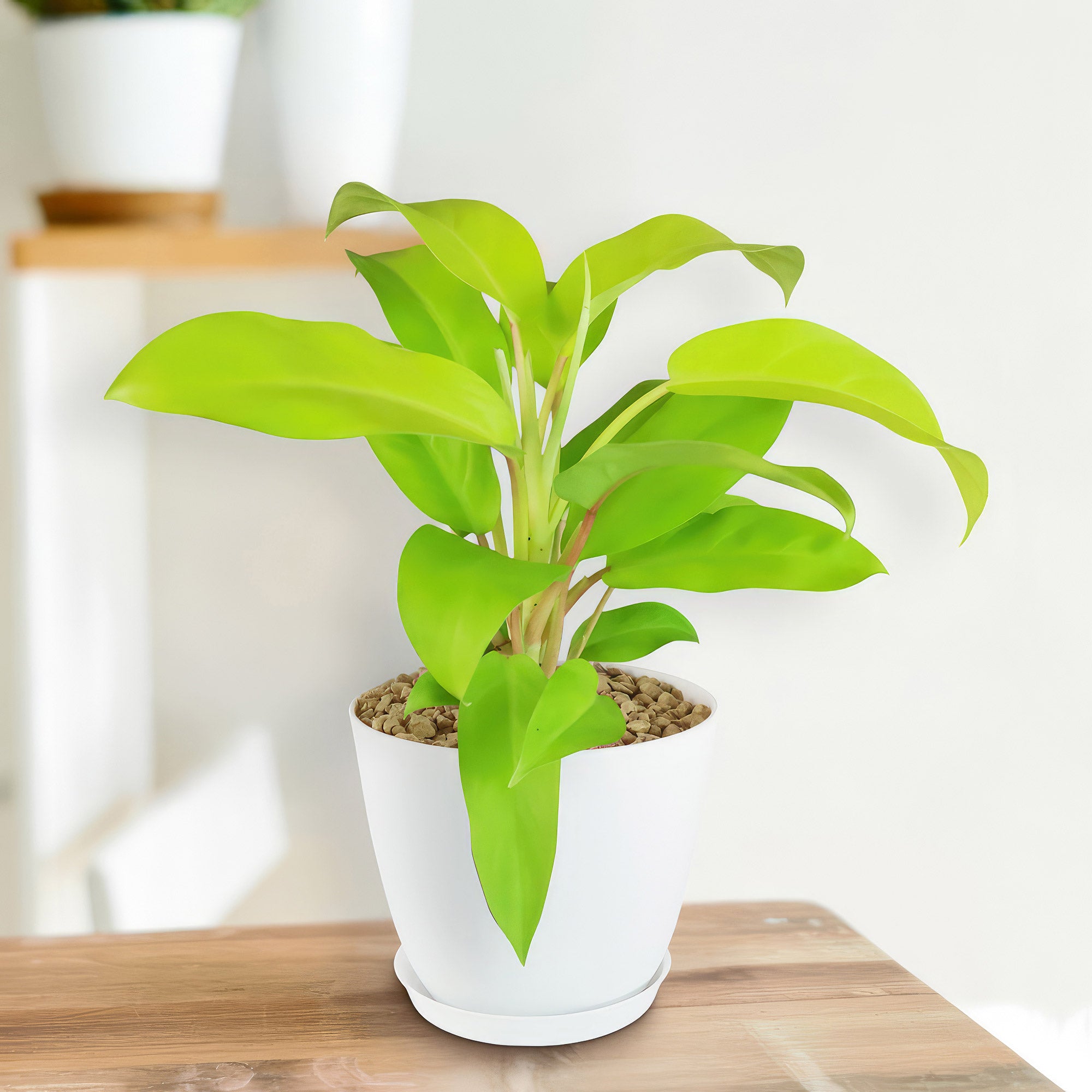
SKU: 73741666220
golden goddess philodendron

golden goddess philodendron ‘Golden Goddess’ Philodendron 6" Pot / Teal / Without Pot

Sale price$21.51 Regular price$23.90
Save 10%

Pay in installments of $5.97 with ShopPay, AfterPay and Klarna

Shipping Estimate
USA
  • USA
  • CAN

Ships within 48 hours · Estimated delivery Jul 18 - Jul 23

Promo Codes Available:

For Your Every Summer RSVP, with Code: SUMMER15

Description

golden goddess philodendron ‘Golden Goddess’ Philodendron 6" Pot / Teal / Without PotThe Golden Goddess Philodendron is a striking tropical houseplant known for its vibrant golden yellow foliage and easy to care nature. This fast growing climbing philodendron has gained immense popularity among houseplant enthusiasts due to its adaptability, bright color, and ability to thrive indoors with minimal maintenance. Unlike traditional green philodendrons, its chartreuse leaves add a lively pop of color to any indoor space, making it a

The ‘Golden Goddess’ Philodendron is a striking tropical houseplant known for its vibrant golden-yellow foliage and easy-to-care nature. This fast-growing climbing philodendron has gained immense popularity among houseplant enthusiasts due to its adaptability, bright color, and ability to thrive indoors with minimal maintenance. Unlike traditional green philodendrons, its chartreuse leaves add a lively pop of color to any indoor space, making it a favorite for plant collectors and interior decorators alike.

Native to the tropical rainforests of South America, the philodendrons are often found climbing trees, using aerial roots to anchor themselves.

The Philodendron ‘Golden Goddess’ has striking, bright golden-yellow leaves. 

One of its most unique features is its changing leaf color; new leaves start as bright yellow and slowly turn lime-green as they mature.

The amount of light also affects this color shift, with brighter light keeping the leaves golden and lower light making them greener.

This golden goddess plant has a climbing or trailing growth habit, making it an excellent choice for trellises, moss poles, or hanging baskets.

This fast-growing philodendron can quickly reach impressive heights when given the right support. 

When grown indoors as a houseplant, Philodendron ‘Golden Goddess’ typically grows up to 6 feet tall, depending on care and support. If allowed to climb, it can grow even taller, creating a lush vertical display. The leaves can reach up to 8 inches in length, developing a full and dense appearance over time. 

Philodendron ‘Golden Goddess’ is a climbing philodendron, and providing a moss pole, trellis, or other vertical support will help it develop larger leaves and a more upright growth habit. 

If placed next to a wall, it may lean toward it, but without a textured surface or additional support, it won't attach and climb effectively on its own. Aerial roots will try to grip onto a rough surface, but a moss pole or trellis will encourage stronger, healthier vertical growth.

The flowers of Philodendron ‘Golden Goddess’ are small, inconspicuous, consisting of a spathe and spadix. The spathe is a leaf-like part that wraps around the flower, while the spadix is a thick, upright spike where tiny flowers grow. These blooms are small and not very noticeable, and the plant rarely flowers indoors. If it does bloom, it usually happens in the warmer months, like late spring or summer.

When and How to Water Your Golden Goddess Philodendron 

It is a drought-tolerant tropical plant, making it an excellent choice for those who occasionally forget to water. This variety thrives in slightly dry conditions and does not tolerate overwatering. The best approach is to allow the top two inches of soil to dry out before watering again. Overwatering can lead to root rot, so it's crucial to ensure proper drainage in the pot or planting area.

In the spring and summer, during the active growing season, the Golden Goddess requires more frequent watering. Warmer temperatures and increased light exposure speed up soil evaporation, so checking moisture levels at least once a week is advisable. Deep watering is best, ensuring moisture reaches the roots. However, excess water should always drain out, preventing waterlogged conditions. Misting is not necessary but can be beneficial in dry indoor environments to maintain humidity. 

As fall and winter arrive, the plant enters a semi-dormant state, requiring significantly less water. Watering should be reduced to every 2 to 3 weeks, depending on indoor humidity levels. Since the plant is not actively growing during this time, it consumes less water. Always check the soil before watering to prevent overwatering, as the roots remain vulnerable to rot during dormancy. 

Light Requirements – Where to Place Your ‘Golden Goddess’ Plant

When grown indoors as a houseplant, your ‘Golden Goddess’ Philodendron thrives in bright, indirect light, making it an ideal houseplant for well-lit spaces.

It should be placed near an east- or west-facing window where it can receive gentle morning or late afternoon sunlight.

Avoid direct midday sun exposure, as its leaves can scorch. If natural light is insufficient, a grow light can supplement the plant’s needs, ensuring its vibrant golden foliage stays bright.

For outdoor cultivation, the plant does best in partial shade to filtered sunlight, as full sun exposure can cause leaf burn.

Ideally, it should receive around 4 to 6 hours of bright, indirect sunlight per day. A shaded patio, under a tree canopy, or on a covered porch are excellent locations for growing this philodendron outdoors. If grown in a particularly hot climate, ensure it is shielded from intense afternoon sun to prevent leaf damage. 

Optimal Soil & Fertilizer Needs 

The Philodendron plant thrives in well-drained, nutrient-rich soil.  Aroid potting mixes work exceptionally well for this variety, as they provide the right balance of drainage and nutrition. Avoid heavy, compact soils that retain too much moisture, as this can lead to root rot. Instead, make or buy a well-draining potting mix, or ideally, use our specialized potting mix, which contains 5 natural substrates and mycorrhizae to promote the development of a strong root system that helps your plant to thrive. 

To fertilize your Golden Goddess plant, use a liquid NPK fertilizer (5-10-5) once a year in the spring, during the growing season, to promote healthy foliage. Organic fertilizers like worm castings or compost can also be incorporated into the soil to enhance nutrient levels over time. 

During fall and winter, fertilization should be stopped entirely, as the plant's growth slows. Over-fertilizing during dormancy can lead to nutrient buildup and potential root damage. Instead, focus on maintaining proper watering habits and light conditions. 

This Philodendron works well with other climbing varieties such as Philodendron Brasil, Philodendron Mcdowell, making it a versatile and colorful addition to your home or office.

Hardiness Zones & More

For indoor growth as a houseplant, ‘Golden Goddess’ prefers temperatures between 65°F and 80°F with moderate to high humidity. It thrives in well-lit environments with indirect light. While it can tolerate lower humidity levels, maintaining at least 50% humidity ensures optimal growth. Placing it near a humidifier or pebble tray can help increase moisture levels in dry indoor climates. 

In the United States, this is mostly an indoor plant, but if you live in southern Florida or Hawaii, then you can cultivate it outdoors in USDA zones 9-11.

It should be planted in a shaded to partially shaded location, with humidity levels ideally above 50%.

If temperatures drop below 50°F, bringing the plant indoors is necessary to prevent cold stress.

In frost-prone areas, container planting allows easy relocation during winter months. 

Wildlife – Golden Goddess Flowers Attract the Following Friendly Pollinators

The small, inconspicuous flowers of the Golden Goddess plant attract a variety of pollinators, such as bees, butterflies, hummingbirds, beetles, and other pollinators in tropical and subtropical regions. 

Butterflies
Bees
Hummingbirds
Lady Bugs
Multi Pollinators
Other Birds

According to the ASPCA, Philodendron plants are mildly toxic to humans, cats, dogs, and other pets due to the presence of insoluble calcium oxalates. Ingestion can cause mouth irritation, excessive drooling, and gastrointestinal distress. However, it is safe to touch and handle, making it a popular choice for indoor houseplants.  

How to Propagate Your Philodendron Golden Goddess 

The Golden goddess philodendron propagation is best achieved through stem cuttings. Choose a healthy stem with at least two to three nodes and use clean, sharp shears to cut just below a node. Remove any lower leaves and place the cutting in water or moist soil. In water, roots should begin to form within two to three weeks. If propagating in soil, keep it consistently moist and in a warm, bright environment. Once roots are well-established, transplant the cutting into its permanent container. 

Key Takeaways

  1. The Philodendron Golden Goddess is a fast-growing climber, that has a vining growth habit and can be trained to climb using a moss pole or trellis.
  2. It can tolerate short periods of dryness but thrives with regular watering when the soil is dry.
  3. When small, it fits perfectly on desks or shelves, but as it matures, it can be grown in hanging baskets or as a climbing plant.
  4. It thrives in bright, indirect light and adapts well to typical home conditions.
  5. The new leaves start as bright yellow and gradually turn lime-green, depending on light exposure.

The Bottom Line 

Overall, the Philodendron ‘Golden Goddess’ is a must-have plant for anyone looking to add a vibrant, low-maintenance plant to their collection. Its striking yellow foliage, adaptability, and fast growth make it an excellent choice for homes, offices, and indoor gardens. Whether climbing up a trellis or trailing from a hanging pot, this plant adds a tropical touch and an instant burst of color to any space. With proper care—bright indirect light, occasional watering, and well-draining soil—it will thrive for years to come. This philodendron variety is perfect for plant lovers who want an easy-care, visually striking houseplant. 

Shipping Notes
  • Free Standard Shipping on $100+ Orders to the USA.
  • Except Preorder products are shipped in 48 hours.
  • Delivery to the USA:
  1. Standard Shipping : 3-10 business days
  • If time is of the essence, please consider selecting expedited delivery for faster service.
Exchange/Return Notes
  • We offer a 30-day return/exchange service after receiving.
  • Final sale items are not eligible for returns or exchanges.
  • To process your return/exchange, please contact us at [email protected]
  • Please click here for more details>>> Return & Exchange Policy
SKU: 73741666220

Discover Niche Categories That Outsell golden goddess philodendron

Top-Converting Item to Boost Your Average Order

4.5 ★★★★★
Based on 13 reviews
Sort
Highest Rating
Newest First
Oldest First
Product Reviews
D
Verified Purchase
Dustin
Pawtucket, US
★★★★★ 5
Forgotten Civilization: An astounding book not easily forgotten
'Forgotten Civilization' is a paradigm-shattering book which won't be easily forgotten. Dr. Robert Schoch possesses a rare talent for writing and public speaking which is backed up by and informed with all the intellectual rigor of a true scientist, but easily comprehensible and accessible to the general public. His passion for the subject of ancient civilizations is inspiring, and his courage and dedication unquestionable. For those of you interested in the mysteries surrounding ancient civilizations, 'Forgotten Civilization' is one of the best books ever written about the subject. Like most everyone else, I first heard about Dr. Robert Schoch when I saw the television show "The Mysterious Origins of Man," where he presented persuasive evidence of weathering and erosion on the Sphinx, showing that it must have been built during a much earlier time than what most Egyptologists believed. Back then a lot of Egyptologists laughed and ridiculed the notion that the Sphinx could be any older than a couple of thousand years. Twenty years later, few of them are still laughing. In 'Forgotten Civilization,' Dr. Robert Schoch turns his attention to the paradigm-busting site of Gobekli Tepe, a sophisticated megalithic complex unearthed in southeast Turkey, which dates back more than 10,000 years ago. Nobody knows who built it, but its age and existence irrefutably points to the presence of a highly sophisticated yet unknown culture who obviously possessed a great deal of technological knowledge and social organization at a time when most archeologists believed the human race was little more than nomadic cave men, capable of nothing more interesting than eking out a primitive, subsistence mode of survival through hunting and foraging. The discovery of Gobleki Tepe has turned the world of ancient civilizations and human history on its head, forcing what will eventually amount to a complete rewriting of human history. 'Forgotten Civilization' is a ground-breaking book which is vastly entertaining to read. Through the course of the book, which unravels like a globe-trotting mystery adventure-thriller, Schoch also reveals credible scientific evidence which shows how a previous high civilization could have been completely destroyed by massive solar outbursts and coronal mass ejections from the Sun, which would have scorched the surface of the planet and touched off natural disasters all over the world, plunging humanity back into a dark age which would take thousands of years to recover from. More chillingly, he shows how the Sun goes through natural cycles of activity over the course of thousands of years--and how history could repeat itself and this same fate could happen again, and destroy much of our modern civilization. Dr. Robert Schoch's book 'Forgotten Civilization' is for anyone who has ever wondered about the origins of civilization, the questions it raises about both the past and the future will remain with you long after you read the last page.
WAS THIS REVIEW HELPFUL?YesReportShare
Reviewed in the United States on November 26, 2013
D
Verified Purchase
Drew B.
Los Angeles, US
★★★★★ 5
Perhaps the most interesting book that I have ever read...
Format: Paperback
This book is perhaps the most fascinating piece of non-fiction that I have ever read. Dr. Schoch is a Yale educated professor at Boston University who presents information in a manner that is enjoyable and truly educational. If human history is a subject of interest for you, then you will recognize him immediately, as he has appeared on many television shows on the subject. When I bought his first book, I had the "oh, THAT guy" moment when I read the section about the author. He's the geologist/geophysicist who, back in the mid-1990's, studied the Sphinx enclosure and determined that it was condensation that smoothed the sides- rather than wind. This requires the dating of the construction of the Sphinx to draw back by many thousands of years due to the timeline of such rainfall. As such, he threw the discipline of human anthropology on it's ear. This met with much resistance from from anthropologists but, as he says, "I'm sorry if my findings contradict your theory but..." This book flows VERY smoothly and, without giving spoilers about his extensive research, provides more of an epiphany than anything that I have ever read before. Even when reading it for the second time, the book is very hard to put down. Schoch is a true educator and has a genuine talent for presenting his findings. As an author, he is clear and concise. He builds a powerful and enthralling case, the explanation of which incorporates the solving of the mysteries of the Rongorongo glyphs on Easter Island, the ancient vitrified stone castles in Scotland and the dating of the Sphinx into a plausible, scientifically supported timeline that is nothing less than completely fascinating. I have no question that my grandchildren will study human history that conforms to his research and discoveries. The irony is that he will be considered one of the "fathers of modern anthropology" for the next generation, and he's a GEOLOLOGIST! Get this book, you will NOT be disappointed!
WAS THIS REVIEW HELPFUL?YesReportShare
Reviewed in the United States on February 20, 2018
K
Verified Purchase
K. Ryan Kane
Louisville, US
★★★★★ 4
I enjoyed this book immensely
Format: Paperback
A pioneering book! It breaks new ground and proposes new ideas that are plausible. I enjoyed this book immensely. But with every pioneering book comes beliefs that may not always be what they seem. I withheld one star because there are some ideas proposed that I found hard to believe entirely. I like the fact that Dr. Schoch includes Biblical passages but I don't agree with the majority of his interpretations. For example, Ezekiel's writings and visions are not about shapes he saw in the sky that Dr. Schoch thinks are from solar outbursts or auroral displays. Instead, most of those are visions he had of the "Last Days." But he didn't know exactly what he was seeing so he did his best to describe the things he saw. The other point I would like to make is that not all of the glyphs from thousands of years ago could be describing auroral displays or solar outbursts. I would imagine that if solar flares were racing toward Earth, (1) there wouldn't be enough time to look at them and study their shapes because you would be racing for cover, (2) they would be too bright whereas nobody could actually look at them long enough to study their shapes even if they had modern sunglasses, and (3) there would be a lot more evidence of scorched and burned areas of Earth so that it would be more obvious if solar activity was what had set society back thousands of years. But I don't recall Dr. Schoch theorizing about these things. Overall the book is great and I think he right about a lot of things. Highly recommended!
WAS THIS REVIEW HELPFUL?YesReportShare
Reviewed in the United States on October 1, 2014
C
Verified Purchase
Carol E.
Charlottesville, US
★★★★★ 5
WHY YOU SHOULD BUY THIS BOOK
Format: Paperback
Forgotten Civilization by Dr. Robert Schoch Why should you buy this book? 1) You're already looking at it so you must have some interest in this topic. 2) Dr. Schoch has a great ability to take his, or others, theories and support them with well researched scientific data. This is helpful to those of us who are curious about alternative explanations but are still dependent on the "scientific thinking" paradigm. (He doesn't make statements like "when humans bred with aliens in 20,823 BC..."). 3) He always makes you think about conventional wisdom in a new way. For instance, in this book - the age of Easter Island statues (moai). How DID they get buried so deeply when they (conventionally) only go back to a South Pacific Polynesian settlement times?? I have stood in front of the moais on Easter Island and read many books on it's history and it never occurred to me to question the timeline. It takes that unique geologist perspective which Dr Schoch brings to his writings. 4) He introduces you to other researchers or writers that you will want to know more about. Like Thomas Brophy, Anthony Peratt, Paul LaViolette and many others. 5) The Appendices. Some excellent information on multiple topics included at the end of the book. 6) Because Dr. Schoch has gone where many others SHOULD go - against conventional archeological/historical wisdom which makes no sense. His initial theories on the age of the Sphinx as a young academic were very daring and absolutely correct. The geological community had no problem with his ideas - but Egyptologists did, and they have been after him ever since. Choosing a controversial research path has meant some changes in his academic career I'm sure, as "Academics," for all it's spouting of tremendous support for new knowledge and research is very much mired in politically correct concrete. (Go to Egypt and look for yourself. Even a casual tourist will see how wrong standard academic theories are currently). 7) I guarantee you will learn new and interesting things that just may change your life - or at the very least, change the way you think about the future. -C. Engel
WAS THIS REVIEW HELPFUL?YesReportShare
Reviewed in the United States on September 27, 2012
K
Verified Purchase
Kindle Customer
Port Orchard, US
★★★★★ 3
A Book About Everything and Nothing
This was a great idea for a book and it's too bad that Mr. Schoch decided not to write it. Some of the ideas about solar events, the way the plasma manifested in the sky as it relates to ancient petroglyphs is fascinating. Mr. Schoch spent very little time in this space however (in spite of the book's title). Instead we got a brief, incomplete overview coupled with a survey of every piece of fringe science out there from the memory of water, to quantum entanglement to telepathy. There was the obligatory chapter on his work with the Sphinx of course. It always comes back to the Sphinx with this guy. Not an original thought in the book, but there was plenty of promotion of fringe science, especially the work of Paul LaViolette whose confusing and widely ignored and self-published work got several chapters. I gave the book 3 stars for its entertainment value and docked it two for not staying on point. This is still a great and fascinating subject. I wish Mr. Schoch thought so too.
WAS THIS REVIEW HELPFUL?YesReportShare
Reviewed in the United States on March 30, 2015

recommand products