SKU: 74669706208
philodendron glad hands vs pedatum

philodendron glad hands vs pedatum Philodendron Glad Hands

Sale price$23.08 Regular price$25.64
Save 10%

Pay in installments of $6.41 with ShopPay, AfterPay and Klarna

Shipping Estimate
USA
  • USA
  • CAN

Ships within 48 hours · Estimated delivery Oct 10 - Oct 15

Promo Codes Available:

For Your Every Summer RSVP, with Code: SUMMER15

Description

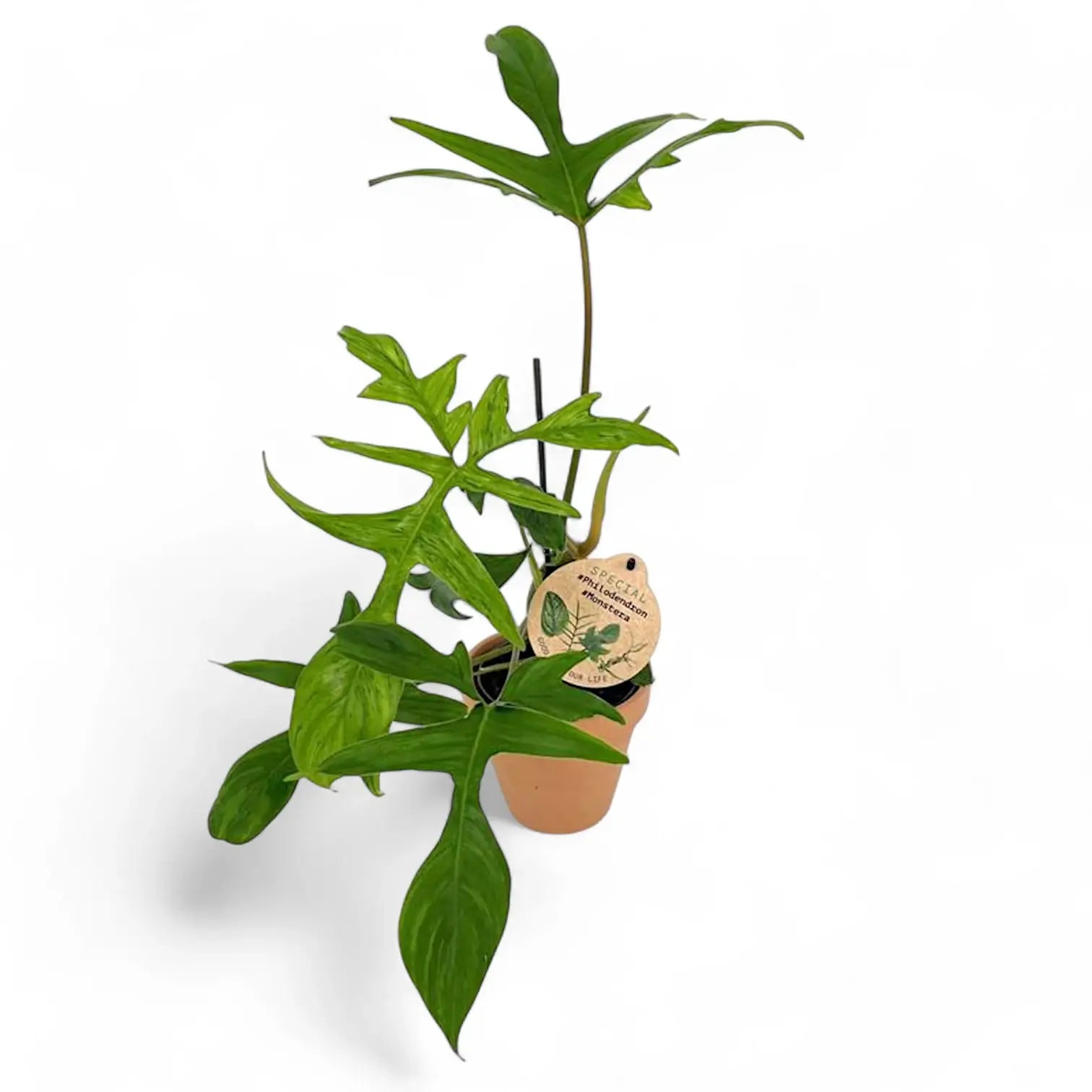
philodendron glad hands vs pedatum Philodendron Glad HandsPhilodendron 'Glad Hands' (quercifolium) Philodendron 'Glad Hands' is a narrow form of Philodendron pedatum, grown for deeply divided leaves with long, slim lobes that spread from the blade like fingers. The full leaf shape develops over time, so young plants can look slimmer and less divided before the stem gains size and support. This plant grows from a climbing stem with clear nodes and aerial roots. As the stem extends, each node can produce

Philodendron 'Glad Hands' (quercifolium)

Philodendron 'Glad Hands' is a narrow form of Philodendron pedatum, grown for deeply divided leaves with long, slim lobes that spread from the blade like fingers. The full leaf shape develops over time, so young plants can look slimmer and less divided before the stem gains size and support.

This plant grows from a climbing stem with clear nodes and aerial roots. As the stem extends, each node can produce another leaf and attach to support through new root points. A pole, plank, or trellis helps the plant anchor, keeps the stem upright, and gives divided leaves space to spread.

Narrow lobes and node-by-node growth

  • Growth habit: Climbing Philodendron with nodes, aerial roots, and a stem that responds well to vertical support.
  • Leaf shape: Long, narrow lobes give older leaves a hand-like outline.
  • Development: Leaf divisions become clearer as the plant gains size, support, and stronger root growth.
  • Petiole spread: Leaves are held away from the stem, so established plants need space around the support.
  • Root behaviour: Aerial roots help the climbing stem attach and support larger foliage over time.

Pedatum background and quercifolium name

Philodendron pedatum (Hook.) Kunth was published in Enumeratio Plantarum 3:49 in 1841. It is an accepted South American species that grows as a climber in wet tropical habitats. Philodendron quercifolium Engl., published in Botanische Jahrbücher für Systematik 26:546 in 1899, is now placed under Philodendron pedatum.

The quercifolium name refers to oak-like divided leaves and still appears around this plant in cultivation. This narrow form shows a slimmer, more finger-like expression of pedatum-style leaf division once the stem is rooted and climbing. Older leaves gain a more defined outline, not just a larger size.

Care for divided leaves

  • Light: Provide bright filtered light. Strong indirect light supports shorter internodes and more developed leaves, while harsh direct sun can scorch exposed lobes.
  • Watering: Water thoroughly once the upper substrate has dried slightly. Keep moisture steady during active growth, but do not leave the pot standing in water.
  • Substrate: Use a chunky aroid mix with bark or coco chips, perlite or pumice, and a moisture-holding base. The roots need both moisture and air around them.
  • Pot choice: Choose a pot with drainage holes and enough depth to hold the support firmly. Avoid oversized pots that keep the lower stem wet for too long.
  • Repotting: Repot when roots fill the pot or the support becomes unstable. Move up gradually so the root zone stays aerated.
  • Support: Add a pole, plank, or trellis early. Attach the stem loosely so aerial roots can reach the support without being crushed.
  • Humidity: Aim for moderate to high humidity. Around 50–70% helps the narrow lobes open without dry tips or tears.
  • Temperature: Keep at about 18–28°C. Cool, wet conditions slow root activity and can damage the lower stem.
  • Feeding: Feed lightly during active growth with a balanced fertiliser. Reduce feeding when light and leaf production slow down.
  • Growth rate: Expect moderate climbing growth once rooted and supported. Leaf shape improves gradually as the stem strengthens.
  • Pruning: Remove yellowing leaves and trim stretched stems above a node if the plant needs reshaping. Healthy cut sections can be used for propagation.
  • Placement: Give the plant room around its support so the lobed leaves can spread without rubbing against walls, shelves, or neighbouring plants.
  • Semi-hydroponics: This Philodendron can adapt to mineral or semi-hydro substrates if roots are transitioned gradually and the reservoir is kept clean.
  • Propagation: Take stem cuttings with at least one node and preferably an aerial-root nub. Keep cuttings warm and humid while roots form.

Juvenile leaves, torn lobes and stem stretch

  • Leaves staying juvenile: Check support, light, and root health. A divided leaf shape develops more reliably on a climbing, well-rooted stem.
  • Yellow lower leaves: Inspect the substrate and roots. Persistent wetness around the lower stem can cause older leaves to decline quickly.
  • Brown lobe tips: Look for dry roots, low humidity, fertiliser buildup, or hot sun through glass.
  • Long gaps between leaves: The stem may be reaching for light or growing away from its support. Move it into brighter filtered light and secure new growth.
  • Torn new leaves: New lobes can catch while unfurling. Keep watering stable and humidity moderate rather than forcing the leaf open.
  • Loose stem attachment: If the stem pulls away from the support, retie it gently at the nodes and guide new aerial roots toward the surface.
  • Pests: Check leaf undersides, petiole bases, and cataphylls for thrips, mites, scale, and mealybugs.

Pet safety and skin irritation

Philodendron 'Glad Hands' should be kept away from pets and children that may chew leaves or stems. Philodendron contains calcium oxalate crystals, which can irritate the mouth, throat, and digestive tract if ingested. Sap may irritate sensitive skin after pruning or propagation.

Name meaning and botanical background

Philodendron means “tree-loving”, a reference to the climbing habit common in the genus. The epithet pedatum means foot-like, matching the divided leaf outline of Philodendron pedatum. Quercifolium combines Latin roots for oak and leaf, referring to an oak-like leaf shape. The name 'Glad Hands' suits the hand-like spread of the leaf lobes.

Choose Philodendron 'Glad Hands' for a climbing Philodendron with slim, fingered leaves and a distinctive narrow-lobed outline.

Shipping Notes
  • Free Standard Shipping on $100+ Orders to the USA.
  • Except Preorder products are shipped in 48 hours.
  • Delivery to the USA:
  1. Standard Shipping : 3-10 business days
  • If time is of the essence, please consider selecting expedited delivery for faster service.
Exchange/Return Notes
  • We offer a 30-day return/exchange service after receiving.
  • Final sale items are not eligible for returns or exchanges.
  • To process your return/exchange, please contact us at [email protected]
  • Please click here for more details>>> Return & Exchange Policy
SKU: 74669706208

Discover Niche Categories That Outsell philodendron glad hands vs pedatum

Top-Converting Item to Boost Your Average Order

4.6 ★★★★★
Based on 15 reviews
Sort
Highest Rating
Newest First
Oldest First
Product Reviews
P
Verified Purchase
Pomegranate Pear
Lake Worth, US
★★★★★ 5
Valuable perspective; moving; beautiful
Format: Hardcover
I loved this book. I devoured the entire thing in one sitting on a Sunday afternoon. It's a beautiful and tragic and warm story all at the same time. I feel like a lot of times when we hear about the Vietnam war in the United States, it's told from the perspective of American soldiers rather than the Southern Vietnamese who lost their home land. Really refreshing to see this diverse and nuanced perspective. I look forward to Thi Bui's future works.
WAS THIS REVIEW HELPFUL?YesReportShare
Reviewed in the United States on August 23, 2022
S
Verified Purchase
Savannah L.
Lake Worth, US
★★★★★ 5
This book healed me
Format: Paperback
Beautifully written and illustrated. Although Thi Bui and I have astronomically different life experiences, I still found I could relate on a deeply personal level. This book taught me empathy and forgiveness at a time in my life where I struggled to have it. Bui nailed the complicated feelings and emotions that comes with confronting abuse, abusers (who happen to be your parents), and the painful impact of generational trauma on both the parent and child. Highly recommend this book to anyone who is on a path of healing their own broken heart.
WAS THIS REVIEW HELPFUL?YesReportShare
Reviewed in the United States on June 16, 2023
G
Verified Purchase
Gabby M
West Palm Beach, US
★★★★★ 4
Powerful Family History
Format: Paperback
After the birth of her son, Thi Bui feels an increased sense of urgency about learning the stories of her own parents. Like all but her youngest sibling, she was born in Vietnam, though the children came of age in the United States. While the war itself haunts all of them, was the reason they left their homeland, the wounds her parents bear go far beyond the military conflict. This was only the second graphic novel I’ve ever read (both have been memoirs), and like the first was also selected by my book club. I feel like the limitations of the format mean it will always be a less preferred one for me, because I found myself wanting more words, more depth to the writing itself. But the story is deeply compelling, detailing her father’s brutal childhood, her mother’s much softer one, how they came together, and how the Vietnam War disrupted the future they thought they might have. It’s not as straightforward as “Americans bad”, and Bui is not afraid of the moral ambiguity of that time and place, where the best interests of the majority of the Vietnamese people was an open question for larger forces that seemed to have little room for consideration of what might have actually made regular lives easier to lead. And apart from the larger geopolitical machinations around them, the family had their own share of tragedy, including the death of their first child and a later stillbirth. But three living children and another on the way was enough for her parents to make frantic arrangements to leave, finally succeeding and eventually making their way to the United States. But of course, that was not the end of their story, just the beginning of a new chapter. Bui’s childhood as she depicts it makes it clear that it wasn’t the stuff dreams are made of, but what shines through is her tremendous empathy for her parents and how they became the people she experienced them as. Overarching the narrative is a meditation on parenthood, as it is the birth of her own child that inspires her to ask her parents more. They might have made major mistakes, but it is clear that they loved their children and did what they thought was best for them, making countless sacrifices to give them the best opportunities possible, even if that love was not always shown the way that they wanted and needed to feel it. Vietnamese perspectives on the war in their country were not something I was exposed to growing up (honestly the Vietnam War itself wasn’t something I remember being taught with particular rigor in high school apart from its connection to electoral politics), and I appreciated learning more about the history of the country and how the people who actually lived through the conflict thought about it. Even though this is not my preferred format, I think Bui uses it well to engage in some non-linear storytelling and to very literally illustrate what she’s trying to get it, like the way she parallels the way her relatively rural parents must have felt seeing Saigon for the first time with the way she felt when she first moved to New York, a sense of awe and possibility. It’s a powerful, moving work and I would recommend picking it up!
WAS THIS REVIEW HELPFUL?YesReportShare
Reviewed in the United States on February 3, 2026
R
Verified Purchase
Riyen
Lexington, US
★★★★★ 5
Truly, the best we could do
Format: Kindle
An excerpt from my analysis essay I submitted for my literature course: By revisiting her family’s past from before, during, and after the Vietnam War, she gained a deeper understanding of the emotional burdens her parents carried and the sacrifices they made that defined the entirety of their lives. Bui’s illustrated graphic memoir reveals that trauma does not simply disappear over time; instead, it becomes inherited, processed, and transformed. Through this process, Thi Bui is able to move toward empathy for her parents, acceptance of who they are, and a more complete sense of self.
WAS THIS REVIEW HELPFUL?YesReportShare
Reviewed in the United States on April 21, 2026
K
Verified Purchase
Kathy
Natrona Heights, US
★★★★★ 5
Phenomenal. A must-read!
Format: Paperback
I first learned about this book only a week ago when visiting my sister for Thanksgiving in Eugene, Oregon. We went to the Jordan Schnitzer Museum of Art where I saw some work on display by the author, and there was a copy of her book available to look at, so I perused through and decided to buy it and read it. I'm so glad that I did! This is an incredible, poetic story that spans four generations, multiple wars and conflicts, and examines the fragility of the author's relationship with her parents and with her sense of place and motherhood. This book is one of the best I've read in a long time, and the art is moving and beautiful. It gave me new insight into the struggles of refugee life, and created a truly relatable narrative. I devoured this story in one Saturday. I highly recommend it.
WAS THIS REVIEW HELPFUL?YesReportShare
Reviewed in the United States on December 2, 2018

recommand products