SKU: 76964898590
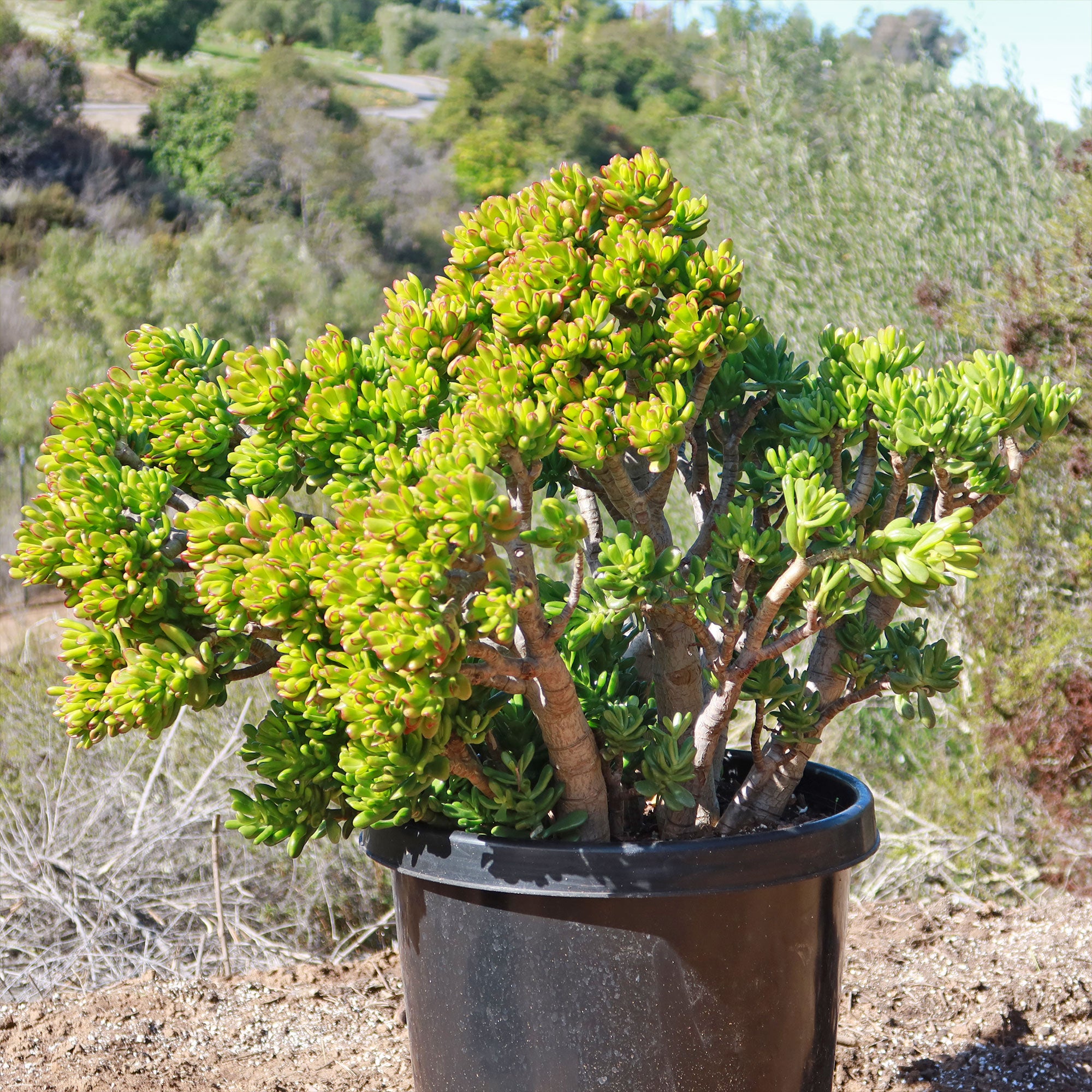
compact mini jade succulent

compact mini jade succulent Jade Bonsai Tree

Sale price$25.26 Regular price$28.07
Save 10%

Shipping Estimate
USA
  • USA
  • CAN

Ships within 48 hours · Estimated delivery Jul 12 - Jul 17

Promo Codes Available:

For Your Every Summer RSVP, with Code: SUMMER15

Description

compact mini jade succulent Jade Bonsai TreeIntroducing a stunning jade bonsai tree plant, also known as Crassula ovata 'Hobbit', similar to Gollum jade. It is a cultivar of the Crassula ovata species, originally from South Africa. This lovely plant goes by several common names, such as Hobbit Jade, Shrek's Ears, and Ogre's Ears. It's important to note that while Crassula ovata Hobbit is referred to as a "tree," it is actually a succulent plant that can develop a bonsai like base, giving it a

Introducing a stunning jade bonsai tree plant, also known as Crassula ovata 'Hobbit', similar to  Gollum jade. It is a cultivar of the Crassula ovata species, originally from South Africa. This lovely plant goes by several common names, such as Hobbit Jade, Shrek's Ears, and Ogre's Ears.

It's important to note that while Crassula ovata Hobbit is referred to as a "tree," it is actually a succulent plant that can develop a bonsai-like base, giving it a tree-like appearance. This adds to its unique charm and makes it a popular choice among bonsai enthusiasts.


The jade bonsai tree probably needs to be 10 gal minimum to start looking like a tree; ours is a15gal, which is why it has a more mature trunk and developed appearance compared to dwarf jade bonsai trees. The larger size allows for more intricate shaping and growth potential.

When cultivated as a small bonsai tree, this jade bonsai tree typically reaches a height of around 6-8 inches, showcasing a compact shape and bushy appearance.

However, when grown as a regular potted plant, it can grow up to 3 feet tall.  Imagine adding a rare and beautiful plant to your collection that develops into a woody, branching shrub that makes an excellent large bonsai tree.

If given the proper care, the jade hobbit plant can live up to 70 years. Although it grows slowly, adding only two inches to its height each year, this plant can grow to a maximum height of three to six feet. 

The jade bonsai tree boasts thick, fleshy leaves that are tubular and spoon-shaped, resembling the ears of characters from movies like "The Hobbit" or "Shrek." Its leaves have a glossy, jade-green hue, and when exposed to direct sunlight, they may develop reddish edges.

The flowers of this jade bonsai tree are pinkish-white, star-shaped, and bloom from late winter to late spring, making it a true showstopper. Although it typically does not bloom indoors, this jade succulent's green and white variegated leaves are attractive.

When and How to Water Your Hobbit Jade Plants

The jade bonsai tree is drought-tolerant by nature, and its fleshy, water-storing stems can hold a lot of water.  However, their root structure is easily susceptible to overwatering, so make sure that you don't overwater, as it can lead to root rot and fungal infections. The Hobbit Jade prefers watering once every 1-2 weeks in the growing season, and once a month in the dormant season.

The Crassula ovata hobbit prefers to be watered using the "soak and dry" technique. This involves thoroughly watering the jade hobbit plant before allowing it to completely dry out between watering sessions. 

Both potted and outdoor variegated jade hobbit plants should receive a deep soak once or twice a month during their growth periods, ensuring proper drainage so that the roots don't become waterlogged. Avoid watering your outdoor Crassula species when it's raining or during the winter months.

Light Requirements - Where to Place Your Jade Hobbit Plant

If growing indoors, place your Crassula ovata hobbit directly in front of a west- or south-facing window.

If they don't receive enough light, their stems may grow leggy and become paler, and their spines will shorten. So, make your jade hobbit plant happy and give it plenty of light.

When grown outdoors, providing enough light for these desert jade hobbit plant (Crassula ovata Hobbit) succulents is one of the most important aspects of their care.

It is important to grow your jade plants in areas that receive at least 4-6 hours of bright, indirect light daily to keep them happy. Under bright sunlight, bright red margins appear on leaves that are up to 2 inches long.

It's critical to remember that during a heatwave, during long periods of extreme heat, your jade hobbit tree could still sustain sun damage or get sunburned. You can protect the plant in this situation by moving it indoors or to a shaded area.

Optimal Soil & Fertilizer Needs 

The hobbit jade plants prefer sandy, well-drained soil, as excess moisture can promote root and stem rot. Planet Desert specializes in succulents and has a specialized succulent potting soil that includes an organic substrate with mycorrhizae to help with the growth of a healthy root system to help your Crassula ovata hobbit jade succulents thrive.

When it comes to fertilizing your jade hobbit plant, organic fertilizers with an equal mixture of 5-10-5 (NPK) once a year in the growing season (spring) will keep your soil alive. So, skip those harsh chemicals and give your hobbit jade succulent some love with some awesome organic fertilizer!

Hardiness Zones & More 

In the United States, this is mostly an indoor plant, but if you live in southern Florida or Hawaii, then you can cultivate it outdoors in USDA zones 9-11.

If you live in a colder climate, it's best to keep the bonsai indoors during winter or provide protection from frost.

When placing the Jade Bonsai Tree outdoors, choose a location that receives bright, indirect sunlight or partial shade. Avoid exposing it to direct, intense sunlight, as it can scorch the leaves. Additionally, ensure the soil has excellent drainage to prevent waterlogging.

How to Grow Best Indoors Jade Bonsai Tree

When it comes to indoor bonsai cultivation, the Crassula ovata hobbit prefers average room temperatures between 60-75°F. It can tolerate slightly cooler temperatures during winter, around 50-55°F, but avoid exposing it to freezing temperatures. The Jade Bonsai Tree is adaptable and can tolerate average indoor humidity levels. However, it appreciates a slightly more humid environment, especially during the dry winter months. To increase humidity, you can place a tray filled with water near the growing bonsai or use a humidifier.

Wildlife - Hobbit Jade Plant Attracts the Following Friendly Pollinators

The Hobbit Jade Plant is known to attract butterflies, bees, and hummingbirds due to its vibrant flowers and sweet nectar. These pollinators play a crucial role in the plant's reproduction and overall ecosystem health.

Butterflies
Bees
Hummingbirds
Lady Bugs
Multi Pollinators
Other Birds

Key Takeaways

  1. The curled, tubular leaves resemble little green fingers or trumpet-shaped tubes, which inspired its name ‘Hobbit’ after J.R.R. Tolkien’s mythical characters.
  2. Unlike the standard jade, the ‘Hobbit’ grows more compact and twisted, making it a naturally ideal candidate for bonsai without needing extensive shaping.
  3. In feng shui, it is considered a “money magnet” plant, and the unusual tubular leaves are thought to resemble fingers grasping prosperity.
  4. The tips of its tubular leaves can turn bright red when exposed to plenty of sunlight or cool night temperatures, adding seasonal color variation.

How to Propagate Your Crassula ovata 'Hobbit'

Crassula ovata 'Hobbit' can be propagated through stem cuttings or leaf cuttings. To propagate through stem cuttings, simply cut a healthy stem from the plant and allow it to callous before planting it in well-draining soil. Leaf cuttings can be taken by gently twisting a leaf from the plant and allowing it to dry out before planting it in soil.

Final Thoughts

Overall, the Jade Bonsai tree (Crassula ovata Hobbit) is a super cool plant with some awesome features. It's got these thick, succulent leaves that give it a unique and tree-like appearance. Crassula ovata Hobbit, often referred to as a "tree," is actually a succulent plant that can create a bonsai-like base, enhancing its unique charm and making it a popular choice among bonsai enthusiasts. Provide bright, indirect sunlight or partial shade, and use well-draining soil. Protect it from frost during colder months.

Shipping Notes
  • Free Standard Shipping on $100+ Orders to the USA.
  • Except Preorder products are shipped in 48 hours.
  • Delivery to the USA:
  1. Standard Shipping : 3-10 business days
  • If time is of the essence, please consider selecting expedited delivery for faster service.
Exchange/Return Notes
  • We offer a 30-day return/exchange service after receiving.
  • Final sale items are not eligible for returns or exchanges.
  • To process your return/exchange, please contact us at [email protected]
  • Please click here for more details>>> Return & Exchange Policy
SKU: 76964898590

Discover Niche Categories That Outsell compact mini jade succulent

Top-Converting Item to Boost Your Average Order

4.6 ★★★★★
Based on 1841 reviews
Sort
Highest Rating
Newest First
Oldest First
Product Reviews
A
Allen Mickle
Lowell, US
★★★★★ 5
Best Book on the Integration of Faith and Learning
Format: Paperback
A problem area in Christian ministry is the area of Christian higher education. As we continue to progress through the 21st century we continue to see the decline of the Christian higher education movement. What was once a strong area in the Christian ministry, Christian higher education is failing. The Bible College movement has been in decline for sometime. Schools are folding without the students or the funds to stay open. Most people are going to secular colleges and universities over Christian schools. One of the major problems with Christian higher education has been the failure to critically interact with the movement and offer an approach to dealing with this decline. David Dockery has helped fill this void with his recent volume, Renewing Minds. Dockery, President of Union University in Jackson, TN, is extremely qualified to write in this capacity. A clear and thoughtful theologian, he has extensive experience in the areas of leading and administrating a Christian higher education institution. Not only has he lead Union University he also serves as chairman of the board of the Council for Christian Colleges and Universities. With recommendations from J. I. Packer, R. Albert Mohler, Chuck Colson, and a foreword by Robert P. George of Princeton University, this is a volume that should be seriously considered by all who love Christian education. In Chapter 1, Dockery highlights the problem in America. He writes, "I believe that the integration of faith and learning is the essence of authentic Christian higher education and should be wholeheartedly implemented across the campus and across the curriculum. This was once the goal of almost every college in America. This is no longer the case.... What happened was a loss of an integrated worldview in the academy. There was a failure to see that every discipline and every specialization could be and should be approached from the vantage point of faith, the foundational building block for a Christian worldview" (pp. 5-6). Tracing the history of the departure of American schools into secularism and surveying the kinds of Christian higher education institutions in North America leads to a defense of the system derived from Matthew 22:36-40 and the Great Commandment to love the Lord your God with your mind! The rest of the book explains how to go about obeying the Great Commandment in Christian higher education. Chapter 2 builds on this by explaining from the Scriptures the role of the Christian higher education institution and deals especially with the role of the Church, and therefore the Christian higher education institution in society. Chapter 3 explains the process of shaping a Christian worldview and the impact on this on Christian higher education. Chapter 4 is about reclaiming the Christian intellectual tradition. Dockery writes here after tracing the history of the Christian intellectual tradition "Certainly we all learn apart from the great Christian intellectual tradition, apart from the vantage point of faith. But we cannot connect these things into a unified whole, we cannot fully understand the grand metanarrative; we cannot truly grasp how to explore and engage the issues in history and science, business and health care, apart from this approach to learning. Thus we must seek to sanctify the secular because Jesus Christ has come to earth" (p. 84). Chapter 5 addresses the issues of integrating faith and learning. Chapter 6 addresses the necessary concept of developing a place of belonging and community where scholars, educators, staff, and students live together, share, serve, and learn. Chapter 7 begins to offer practical ways of establishing this grace-filled academic community. Chapter 8 articulates how to develop a theology of Christian higher education. Developing this theology would have positive implications for the academic community and the individual. Chapter 9 serves as the culmination of the book with thinking globally about the future. With the changes in communication we must embrace the new in order to communicate the orthodoxy of the past into a new global world. This means listening as much as talking especially as global Christianity begins to reflect non-Western images, positions, and principles. Christian higher education does not just simply say the West is best but listens to all Christian voices in order to best communicate the timeless truth in new ways. This is then concluded by an extensive bibliography on the integration of faith and learning. Dockery's book fills a great need in the area of Christian higher education. He states the issues and the problems, traces the history of Christian higher education, articulates a biblical defense of the integration of faith and learning as well as a comprehensive theological defense. Not only does he articulate this at an academic level but he does not neglect the spiritual aspect of things, emphasizing not just "smart" Christians but "spiritual" Christians. The movement from "theory" to "practice" in Dockery's book is exceptional. I hardly find anything in it that I would disagree with or anything I wish I say that I did not see in the book. It is an even handed treatment that should be read by those who care about Christian higher education and especially those involved in Christian higher education. May we see a renewal of a close integration of faith and learning on our campuses as we emphasize the great truth that all truth is God's truth. May we raise up godly men and women who are passionate about the truth and about serving Christ in the world around them through the Great Commission. And may those of us involved in Christian higher education lead the way through authentic spirituality grounded in the truth. Highly recommended!
WAS THIS REVIEW HELPFUL?YesReportShare
Reviewed in the United States on October 10, 2009
R
Verified Purchase
Reid McCormick
Cuba, US
★★★★★ 2
Not much about higher education
Format: Paperback
I gave this book 3 stars not because I think it was bad, but because it didn't really have much to do with higher education. I am a big believer in Christian higher education and the integration of faith and learning, however, if you were to take this book and replace "Christian higher education" with a phrase like "the Christian community" or the "Church family" no one would notice the difference. I do believe in much of what he said but that's because I follow Christ. I didn't expect him to spend chapters on what Christians believe and how they differ from other religions, I was hoping for an intelligent argument and exploration of Christian higher education and how it differs from other higher education. And the argument, higher education used to be all Christian higher education is not a good argument. Once again, not a bad book but just not what I expected based on the description and title.
WAS THIS REVIEW HELPFUL?YesReportShare
Reviewed in the United States on December 7, 2011
W
wisdomofthepages.com
Lowell, US
★★★★★ 5
A Sterling Vision of Christian Education
David Dockery is the president of my alma mater, Union University in Jackson, Tennessee. Therefore, I have always taken great interest in keeping up with what Dockery says and does in the realm of Christian higher education. B&H publishing has done us all a favor by pulling together his ideas into a unified book with the theme - "Serving Church and Society through Christian Higher Education". Dockery's heart beats with the passion of a pastor, theologian, academic, and administrator. He sees the Christian university as a place in society where both mind and heart can renewed along biblical and gospel lines. It is difficult work in our day, but it is a necessary work. Dockery writes, "I believe that the integration of faith and learning is the essence of authentic Christian higher education and should be wholeheartedly implemented across the campus and across the curriculum." And how is this accomplished? Dockery says, "We need more than just new ideas and enhanced programs, we need distinctively Christian thinking, the king of touch-minded thinking that results in culture-engaging living. ...This perspective involves the whole of our human personality. Our minds are to be renewed, our emotions purified, our conscience kept clear, and our will surrendered to God's will. Applying the Great Commandment entails all that we know of ourselves being committed to all that we know of God." A number of the chapters in this book simply sparkled with insight. Pastors will especially note the overlap of Dockery's vision of Christian community in the university with what we also hope to find within the local church. For example, Dockery writes a chapter on "Establishing a Grace-Filled Academic Community" that could and should be applied to the local church as well, with an emphasis on unity, shared life, worship, and service. Within chapter six is a section titled, "Building Blocks for Building a Community with Renewed Message", a message with such urgency and clarity that I did in fact bring it home to our church for a renewed sense of Christian community. Such is the case for much of this excellent book. You may not have a vocational calling to higher education. However, as a pastor or Christian parent, it is your responsibility to consider carefully the type of institution you send your students to for university education. Dockery writes, "I would suggest that the starting point of loving God with our minds, thinking Christianly, points us to a unity of knowledge, a seamless whole, because all true knowledge flows from the one Creator to His one creation." Dockery's vision is compelling and sound, and I heartily recommend this book.
WAS THIS REVIEW HELPFUL?YesReportShare
Reviewed in the United States on November 22, 2007
M
Verified Purchase
Martin B.
Draper, US
★★★★★ 5
Good Value & Good Product.
For those of us that don't eat a lot of fruits and veggies normally, this product really helps. It meets my needs for fruits and veggies. It's easy to take, goes down well, and has no after taste. Good value too.
WAS THIS REVIEW HELPFUL?YesReportShare
Reviewed in the United States on April 11, 2026
T
Verified Purchase
Tanny
Houston, US
★★★★★ 5
Good product, reasonable price.
Good product. Easy to swallow. Reasonable price.
WAS THIS REVIEW HELPFUL?YesReportShare
Reviewed in the United States on May 22, 2026

recommand products