SKU: 77216944714
areca palm low light

areca palm low light Chrysalidocarpus lutescens

Sale price$20.26 Regular price$22.51
Save 10%

Pay in installments of $5.63 with ShopPay, AfterPay and Klarna

Shipping Estimate
USA
  • USA
  • CAN

Ships within 48 hours · Estimated delivery Aug 16 - Aug 21

Promo Codes Available:

For Your Every Summer RSVP, with Code: SUMMER15

Description

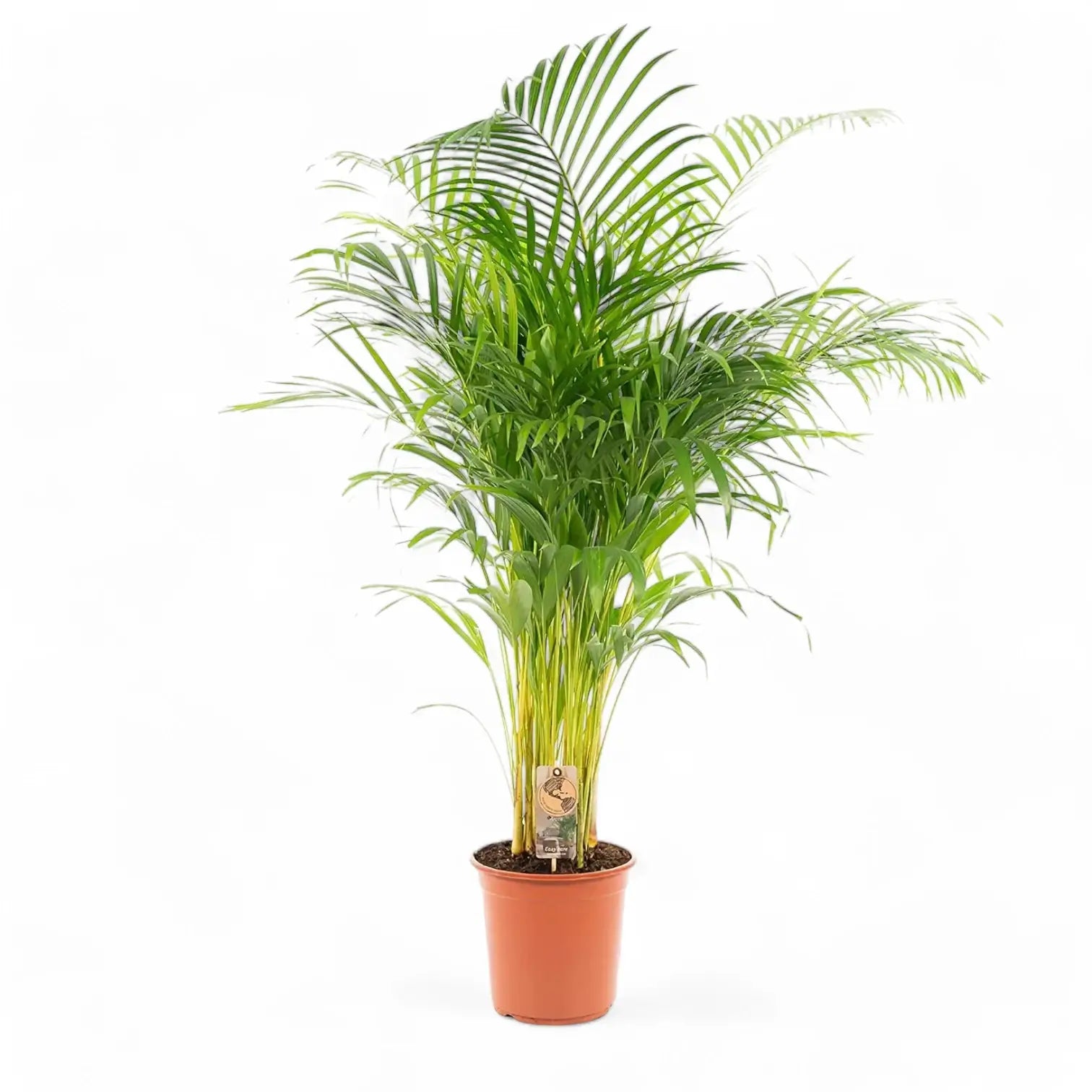
areca palm low light Chrysalidocarpus lutescensChrysalidocarpus lutescens Chrysalidocarpus lutescens, still widely known under the synonym Dypsis lutescens, is a clustering palm with upright cane like stems and long, arching feather leaves. Several stems rise from the base, creating a soft, fountain shaped crown with yellow green petioles and narrow leaflets arranged along each frond. Indoors, this palm develops slowly into a broad, leafy specimen with a layered vertical outline. As the stems

Chrysalidocarpus lutescens

Chrysalidocarpus lutescens, still widely known under the synonym Dypsis lutescens, is a clustering palm with upright cane-like stems and long, arching feather leaves. Several stems rise from the base, creating a soft, fountain-shaped crown with yellow-green petioles and narrow leaflets arranged along each frond.

Indoors, this palm develops slowly into a broad, leafy specimen with a layered vertical outline. As the stems mature, they become more defined, while the fronds keep the crown airy, layered, and finely textured.

Golden cane palm details

  • Golden cane palm forming grouped yellow-green stems
  • Arching pinnate fronds with many narrow green leaflets
  • Yellow-green leaf stalks and midribs give the plant its warm tone
  • Can form a sizeable indoor floor plant over time
  • Rarely flowers indoors; mature outdoor plants may produce yellow flowers and small fruits

Eastern Madagascar origin and clumping growth

Chrysalidocarpus lutescens is native to Madagascar and belongs to the palm family, Arecaceae. In habitat and tropical cultivation it can grow as a shrub-like or tree-like palm, with multiple stems forming a broad clump. Indoors, its final shape depends on light, root space, and steady watering.

Each stem grows from a central crown. Fully brown fronds can be removed at the base, while green fronds should stay in place so the palm retains enough leaf area for new fronds. New fronds emerge from the growing points and gradually open into the palm’s feathered canopy.

Because this palm forms a clump, uneven growth is normal: some canes may sit lower while newer stems fill the centre. Turn the pot occasionally so the crown develops evenly, and keep the leaf bases open enough for inspection because pests often settle where the fronds meet the stems.

Keeping Chrysalidocarpus lutescens evenly leafy

  • Light: Use a bright, indirect position. Gentle morning or late afternoon sun suits acclimated plants, while strong midday sun behind glass can scorch fronds.
  • Watering: Keep the substrate evenly lightly moist during active growth, then let the upper layer dry before watering again. Avoid cold, saturated soil.
  • Substrate: Use an airy, well-drained palm or houseplant mix with mineral drainage material to keep the root zone open.
  • Temperature: Keep the palm warm, ideally above 18 °C, and avoid cold draughts or temperatures below about 15 °C.
  • Humidity: Average to moderate indoor humidity is workable, although very dry heated air can crisp leaflet tips. Use a humidifier where winter air becomes persistently dry.
  • Feeding: Use a low-strength fertiliser in spring and summer. Too much feed can show as yellowing or salt stress on leaflet tips.
  • Repotting: Move up one pot size when roots have filled the container, often after 2–3 years. Avoid oversized pots that keep the mix wet for too long.
  • Pruning: Remove only fully spent fronds. Cutting green fronds reduces the palm’s active leaf area.
  • Leaf cleaning: Wipe dusty leaflets gently or rinse the fronds with lukewarm water so the narrow leaflets can receive light evenly.

Frond, cane and pest checks

  • Brown tips: Often linked to dry air, irregular watering, salt build-up, or old leaf age. Check moisture pattern and flush the substrate if fertiliser salts have built up.
  • Yellowing fronds: Can follow overwatering, poor drainage, low light, nutrient imbalance, or natural ageing of older leaves. Check the root zone before feeding.
  • Mites or scale insects: Fine stippling, webbing, sticky residue, or bumps on stems and leaf bases need early inspection and treatment.
  • Collapsed stems: Soft bases usually point to root or crown stress from persistently wet, cool conditions.

Pet-safe palm status

ASPCA treats the areca palm, Chrysalidocarpus lutescens, as non-toxic to cats and dogs. Sensitive pets may still get mild stomach upset from chewing the fronds.

Accepted name and synonym note

Chrysalidocarpus lutescens H.Wendl. is the accepted botanical name for this Arecaceae species. Dypsis lutescens remains a common synonym in horticulture. The genus name refers to chrysalis-like fruits, while lutescens means turning yellow, matching the yellow tones in the flowers, stems, and leaflet midribs.

Chrysalidocarpus lutescens grows into golden cane clusters with airy fronds and a full upright palm outline.

Shipping Notes
  • Free Standard Shipping on $100+ Orders to the USA.
  • Except Preorder products are shipped in 48 hours.
  • Delivery to the USA:
  1. Standard Shipping : 3-10 business days
  • If time is of the essence, please consider selecting expedited delivery for faster service.
Exchange/Return Notes
  • We offer a 30-day return/exchange service after receiving.
  • Final sale items are not eligible for returns or exchanges.
  • To process your return/exchange, please contact us at [email protected]
  • Please click here for more details>>> Return & Exchange Policy
SKU: 77216944714

Discover Niche Categories That Outsell areca palm low light

Top-Converting Item to Boost Your Average Order

4.2 ★★★★★
Based on 27 reviews
Sort
Highest Rating
Newest First
Oldest First
Product Reviews
F
Verified Purchase
Firebabe
Whiting, US
★★★★★ 5
Great quality. Easy to clean. Nice appearance.
Color: Red, Size: 4.3-Quart
Solid, heavy pot for cooking and baking. I bought it mainly for making soups, stews and breads. I have only tried soups thus far. The pot cleaned up very easily. The bottom of the pot heated uniformly. Nothing was stuck to the pot when I was simmering on the glass top stove. I have not had the chance to bake yet, but seeing how evenly it held heat while cooking, I am thinking this will be perfect. I bought the red color. It gives a nice pop of color in my kitchen. This pot will probably last me a long time. I would buy one if I needed a replacement, or a gift for someone.
WAS THIS REVIEW HELPFUL?YesReportShare
Reviewed in the United States on November 29, 2025
A
Verified Purchase
Amazon Customer
Grantham, US
★★★★★ 5
Great quality for price after 3 years of use
Color: Matte Navy, Size: 6-Quart, Color: Matte Navy, Size: 6-Quart
I’m 3.5 years in and use it weekly. So far it’s been a great product especially for the price. We are really into soups, roast, and I bake bread a lot. This thing is amazing and a great quality. It’s easy to clean, does great in the oven, and stands up great to constant use. I only have a small amount of staining at the bottom, and a couple scratches from metal utensils. The lid is solid and the handle is really secure still, which is a problem I’ve had with other brands I’ve tried.
WAS THIS REVIEW HELPFUL?YesReportShare
Reviewed in the United States on February 2, 2026
G
Verified Purchase
Gwen Jones
Port Orchard, US
★★★★★ 5
Quality product
Color: Navy, Size: 6-Quart
I absolutely LOVE my Dutch oven! The reduced cooking time for certain cuts of meat for stews, pot roast, etc., is a definite game changer!! The meat comes out so juicy and tender. I made curry and did the "burning" of the curry and was hesitant because I didn't want the pot to be stained. There were no stains left at all. I've used it numerous times since purchasing and it still looks new. It's very durable and the color is beautiful. If you're looking for a functional, quality, and durable Dutch oven without breaking the bank, this is it! I highly recommend.
WAS THIS REVIEW HELPFUL?YesReportShare
Reviewed in the United States on February 9, 2026
S
Verified Purchase
Serhii
Lexington, US
★★★★★ 5
Exactly what I wanted
Color: Blue, Size: 6-Quart
Amazing! Looks beautiful, high quality, good price. Well packaged, no defects. Heavy of course :) Blue color is amazing!
WAS THIS REVIEW HELPFUL?YesReportShare
Reviewed in the United States on April 26, 2026
B
Verified Purchase
Booksalottle
Louisville, US
★★★★★ 4
Nothing Exceptional but Gets the Job Done
Color: Blue, Size: 4.3-Quart, Color: Blue, Size: 4.3-Quart
I’ve owned this 4.5 Qt. Amazon Enameled Cast Iron Dutch Oven for almost two months and have used it three times to date. Upon arrival and at first glance, the gradient blue color is beautiful and super glossy; most importantly, the pot is heavy for its size - as it should be. It looks exactly like the product pictures, with a globular shape than square shape as others. Unfortunately, I also noticed that there was one pin hole and two tiny uneven protrusions on the enamel inside the pot. I own three other enameled cast iron cookware from two other brands (photos attached for size comparison) and performance wise, this cast iron by Amazon performs equally to them. The pot isn’t exceptional or special but it gets the job done. Other than the pin holes and protrusions, I have no complaints. This isn’t my first rodeo so when heating up the pot and while cooking, I have zero issues. I am starting the pan off at 4-Stars and will update my review as time progresses, or if I have any major issues with its durability or performance in subsequent months. For the amateur home cook, or for anyone who is new to cast iron cooking, below I’ve included tips that you may find useful while using this or any other enameled cast iron cookware. ================================ Regarding the 3 Photos and 1 video I've Attached: (Note: all photos were taken with an iPhone under kitchen lights during the evening. Photos have not been edited nor enhanced.) Photo 1: Size comparison of this Amazon Enameled Cast Iron Dutch Oven compared to three other enameled cast iron cookware that I own from two other brands. From left to right: 7 qt. Tramontina, 4.5 qt. Amazon, 3 qt. Lodge 4 qt. Tramontina. Photos 2 and 3: fresh produce shown next to 4.5qt Amazon Dutch Oven for color and size contrast. Video: 4.5 qt. Amazon Enameled Cast Iron Dutch Oven on gas stove over medium heat, with food cooking. ================================ TIPS THAT YOU MAY FIND USEFUL While Using your cast iron dutch oven: (Note: I included these similar tips in my review of a different enameled cast iron pot from a different brand. My tips can apply to all enameled cast iron cookware) 1. If you find that you have issues with food sticking, it could be that you are not heating up your cast iron pot properly to prevent undue hot spots. I heat my pot up gradually starting at low, then medium, then high heat. After my pot is very hot is when I add my fat/cooking oil. As the oil is heating up in the pot, I lift it and swirl the oil around to coat all sides of the pot that will come in contact with food. 2. Take into consideration the temperature of the items you are adding to your heated pot. As a general rule for cooking: when ever possible, ensure that the items you are adding to a hot pot are at room temperature, rather than ice cold from the fridge; this will assist with even cooking. 3. Also, get comfortable with adjusting your heat by lowering and raising it based on what you’ve added to the pot. In general, you will need more heat at the beginning of the cooking process, and less heat towards the end. If you cook by recipe, I highly recommend that you read all the steps ahead before starting, so that you become familiarized with all the procedures, allowing you to maneuver accordingly when you start cooking. 4. At the exception of searing meat to achieve a brown crust, deep frying, or when caramelizing onions, you should be stirring your pot (I recommend using a wooden spoon) every few minutes when cooking in cast iron that is placed over high heat. If you are braising on the stove at low heat versus braising in the oven, the frequency of your stirring will need to be adjusted. No matter how you’re cooking though, a watchful eye on the pot plus stirring, should both be a habit not an afterthought. 5. For all cooking vessels in general but especially for cast iron: after cooking, allow your pot to cool down completely before cleaning. NEVER immerse a hot cast iron pot into cold water, nor pour cold dish water into hot pot. You risk not only being scald by dangerous steam, but you also risk weakening the enamel, therefore lessening the durability of your pots over time. 6. This cookware and others like it from Tramontina and Lodge are economical and if used correctly, will perform well for most cooking; if used correctly, they should also last for years. Nonetheless, if you can afford it, authentic enameled cast iron cookware made in France by Le Creuset is the best way to go. Le Creuset is the gold standard in cast iron cookware and their quality is second to none. I definitely recommend this Amazon dutch oven but if you can afford to splurge, Le Creuset's reputation is stellar. As a professional chef, I've used them in high end kitchens and their quality and performance is premier.
WAS THIS REVIEW HELPFUL?YesReportShare
Reviewed in the United States on July 2, 2018

recommand products