Pay in installments of $5.58 with
 ,
,
 and
and

Shipping Estimate
USA
- USA
- CAN
- USA
- CAN
Ships within 48 hours · Estimated delivery Oct 9 - Oct 14
 Promo Codes Available:
For Your Every Summer RSVP, with Code: SUMMER15
Description
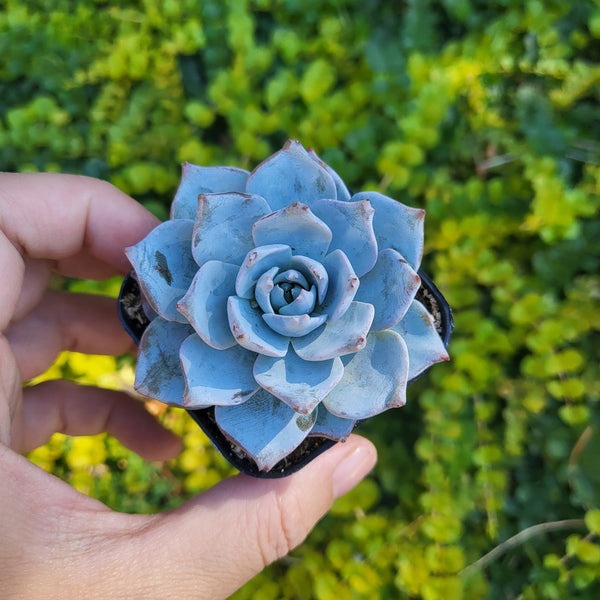
blue succulent Echeveria Blue Bird RosetteDescription Light Soil Water Hardiness Echeveria 'Blue Bird' is a beautifully symmetrical succulent with soft, powdery blue foliage and a neat rosette shape. A hybrid variety within the Crassulaceae family, it shares ancestry with Echeveria species native to Mexico, where many evolved under sunny, rocky conditions. 'Blue Bird' forms a single, tight rosette of thick leaves coated in a fine layer of farina, a natural wax that gives the plant its pale,
-
Echeveria 'Blue Bird' is a beautifully symmetrical succulent with soft, powdery blue foliage and a neat rosette shape. A hybrid variety within the Crassulaceae family, it shares ancestry with Echeveria species native to Mexico, where many evolved under sunny, rocky conditions. 'Blue Bird' forms a single, tight rosette of thick leaves coated in a fine layer of farina, a natural wax that gives the plant its pale, pastel appearance. In bright light, the leaves often take on a silvery-blue tone, sometimes blushing pink at the edges during cooler seasons.
The rosette of the Blue Bird can grow up to 6 to 10 inches wide, with leaves that are broad, pointed, and slightly upturned at the tips. Its uniform, open shape and subtle coloring give it a soft, elegant look compared to more rigid or heavily textured succulents. Mature plants may occasionally produce a tall flower stalk bearing small coral or salmon-pink blooms, although Blue Bird is mainly admired for the beauty of its foliage. The flower spikes add a delicate touch, rising gracefully above the main rosette without disrupting the plant's clean lines.
Compared to similar varieties like Echeveria 'Blue Prince', Blue Bird has a softer, paler color and a more open, airy rosette structure. While Blue Prince tends to have darker, tighter rosettes, Blue Bird maintains a lighter and wider form, giving it a more ethereal presence in succulent displays. Both plants share a powdery coating, but Blue Bird appears more pastel and delicate overall.
Because of its size, form, and delicate color, Echeveria 'Blue Bird' is often used as a centerpiece in succulent bowls or as a gentle contrast among darker or more textured plants. It thrives with good light and minimal watering, making it easy to care for in the right conditions. Like most Echeverias, it does best when left relatively undisturbed, allowing its rosette to develop fully without crowding from nearby plants.
-
Prefers bright, direct to very bright indirect light for best color and compact growth. Insufficient light can cause the rosette to stretch and lose its shape.
Water thoroughly when the soil is completely dry, making sure to avoid watering directly into the rosette to prevent rot. Reduce watering significantly during the cooler months.
Adapts best to low to moderate indoor humidity. High humidity can increase the risk of fungal issues, especially if air circulation is poor.
Grows best between 65–80°F. Protect from frost, as freezing temperatures can damage or kill the plant.
Needs a fast-draining succulent or cactus mix with added perlite or coarse sand. Good drainage is essential to prevent root and crown rot.
Feed lightly once or twice during the growing season with a diluted, low-nitrogen fertilizer. Overfeeding can cause leggy growth and weaken the plant.
Echeveria 'Blue Bird' is considered non-toxic to pets and humans. Still, it’s best to discourage pets from chewing on any plant.
- Zone 9-11
Shipping Notes
- Free Standard Shipping on $100+ Orders to the USA.
- Except Preorder products are shipped in 48 hours.
- Delivery to the USA:
- Standard Shipping : 3-10 business days
- If time is of the essence, please consider selecting expedited delivery for faster service.
Exchange/Return Notes
- We offer a 30-day return/exchange service after receiving.
- Final sale items are not eligible for returns or exchanges.
- To process your return/exchange, please contact us at [email protected]
- Please click here for more details>>> Return & Exchange Policy
4.8 ★★★★★
Based on 10 reviews
Sort
Product Reviews
★★★★★ 5
Informative
Format: Paperback
Very interesting. Great complement for a history or sociology class.
WAS THIS REVIEW HELPFUL?YesReportShare
Reviewed in the United States on November 11, 2024
★★★★★ 1
small comic book
Format: Paperback
more like a pamphlet than a book... very disappointing
WAS THIS REVIEW HELPFUL?YesReportShare
Reviewed in the United States on November 18, 2020
★★★★★ 3
Booklet.
Format: Paperback
Book was depicted like a comic book. Disappointed in the content and how it was presented.
WAS THIS REVIEW HELPFUL?YesReportShare
Reviewed in the United States on December 5, 2024
★★★★★ 5
Well-told, fascinating history of an important event.
Format: Hardcover
There are many books available about the D-Day Invasion of World War II. But because so many people were involved, there are endless ways for the story to be told. In addition, for the same reason, authors have to pick and choose what information to share, there is simply too much to share in any one book. Plus, no two authors tell the story in the same way. Thus, there is a place for Hopkinson's book on the subject. And she's done a fabulous job in sharing the information in a way that works for adolescent readers.
The book starts with the experience of a young man flying over France as one of the thousands of paratroopers proceeding the sea-based invasion. This makes for a great beginning as it pulls the reader right into the story. Following a brief description of what D-Day was and how the U.S. Army was organized (helpful for those with little military or World War II background), Hopkinson goes back and tells the story of the major events that led up to the invasion itself. The book is divided up into 7 parts as follows: The Plan, The Gods of War, Night Into Day, Utah, Omaha, Aftermath: More than Courage, Quartermaster's Department. Each section includes important information related to the general plans and some of the individuals involved in creating those plans. As this book is written for American youth, it focuses on the two invasion sites that the Americans helped invade, the beaches code named Utah and Omaha. I especially appreciated the widespread use of quotes and experiences from individuals who were there. The story feels more real when one reads the words of an actual person. The inclusion of 'dispatches' and 'Reader's Invasion Briefings' helped create context in relation to specific issues that came up during the invasion.
All in all Hopkinson has created a compelling account of a day that changed the world forever. A day that young history buffs will want to know about. This is a book that would be easy to recommend to young readers who want a glimpse into the experiences of those involved in both the planning and executing of D-Day.
WAS THIS REVIEW HELPFUL?YesReportShare
Reviewed in the United States on October 3, 2018
★★★★★ 5
Read for yourself. Then book talk and get in the hands of students.
Format: Hardcover, Format: Hardcover
The kind of book you don’t want to put down. For sophisticated YA and adult readers. I thought I knew about D-Day, but as I began to read this book, I realized I had no idea what a complex operation this was--the covert planning and the freaking size of this plan. 13,000 U.S. paratroopers jumped out of planes. Some 57,000 stormed the beaches at Normandy. Others were brought in on "horsas" --airplane "gliders" made of balsa wood that were pulled by bigger planes and then let go to glide into enemy territory - with hundreds of men and equipment including jeeps aboard. Even though they'd planned and planned, the implementation was a debacle. Paratroopers and gliders landed off course. Amphibious vehicles, loaded with men, beached in the wrong spot or were hit by German weaponry and sank, leaving soldiers to drown or swim to shore, loaded down with 75 pounds of equipment. The Germans had lined the coast with explosives and were nested in to bunkers, ready to attack. The U.S. attempted to destroy some of this before men landed but were not successful. The men landing did not know this until they came upon well-fortified, heavily armored and waiting Germans (especially at Omaha Beach). It was a mess. And yet, they got a "toehold" onto the German occupied territory. A toehold that allowed the Allied forces to start moving against Hitler's army.
I’m writing all of this to say that Hopkinson expertly conveys the gravity and enormity of the situation. She does not pretend to know the feelings or thoughts of individuals involved in this experience. Instead she uses well-established facts and primary sources including many quotes from oral histories to tell the story of this day. Honestly, I finished this book thinking, “OMG” and feeling incredibly indebted to these soldiers and any other person who has served our country.
IN A CLASSROOM – My first thought is “Why do we still rely on textbooks in any kind of high school history class?” Book talk this. And then recruit a group of students to read, engage in student-led conversations, learn from additional sources, and then share their learning (and even their gratitude). Questions that might serve as a guide:
• “What made this endeavor enormous?” This kind of question includes the literal numbers, but also thinking critically about the emotional and mental weight of this plan on key individuals that Hopkinson alludes to and thinking beyond the text to the planning that Hopkinson does not describe, but that must have had to happen to get the troops ready.
• “How does Hopkinson weave complex details together in a way that makes the enormity of what happened accessible to the reader?” This could include a discussion of how she includes statistics, but also oral histories. What is the role of each of these types of details?
• “What does Hopkinson leave out?” or “What choices did Hopkinson clearly make about what to include and what not to include?” or “How does Hopkinson establish accuracy and authority throughout the text?”
IF YOU BOOK TALK THIS, a couple of tips:
• I would not take for granted the value of students previewing this text before reading, of students thinking through the design of the text (looking carefully at the table of contents) and the PURPOSE of special features (e.g., sidebars like “reader’s invasion briefing” and “dispatch”). This will help them navigate and make sense of the information. Even sophisticated readers could benefit from this.
• Also, for me, the narrative really picked up in Part 2 after Hopkinson develops the context for D-Day and describes initial planning. Keep an eye on (striving) readers during Part 1 or until you feel like they are on a roll. It wouldn't hurt to provide extra scaffolds like a current map of Europe, readers can reference as they move through the book or a chance to explore the topic (with video, etc) before they read.
• The technical language that Hopkinson includes early on related to service members' rank, division, etc. may bog some readers down. Do not let this deter them. You may need to think aloud in front of students about how you make sense of these terms as a reader and continue moving forward. This lightens up and becomes easier to navigate a little bit into the book.
The courage it took to face that day (and many others that we have asked service members to face since then) is stunning. As a reader of this book, YOU FEEL THIS. Towards the end of reading this book, I went to lunch with family and as we entered the restaurant, I saw a group of service members eating at a table nearby. I couldn't help it...I quietly paid for their lunch. I asked to be anonymous, but the wait staff gave me away. When the service members came over to say thank you and shake my hand, I nearly wept. I live in a freaking silo—I know no one serving in the military. This book strengthened by gratitude to anyone who has served our country. Thank you, Deborah Hopkinson.
WAS THIS REVIEW HELPFUL?YesReportShare
Reviewed in the United States on November 11, 2018