SKU: 78913114396
mccolleys finale philodendron

mccolleys finale philodendron Philodendron McColley's Finale

Sale price$20.80 Regular price$23.11
Save 10%

Pay in installments of $5.78 with ShopPay, AfterPay and Klarna

Shipping Estimate
USA
  • USA
  • CAN

Ships within 48 hours · Estimated delivery Oct 26 - Oct 31

Promo Codes Available:

For Your Every Summer RSVP, with Code: SUMMER15

Description

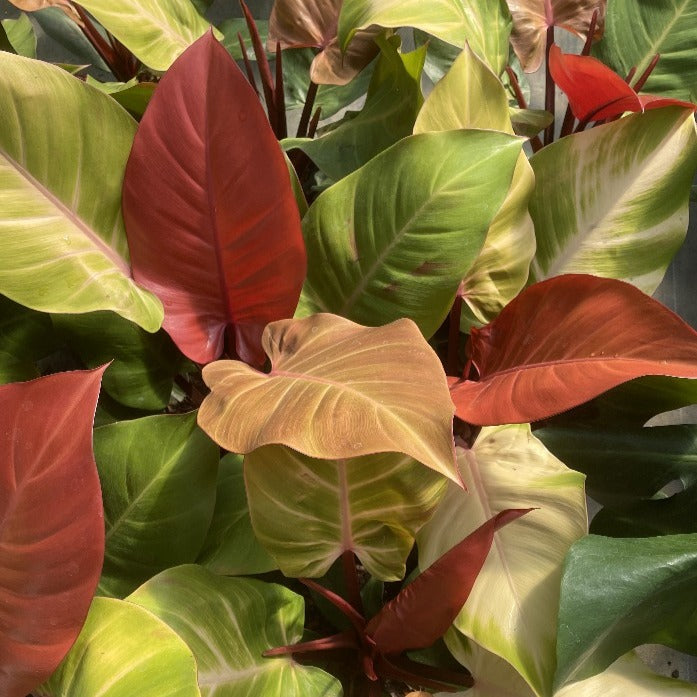
mccolleys finale philodendron Philodendron McColley's FinaleCopper, Orange, and Deep Green Leaves on One Plant Philodendron McColleys Finale is like a miniature autumn forest in a single pot. New leaves unfurl in vibrant copper red and orange tones, then slowly age through bronze into a deep, glossy green, so you often see several colors at once. The broad, paddle shaped leaves are thick and shiny, held on rich red petioles that add even more contrast. Its a true foliage feature plant: compact enough for desks

Copper, Orange, and Deep Green Leaves on One Plant

Philodendron McColley’s Finale is like a miniature autumn forest in a single pot. New leaves unfurl in vibrant copper-red and orange tones, then slowly age through bronze into a deep, glossy green, so you often see several colors at once. The broad, paddle-shaped leaves are thick and shiny, held on rich red petioles that add even more contrast. It’s a true foliage feature plant: compact enough for desks and side tables, but bold enough to anchor a whole plant shelf.

Compact, Self-Heading, and Upright

Unlike vining philodendrons, McColley’s Finale is a self-heading hybrid, which means it grows in a tight, upright clump instead of trailing. Over time, it develops into a sturdy, vase-shaped plant with layered foliage, typically reaching 2.5 to 3 feet in height with support and 12 to 16 inches in width when grown indoors. The growth is moderate rather than fast, so it doesn’t outgrow containers overnight, but it’s vigorous enough that you’ll regularly see fresh new leaves pushing from the center. That tidy habit makes it perfect for modern interiors, shelves, plant stands, and bright corners that need structure and color.

Flexible Light and Easy Watering

McColley’s Finale thrives in bright, indirect light but is surprisingly adaptable. It will live happily in medium light and can even perform well in quality fluorescent or LED lighting, which makes it ideal for offices and apartments. Avoid harsh, direct afternoon sun, which can scorch the foliage; morning or filtered sun is fine as long as the leaves aren’t baking in the sun. Plant it in a well-draining potting mix—something rich and airy with added perlite or bark—and always use a pot with drainage holes.

For watering, let the top inch or two of soil dry out between watering sessions, then water thoroughly until excess water drains from the bottom. Philodendrons prefer evenly moist, never soggy soil; they’d rather go slightly dry than sit in water. Average home humidity is usually fine, but this plant appreciates moderate to higher humidity for the best leaf quality, so grouping it with other plants or adding a pebble tray or humidifier can help prevent crispy tips. Keep it in typical indoor temperatures above about 60°F, away from cold drafts or blasting heat vents.

Statement Houseplant with Designer Color

Indoors, McColley’s Finale acts like a living accent piece. Its warm-toned foliage pairs beautifully with neutral décor, black planters, or natural baskets, and it’s a standout companion to deep green monsteras, dark snake plants, and silver-toned foliage. Use a single plant as a focal point on a console or end table, or repeat it in matching planters for a pulled-together look in an entryway or lobby. Because it stays compact and upright, it’s also excellent on plant shelves or as a color pop in a mixed indoor “jungle” where you want both structure and seasonal-feeling color year-round.

Shipping Notes
  • Free Standard Shipping on $100+ Orders to the USA.
  • Except Preorder products are shipped in 48 hours.
  • Delivery to the USA:
  1. Standard Shipping : 3-10 business days
  • If time is of the essence, please consider selecting expedited delivery for faster service.
Exchange/Return Notes
  • We offer a 30-day return/exchange service after receiving.
  • Final sale items are not eligible for returns or exchanges.
  • To process your return/exchange, please contact us at [email protected]
  • Please click here for more details>>> Return & Exchange Policy
SKU: 78913114396

Discover Niche Categories That Outsell mccolleys finale philodendron

Top-Converting Item to Boost Your Average Order

4.9 ★★★★★
Based on 15 reviews
Sort
Highest Rating
Newest First
Oldest First
Product Reviews
K
Verified Purchase
Kristen
Pawtucket, US
★★★★★ 5
Amazing Book Every Church Leader Should Read
Format: Paperback
Great Book and worth reading
WAS THIS REVIEW HELPFUL?YesReportShare
Reviewed in the United States on April 6, 2024
L
LGB
Lake Worth, US
★★★★★ 5
Provocative Read!
Format: Audiobook
I found this book to be profound, provocative, and very different than any other books I have read on racism and ableism. I never understood how ableism is the catalyst for racism, and how disability compounds racism. Highly recommend especially for those who are well versed in social justice.
WAS THIS REVIEW HELPFUL?YesReportShare
Reviewed in the United States on September 25, 2025
R
Richard P.
Los Angeles, US
★★★★★ 5
Destined to Be One of My Favorite Books of the Year
Format: Paperback
I will openly acknowledge that Lamar Hardwick, the lead pastor of Atlanta's Tri-Cities Church and a pastor with autism, wasn't on my disability theology radar and I wasn't sure what to expect from his upcoming release "How Ableism Fuels Racism: Dismantling the Hierarchy of Bodies in the Church." I was blown away. With "How Ableism Fuels Racism," Hardwick proposes that ableism and the resulting disability discrimination are the root causes of racial bias and injustice in American culture and in the church. Weaving together a tapestry of historical records, biblical interpretation, and disability studies, Hardwick examines how ableism in America led to the creation of images, idols, and institutions that would ultimately fuel both disability and racial discrimination. After engaging in this discussion, Hardwick calls the church into action to address the deeper issues of ableism and offers practical steps to help readers dismantle ableism and racism in both attitude and practice. As an ordained minister and seminary graduate who is also a paraplegic and double amputee, I've long immersed myself in the world of disability theology and long believed that the church embraces the hierarchy of bodies about which Hardwick writes. "How Ableism Fuels Racism" served up a myriad of Aha! moments for me and times when long-held beliefs were finally communicated with clarity. Interestingly, Hardwick even clarified for me what had troubled me with another book I recently read around the issue of "deconstruction." I may have actually shouted out "Yes, that's it!" I've long believed that being accommodated by a church is the ground floor step toward full inclusion. It's far from enough, yet for an institution that fought against the ADA it's often seen as the ultimate gift for those with disabilities. Instead, Hardwick argues that the church should be passionately pursuing those with disabilities and others outside the "typical" hierarchy of bodies." I'm telling you. Brilliant stuff here. I can't stop thinking about it. Precise in its criticism yet also constructive and forward thinking, "How Ableism Fuels Racism" confronts the shameful and shame-filled underbelly of American Christianity and offers a broader and more inclusive vision of God, faith, and church life. How much did I love this book? I'm already reading it again.
WAS THIS REVIEW HELPFUL?YesReportShare
Reviewed in the United States on February 20, 2024
I
ivory6194
Lowell, US
★★★★★ 5
great read for those in the church who want to learn more about equality
Format: Kindle
While this book focuses on ableism and racism, I learned a significant amount about how the church has perpetuated ableism over the years and how the founding fathers of our country used religion and ableism as the initial forms of a caste system. Black bodies were seen as inferior and therefore were able in their minds able to be enslaved. This book is a great read for those in the church who want to learn more about equality and how we as a community and church can do better about falling into the trap that we may be "better than." Lamar Hardwick quoted many different authors and theologians, including one who wrote a book about how Jesus was disabled as a result of the crucifixion. This book is great food for thought and I recommend for those who want to learn more about how they and the church view those seen as different. "Racial slavery in the West began by using disability to make chattel slavery a matter of charity rather than a matter of equality. Defining Africans as mentally inferior and effectively disabled allowed for proslavery advocates to appeal to the Christian ethos of benevolence." "The challenge is that beauty is an abstract concept. Our inability to define beauty without using a deficit model stands in contrast to our fundamental beliefs about how God created us. Our origin begins outside of us. An infinitely holy and wise God who creates with intention and intimacy placed us in the world. Acknowledging God's creative genius challenges us to believe that God does not create anything that is not beautiful in its own way."
WAS THIS REVIEW HELPFUL?YesReportShare
Reviewed in the United States on June 11, 2024
L
Lindsay L. O’Connor
Port Orchard, US
★★★★★ 5
A must-read for Christians seeking a more robust & liberating theology
Format: Paperback
This is a powerful book and an important challenge to the status quo in modern U.S. American Christianity (and beyond, I suspect, but I will speak from my own context). I appreciated Hardwick’s illumination of the direct link between ableism and racism, which he explained in a way I had never heard before. I also found his interpretation and application of scripture from a disability theology lens to be insightful. He uses a framework that shows “how ableism in America led to the creation of images, idols, and institutions that perpetuate both disability and racial discrimination.” I’m fairly new to learning about disability theology and found this book to be a helpful, accessible read that challenged some of the core assumptions many of us inherited from our white western evangelical upbringing. Hardwick combines his own life experience as a Black disabled pastor with his thought-provoking engagement with scripture to call Christians to a more just and liberating theology. Disability theology is not simply a means of including disabled folks in the Christian community but is an essential lens through which we will see Jesus, others, and ourselves in a completely new light that is transformative.
WAS THIS REVIEW HELPFUL?YesReportShare
Reviewed in the United States on June 13, 2024

recommand products