SKU: 81842244254
tiny series asiatic lilies

tiny series asiatic lilies Lily Looks™ Tiny Bee Asiatic Lily

Sale price$22.47 Regular price$24.97
Save 10%

Pay in installments of $6.24 with ShopPay, AfterPay and Klarna

Shipping Estimate
USA
  • USA
  • CAN

Ships within 48 hours · Estimated delivery Jul 18 - Jul 23

Promo Codes Available:

For Your Every Summer RSVP, with Code: SUMMER15

Description

tiny series asiatic lilies Lily Looks™ Tiny Bee Asiatic LilyLily Looks Tiny Bee Asiatic Lily! The Lily Looks Tiny Bee Asiatic Lily PP#16255 (Lilium asiatic 'Tiny Bee') is a dwarf Asiatic Lily, prized for its brilliant yellow blooms speckled with deep maroon spots. As part of the Lily Looks series, this variety is specially bred for high bud count, compact size, and reliable blooming, making it a perfect choice for small sun gardens. Asiatic Lilies are some of the earliest Lilies to bloom, bringing vibrant

Lily Looks™ Tiny Bee Asiatic Lily!

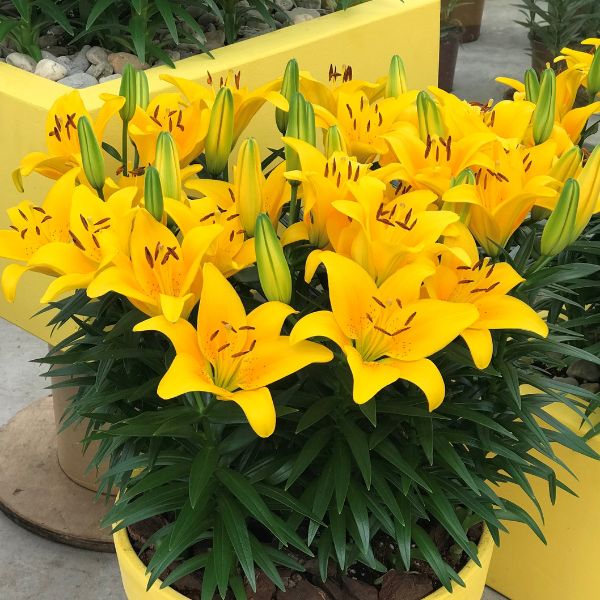
The Lily Looks™ Tiny Bee Asiatic Lily PP#16255 (Lilium asiatic 'Tiny Bee') is a dwarf Asiatic Lily, prized for its brilliant yellow blooms speckled with deep maroon spots. As part of the Lily Looks™ series, this variety is specially bred for high bud count, compact size, and reliable blooming, making it a perfect choice for small sun gardens.

Asiatic Lilies are some of the earliest Lilies to bloom, bringing vibrant color to the garden from early to mid-summer. The Lily Looks™ Tiny Bee Asiatic Lily stands out with its dwarf habit, growing just 12-14 inches tall, making it a perfect fit for small-space gardening!

Key Benefits

  • Compact and Space-Saving – Grows 12-14 inches tall and 10-12 inches wide, perfect for small gardens and patio containers.
  • Vibrant Yellow Blooms – Bright golden-yellow flowers with deep maroon speckling provide bold summer color.
  • Early Season Bloomer – One of the first Lilies to bloom, adding color to the garden in early to mid-summer.
  • Drought-Tolerant & Easy to Grow – Thrives with minimal watering once established.
  • Pollinator-Friendly – Attracts butterflies and hummingbirds, enhancing biodiversity.
  • Deer and Rabbit Resistant – Natural resistance to browsing animals makes it an excellent choice for wildlife-prone areas.
  • Low-Maintenance Perennial – Returns year after year, multiplying to create larger clusters over time.
  • Ideal for Cut Flowers – Long-lasting blooms and sturdy stems make them perfect for floral arrangements.

Landscaping With Lily Looks™ Tiny Bee Asiatic Lily

This easy-care Lily is deer-resistant, drought-tolerant, and attracts pollinators like butterflies and hummingbirds. Its upright, sturdy stems keep the flowers well-supported, making it an excellent choice for cut flower arrangements. With minimal maintenance requirements and a long-lasting bloom period, the Tiny Bee Asiatic Lily is an ideal addition to both beginner and expert gardens alike! Use it in:

  • Borders and Edging – Creates a neat, colorful front-of-bed planting that pairs well with other perennials.
  • Container Gardening – The dwarf size makes it an excellent choice for patio planters and small-space gardens.
  • Rock Gardens – Thrives in well-drained soil, adding a bold pop of color among stones and gravel.
  • Mixed Perennial Beds – Complements Coneflowers, Salvia, and Daylilies, providing continuous color throughout the season.
  • Cut Flower Gardens – Produces long-lasting, sturdy-stemmed blooms ideal for bouquets and floral arrangements.
  • Mass Plantings – Plant in groups for a striking, high-impact display of golden yellow in early summer.

How To Care For Lily Looks™ Tiny Bee Asiatic Lily

This easy-to-grow Lily requires little maintenance while offering seasonal beauty year after year. They are hardy perennials, thriving in full sun and well-drained soil, and they multiply readily, forming larger clumps over time for an ever-expanding display. Follow these simple care tips for best results:

  • Sun Exposure – Thrives in full sun, requiring at least 6 hours of direct sunlight daily.
  • Soil Requirements – Prefers well-drained, fertile soil but avoid soggy or heavy clay conditions to prevent bulb rot.
  • Watering – Keep soil moderately moist during active growth; once established, it is drought-tolerant.
  • Fertilization – Apply a balanced, slow-release fertilizer in early spring to support strong growth and blooms returning year after year.
  • Mulching – A 3-4 inch layer of mulch helps retain moisture and regulate soil temperature. Both in pots and in the ground!
  • Deadheading – Remove spent blooms to encourage continued flowering and keep plants looking tidy.
  • Dividing & Propagation – Asiatic Lilies multiply naturally; divide clumps every 3-4 years if overcrowding occurs.

Bold Gold Blooms!

The Lily Looks™ Tiny Bee Asiatic Lily is a must-have for gardeners who want brilliant color, compact size, and easy maintenance. As a hardy, drought-tolerant perennial, it delivers seasonal beauty year after year!

Planted in any sized garden, this bright yellow Asiatic Lily adds early summer vibrancy, attracts pollinators, and resists deer and rabbits. Now available at Nature Hills Nursery!

Shipping Notes
  • Free Standard Shipping on $100+ Orders to the USA.
  • Except Preorder products are shipped in 48 hours.
  • Delivery to the USA:
  1. Standard Shipping : 3-10 business days
  • If time is of the essence, please consider selecting expedited delivery for faster service.
Exchange/Return Notes
  • We offer a 30-day return/exchange service after receiving.
  • Final sale items are not eligible for returns or exchanges.
  • To process your return/exchange, please contact us at [email protected]
  • Please click here for more details>>> Return & Exchange Policy
SKU: 81842244254

Discover Niche Categories That Outsell tiny series asiatic lilies

Top-Converting Item to Boost Your Average Order

4.1 ★★★★★
Based on 24 reviews
Sort
Highest Rating
Newest First
Oldest First
Product Reviews
S
Verified Purchase
Samantha Laubenstine
Chelsea, US
★★★★★ 5
Perfect for spring time!
Format: Hardcover
Such a great book series I love reading it to my boys!
WAS THIS REVIEW HELPFUL?YesReportShare
Reviewed in the United States on March 31, 2026
A
Verified Purchase
Ashley Mandrell
Natrona Heights, US
★★★★★ 5
Good buy
Format: Hardcover
This is a super cute book! It teaches about spring and we enjoy reading it!
WAS THIS REVIEW HELPFUL?YesReportShare
Reviewed in the United States on February 19, 2026
D
Verified Purchase
Don Morris
Massapequa, US
★★★★★ 5
"Racial Capitalism"
Format: Paperback
Cedric J. Robinson’s Black Marxism is first a history of Black people appearing in historical texts as far back as Herodotus (c. 484 – c. 425 BCE) in ancient Greece, and second a history of “the collisions of the Black and white ‘races’ beginning in the fifteenth and sixteenth centuries.” Robinson’s thesis connects the evolution of capitalism to its roots in racism (racialism) understood in broad terms to comprise the subjugation of one class/group/nation/race by another (the Irish by the English in the nineteenth century, for example). He uses the term “racial capitalism” to express this process—the necessity of opposing classes for the function of capitalism. As a result, “racialism,” he says, “would inevitably permeate the social structures emergent from capitalism.” Keynes attributed the slow change in the “standard of life of the average man” until the beginning of the eighteenth century to “the remarkable absence of important technical improvements and to the failure of capital to accumulate.” Capital is accumulated, in Marx’s view, through the accretion of “surplus labor” which is the extra time a worker “must add to the working time necessary for his own maintenance . . . in order to produce the means of subsistence for the owners of the means of production.” Robinson ties capitalism’s early exploitation of surplus labor to slave labor and the slave trade noting, “historically, slavery was a critical foundation for capitalism.” Robinson traces the forced transport of Black people from Africa (the diaspora) to Europe, as well as Central, South, and North America as a foundation of early capitalism (and slavery as its form of “primitive accumulation” of capital). In his discussions of slavery, Robinson stresses the sense of the enslaved people with respect to their captors in terms of the slaves’ resistance, hostility, and defiance of the masters—their “Black radicalism.” As Robinson’s text approaches the twentieth century and the influence of Marx, his focus narrows to the significance and character of specific Black leaders including W. E. B. Du Bois, C. L. R. James, and Richard Wright and their respective connections to Marxism’s diverse interpretations. Marxism, says Robinson, “has proven insufficiently radical to expose and root out the racialist order that contaminates its analytic and philosophic applications or to come to effective terms with the implications of its own class origins.”
WAS THIS REVIEW HELPFUL?YesReportShare
Reviewed in the United States on September 2, 2022
E
Verified Purchase
Emma
Port Orchard, US
★★★★★ 5
Any socialist movement must centrally address racial liberation to succeed.
Format: Kindle
Robinson's masterwork powerfully demonstrates how the Black radical tradition emerged from the shared experiences of resistance to racial capitalism and colonialism. By tracing this intellectual and political lineage through figures like W.E.B. Du Bois, C.L.R. James, and Richard Wright, Robinson shows that Black liberation struggles were not simply an offshoot of European socialism, but represented their own distinctive radical tradition. A key insight is how Black resistance movements developed theoretical frameworks and modes of struggle that went beyond traditional Marxist analysis. Where European Marxism focused primarily on class conflict within industrial capitalism, Black radical thinkers recognized that racial oppression was fundamental to how capitalism developed globally through colonialism and slavery. This more comprehensive analysis helped explain why racial liberation had to be central to any meaningful socialist transformation in the United States. The book compellingly argues that Black liberation movements - from slave rebellions to civil rights to Black Power - represented some of the most significant challenges to American capitalism. These struggles exposed how racial oppression was not incidental but essential to American economic and social relations. By fighting for racial justice, these movements struck at the foundations of the capitalist order itself. Robinson's updated edition strengthens these arguments by extending the analysis into more recent decades. He examines how Black radical politics evolved in response to neoliberalism and continued racial inequalities, while maintaining connections to earlier traditions of resistance. For readers interested in both racial justice and socialist politics, this book remains invaluable for understanding how these struggles are fundamentally interconnected. It demonstrates why any socialist movement in the United States must centrally address racial liberation to succeed in transforming society.
WAS THIS REVIEW HELPFUL?YesReportShare
Reviewed in the United States on November 11, 2024
T
Verified Purchase
Tee
Cuba, US
★★★★★ 5
A Classic That Requires Time
Format: Paperback
This book is for a particular type of reader. Robinson’s writing is beautiful, but not easy. The ideas are complex. It takes effort to get through. But, if you are interested in Black politics, and looking for fresh thinking, I recommend it highly. The funny thing is, the title is misleading. It is more about Europe and the formation of capitalism, and what Robinson defines as The Black Radical Tradition. Marx is critiqued but not rejected, and held uneasily at arm’s length. As Angela Davis wrote, this book needs to be read more than once. It’s like an album or a movie that is so unique and rich that you know you probably missed something on the first go-round. I expect to return to it many years to come.
WAS THIS REVIEW HELPFUL?YesReportShare
Reviewed in the United States on November 15, 2023

recommand products