SKU: 86287523871
aloe vera plant philippines

aloe vera plant philippines Aloe 'arborescens' – Coastal Succulents, Cacti & Alpines

Sale price$19.32 Regular price$21.47
Save 10%

Pay in installments of $5.37 with ShopPay, AfterPay and Klarna

Shipping Estimate
USA
  • USA
  • CAN

Ships within 48 hours · Estimated delivery Oct 22 - Oct 27

Promo Codes Available:

For Your Every Summer RSVP, with Code: SUMMER15

Description

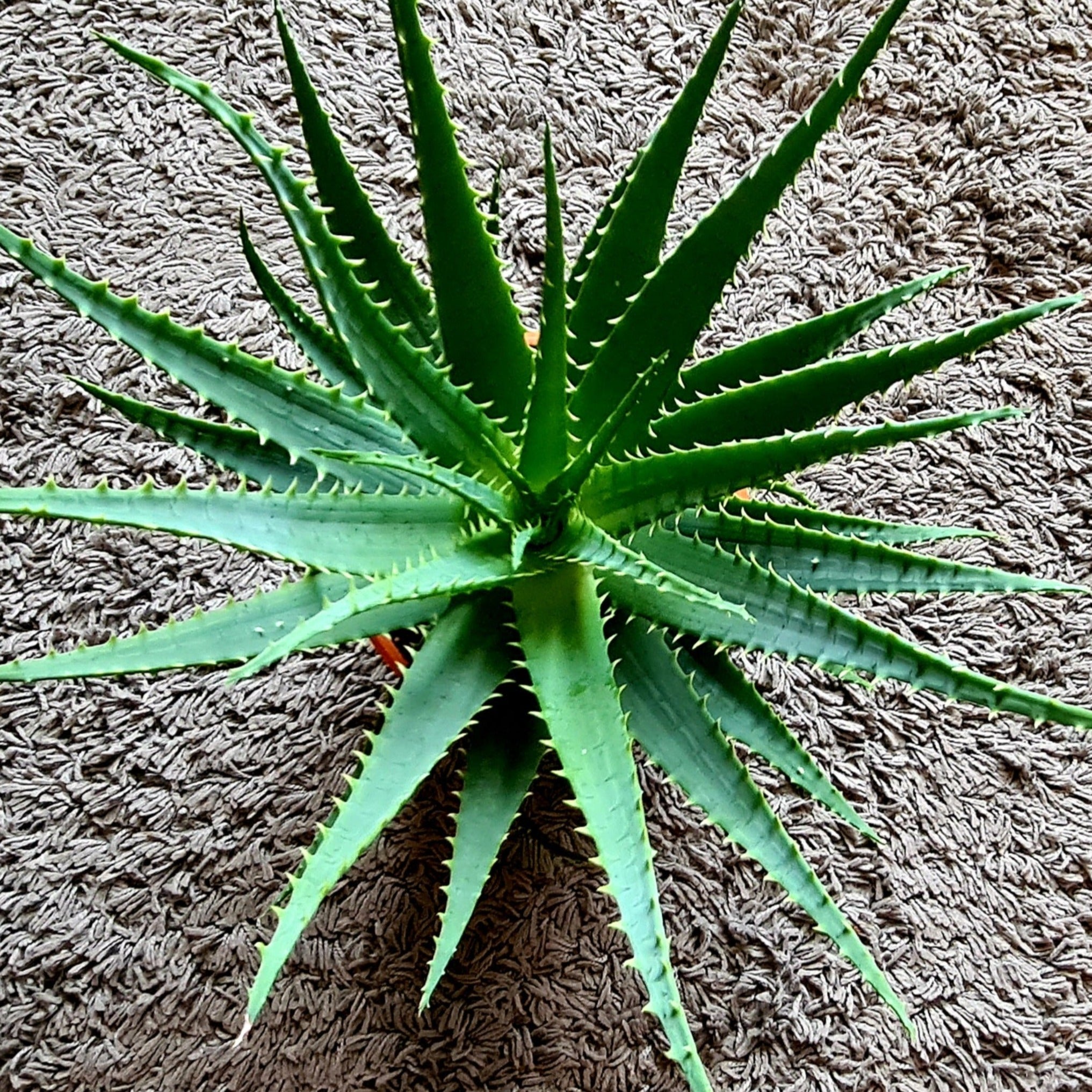
aloe vera plant philippines Aloe 'arborescens' – Coastal Succulents, Cacti & AlpinesAloe 'arborescens' aka the 'Torch Aloe' is native to Malawi, Zimbabwe, Mozambique and South Africa. It bears dense rosettes of succulent, toothed, sword shaped leaves, from which tall, torch like Red flowers similar to kniphofia appearing in Summer. This drought tolerant Aloe prefers to grow in sandy or rocky well drained soil. It is usually found growing along exposed ridges, cliffs and rocky outcrops in mountainous areas, but is well adapted to grow

Aloe 'arborescens' aka the 'Torch Aloe' is native to Malawi, Zimbabwe, Mozambique and South Africa.

It bears dense rosettes of succulent, toothed, sword-shaped leaves, from which tall, torch-like Red flowers – similar to kniphofia – appearing in Summer.

This drought-tolerant Aloe prefers to grow in sandy or rocky well-drained soil. It is usually found growing along exposed ridges, cliffs and rocky outcrops in mountainous areas, but is well adapted to grow anywhere from mountain tops all the way down to sea level, and even in habitats such as dense bush and coastal forests.

Being salt-tolerant, this Aloe can tolerate coastal conditions and is the ideal Plant for a Coastal Planting scheme in the South of the UK.


Please Note: Succulents change colour throughout the year and the plants we deliver can look different from the pictures. All plants are shipped bare root (without soil).


 Native to

Malawi, Zimbabwe, Mozambique and South Africa 
Hardiness -4°C
Growth

The long, thin, succulent, sword-shaped leaves are grey-green in colour, or green with a slight blue tint, and are lined with pale teeth along the leaf margins. Leaves are arranged in at the ends of the branches, and they curl backwards down towards the base of the plant. The individual rosettes grow to around 45cm wide.

Sun Full Sun/Part Shade
Exposure Any
Soil Free draining, plenty of Gravel
Moisture Dry in winter. 
Shipping Notes
  • Free Standard Shipping on $100+ Orders to the USA.
  • Except Preorder products are shipped in 48 hours.
  • Delivery to the USA:
  1. Standard Shipping : 3-10 business days
  • If time is of the essence, please consider selecting expedited delivery for faster service.
Exchange/Return Notes
  • We offer a 30-day return/exchange service after receiving.
  • Final sale items are not eligible for returns or exchanges.
  • To process your return/exchange, please contact us at [email protected]
  • Please click here for more details>>> Return & Exchange Policy
SKU: 86287523871

Discover Niche Categories That Outsell aloe vera plant philippines

Top-Converting Item to Boost Your Average Order

4.4 ★★★★★
Based on 10 reviews
Sort
Highest Rating
Newest First
Oldest First
Product Reviews
M
Verified Purchase
Mr. Stripey
Boise, US
★★★★★ 5
Informative studies of how scientists are trying to address environmental issues today
Format: Paperback
In this book Kolbert travels to visit scientists attempting to address the environmental changes that humans are creating on the planet. The chapters focus on different issues, such as invasive species, and species loss, and includes field site visits, and also references for more reading. If you read this, and Sixth Extinction, and Field Notes From a Catastrophe, you will get a great oversight of some of the environmental issues that we face, although not any neat solutions. All the case studies build up into a wider understanding.
WAS THIS REVIEW HELPFUL?YesReportShare
Reviewed in the United States on December 23, 2023
D
Verified Purchase
Dave of Dublin
San Leandro, US
★★★★★ 3
disappointing
Format: Hardcover
I was excited to read "Under a White Sky". Unfortunately, it seems that the author just sort of stopped writing when COVID hit. See page 197, where author laments the arrival of COVID. FOur pages later, book ends. The author even says on page 197: "Here I was, trying to finish a book about the world spinning out of control, only to find the world spinning so far out of control that I couldn't finish the book". Couldn't finish the book, but COULD publish it and sell it to people like me. The early chapters are interesting, each one covering a different topic related to man messing with nature. Good stuff. But I expect some analysis, some conclusion, something to sum it all up. It just isn't there. Topic and early chapters showed great promise. But the ending is truly lacking. And as the author alludes, unfinished.
WAS THIS REVIEW HELPFUL?YesReportShare
Reviewed in the United States on March 7, 2021
I
Verified Purchase
Immer
Cuba, US
★★★★★ 4
As A Dominant Species, We Dance On The Razor’s Edge
Format: Hardcover
Under A White Sky Elizabeth Kolbert’s claim to fame is her book The Sixth Extinction. In comparison Kolbert’s under A White Sky is rather short and disorganized, yet her coverage of those working on solutions to Climate Change is pretty darn interesting.  In her conclusion, she writes, “This has been a book about people trying to solve problems created by people trying to solve problems.” Putting this sentence at the book’s beginning rather than buried at its end would have provided a reader a compass to help determine where Kolbert was going with her dialogue. As she wades through the reversed direction of the Chicago river; Asian carp; Cane toads; forced and accelerated evolution in regard to coral, in particular in regard to the Great Barrier Reef (without discussing the importance of the worlds reefs; the continual flooding of New Orleans both despite and because of the actions of The Army Corps of engineers, one begins to ponder a general connection that might exist, while the book itself is headed toward a two star rating. Then, Kolbert got to Global Warming and Climate science. The book’s last sixty pages are worth the complete price of admission. The chapter begins with carbon sequestration, the pros and cons of how it can be done, and does it also contribute to the growing problem. The stoppered bathtub” analogy is perhaps the best analogy I’ve heard in regard to the anthropocentric carbon dioxide problem on the Earth. The tub is full of water/ the sky’s CO2 level; the tubs stoppered, so the water isn’t going anywhere, and the atmosphere’s increased CO2 level won’t drop in the near future either; and even if the water flow to the tub is reduced, it will still accumulate until over flowing, as will reduced emissions continue to amass in the atmosphere. In a sense, we are already beyond the tipping point in terms of global temperature increase. Harvard University Center for the Environment director Dan Schrag says, “I’m a scientist. My job is not to tell people the good news. My job is to describe the world as accurately as possible.” He predicts, due to the fact that the oceans must equilibriate. “If we were to stop CO2 emissions tomorrow, which of course isn’t possible, it’s still going to warm for centuries. That’s just basic physics.” Thus enters the topic of geoengineering, and the connection with people trying to solve problems created by people trying to solve problems truly comes into focus. Kolbert , in a rather clandestine way connects the dots of her past “local problems”, but now the problem fix, if it doesn’t work could create problems beyond solving. She hits the nail on the head with this. Humans have been around 35-50 thousand years, but only the last ten thousand or so have they thrived, largely due to agriculture and differentiation of what one can do because of agriculture. But ag has only been able to thrive because of the rather consistent global weather of the past ten thousand years, due to glacial retreat. This has been presented in great detail by Jared Diamond in his book Guns, Germs, and Steel. The CO2 we’ve put into the atmosphere isn’t going anywhere, as we continue to pour more into the mix. Her interviews with climate scientists do not bode well for our species, as everything they think of to combat the CO2 conundrum brings more as the bathtub continues to fill. One could say humans have become victims of their own success as a species. Ultimately, one gets the feeling from Kolbert and her interviews, that the enormous fluctuations in the Earth’s climate over geological time, and those yet to come, render whatever we do as humans as a moot point. The Earth will shake is off as a dog rids itself of fleas. She also brings to the argument, when the blank really hits the fan, as it will despite, or because of any preventative efforts by man, the resulting population displacements will be staggering. A sobering, informative book as we, as a species, dance on the razor’s edge.
WAS THIS REVIEW HELPFUL?YesReportShare
Reviewed in the United States on September 24, 2021
C
Verified Purchase
Christine Liu
Fort Morgan, US
★★★★★ 5
fascinating and compellingly written
Format: Hardcover
Elizabeth Kolbert is one of my favorite nonfiction authors. She has such a knack for writing in a clear, compelling way that makes you think and marvel and ask questions you've never considered before. In her previous book, The Sixth Extinction, she catalogs all the ways in which humans have drastically changed the natural world, ushering the new age of the Anthropocene. Under a White Sky is an exploration of the ways scientists around the world are trying to undo those changes. There are people engineering unique solutions to combat a variety of environmental threats: invasive carp in the Chicago River and cane toads in Australia, Louisiana's rapidly disappearing Mississippi River delta, rare species that now depend entirely on human conservation for their continued survival, and, perhaps most pressingly, the problem of rising carbon emissions and global climate change. That there are brilliant minds working innovatively to solve these problems inspires optimism. But these sobering portraits really highlight the extreme human measures it takes to keep at bay the problems caused by humans interfering with nature in the first place. We've already transformed the planet; how much more will it be transformed by these interventions, and in what ways?
WAS THIS REVIEW HELPFUL?YesReportShare
Reviewed in the United States on March 11, 2021
C
Verified Purchase
Carlos
Whiting, US
★★★★★ 5
Exactly what I ordered
Format: Paperback
As described the book was in great condition and ut was delivered with care
WAS THIS REVIEW HELPFUL?YesReportShare
Reviewed in the United States on August 12, 2025

recommand products