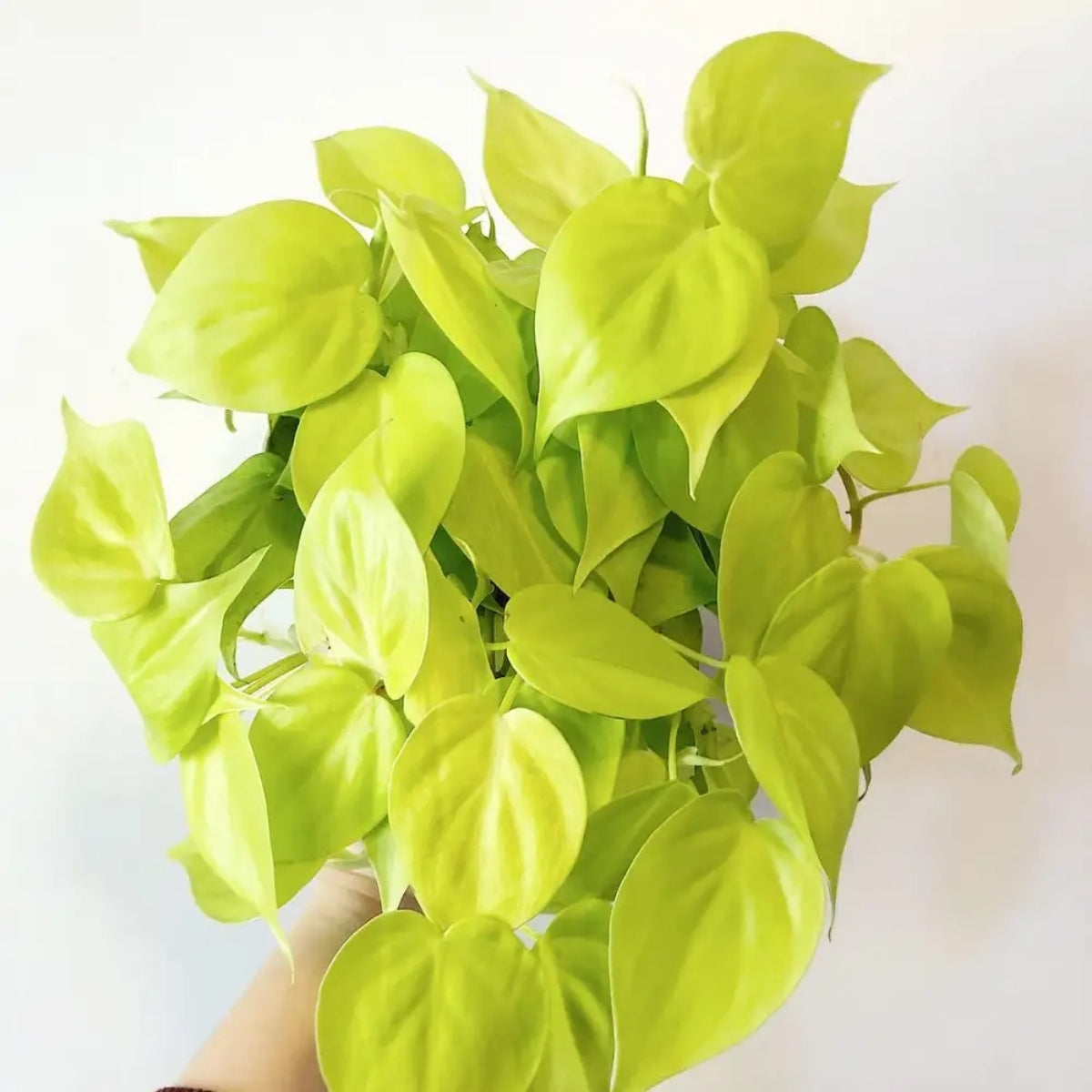
heart leaf philodendron yellow leaves Philodendron Lemon Lime for Sale
SKU: 87728449016
heart leaf philodendron yellow leaves

heart leaf philodendron yellow leaves Philodendron Lemon Lime for Sale

Sale price$21.15 Regular price$23.50
Save 10%

Shipping Estimate
USA
  • USA
  • CAN

Ships within 48 hours · Estimated delivery Jul 8 - Jul 13

Promo Codes Available:

For Your Every Summer RSVP, with Code: SUMMER15

Description

heart leaf philodendron yellow leaves Philodendron Lemon Lime for SaleNeon Color That Instantly Makes Any Room Feel Alive Philodendron Lemon Lime is the turn the lights on houseplantbright chartreuse leaves that glow in a way most greens simply dont. The foliage is heart shaped, fresh, and high impact, giving you that bold color pop look without demanding fussy care. Its perfect for brightening a neutral corner, adding contrast to darker leaf plants, or creating a modern, energetic vibe on a shelf or plant stand. Even a

Neon Color That Instantly Makes Any Room Feel Alive

Philodendron Lemon Lime is the “turn the lights on” houseplant—bright chartreuse leaves that glow in a way most greens simply don’t. The foliage is heart-shaped, fresh, and high-impact, giving you that bold color-pop look without demanding fussy care. It’s perfect for brightening a neutral corner, adding contrast to darker-leaf plants, or creating a modern, energetic vibe on a shelf or plant stand. Even a small pot makes a statement, because the color reads from across the room.

This is also a plant that grows with you. Keep it compact and bushier with occasional pinches, or let it trail into a lush waterfall of neon leaves. Train it up a moss pole to create a climbing, “living column” look, or tuck it into a hanging basket where the vines can spill naturally. It’s a fast favorite for beginners because it’s forgiving, adaptable, and rewarding—when it’s happy, it grows. If you want the easiest way to add big color to your indoor plant lineup, Lemon Lime delivers that “wow” factor quickly.

A Fast-Growing Vine That Trails Or Climbs On Your Terms

Lemon Lime is a heartleaf philodendron type, which means it’s built to vine. In good conditions, it can trail several feet over time, filling out a pot and draping gracefully over edges. If you prefer a fuller look instead of long vines, prune lightly to encourage branching. Each trim can turn one vine into two, creating a denser plant that looks intentionally styled rather than “one long string.” That flexibility makes it ideal for shelves, bookcases, tall planters, and hanging hooks.

You can also train it upward for a more architectural look. Give it a pole or trellis, and the plant will start to climb, often producing larger leaves as it grows. This is a great choice if you want a vertical statement without a massive footprint. Whether you go trailing or climbing, the key is consistent, indirect light and a potting mix that drains well. If you’ve been looking for a vine that grows enthusiastically and stays easy, Philodendron Lemon Lime is one of the most satisfying indoor plants to own.

Light And Water Clarity That Keeps Leaves Bright And Vines Healthy

For the brightest lemon-lime color, place this plant in bright, indirect light—near an east-facing window or a few feet back from a sunny south or west window. It also tolerates medium and even lower light, but the tradeoff is slower growth and less intense color. If vines stretch and leaves space out, that’s your signal to increase light. Avoid direct afternoon sun, which can stress foliage and dull its appearance over time.

Watering is simple: water thoroughly, then let the top 1–2 inches of potting mix dry before watering again. Constantly wet soil is the fastest route to yellow leaves and root issues. Use a well-draining mix (a standard indoor mix boosted with perlite or bark works great) and always choose a pot with drainage holes. In brighter light and warmer rooms, you’ll water a bit more often; in winter, you’ll usually water less. Keep the routine steady, and Lemon Lime will reward you with healthy vines and vibrant, glowing leaves.

Easy Styling For Hanging Baskets, Poles, And Everyday Spaces

Philodendron Lemon Lime is one of the best “anywhere” plants for indoor décor. Hang it high and let vines cascade, or set it on a shelf where it can trail down and soften hard lines. If you want a bigger statement, train it up a pole and let it become a living accent piece. It also propagates easily from stem cuttings, so you can fill out your pot, create a second plant, or share it with a friend.

One important note for households with pets and kids: philodendrons are not considered pet-safe if chewed, so place this plant out of reach if you have curious nibblers. The good news is that it’s easy to position safely—high shelves, hanging baskets, or a plant stand in a low-traffic spot. Give it warm indoor temperatures, moderate humidity (average home humidity is usually fine), and occasional pruning to shape, and you’ll have a bright, reliable vine that looks lush without constant attention.

Shipping Notes
  • Free Standard Shipping on $100+ Orders to the USA.
  • Except Preorder products are shipped in 48 hours.
  • Delivery to the USA:
  1. Standard Shipping : 3-10 business days
  • If time is of the essence, please consider selecting expedited delivery for faster service.
Exchange/Return Notes
  • We offer a 30-day return/exchange service after receiving.
  • Final sale items are not eligible for returns or exchanges.
  • To process your return/exchange, please contact us at [email protected]
  • Please click here for more details>>> Return & Exchange Policy
SKU: 87728449016

Discover Niche Categories That Outsell heart leaf philodendron yellow leaves

Top-Converting Item to Boost Your Average Order

4.4 ★★★★★
Based on 424 reviews
Sort
Highest Rating
Newest First
Oldest First
Product Reviews
B
Verified Purchase
Brad Smith
Draper, US
★★★★★ 5
Xylimelts Sensitive
I was sensitive to the regular Xylimelts after a few months use. Painful gums and hives inside my lips and cheeks. The sensitive version immediately corrected the problem and I’ve been using them without issue for nearly a year. The product is a lifesaver for drymouth that occurred when I was sleeping.
WAS THIS REVIEW HELPFUL?YesReportShare
Reviewed in the United States on March 28, 2026
W
Verified Purchase
Whislin ducks
Pawtucket, US
★★★★★ 5
Best that I have found for dry mouth.
These are the best for dry mouth at night. They mostly stay stuck. I say mostly because I have had a few come apart. I think that was my fault.
WAS THIS REVIEW HELPFUL?YesReportShare
Reviewed in the United States on February 20, 2026
S
Verified Purchase
scott
Dallas, US
★★★★★ 5
Lessons described live up to the book title.
Format: Hardcover
A fascinating read filled with eclectic stories of corporate experiences--the good and the bad. This book provides deep insight and guidance for considering what really matters and is most effective in the internal workings of your company to bolster success.
WAS THIS REVIEW HELPFUL?YesReportShare
Reviewed in the United States on April 10, 2026
G
Verified Purchase
GVG
Cuba, US
★★★★★ 5
Must read for any company owner
Format: Hardcover
If you own a company, have a business or are a manager, this is a must read
WAS THIS REVIEW HELPFUL?YesReportShare
Reviewed in the United States on May 24, 2026
M
Verified Purchase
moangu
Grantham, US
★★★★★ 4
Indicators framework done right
Format: Paperback
I have found this book really useful. I would say it could be useful also for anyone working in a large organization and dealing with the challenges, virtues and downsides of performance indicators methodologies, both for career development within the organization and for the organization's success. The book confirms the need to read Andrew Grove's (1983) High Output Management. And it reminds us that Peter Drucker's (1954) The Practice of Management is still relevant. I would highlight several ideas promoted by the book: First, regarding OKRs: the benefits of the transparency of OKRs, with all OKRs visible to the entire organization, from the CEO down to the lowest level employees; the recommendation of dual planning (annual and quarterly); the role OKRs should have on engagement, commitment and motivation; the importance of constructing and cascading OKRs in a meaningful way as opposed to by rote (set them and forget them), enthusiastic compliance instead of bureaucratic compliance; the need to have two kinds of goals (committed and aspirational); the need to encourage staff to define a portion of their OKRs, to let them develop their own objectives, a healthy proportion of alignment (top-down) and autonomy (bottom-up); the key role of culture and the impossibility sometimes of changing it without staff renewal; the recommendation to separate bonuses from the OKR cycle; the flexibility to adjust or discard OKRs mid-cycle; the real risk of big organizations at any time of having some significant percentage of people working on the wrong things; Second, all the discussion regarding performance management, the recognized futility and sometimes demoralizing effect of annual performance reviews, is very insightful. Other thoughts, not original from this book, but worth recalling: ideas are easy, execution is everything; the ideal number of direct reports to a manager should be somewhere between 7 and 20; the most important things need to get done first or they won't get done at all; not everything that can be counted counts and not everything that counts can be counted; transparency and accountability are two related but clearly different concepts, the latter rather an outcome, the former totally an output; moral suffers when people know they can't succeed. Unfortunately, the book has its shortcomings, most of them associated with the testimonies of OKR virtues. Particularly interesting is the case of Zume Pizza, presented as a success case (and OKR as one of the critical factors of that success story). However, we know now that the company bankrupted a few years after the book was published, showing that even the most successful venture capitalist is not always right, his knack for business not always foolproof. And also showcasing that OKRs might be necessary but certainly not sufficient. At any rate, since the book is complemented by a website (https://www.whatmatters.com/) I wish the author shared there a post-mortem, assessing what happened and the relationship between OKRs and that failure. On the other hand, the case of Bono's NGO could have been spared. Zero value added. And, maybe, also the one about the Gates Foundation. Both examples are part of the book's evangelizing, metaphor-ridden and inspirational tone, where billionaires are presented as driven only for the possibility of bringing happiness to humanity and not as real people, that take most of their decisions in the pursuit of money, power or fame.
WAS THIS REVIEW HELPFUL?YesReportShare
Reviewed in the United States on August 16, 2025

recommand products