SKU: 90779608233
palms and philodendrons

palms and philodendrons Philodendron Glad Hands

Sale price$22.88 Regular price$25.42
Save 10%

Pay in installments of $6.36 with ShopPay, AfterPay and Klarna

Shipping Estimate
USA
  • USA
  • CAN

Ships within 48 hours · Estimated delivery Oct 22 - Oct 27

Promo Codes Available:

For Your Every Summer RSVP, with Code: SUMMER15

Description

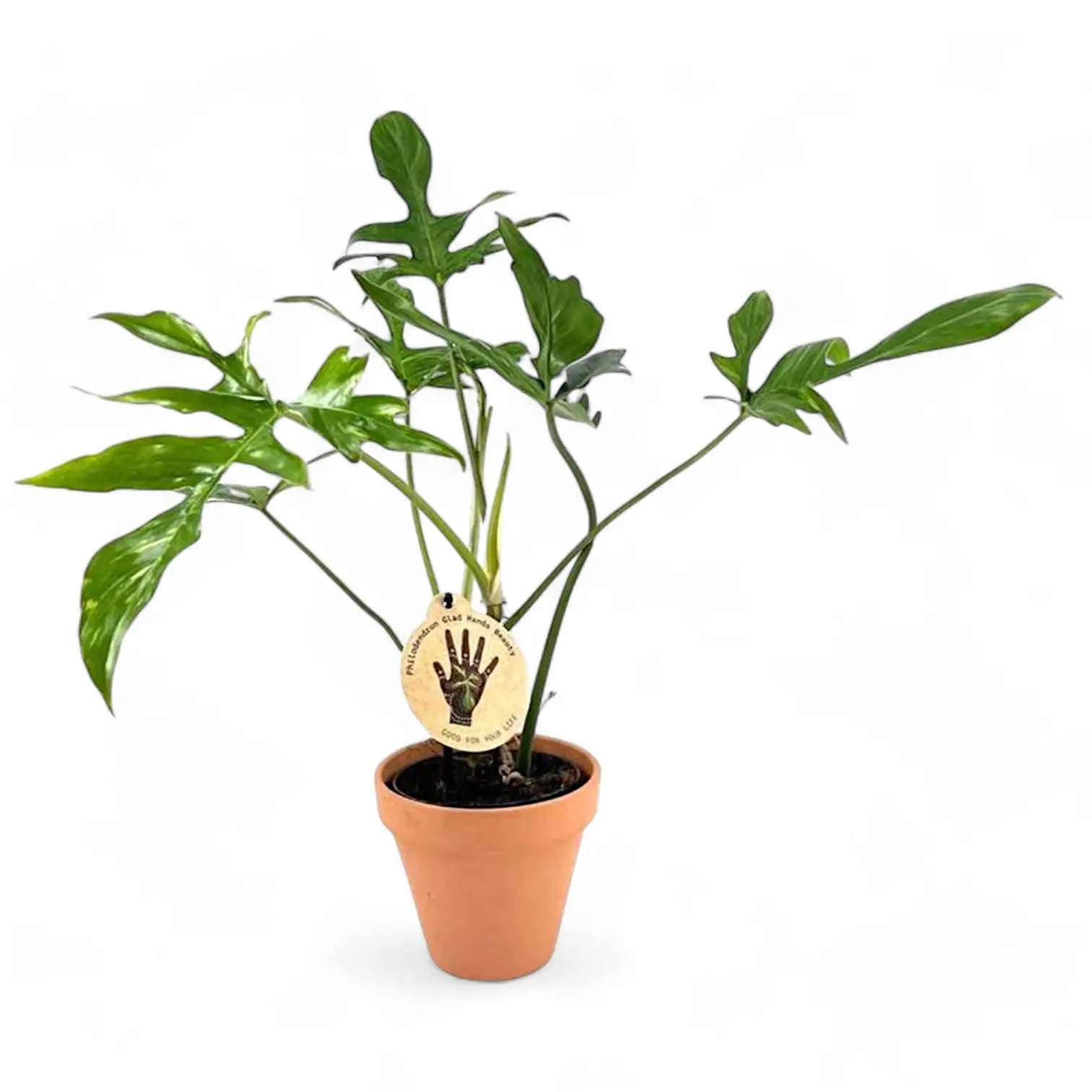
palms and philodendrons Philodendron Glad HandsPhilodendron 'Glad Hands' (quercifolium) Philodendron 'Glad Hands' is a narrow form of Philodendron pedatum, grown for deeply divided leaves with long, slim lobes that spread from the blade like fingers. The full leaf shape develops over time, so young plants can look slimmer and less divided before the stem gains size and support. This plant grows from a climbing stem with clear nodes and aerial roots. As the stem extends, each node can produce

Philodendron 'Glad Hands' (quercifolium)

Philodendron 'Glad Hands' is a narrow form of Philodendron pedatum, grown for deeply divided leaves with long, slim lobes that spread from the blade like fingers. The full leaf shape develops over time, so young plants can look slimmer and less divided before the stem gains size and support.

This plant grows from a climbing stem with clear nodes and aerial roots. As the stem extends, each node can produce another leaf and attach to support through new root points. A pole, plank, or trellis helps the plant anchor, keeps the stem upright, and gives divided leaves space to spread.

Narrow lobes and node-by-node growth

  • Growth habit: Climbing Philodendron with nodes, aerial roots, and a stem that responds well to vertical support.
  • Leaf shape: Long, narrow lobes give older leaves a hand-like outline.
  • Development: Leaf divisions become clearer as the plant gains size, support, and stronger root growth.
  • Petiole spread: Leaves are held away from the stem, so established plants need space around the support.
  • Root behaviour: Aerial roots help the climbing stem attach and support larger foliage over time.

Pedatum background and quercifolium name

Philodendron pedatum (Hook.) Kunth was published in Enumeratio Plantarum 3:49 in 1841. It is an accepted South American species that grows as a climber in wet tropical habitats. Philodendron quercifolium Engl., published in Botanische Jahrbücher für Systematik 26:546 in 1899, is now placed under Philodendron pedatum.

The quercifolium name refers to oak-like divided leaves and still appears around this plant in cultivation. This narrow form shows a slimmer, more finger-like expression of pedatum-style leaf division once the stem is rooted and climbing. Older leaves gain a more defined outline, not just a larger size.

Care for divided leaves

  • Light: Provide bright filtered light. Strong indirect light supports shorter internodes and more developed leaves, while harsh direct sun can scorch exposed lobes.
  • Watering: Water thoroughly once the upper substrate has dried slightly. Keep moisture steady during active growth, but do not leave the pot standing in water.
  • Substrate: Use a chunky aroid mix with bark or coco chips, perlite or pumice, and a moisture-holding base. The roots need both moisture and air around them.
  • Pot choice: Choose a pot with drainage holes and enough depth to hold the support firmly. Avoid oversized pots that keep the lower stem wet for too long.
  • Repotting: Repot when roots fill the pot or the support becomes unstable. Move up gradually so the root zone stays aerated.
  • Support: Add a pole, plank, or trellis early. Attach the stem loosely so aerial roots can reach the support without being crushed.
  • Humidity: Aim for moderate to high humidity. Around 50–70% helps the narrow lobes open without dry tips or tears.
  • Temperature: Keep at about 18–28°C. Cool, wet conditions slow root activity and can damage the lower stem.
  • Feeding: Feed lightly during active growth with a balanced fertiliser. Reduce feeding when light and leaf production slow down.
  • Growth rate: Expect moderate climbing growth once rooted and supported. Leaf shape improves gradually as the stem strengthens.
  • Pruning: Remove yellowing leaves and trim stretched stems above a node if the plant needs reshaping. Healthy cut sections can be used for propagation.
  • Placement: Give the plant room around its support so the lobed leaves can spread without rubbing against walls, shelves, or neighbouring plants.
  • Semi-hydroponics: This Philodendron can adapt to mineral or semi-hydro substrates if roots are transitioned gradually and the reservoir is kept clean.
  • Propagation: Take stem cuttings with at least one node and preferably an aerial-root nub. Keep cuttings warm and humid while roots form.

Juvenile leaves, torn lobes and stem stretch

  • Leaves staying juvenile: Check support, light, and root health. A divided leaf shape develops more reliably on a climbing, well-rooted stem.
  • Yellow lower leaves: Inspect the substrate and roots. Persistent wetness around the lower stem can cause older leaves to decline quickly.
  • Brown lobe tips: Look for dry roots, low humidity, fertiliser buildup, or hot sun through glass.
  • Long gaps between leaves: The stem may be reaching for light or growing away from its support. Move it into brighter filtered light and secure new growth.
  • Torn new leaves: New lobes can catch while unfurling. Keep watering stable and humidity moderate rather than forcing the leaf open.
  • Loose stem attachment: If the stem pulls away from the support, retie it gently at the nodes and guide new aerial roots toward the surface.
  • Pests: Check leaf undersides, petiole bases, and cataphylls for thrips, mites, scale, and mealybugs.

Pet safety and skin irritation

Philodendron 'Glad Hands' should be kept away from pets and children that may chew leaves or stems. Philodendron contains calcium oxalate crystals, which can irritate the mouth, throat, and digestive tract if ingested. Sap may irritate sensitive skin after pruning or propagation.

Name meaning and botanical background

Philodendron means “tree-loving”, a reference to the climbing habit common in the genus. The epithet pedatum means foot-like, matching the divided leaf outline of Philodendron pedatum. Quercifolium combines Latin roots for oak and leaf, referring to an oak-like leaf shape. The name 'Glad Hands' suits the hand-like spread of the leaf lobes.

Choose Philodendron 'Glad Hands' for a climbing Philodendron with slim, fingered leaves and a distinctive narrow-lobed outline.

Shipping Notes
  • Free Standard Shipping on $100+ Orders to the USA.
  • Except Preorder products are shipped in 48 hours.
  • Delivery to the USA:
  1. Standard Shipping : 3-10 business days
  • If time is of the essence, please consider selecting expedited delivery for faster service.
Exchange/Return Notes
  • We offer a 30-day return/exchange service after receiving.
  • Final sale items are not eligible for returns or exchanges.
  • To process your return/exchange, please contact us at [email protected]
  • Please click here for more details>>> Return & Exchange Policy
SKU: 90779608233

Discover Niche Categories That Outsell palms and philodendrons

Top-Converting Item to Boost Your Average Order

4.4 ★★★★★
Based on 10 reviews
Sort
Highest Rating
Newest First
Oldest First
Product Reviews
R
Verified Purchase
Rich
West Palm Beach, US
★★★★★ 5
Buy it.
This is not merely another guide to intensive care. Well-organized and detailed, it hits the right note between the things a beginner has to know (and probably has some idea about) and the things a beginner needs to know (but is clueless). It even includes a chapter on burnout. Recommended for everyone new to the ICU, and also everyone who has been around awhile. I’m going to get a lot of use from this text, I can already tell.
WAS THIS REVIEW HELPFUL?YesReportShare
Reviewed in the United States on June 19, 2018
W
Verified Purchase
W. Lonfrost
Port Orchard, US
★★★★★ 3
A little too beginner; doesn't translate well to USA patterns of practice
Format: Paperback
The book title really says it all, it really is the BEGINNER'S guide to the ICU for junior doctors and allied health professionals - more like an introduction to important concepts rather than a guide really. The strengths of the text come from its stated purpose of being a absolute, beginner's guide to critical care. The book would be appropriate for perhaps a 4th year med student or a intern who is very early in residency w/ little ICU experience or a newly minted APP; there's little to be gained by a advanced resident, fellow or practicing physician. The chapters are very short which provide a mere grazing-the-surface of important critical care concepts - some chapters are too short to really be useful (e.g. the paltry coverage of ultrasound in crit care (p. 159) is only 10 pages including pictures). The book, editors and authors are UK-based which makes the units of measurement, choice of drugs and some practice patterns, not consistent with what is typical in the USA. For this reason I cannot recommend this text for American learners; e.g. blood glucoses are measured in mmol/L internationally, however USA, Germany use mg/dL where a normal BG in UK may be "4.4" but in the US one might consider a normal BG "80". This carries over again with concepts of ABG's and their utility in ventilator settings, respiratory emergencies and sepsis, etc. which become more confounding when using the PaCO2/PaO2 kPa instead of the mmHg used in American ICU's. When a BEGINNER is trying to learn the FUNDAMENTALS of crit care I recommend that a learner be introduced to the concepts using data measurement they are expected to utilize in practice rather than going through the mental gymnastics of doing conversions and THEN making a treatment decision. The theme of UK and USA differences continues into drug therapy. For example when covering RSI and sedation the authors discuss the utility of sodium thiopental, however this drug has not been available in the USA for many years. In addition there were some other areas where some recommended drugs did not correlate w/ typical USA patterns and others that received hardly any mention (e.g. little mention of vasopressin as an adjunct in pressor support, other paralytics in RSI such as succinyl choline, rocuronium, CCB's and BB's in atrial fibrillation). Least of all there are multiple areas where drug/device names that refer to the same agent but would confuse a beginner starting in the USA (e.g. albuterol = salbutamol, aceteminophen = paracetamol, norepinephrine = noradrenaline, Guedel = OPA etc.). Lastly, on the topic of UK vs worldwide differences the epidemiologic data mentioned refers to UK populations making it somewhat of an abstraction of the prevalence of disease in your area of practice if you're outside the UK. Which is fine, just be aware of that. The chapters, however, are well organized and majority begin with a clinical case which I find is a approach that cements concepts in learner. If anything I feel that some are much to short, even for a beginner. I'm specifically referring to the Cardiac Arrythmias chapter (p 233). There is much to cover on this topic and the 5 pages dedicated to it is simply not enough and there is no further recommended reading. And importantly, the EKG figures were switched around on p234 and p235, which again does a beginning learner a disservice. I did find the chapters dedicated specifically to ICU concepts useful such as "Fighting the Ventilator" and "Endotracheal tube and tracheostomy problems" which cover just enough ground for the trainee. Unfortunately, none of the chapters have in-text citations with little primary references - I did have some questions regarding some chapter authors recommendations and I'm unable to look up where the works cited to review the quality of evidence. There are multiple chapter authors and unfortunately this creates some redundancies. I could only find one area where there was a contradiction between authors which one author stated there is no contraindication for insertion of a NPA in setting of base-of-skull fracture (p.79) and on the next chapter another author stating that "nasopharyngeal airway is contraindicated if there is the possibility of a base of skull injury!" (p.87) - less than 10 pages apart. Again, there's no primary texts referenced and I can't confirm where the best, up to date evidence lies. In SHORT: this is a useful text to the BEGINNER who is looking to obtain a broad overview of critical care CONCEPTS. It is pretty easy to read through and simple to digest where I a motivated learner could get through the full 440 pages relatively quickly and gain a good grasp & appreciation of the concepts of critical care. The text accomplishes its goal of being a BEGINNER'S GUIDE to ICU and explicitly identifies its target audience in the title: . . . . A Handbook for Junior Doctors and Allied Professional. I do NOT recommend the text to American trainees for the reasons above (drugs, units, differences in practice patterns) and I don't recommend the text to practicioners who have more experience.
WAS THIS REVIEW HELPFUL?YesReportShare
Reviewed in the United States on January 19, 2021
J
Verified Purchase
Jose
Houston, US
★★★★★ 3
Material
Format: Paperback
The material is not the greatest very basic and it is all UK based
WAS THIS REVIEW HELPFUL?YesReportShare
Reviewed in the United States on February 2, 2020
O
Verified Purchase
Olivia Lee
Cuba, US
★★★★★ 5
Good
Format: Spiral-bound
Good quality book
WAS THIS REVIEW HELPFUL?YesReportShare
Reviewed in the United States on May 8, 2026
S
Verified Purchase
shrima
Pawtucket, US
★★★★★ 5
Essential Tool for Efficient and Accurate Medical Coding
Format: Spiral-bound
The book arrived in excellent condition. The pages are made with high quality paper The color coded sections makes it easy to find the information you need The Pros- Up to date user friendly features durable built. The Cons- The book is so big is it hard to carry around The book is an investment so I did not mind the price. Also in my opinion if you are taking the CPC exam it is best to have the latest version of the CPT book as most of the questions are about this section. I highly recommend the 2024 edition as some things have changed and it's best to have the up- to- date edition especially for class or testing. Tips- Use tab dividers to help you find the sections quicker during testing.
WAS THIS REVIEW HELPFUL?YesReportShare
Reviewed in the United States on April 15, 2024

recommand products