SKU: 93366705256
african mask elephant ear plant

african mask elephant ear plant African Mask Alocasia – Plant Detectives

Sale price$26.66 Regular price$29.62
Save 10%

Pay in installments of $7.41 with ShopPay, AfterPay and Klarna

Shipping Estimate
USA
  • USA
  • CAN

Ships within 48 hours · Estimated delivery Sep 16 - Sep 21

Promo Codes Available:

For Your Every Summer RSVP, with Code: SUMMER15

Description

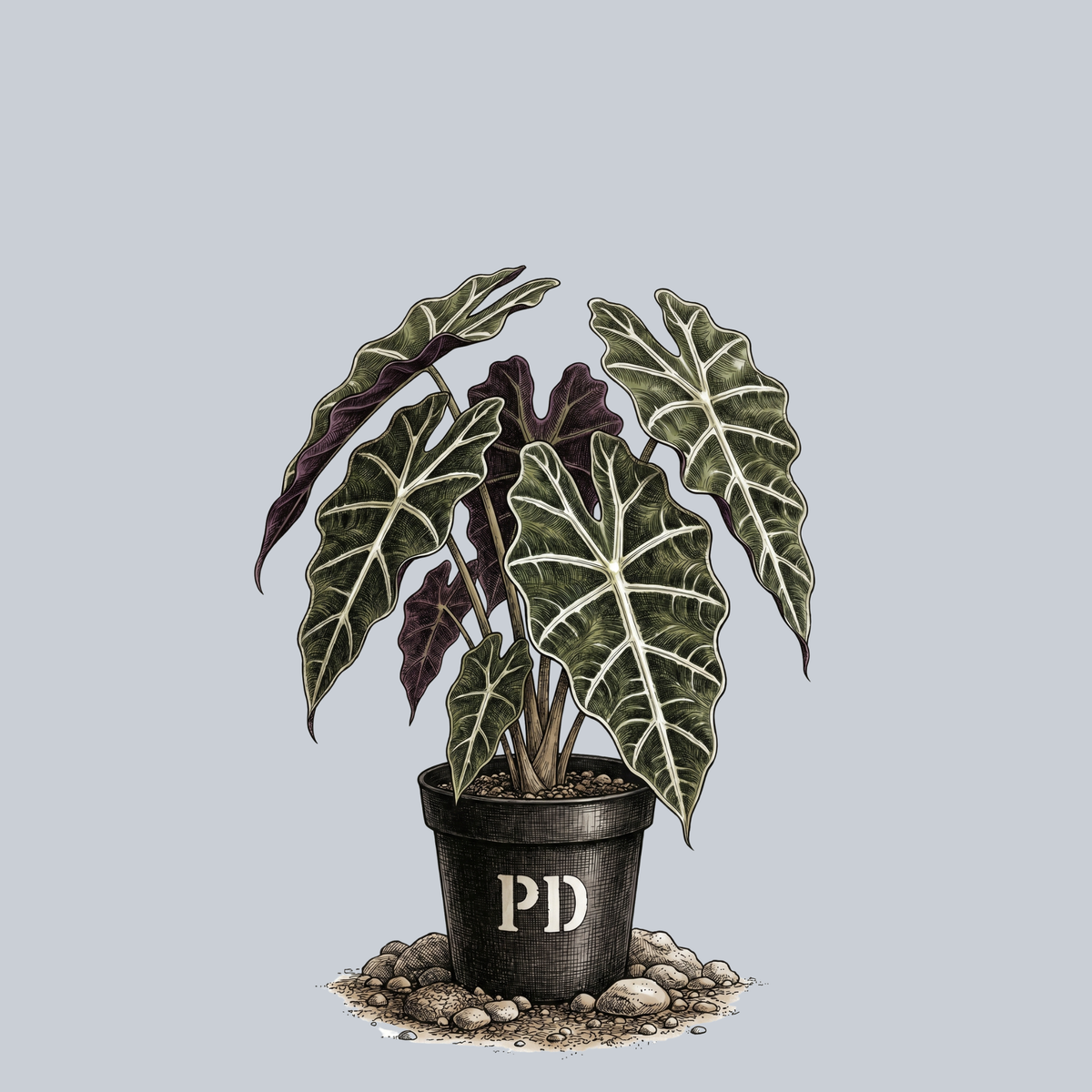
african mask elephant ear plant African Mask Alocasia – Plant DetectivesAfrican Mask Alocasia (Alocasia x amazonica) African Mask Alocasia is a dramatic tropical houseplant valued for its dark, shield shaped foliage, bold silver white veining, and compact architectural form. Its glossy, wavy edged leaves create a high contrast look that stands out on plant stands, tabletops, shelves, offices, and bright indoor corners. This plant brings strong visual impact without needing flowers, making it a favorite for interiors where

African Mask Alocasia (Alocasia x amazonica)

African Mask Alocasia is a dramatic tropical houseplant valued for its dark, shield-shaped foliage, bold silver-white veining, and compact architectural form. Its glossy, wavy-edged leaves create a high-contrast look that stands out on plant stands, tabletops, shelves, offices, and bright indoor corners. This plant brings strong visual impact without needing flowers, making it a favorite for interiors where foliage texture and shape matter. With bright indirect light, warm temperatures, steady moisture, and higher humidity, African Mask Alocasia adds a refined tropical accent to indoor plant collections.

Distinctive Features

African Mask Alocasia is best known for its leathery, arrowhead-shaped leaves that are dark green to bronze-green with prominent white to silvery green veins. The leaves have wavy margins and a sculptural shape that gives the plant a bold, almost metallic appearance. Its compact size makes it easier to place indoors than many larger elephant ear plants, while still delivering a strong tropical look. Flowers are uncommon indoors and not the main feature, since the plant is grown primarily for its striking foliage.

Growing Conditions

  • Sun: Grows best in bright indirect light, with protection from harsh direct sun that can scorch the foliage.
  • Soil: Prefers a fertile, well-drained indoor potting mix that holds light moisture while still allowing good airflow around the roots.
  • Water: Keep soil evenly moist during active growth, watering when the upper portion begins to dry, and avoid both bone-dry soil and standing water.
  • USDA Zones: Best grown as a houseplant in most climates and hardy outdoors only in frost-free tropical conditions, generally USDA Zones 10 to 12.
  • Mature Size: Typically reaches about 1 to 2 feet tall and 1 to 2 feet wide indoors, depending on pot size, light, humidity, and care.
  • Habit: Forms a compact, upright tropical houseplant with bold leaves rising from the base on sturdy petioles.

Ideal Uses

  • Focal Point: Use as a bold indoor focal point on plant stands, tabletops, office desks, shelves, or bright corners where its dark foliage and bright veins can stand out.
  • Tabletop Plant: Place in a decorative container where its compact size and dramatic foliage can add impact without taking up too much room.
  • Office Plant: Use in bright office spaces where a distinctive foliage plant can bring structure and color to the setting.
  • Interior Accent: Pair with softer green houseplants, ferns, pothos, or trailing plants to create contrast in leaf shape, color, and texture.
  • Container Planting: Grow in a well-drained pot with drainage holes, using a container that supports steady moisture without trapping excess water.

Low Maintenance Care

  • Watering: Water when the upper soil begins to dry, then allow excess water to drain fully so the roots stay moist but not soggy.
  • Humidity: Provide higher humidity when possible, especially in dry indoor rooms, to help reduce leaf edge browning and stress.
  • Light Care: Keep near a bright window with filtered light and rotate the pot occasionally for balanced growth.
  • Leaf Care: Wipe leaves gently with a damp cloth to remove dust and keep the dramatic veining visible.
  • Fertilizing: Feed lightly during the active growing season with a balanced houseplant fertilizer, following label directions.
  • Dormancy: Reduce watering if growth slows in winter, since Alocasia may rest or drop leaves when light and temperatures decline.

Why Choose African Mask Alocasia?

  • Dramatic Foliage: Displays dark shield-shaped leaves with bold silver-white veining for strong indoor contrast.
  • Compact Size: Fits tabletops, shelves, plant stands, offices, and smaller rooms better than many larger elephant ear plants.
  • Architectural Shape: Adds sculptural form and tropical texture to interior plant displays.
  • High-Impact Accent: Creates a striking look even without flowers, making it valuable for foliage-focused indoor designs.
  • Container Friendly: Performs well in decorative pots when given bright indirect light, steady moisture, warmth, and humidity.

African Mask Alocasia is an excellent choice for anyone who wants a compact houseplant with bold foliage and a refined tropical look. Its dark leaves, bright veining, wavy edges, and architectural habit make it a standout plant for bright indoor spaces where color, structure, and texture are all part of the design.

Shipping Notes
  • Free Standard Shipping on $100+ Orders to the USA.
  • Except Preorder products are shipped in 48 hours.
  • Delivery to the USA:
  1. Standard Shipping : 3-10 business days
  • If time is of the essence, please consider selecting expedited delivery for faster service.
Exchange/Return Notes
  • We offer a 30-day return/exchange service after receiving.
  • Final sale items are not eligible for returns or exchanges.
  • To process your return/exchange, please contact us at [email protected]
  • Please click here for more details>>> Return & Exchange Policy
SKU: 93366705256

Discover Niche Categories That Outsell african mask elephant ear plant

Top-Converting Item to Boost Your Average Order

4.2 ★★★★★
Based on 27 reviews
Sort
Highest Rating
Newest First
Oldest First
Product Reviews
J
Jordan Bell
Lowell, US
★★★★★ 5
Plato's dialogue about the physical world
Format: Paperback
The two biggest topics in the Timaeus are astronomy and the elements of bodies, which are constructed using triangles and the tetrahedron, octahedron, icosahedron, and cube. I would like to see a translation of the Timaeus that uses it as a way to introduce all the astronomy that appears in the dialogue. Introducing the astronomy does not mean just talking in words about spheres or the zodiac or the ecliptic, but actually explaining how these were used by astronomers. Cornford has much to say, but to someone who has not learned any Greek astronomy his commentary will be opaque and hard to use. I didn't know the astronomy well enough to readily understand Cornford's explanations. I plan to learn more classical Greek astronomy, perhaps using Evans' , and then read Waterfield's translation of the Timaeus . Before reading this you should have read the Republic and know some classical Greek natural philosophy, mathematics, and astronomy. Although Cornford's commentary makes the dialogue staccato, I am glad for it because I wouldn't otherwise have understood much of what Plato says. The Timaeus and the Parmenides are the two dialogues of Plato that one needs commentary to understand; the Parmenides demands the commentary because so much of what is happening depends on the original language, and the Timaeus demands the commentary because of all the things the reader is supposed to be familiar with. The following is a list of topics I kept while reading the dialogue: theory of Forms 27d-28a, 51a-52a; harmonics 35b-36b; time 37c-38e, 39b-e; vision 45b-46c, 67c-68d; space 52b; surfaces 53c; weight 62d-63e; sound 67a-67c; physiology 70c-79e, 80d-86a; antiperistasis 79e-80c.
WAS THIS REVIEW HELPFUL?YesReportShare
Reviewed in the United States on December 12, 2015
S
Steve Lookner
Whiting, US
★★★★★ 4
Helpful, but Waterfield is better for an intro
Format: Paperback
This is basically a scholarly paragraph-by-paragraph commentary on the Timaeus. It's really good for what it is, but I don't recommend it as your first introduction to the Timaeus -- rather, I recommend Waterfield: http://www.amazon.com/Timaeus-Critias-Oxford-Worlds-Classics-ebook/dp/B006NTMD16 A problem with using Cornford as an introduction is that he comments on everything, and it's hard to figure out what the main themes are. I tried reading Cornford as an intro and gave it up, but once I'd read Waterfield I found Cornford extremely helpful both in elucidating passages further than Waterfield does, and in interpreting passages Waterfield doesn't cover. So if you're looking to learn about the Timaeus, I'd suggest Waterfield first and Cornford second (or Cornford alongside Waterfield).
WAS THIS REVIEW HELPFUL?YesReportShare
Reviewed in the United States on February 24, 2014
B
Brian Chrzastek
West Palm Beach, US
★★★★★ 5
Cornford's running commentary is arguably the best suited to fulfill this desire
Readers of any of Plato's works are bound to feel they might profit from various commentaries. His Timaeus, in particular, may be said to elicit such a hope because of number and intricacy of its details. Cornford's running commentary is arguably the best suited to fulfill this desire: it helps make clear the integrity of the dialogue as a whole and illumines the specific points along the way. Although this work is certainly dated, originally published in 1937, it is certainly one of the best full commentaries on the Timaeus.
WAS THIS REVIEW HELPFUL?YesReportShare
Reviewed in the United States on November 4, 2014
R
Roberto V. Novaes
Charlottesville, US
★★★★★ 5
Plato's view of the creation of the world
Format: Paperback
A cosmology is a narrative concerning the creation of the universe. Many ancient philosophers have written or elaborated this kind of work. The Platonic dialogue Timeus is an account of the work of the creator god (called the demiurge - or artisan) sculpting the chaotic material world in accordance with the immaterial model of the Ideas. But the text was written in a very hermetic and symbolic language, making its interpretation difficult or even impossible without the knowledge of the references and symbols used by Plato. This book is a complete translation of the text followed by a comprehensive commentary explaining in detail every passage. Francis MacDonald Cornford is one of the most important ancient philosophy scholars, and this work reveals his deep knowledge of Platonic and Greek thought. It is a must have for anyone interested in greek and Platonic philosophy.
WAS THIS REVIEW HELPFUL?YesReportShare
Reviewed in the United States on February 13, 2008
J
Verified Purchase
Jen G
Bozeman, US
★★★★★ 5
Joy restored!
Format: Paperback
Now, to be honest, I've been a John & Stasi Eldredge reader for a long time. I love their books and their writing styles. But more than their skills with language is their transparency and candor. If you get the chance to meet them, you'll see that who they are in person is just how they portray themselves in their books. They're honest. They're kind--both with themselves and with others and they're consistently dedicated to telling the truth--no hype. No bait and switch. Now, to Defiant Joy. This is a book for those who have lost joy. This is a book for those who have been blinded to the subtle creep of disappointment and cynicism that has tragically become the filter through which they see life. Let's be honest. Life can really suck sometimes. And it's both understandable and inevitable that joy is harder and harder to find...much less experience. Stasi has lived enough life to understand that condition. She shares her own struggles and disappointments--all of which give her credibility when she invites her readers to consider seeking joy in the midst of less than joyful circumstances. "Defiant Joy" is a fitting title for those who don't want to give up yet; who don't want to give in to resignation. And that's the invitation Stasi gently offers--there is another option beside resignation, cynicism, depression and disillusionment. Joy! Who would have thought? Stasi writes like she talks. Reading her work is like sitting down with a good friend for an honest and frank conversation about what really matters. She's the kind of friend we all long to have--one who tells us what we need to hear instead of what we want to hear; one who tells us the truth, even when we've lost hope of ever finding it. You won't find any relativism or warm-fuzzy self-talk. This is not a self-help book. Stasi has suffered too much to offer simplistic answers to some of the most difficult questions. I highly recommend this book. It's on my suggested reading list for the community I lead. Stasi is one battle-experienced traveler who's offering other weary travelers hope for the journey ahead. I'll bet money you'll discover joy again.
WAS THIS REVIEW HELPFUL?YesReportShare
Reviewed in the United States on January 18, 2019

recommand products