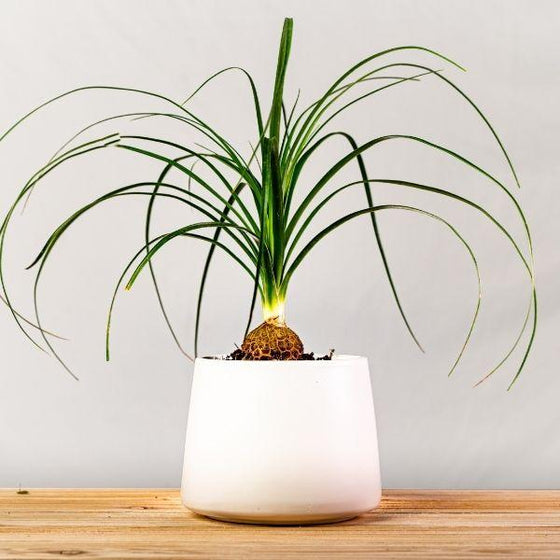
ponytail palm cluster Ponytail Palm
SKU: 95021719501
ponytail palm cluster

ponytail palm cluster Ponytail Palm

Sale price$26.01 Regular price$28.90
Save 10%

Shipping Estimate
USA
  • USA
  • CAN

Ships within 48 hours · Estimated delivery Jul 6 - Jul 11

Promo Codes Available:

For Your Every Summer RSVP, with Code: SUMMER15

Description

ponytail palm cluster Ponytail PalmCurly Ponytail Foliage on a Swollen Trunk Ponytail Palm is one of those plants that makes people smile at first glance. A swollen, bulbous base tapers into a slender trunk, crowned with a fountain of long, ribbon like leaves that spill over the sides like a green ponytail. Despite its common name, it isnt a true palm at all, but a caudex forming succulent native to Mexico, which has evolved to store water in its thick base. The look is part desert

Curly “Ponytail” Foliage on a Swollen Trunk

Ponytail Palm is one of those plants that makes people smile at first glance. A swollen, bulbous base tapers into a slender trunk, crowned with a fountain of long, ribbon-like leaves that spill over the sides like a green ponytail. Despite its common name, it isn’t a true palm at all, but a caudex-forming succulent native to Mexico, which has evolved to store water in its thick base. The look is part desert sculpture, part whimsical houseplant, and it fits just as well on a sunny windowsill as it does styled on a plant stand.

Slow, Compact Growth, and Long-Lived

Indoors, Ponytail Palm is slow-growing, which makes it a fantastic long-term companion plant. Young plants have a single trunk and a tight tuft of foliage, while older specimens gradually thicken their base and may branch into multiple heads over time. In containers inside the home, most plants typically top out at around 3–4 feet tall, although very old specimens in large pots can reach 5–6 feet. Because it grows slowly and stays relatively narrow, it’s easy to tuck into corners, tabletops, or grouped displays without worrying that it will outgrow the space overnight.

Bright Light and Infrequent Watering is all it requires

Think of Ponytail Palm as more of a succulent than a palm when it comes to care. It thrives in bright, indirect light and happily basks in a bit of gentle direct sun, especially morning or late-afternoon rays. A bright east or south window is ideal; in lower light, it will survive, but growth slows dramatically, and the trunk may elongate rather than stay stout. Plant it in a very well-draining mix—such as cactus or succulent soil, or potting mix heavily amended with sand and perlite—so that excess water runs through quickly and never lingers around the roots.

Watering is where Ponytail Palm really earns its “set it and forget it” reputation. The caudex stores water, so you’ll want to let the soil dry out completely between waterings, then soak thoroughly and drain well. In most indoor settings, that means watering every 2–4 weeks, less in low light or winter, and a bit more in bright, warm conditions. It prefers typical household temperatures of around 65–80°F and average humidity, shrugging off dry indoor air that would bother more finicky tropicals. Overwatering is just about the only way to truly get into trouble with this plant—if the base ever feels soft or the leaves pull out easily, it’s a sign the roots have stayed wet too long.

Pet-Safe Personality Plant for Home or Office

In the “indoor landscape,” Ponytail Palm is pure personality. Use it as a quirky focal point on a plant shelf, as a sculptural accent on a low stool, or lined up in multiples for a desert-inspired vignette. It pairs beautifully with cacti, snake plants, and other drought-tolerant houseplants, adding a softer, playful texture to an otherwise spiky or architectural grouping. And because it’s considered non-toxic to cats, dogs, and even horses, you can relax a bit if curious paws can’t resist playing with those tempting, dangling leaves.

Shipping Notes
  • Free Standard Shipping on $100+ Orders to the USA.
  • Except Preorder products are shipped in 48 hours.
  • Delivery to the USA:
  1. Standard Shipping : 3-10 business days
  • If time is of the essence, please consider selecting expedited delivery for faster service.
Exchange/Return Notes
  • We offer a 30-day return/exchange service after receiving.
  • Final sale items are not eligible for returns or exchanges.
  • To process your return/exchange, please contact us at [email protected]
  • Please click here for more details>>> Return & Exchange Policy
SKU: 95021719501

Discover Niche Categories That Outsell ponytail palm cluster

Top-Converting Item to Boost Your Average Order

4.8 ★★★★★
Based on 1344 reviews
Sort
Highest Rating
Newest First
Oldest First
Product Reviews
C
Verified Purchase
Carley Rousse
Omaha, US
★★★★★ 5
Good
The only melatonin that works for me
WAS THIS REVIEW HELPFUL?YesReportShare
Reviewed in the United States on April 2, 2026
N
Verified Purchase
N. Hannah
Louisville, US
★★★★★ 5
Source Naturals Melatonin is the best!
My husband and I have been using Source Naturals Melatonin for almost 25 years. I have tried a few other brands, and I definitely think Source Naturals is the best! I once saw a program on Discovery channel about how Melatonin is an important heart antioxidant, and that after age 40 the Melatonin in our system goes way down. We had also just moved to a high altitude town, and I was having great difficulty sleeping because of the high altitude. We started taking Source Naturals Melatonin, and I was able to sleep like a baby. I really recommend the time release especially, and we also take a 1 mg sublingual lozenge to fall asleep more quickly.
WAS THIS REVIEW HELPFUL?YesReportShare
Reviewed in the United States on August 27, 2017
T
Verified Purchase
Tausha Porter
Grantham, US
★★★★★ 5
Well researched information
Format: Paperback
It's carefully researched by an intelligent and qualified individual. Sources are all listed for people who want to do their own research.
WAS THIS REVIEW HELPFUL?YesReportShare
Reviewed in the United States on April 16, 2026
K
Verified Purchase
Kevin Mack
Fort Morgan, US
★★★★★ 5
The Three (3) Pillars of my bedrock testimony have been destroyed
Format: Paperback
Having been born and reared in the Church, it was not merely a "church," but it was "The Only True Church on the Face of the Earth." It was my identity, I served a misson, Branch President, H.P., Stake Mission President, sending my son on his mission next week, so imagine my sense of betrayal, and the helplessness and confusion I felt after reading this book. My three (3) pillars were: (1) a young man may spawn a lie, for personal motivations, but he can still be a Prophet, and nobody would carry a lie so far as to be killed for it; (2) No man could have written the Book of Mormon; and (3) the Temple Ceremony is so sacred and unusual that it could not have been imagined or contrived. Well, this most carefully documented, carefully written, carefully researched book, has all but destroyed my pillars. Fawn Brodie, Niece of the Prophet, David O. McKay, has done meticulous research and I have searched for but never found or read an official LDS Church response or debunking of it; I've searched the BYU F.A.R.M.S. site hoping for an academic, honest review of her evidence and hoping to find that Ms. Brodie's research was flawed or dishonest. But despite my motivations and wide-spread search, I have never read a criticism of her sources, or documented proof that her research is false, or that her conclusions are false, only that she had an agenda and some of her conclusions are specious and not well supported. Well, that is simply disengenuous criticism. To say that Ms. Brodie can only prove "A, B, C, and D," but "jumps" to a conclusion that "E" exists, is simply blind faith ignorance and dishonest academia. This book constitutes the "mysteries," that the Church teaches its members to stay away from. But it is hardly a mystery. This book explains with a clarity and insight never-before heard by an LDS member, how Joseph Smith wrote the Book of Mormon, how he practiced polygamy before receiving the alleged revelation; why he was tarred and feathered; exactly where the Temple signs and symbols came from; the extent Joseph would go to protect his power and authority, and many more "mysteries." No active member of the Church should read this book lest their eyes be opened. It hurts! Truth is not pleasant sometimes, why should it be. I just wanted it "straight," I didn't want to be lied to any longer. If the Church simply said, "we're a good church, doing good deeds, helping the poor, please give your tithes to help us, I would most certainly go. But the Church says, "we are the only true and living church on the face of the earth." To me, that's a challenge to find out for myself, which I did. Now, I am a "mormon in recovery." My entire belief system, every single word I've ever been taught, is a lie. I am undone. Now I must look to God, for answers that I thought only the LDS Church had.
WAS THIS REVIEW HELPFUL?YesReportShare
Reviewed in the United States on August 3, 2006
J
Verified Purchase
John E. Mack
Draper, US
★★★★★ 5
Everyone interested in Mormon History or Mormonism should read this book.
Format: Paperback
This book is a classic, and is generally recognized as such. The topic, which is the life of Joseph Smith, found its ideal author in Fawn Brodie, a Mormon who was on the verge of excommunication and who as about as sympathetic to Smith as an honest historian could be. One is tempted to say that Smith is presented, warts and all. But it would be more helpful to say that Smith is presented, virtues and all, because a man who concocts what purports to be holy scripture, who fakes divine revelation, who organizes three Waco-type compounds, who institutes militias and secret societies to kill his enemies, who decrees polygamy to satify the lusts of himself and his male colleagues, who orders the destruction of his enemies and who lies about most of these things probably has more warts than virtues. Brodie wrestles constantly with the issue of how a man of such limited education and rather obvious fraudulent intent could attract thousands of dedicated followers. It is no wonder that Brodie in her later works became so attracted to psycho-history. She advances a rather attractive hypothesis which suggests how Smith could have deluded himself into believing his own nonsense: Since all our thoughts are the product of previous states of mind, and since these states include all the factors which go into our perceptions, concepts and mental "programs", there is no essential difference between our control over our waking thoughts and our control over our dreams, reveries, and other semi-conscious states. We just think there is, because the illusion of control is part of the nature of the mental state we call "consciousness." If that is so, then it can be argued that a "revelation" which derives from our past state of mind is no more originated by our own will than the conscious perception that we are being visited by the angel Moroni. Of course, this line of thought comes dangerously close to solipsism, and solipsism comes dangerously close to autotheism (if there is nothing else in the universe but oneself, then everything there is must be an extension of oneself, and hence one must be God). Toward the end of his life, Smith's megalomania was indeed headed in this direction. Brodie does a wonderful job describing how Charismatic Smith must have been. To have persuaded people of real intelligence and ability like Brigham Young and his own wife Emma into believing and supporting him throughout his career, and to have, as she puts it, "Caused men to see visions" is no mean feat. And to have created a religion which, for all its faults, is far more admirable than its own founder bespeaks one of the most fascinating characters in American history. Everyone interested in religion, psychology, and American History should read this book.
WAS THIS REVIEW HELPFUL?YesReportShare
Reviewed in the United States on July 14, 2007

recommand products