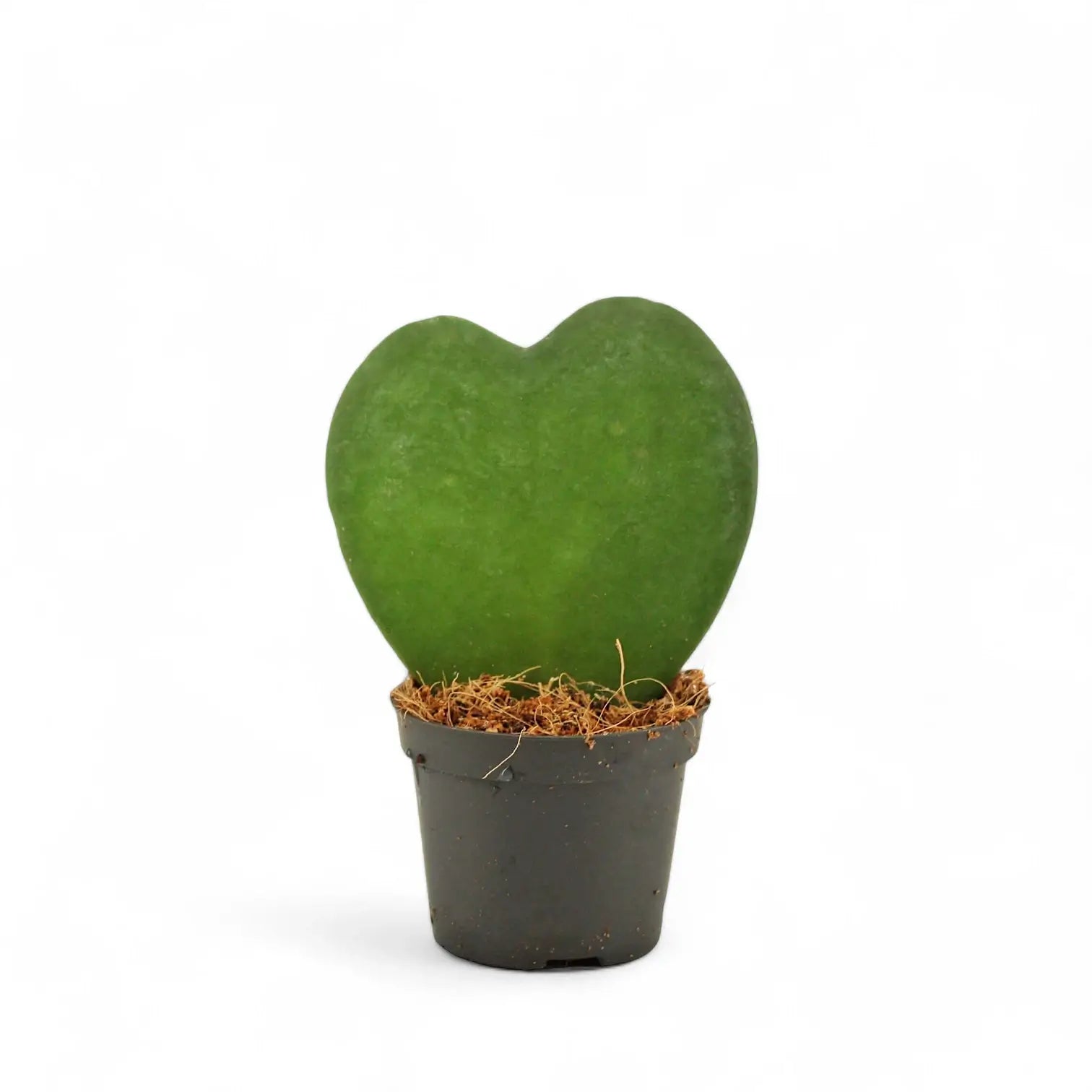
SKU: 98355224695
succulent heart shaped leaves

succulent heart shaped leaves Hoya kerrii

Sale price$26.85 Regular price$29.83
Save 10%

Pay in installments of $7.46 with ShopPay, AfterPay and Klarna

Shipping Estimate
USA
  • USA
  • CAN

Ships within 48 hours · Estimated delivery Sep 7 - Sep 12

Promo Codes Available:

For Your Every Summer RSVP, with Code: SUMMER15

Description

succulent heart shaped leaves Hoya kerriiHoya kerrii Hoya kerrii is the classic heart leaf wax plant, grown for thick, fleshy leaves arranged in opposite pairs on slow, twining stems. A rooted stem plant can develop into a long lived vine with aerial roots at the nodes, while a single rooted leaf often remains a living leaf for a very long time. Stem tissue is what allows the plant to build a true vine. Established plants grow deliberately, sending out searching stems before new leaves

Hoya kerrii

Hoya kerrii is the classic heart-leaf wax plant, grown for thick, fleshy leaves arranged in opposite pairs on slow, twining stems. A rooted stem plant can develop into a long-lived vine with aerial roots at the nodes, while a single rooted leaf often remains a living leaf for a very long time. Stem tissue is what allows the plant to build a true vine.

Established plants grow deliberately, sending out searching stems before new leaves appear. Mature vines can produce rounded umbels of waxy flowers with night fragrance and reddish-brown nectar, so flowering plants are best kept away from surfaces that could stain.

Heart-shaped Hoya kerrii leaves and slow vine growth

  • Growth habit: Slow, twining epiphytic to lithophytic vine with aerial roots along mature stems.
  • Leaves: Thick, green, heart-shaped leaves with a firm, succulent texture.
  • Stem cuttings: Rooted stems can grow into vines; rooted single leaves usually remain as leaves.
  • Flowering: Mature plants can form waxy umbels on persistent spurs.
  • Placement: Older stem plants can be grown on hoops, trellises or hanging pots once active vine growth begins.

From rooted stem cutting to mature sweetheart vine

Hoya kerrii is native from Indochina to western Malesia, where it grows as a climbing epiphyte or lithophyte in wet tropical habitats. Its thick leaves hold moisture, while its roots are adapted to airy positions on bark or rock rather than dense, heavy soil.

In indoor cultivation, the slow pace is normal. A healthy rooted stem cutting may spend months building roots before extending new shoots. Bare vines should usually stay in place because they can later produce leaves or flowering spurs.

Root care for slow-growing Hoya kerrii

  • Light: Give bright filtered light for strong leaf growth and flowering potential. Very dim positions slow this species further.
  • Watering: Water deeply, then let most of the mix dry before watering again. Thick leaves store moisture, but roots still need regular rehydration.
  • Substrate: Use bark, pumice, perlite and coco chips so water drains quickly and oxygen remains around the roots.
  • Pot size: Keep the pot close to the size of the root system. A large pot can stay wet too long around a slow-growing plant.
  • Humidity: Average to moderate humidity is usually enough, with steadier growth around 50–70%.
  • Temperature: Keep at 18–28°C and avoid cold, damp substrate.
  • Training: Guide new stems onto a hoop or trellis while they are flexible, or let mature stems trail from a hanging container.
  • Peduncles: Leave old flowering spurs attached, as they can bloom again on mature plants.

No vine growth, wrinkled leaves and sticky flowers

  • No vine growth: Check whether the plant has a node and stem tissue. A rooted leaf alone usually stays alive but remains static.
  • Wrinkled leaves: Check the full depth of the pot. Wrinkling can come from dryness or from damaged roots that cannot absorb water.
  • Yellow soft leaves: Look for wet substrate, low temperature or a pot that holds moisture around the roots for too long.
  • Bare searching stems: Keep healthy bare vines unless shaping is needed; they can later carry leaves or flowers.
  • Sticky flowering: Mature umbels may drip reddish-brown nectar, so move the plant away from porous surfaces when buds open.

Pet safety and milky sap

Hoya kerrii is listed as non-toxic to cats, dogs and horses by NC State Extension and ASPCA. The plant is still ornamental and can release milky sap when cut, so wash hands after pruning and keep trimmings away from pets that chew houseplants.

Hoya kerrii name origin and family

Hoya kerrii Craib belongs to Apocynaceae and was first published in 1911. The species epithet honours Arthur Francis George Kerr, the plant collector associated with early material from Southeast Asia, while Hoya honours Thomas Hoy.

Hoya kerrii grows slowly from stem cuttings into a sturdy sweetheart vine with thick paired leaves and long bare runners before new foliage forms.

Shipping Notes
  • Free Standard Shipping on $100+ Orders to the USA.
  • Except Preorder products are shipped in 48 hours.
  • Delivery to the USA:
  1. Standard Shipping : 3-10 business days
  • If time is of the essence, please consider selecting expedited delivery for faster service.
Exchange/Return Notes
  • We offer a 30-day return/exchange service after receiving.
  • Final sale items are not eligible for returns or exchanges.
  • To process your return/exchange, please contact us at [email protected]
  • Please click here for more details>>> Return & Exchange Policy
SKU: 98355224695

Discover Niche Categories That Outsell succulent heart shaped leaves

Top-Converting Item to Boost Your Average Order

4.7 ★★★★★
Based on 19 reviews
Sort
Highest Rating
Newest First
Oldest First
Product Reviews
J
Verified Purchase
Jav M
Lexington, US
★★★★★ 5
Quick and valuable read
Format: Paperback
I love this book. It’s not a sit down and read it through (unless you want to!). It’s a sit, turn to a random page, and read. Sit with it for a bit and think. It’s great poetry and always is insightful. I often purchase this as gifts for friends and is great to have on a “coffee table” or lamp stand.
WAS THIS REVIEW HELPFUL?YesReportShare
Reviewed in the United States on August 1, 2024
A
Verified Purchase
anonymous name
Draper, US
★★★★★ 5
Blessed Ruin: Lessons on the Stages of Love
Format: Paperback
Having already been enchanted by Daniel Ladinsky's previous rendererings of Hafiz in _I Heard God Laughing_ and _The Subject Tonight is Love_, Ladinsky's present effort is worthy of no less acclaim. In fact, his choices this time from the _Divan_(250 poems) bring home with exquisite precision that Hafiz, the Perfect Master is in fact, a Master of Love. The reader gets the clear message in Ladinsky's portrait that Hafiz has intermalized to perfection his teacher's (Mohammad Attar)lessons on the manifold levels of love and its demands: "I saw it was Hafiz who wrote all your notes of sadness, But also etched and gave you Every ecstatic wince of joy your face, body and heart has ever known." (p.38). This is no "New Age" nonsense, which at its worst hails the light and avoids the shadow, Hafiz (though seducing the beginner lover by his promises of sweetness and tenderness, that God could actually "become an infant in your arms"[p,56]) cautions that he "hold's the Lion's Paw whenever I dance."(p.57). Western culture has not received such lessons on divine love since Jesus and Plato, and unfortunately, the fresh images of their teachings on love have all been but lost to humanity, save a small remnant of sketches. Ladinsky's Hafiz both assures and challenges the seeker because any fully-alive being with such capacity for loving as Hafiz dwarfs our puny notions of western romantic love without shaming or condemning it. Only encouraging like a true teacher with compassion would: "You ask for a few words of comfort and guidance. I quickly kneel at your side offering you this whole book . . . Here's a rope, tie it around me, Hafiz will be your companion for life."(p83). Hafiz's language of love utilized the metaphor of his time and culture as Jesus incorporated the images of parable. Ladinsky courageously steps out of line (as surely did Hafiz) and takes the risk to be mundane without being irreverent when describing the labyrinth that is the heart: "There are different wells within your heart. Some fill with each good rain. Others are far too deep for that." (p76) Ladinsky's Hafiz teaches us of a divine being who walks among and talks with and celebrates his creation; yet challenges it to stretch beyond its boundaries of self-interest: " I want both of us to start talking about this great love. As if you , I, and the sun were all married and living in a tiny room, helping each other to cook, do the wash, weave and sew, care for our beautiful animals."(p.180). Ladinsky's fine portrait of this 14th century Perfect Master gives the West the certain bugal cry that God is not dead, but it is we who are dead to God. The success of this book will measure how many of us are indeed alive here, and how many are really interested in the more mature lessons of loving.
WAS THIS REVIEW HELPFUL?YesReportShare
Reviewed in the United States on July 27, 2001
L
Verified Purchase
L. D. Weimer
Louisville, US
★★★★★ 5
One need not be Christian or Muslim or whatever to appreciate his poetry with its deep feelings of connectedness and love of lif
Format: Paperback
The book has a lovely, reasonably long, introduction to Hafiz, his time, and fellow poets which helps to create an open and curious mind for the poems that follow. Although I was familiar with several Hafiz poems before, most of this book was new to me. It is a fairly thick book, with the poems spread lightly on the pages. Plenty of white space surrounds and set off the poems so that although there are many, many poems in the book, they are not crowded. Hafiz celebrates god in a way that is rich and exuberant. One need not be Christian or Muslim or whatever to appreciate his poetry with its deep feelings of connectedness and love of life. In fact, as a Buddhist, I find it is exactly that sensitivity to life, to joy, to the world around, and to other beings around us that offers the greatest illumination. This poetry is wonderful to read just before sleep, or any time, and is a fine addition to any library.
WAS THIS REVIEW HELPFUL?YesReportShare
Reviewed in the United States on April 4, 2015
C
Verified Purchase
charles d barber
New York, US
★★★★★ 4
Absolutely beautiful poetic translation occasionally marred by silly attempts at contemporary relevance
Format: Paperback
Poetry is something I seldom read, but the range of philosophical and religious reflection in Hafiz' writing is amazing, delightful, and life-affirming. Not every poem is equally rewarding, but how could they be? The translations make these ancient short poems speak to the present day, but sometimes too much so--using terms that have only come into our language in the 20th or 21st centuries at times borders on "cutsie", which distracts from the true meaning. When Ladinsky sticks to standard and time-tested language and grammar, his translations have much deeper impact, for me anyway. I have not read other translations of Hafiz, but I imagine previous ones are full of "thee's" and "thou's", and less erudite perspectives. I highly recommend this book--for me is has more understanding and depth concerning daily living than Rumi, for instance. Just beware that there are some shockingly off-the-mark, if sincere, attempts to make this ancient poetry relevant to us now. Ladinsky apparently spent years working on this book, so my hat is off to his scholarship.
WAS THIS REVIEW HELPFUL?YesReportShare
Reviewed in the United States on April 16, 2017
F
Verified Purchase
Farinaz Parsay
New York, US
★★★★★ 5
I love The Gift of Hafiz by Daniel Landinsky I am ...
Format: Paperback
I love The Gift of Hafiz by Daniel Landinsky I am Persian and I love the poetry of Hafiz but the book Gift is the first book I read in English language translated by Daniel Ladinsky. As a Persian who is born and raised knowing the poetry of Hafiz by heart and in their original tongue, I really enjoyed reading the book and appreciated the interpretations and translation. Daniel Ladinsky is an American poet known as interpreter of mystical poetry born and raised in Saint Louise. He has said “the poet who I have worked most with is the 14th century Persian poet Hafiz. And Goethe has said, Hafiz has no peer. And I think Goethe knew what he was talking about”. Daniel Ladinsky has written many other books about Hafiz which are unique and many have come to know about this great Persian Master more glorious in the English language. In a rare interview on October 2013 with the Sun Magazine, Daniel Ladinsky shares about his spiritual longing, his encounter with a living saint in India who inspired him to work on Hafiz. In his preface of “The Gift” he invites us to join him in his fantastic applause of life and says “I vote to inscribe these words of Hafiz on every flag, church bell, temple, mosque, and politician’s brain: Dear ones, let’s anoint this earth with dance! I recommend the book "Gift" to everyone who enjoys poetry.
WAS THIS REVIEW HELPFUL?YesReportShare
Reviewed in the United States on June 11, 2016

recommand products