SKU: 44395765285
wrap dress sewing pattern

wrap dress sewing pattern Mina wrap dress PDF sewing pattern

Sale price$20.84 Regular price$23.16
Save 10%

Pay in installments of $5.79 with ShopPay, AfterPay and Klarna

Shipping Estimate
USA
  • USA
  • CAN

Ships within 48 hours · Estimated delivery Sep 17 - Sep 22

Promo Codes Available:

For Your Every Summer RSVP, with Code: SUMMER15

Description

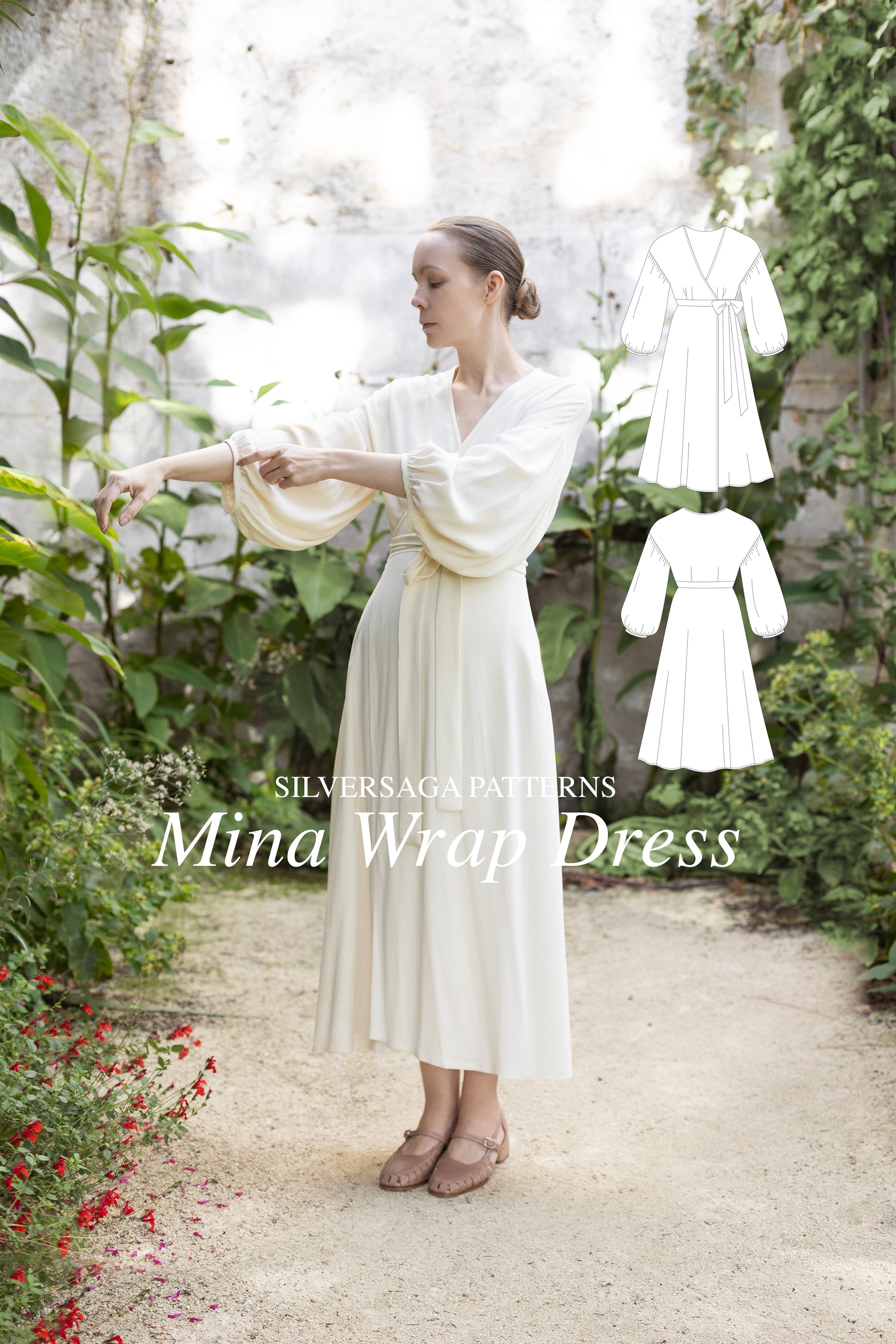
wrap dress sewing pattern Mina wrap dress PDF sewing patternThe Mina wrap dress is a classic wrap dress. A comfortable wardrobe staple that can be worn casually with flats, or dressed up just as easily. Mina features gathered bishop sleeves and a dropped shoulder. The bodice closes with a wrap tie front that can be tied three different ways. The skirt is flared and has hidden side seam pockets. The tie belt makes the waist adjustable. Sewing difficulty This pattern is suitable for experienced beginners. You

The Mina wrap dress is a classic wrap dress. A comfortable wardrobe staple that can be worn casually with flats, or dressed up just as easily. Mina features gathered bishop sleeves and a dropped shoulder. The bodice closes with a wrap tie front that can be tied three different ways. The skirt is flared and has hidden side seam pockets. The tie belt makes the waist adjustable.

Sewing difficulty
This pattern is suitable for experienced beginners. You need to be able to make your own bias tape and sew bias bindings. The pockets are optional. Because of the relaxed style of this dress, it's easy to fit and beginner-friendly.

Fabric suggestions
Choose a lightweight to midweight fabric such as cotton, linen, or blends like linen/viscose, linen/cotton, or cotton/viscose. A softer, drapier fabric will result in less volume. The ivory sample is made in a viscose, 225 gsm.

Fabric usage
The layout is designed for fabric 130 cm (51”) wide. The pieces are arranged efficiently to minimize waste, but we recommend buying a little extra fabric to account for shrinkage, print alignment, or cutting adjustments.

Metric EU34 - EU50:
Dress: 3.50 m - 4.08 m

Imperial US2/4 - US20:
Dress: 3.82 yd - 4.46 yd

Notions and tools
•  Sewing thread.
•  Sharp fabric scissors or rotary cutter, along with pins, fabric marking pen and a seam ripper.

Good-to-have tools (optional)
•  Interfacing for the pocket openings.
•  A clear plastic ruler, a French curve and tracing paper (for any pattern alterations).
•  A thin and sharp hand-stitching needle.

What's included
•  19 page detailed and easy to follow instructions booklet in English
•  A4/US Letter layered print-at-home PDF
•  A0 layered copy-shop PDF

By purchasing this pattern you agree to the terms and conditions. This pattern is available for personal use only. You may not copy, sell, or distribute the pattern or any of the pieces, or sell the finished garment. You may also not use any of the pattern pieces as base for drafting your own pattern, unless it's strictly personal.

Please note that the PDF files are read-only.

Browse the pattern testing gallery
Mina Wrap Dress gallery

Find more inspiration on Instagram
@silversagapatterns 

Hashtags for the Mina Wrap Dress
#SilversagaPatterns #MinaWrapDressPattern

Pattern testers feedback
Fiona: "I am already planning one in every color as it is such a beautiful, feminine wearable design"

Anna: "I absolutely loved sewing it. I often find wrap necklines are loose on me and don’t lie flat. Not here, the neckline is so snug and just the right depth too. Wow, you really nailed it!"

Aria: "Your instructions were very clear and straight forward and I found it to be a very quick and satisfying project"

Katie: "You have a great talent for whimsical design, thank you for sharing your creation with me"

Dhriti: "I love the fit of the dress. I made the smallest size and it fits me like a glove. The wrap overlaps perfectly so that there aren’t any chances of accident both at the top and the bottom"

Shipping Notes
  • Free Standard Shipping on $100+ Orders to the USA.
  • Except Preorder products are shipped in 48 hours.
  • Delivery to the USA:
  1. Standard Shipping : 3-10 business days
  • If time is of the essence, please consider selecting expedited delivery for faster service.
Exchange/Return Notes
  • We offer a 30-day return/exchange service after receiving.
  • Final sale items are not eligible for returns or exchanges.
  • To process your return/exchange, please contact us at [email protected]
  • Please click here for more details>>> Return & Exchange Policy
SKU: 44395765285

Discover Niche Categories That Outsell wrap dress sewing pattern

Top-Converting Item to Boost Your Average Order

4.3 ★★★★★
Based on 12 reviews
Sort
Highest Rating
Newest First
Oldest First
Product Reviews
T
Verified Purchase
Terry Anne
Bozeman, US
★★★★★ 3
Only holds towels in place when it is full or 1/2 full
Color: 01-silver
If you are buying this for the feature of holding the paper towels in place so you can just rip one, I think you will be disappointed. Once the roll becomes smaller (and I tried changing the arm) the arm does not touch the towels. I do like the firm grip on the counter. My other dissatisfaction is the base gets water spots. Being near the sink this happens frequently. It does its job and is attractive.
WAS THIS REVIEW HELPFUL?YesReportShare
Reviewed in the United States on May 21, 2026
J
Verified Purchase
Jay
Fort Morgan, US
★★★★★ 5
Stylish
Color: 01-silver
Good sturdy stand for paper towels. Has small suction cups on bottom for stability. Good finish and good fit under the counter. Heavy base and not flimsy feeling. Brushed aluminum matched other appliances well.
WAS THIS REVIEW HELPFUL?YesReportShare
Reviewed in the United States on January 6, 2026
T
Verified Purchase
The product comes in multiple colors, but the function is terrible
Belleville, US
★★★★★ 5
Goodbye for the value
Color: 02-black
Great value looks wonderful very adorable
WAS THIS REVIEW HELPFUL?YesReportShare
Reviewed in the United States on May 31, 2026
J
Verified Purchase
Jonathan Bailey
Fort Morgan, US
★★★★★ 5
Required Reading for Egyptologists
Format: Paperback
To say the very least, this book is an enlightening read. The author attempts to design a new chronology of Egypt based on a number of archaeological observations he made which pointed to certain anomolies in the standard chronology of the Third Intermediate Period of Egyptian history. The TIP is one of those points in history where information is scanty and there is much room for error in interpreting existing archaeological evidence. Rohl posits that the 21st and 22nd pharaonic dynasties were at least partly contemprary in a period of balkanization of Egypt, contrary to the conventional chronology's view that they were successive. He therefore shifts the entire preceding dynastic histories downward from 200 to 300 years. That is, what we previously though to occur at 1250 BC actually happened at 1000 BC according to Rohl. In so doing Rohl has done much to synchronize Egyptian chronology with the chronology of the bible. Rohl claims that the Amarna letters were not to be compared to Joshua's conquest of Canaan, a period where they clearly do not fit, but rather tell the tale of Saul's and David's claiming of Israel from Phillistine Egyptian vassals. He synchonizes Ramesses II's conquests of Asia Minor with the biblical invasion of Shishak. Also, he identifies the Egyptian 'Hyksos' with the Amalekites of the book of Exodus. There are many other enlightening points of connection with the bible that Rohl makes, but my point here is not to explain them all. The true value of this book for any egyptologist, student of biblical history, or any student of the ancient world at all, is this book's popular presentation of the field of archaeology and ancient history. So rare are books that actually connect a lay reader with the methodologies and evidence upon which researchers base their works. In order to show a need for a revision of Egyptian chronology, Rohl shows how the entirety of Egyptian chronology depends on all but of a handful of archaeological finds, many of them of dubious reliability. Even if Rohl's opponents find more pieces of evidence supporting the standard chronology, the number will still be very small and they will quite likely be as subject to interpretation, as are the ones that Rohl has pointed out. Rohl goes to great lengths to show the history of the observations that scholarship has made, thereby showing us where they may have gone wrong. (As a popular book, I must confess that parts of Rohl's historical narratives depict events in which one expects to find Indiana Jones) Next, when building his own chronology, Rohl puts us close to the texts and archaeological evidence upon which he bases his theories. Rohl's conclusions are in many cases impressive, but in some cases I had to shake my head and come to the conclusion that he was grasping at straws. For instance, I believe that his work in astronomical retrocalulations to find the dates of eclipses recorded in ancient texts is pretty shaky. I even doubt that the text that he is talking about is even mentioning an eclipse. This information has proved to be incredibly valuable to me, however, as I now know that astronomy based chronology, something I though would give absolute and undisputable dates, is as foggy an area of research as any. I do not know if I will eventually embrace Rohl's ideas or not, or if partially. I do know that reading this book has shown me the types of reasoning and observations that old world historians make, and can now make an informed decision about how firm our grip on dating events of the past is. My conclusion: if somebody tells you some biblical event did not happen because the dates don't line up with scientific knowledge, don't be disheartened. We have a LONG way to go before we can truly be confident about such statements, if indeed we will ever arrive at that sort of knowledge. This uncertainty that I have gained from Rohl's book is corroberated by the "Oxford History of Ancient Egypt" which provides wonderful information on Egyptian chronology. Everyone who wants to study ancient history, whether it be Egyptian, biblical, Middle Eastern, or even Chinese for that matter, should read this book, so the next time they read somewhere that 'such and such happened at 3200 BC', they will know to take that statement with a grain of salt. Whether Rohl is right or not, I am forever indebted to him for showing me how chronologists operate. Lastly, I would like to say, after all this talk about archaeology and methodology of Egyptologists, that this book is very readable and comprehensible to the lay reader. Though a smattering of knowledge of biblical and/or Egyptian history will make the book more interesting to the reader, no such knowledge is required in order to understand the book or find value in it. It is truly a popular book intended for the average interested person. I recommend it to all.
WAS THIS REVIEW HELPFUL?YesReportShare
Reviewed in the United States on February 10, 2001
S
Verified Purchase
Stone Dog
Houston, US
★★★★★ 5
Exciting reinterpretation of ancient history.
Format: Paperback
In "Pharoahs And Kings", author David Rohl offers the reader a stunning new interpretation of the events of the ancient world in Egypt and the Levant. In doing so, he ties in Biblical events to their proper place in history. This is a stunning reordering of events and personalities and brings both Egyptian and Biblical history to a much closer synchronization. The book begins in Egypt where Rohl lays out his evidence for condensing the chronology of Egypt. Though we use AD/BC as a method of numbering our years, the ancients did not do so and used regnal dates ("In the third year of Pharoah So-And-So's reign, something happened."). By counting all Pharoahs and their reign lengths, historians felt they had a handle on when, according to our dating system, things happened. When they did so, they discovered the events portrayed in the Bible didn't match. When they date Solomon's reign in Israel to the Iron Age, for example, they find economic development to be poor - a far cry from the Biblical accounts of Solomon's reign as a flowering of culture and rich in trade. Likewise, Jericho's walls did not fall in the time period most historians would place the Exodus and entrance into the Levant of the Hebrews. Therefore, the Biblical accounts are simply myth, nothing more. David Rohl is a historian, not a religious believer and his point of view is as a historian. His focus is to find a more accurate timeline for the events in the ancient Middle East. He begins in Egypt because that is his area of expertise and he gives convincing arguements for re-ordering the events of Egypt. The clincher, for me, was the tombs of Tanis (among other inconsistencies in the conventional dating such as the number of Apis Bulls) in which the tomb of Psusennes I cuts into the tomb of King Oskoron II and was obviously built after the tomb of Oskoron II. The problem? Oskoron II was from the 22nd dynasty while Psusennes was from the 21st! It is quite obviously reversed! Rohl's conclusion is that two dynasties were contemporary and that about 140 years needs to be removed from the timeline of Egypt. When this is done, events in the Levant match the events in the Old Testament very closely. In the New Chronology, Jericho falls just when the Hebrews are entering Canaan according to the Bible. Solomon's Israel is now placed in the Late Bronze Age where there is evidence of prosperous cities and flourishing trade. There is evidence of mentions of both Saul and David in the Amarna Letters. This was a page turner and Rohl's work, although controversial, is backed up by fact and evidence. There is less evidence for some of his conclusions than others (in my mind), but it is well researched and never strays from a scholarly interpretation of the evidence written and on the ground. I actually enjoyed this book! David Rohl writes in a very engaging fashion, often using humor. His writing skill keeps subjects that may seem dull very frsh and exciting. He often uses humor and engages the reader, challenges the reader and forces the reader to think. This is not the usual dry tome on archeology that puts you to sleep! He assists the reader with many and high quality photos and drawings of the evidence and includes "side bars" with definitions and explanations in the margins to help the layman navigate the technical aspects of history and archeology without getting bogged down and overwhelmed. This is a fine book and more than deserving of five stars. It's a very eye-opening and interesting read that doesn't seem like a college textbook. Instead, he challenges the reader while entertaining at the same time. I recommend this book with five stars!
WAS THIS REVIEW HELPFUL?YesReportShare
Reviewed in the United States on September 29, 2012

recommand products