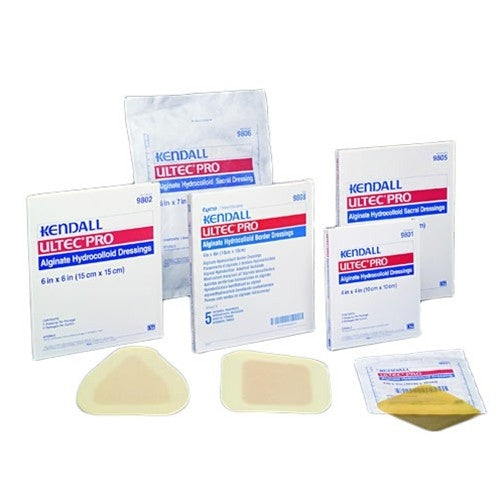
hydrocolloid dressings Kendall Ultec Pro Hydrocolloid 9801 9802 9805–9809
SKU: 74530290931
hydrocolloid dressings

hydrocolloid dressings Kendall Ultec Pro Hydrocolloid 9801 9802 9805–9809

Sale price$23.79 Regular price$26.43
Save 10%
Size: 4

Pay in installments of $6.61 with ShopPay, AfterPay and Klarna

Shipping Estimate
USA
  • USA
  • CAN

Ships within 48 hours · Estimated delivery Jul 4 - Jul 9

Promo Codes Available:

For Your Every Summer RSVP, with Code: SUMMER15

Description

hydrocolloid dressings Kendall Ultec Pro Hydrocolloid 9801 9802 9805–9809Kendall Ultec Pro Alginate Hydrocolloid Dressing 30% Alginate, Thin Profile, 7 Sizes Including Sacral Two dressing technologies. One thin, conformable, occlusive dressing. Kendall Ultec Pro Alginate Hydrocolloid Dressings combine the moist wound healing and bacterial barrier properties of hydrocolloid with the enhanced absorbency of a 30% alginate formulation producing a dressing that handles more exudate than standard hydrocolloid alone while

Kendall Ultec Pro Alginate Hydrocolloid Dressing — 30% Alginate, Thin Profile, 7 Sizes Including Sacral

Two dressing technologies. One thin, conformable, occlusive dressing. Kendall Ultec Pro Alginate Hydrocolloid Dressings combine the moist wound healing and bacterial barrier properties of hydrocolloid with the enhanced absorbency of a 30% alginate formulation — producing a dressing that handles more exudate than standard hydrocolloid alone while maintaining the occlusive seal and extended wear characteristics hydrocolloid is known for. The thin, highly flexible profile reduces the two most common failure points of traditional hydrocolloid dressings: edge roll-up from mechanical friction and melt-down of dressing material into the wound site. The result is a dressing that stays in place longer, changes less frequently, conforms better to irregular surfaces and anatomy, and provides an effective barrier against bacteria and external fluids throughout the wear period. Available in seven configurations — non-adhesive pads, adhesive bordered pads, and two dedicated sacral shapes — to match wound location and fixation need.

✔ 30% Alginate Formula — Greater Absorbency Than Standard Hydrocolloid    ✔ Thin Profile — Reduced Roll-Up & Melt-Down Risk    ✔ Occlusive — Optimal Moist Environment & Bacterial Barrier    ✔ Bordered Edge — Easy One-Handed Application    ✔ Sacral Shapes Available — Designed for Sacral Wound Anatomy


Product Details & Available Sizes

Manufacturer Kendall / Covidien / Medtronic
Dressing Type Alginate hydrocolloid — hybrid construction combining hydrocolloid matrix with 30% alginate content
Alginate Content 30% — provides greater absorbency and reinforced dressing integrity vs. standard hydrocolloid
Profile Thin, highly flexible — reduces roll-up and melt-down risk; improves conformability
Moisture Environment Occlusive — maintains optimal moist wound healing environment throughout wear period
Bacterial Barrier Occlusive construction provides effective barrier against bacteria and external fluids
Exudate Level Light to moderate — not for heavily exudating wounds
Sterility Sterile
Packaging Water-resistant, tamper-evident packaging opens easily for sterile presentation
9801 Non-Adhesive — 4" x 4" — Box of 5
9802 Non-Adhesive — 6" x 6" — Box of 5
9807 Adhesive Bordered — 2½" x 2½" — Box of 5
9808 Adhesive Bordered — 4" x 4" — Box of 5
9809 Adhesive Bordered — 6" x 6" — Box of 5
9805 Adhesive Bordered Sacral — 4" x 5" — Box of 5
9806 Adhesive Bordered Sacral — 6" x 7" — Box of 5

Indicated For — Wound Types

  • Stage I through Stage IV pressure ulcers
  • Dermal ulcers — venous, arterial, diabetic
  • Donor sites
  • Second degree (partial thickness) burns
  • Superficial wounds
  • Light to moderately exudating partial and full thickness wounds

Not indicated for: Heavily exudating wounds — for moderate-to-heavy drainage, a dedicated alginate or foam dressing is more appropriate. Not for infected wounds without concurrent clinical management.


How Ultec Pro Works — The Alginate Hydrocolloid Hybrid

Standard hydrocolloid dressings are built on a gel-forming colloid matrix — typically carboxymethylcellulose (CMC) — that absorbs exudate and swells into a gel mass that creates and maintains a moist wound healing environment under the occlusive film backing. This mechanism works well for light drainage wounds but has two well-documented limitations: absorption capacity is constrained by the hydrocolloid matrix alone, and as the dressing absorbs and swells at the edges, edge lift and roll-up under friction are common failure points. The thick profile of many traditional hydrocolloids also increases the risk that the softened dressing center can be pressed into the wound bed — "melt-down" — particularly under compression or in high-movement locations.

Ultec Pro addresses both issues through its 30% alginate formulation integrated into the hydrocolloid matrix. The alginate component adds a second absorbent mechanism — calcium alginate fiber absorption and gel formation — that works alongside the hydrocolloid to process exudate more efficiently. The combined matrix absorbs more fluid than hydrocolloid alone before reaching saturation, which extends wear time, reduces change frequency, and better prevents the lateral exudate spread that causes periwound maceration. The higher alginate content also reinforces the structural integrity of the dressing as it gels — the dressing holds its form more consistently across the wear period, reducing the gel fragmentation and melt-down tendency of lower-integrity hydrocolloids. The thinner overall profile keeps the dressing flexible and low-profile against the wound surface, reducing mechanical edge stress and the roll-up that leads to premature dressing failure.

  • 30% alginate content — boosts absorption and integrity beyond standard hydrocolloid capacity
  • Dual-mechanism absorption — hydrocolloid CMC gel and alginate fiber gel work together to process exudate
  • Reinforced integrity — dressing holds form as it absorbs, resists melt-down into wound site
  • Thin profile — better conformability to wound contours, reduced edge roll-up under friction and movement
  • Occlusive construction — maintains optimal moist healing environment; effective barrier to bacteria and external fluids throughout wear period
  • Unique formulation absorbs exudate while helping prevent that exudate from spreading to and macerating periwound skin
  • Extended wear time — greater absorbency means fewer dressing changes, reducing cost and patient disruption

Non-Adhesive vs. Adhesive Bordered — Which Variant Is Right?

  • Non-Adhesive (9801, 9802): The dressing pad without an adhesive border — requires a separate secondary dressing or tape to secure in place. Preferred when the periwound skin is fragile, sensitized, or already irritated by adhesives; when the clinician needs custom fixation; or when the dressing will be used under a compression system that provides its own hold. Better choice for patients with a history of adhesive sensitivity or skin stripping on dressing removal.
  • Adhesive Bordered (9807, 9808, 9809): The dressing pad is surrounded by a self-adhesive hydrocolloid border that secures the dressing in one step without tape or secondary fixation. The bordered edge allows easy one-handed application — peel, center over wound, smooth border down. Ideal for home care users, patients managing their own dressings, and clinical settings where application speed and simplicity matter. The adhesive border also provides an additional seal against bacterial entry at the dressing perimeter.
  • Sacral Bordered (9805, 9806): Same adhesive bordered construction as the standard bordered variants, but shaped to conform to sacral anatomy. The contoured shape addresses the challenge that square or rectangular dressings face over the sacrum — corners and straight edges don't conform well to the curved, high-motion surface of the sacrococcygeal area, leading to early edge lift and dressing loss. The sacral shape is designed to follow the natural contours of the sacrum, improving adhesion and wear time in one of the most challenging pressure injury locations in wound care.

Choosing the Right Size

  • 9807 / 2½" x 2½" Bordered: Smallest bordered size — for small wounds, early-stage pressure injuries on bony prominences, superficial dermal wounds, and sites where a compact dressing footprint is needed
  • 9801 / 9808 — 4" x 4" Non-Adhesive & Bordered: Standard size for typical pressure ulcers, dermal ulcers, surgical wounds, and donor sites of average dimensions — the most commonly used size in this line
  • 9802 / 9809 — 6" x 6" Non-Adhesive & Bordered: For larger wounds requiring broader coverage — wide pressure injuries, extensive burns, larger venous ulcers, and wounds where the 4x4 would not provide adequate wound-plus-perimeter coverage
  • 9805 — 4" x 5" Sacral Bordered: Smaller sacral shape for moderate-size sacral wounds — provides anatomically appropriate coverage for Stage I–II sacral pressure injuries and early-stage sacral ulcers
  • 9806 — 6" x 7" Sacral Bordered: Larger sacral shape for more extensive sacral wounds — Stage III–IV pressure injuries, deeper sacral ulcers, or larger sacral surface areas requiring full coverage

Not sure which size or variant is right for your wound? Call 1-866-218-0902 — Mon–Fri, 9am–5pm EST


Why Buy From Medical Department Store?

  • 30+ years serving home medical and wound care customers — A+ BBB Rated
  • 110% Low Price Guarantee — we beat any competitor
  • Medical supply specialists on the phone, not a call center
  • Ships to all 50 states — 5 Southwest Florida locations for local pickup

Questions about Ultec Pro or any of our hydrocolloid wound dressings? Call 1-866-218-0902 — our team is ready to help.

Shipping Notes
  • Free Standard Shipping on $100+ Orders to the USA.
  • Except Preorder products are shipped in 48 hours.
  • Delivery to the USA:
  1. Standard Shipping : 3-10 business days
  • If time is of the essence, please consider selecting expedited delivery for faster service.
Exchange/Return Notes
  • We offer a 30-day return/exchange service after receiving.
  • Final sale items are not eligible for returns or exchanges.
  • To process your return/exchange, please contact us at [email protected]
  • Please click here for more details>>> Return & Exchange Policy
SKU: 74530290931

Discover Niche Categories That Outsell hydrocolloid dressings

Top-Converting Item to Boost Your Average Order

4.5 ★★★★★
Based on 1324 reviews
Sort
Highest Rating
Newest First
Oldest First
Product Reviews
J
Verified Purchase
JustinHoca
Birmingham, US
★★★★★ 5
Helpful and informative
Format: Kindle
Four Views on the Book of Revelation (Counterpoints: Bible and Theology) edited by Stanley N. Gundry and C. Marvin Pate I read this book after previously reviewing Revelation in Context: John’s Apocalypse and Second Temple Judaism. That book was helpful for me to understand Revelation as apocalyptic literature, one example of the genre with similarities to others from the first and second centuries. Interpreting Revelation as apocalyptic literature is itself a choice, and some approaches to Revelation, such as classic dispensationalism with its emphasis on grammatical-historical hermeneutics are skeptical of that approach. As Thomas writes in his chapter “To understand any passage of Scripture in a nonliteral way violates principles of grammatical-historical interpretation unless contextual features signal a need to interpret otherwise” (p. 244). I found Revelation in Context helpful for introducing various apocalyptic books of the age in providing greater context for Jewish thought up to and after John wrote Revelation. The editors of Four Views provide a good overview of the four views presented as well as a good introduction to Revelation. The four authors and their positions are: Kenneth L. Gentry, Jr. (preterist) Sam Hamstra, Jr. (idealist) C. Marvin Pate (progressive dispensationalist) Robert L. Thomas (classical dispensationalist) Each author made a case for his position and responded briefly to points by the other authors. Thomas is the most insistent in his argument and spends the most time critiquing the others’ positions. The differences stem entirely from their hermeneutics, each has a different approach to the book and each calls “foul” with the others’ misuse or lack of consistency of their own hermeneutics. For me, the winner was the preterist position, as I’d never truly been exposed to this paradigm. The author allows it to speak for itself, and I found it appealing because of how well the events of 68-70 AD as described (mainly) by Josephus line up eerily well with the words of Revelation. In some cases, it seems Josephus is quoting Revelation, which made me wonder whether the authors had taken liberties with the actual translation of Josephus’ works. After reading Gentry Jr.’s view, reading Revelation with a preterist’s viewpoint in mind made it a completely different book for me. Whether the position is correct or not, it allowed me to read Revelation again for the first time, so to speak– that was a gift. Thomas drove home for me that classical dispensationalism demands a special place for the ethnic people of Israel including a rebuilding of the temple along with its sacrifices. Babylon on the Euphrates is literally the Babylon of old and must also be rebuilt, which he interprets to be a Persian/Iranian empire that will come to fruition again. I think I can see how this view is at long last falling out of favor. Some of the writers may be somewhat heterodox. Gentry, for example, leaves open some possibilities for partial preterism or has some reasoning other preterists don’t have. Thomas is appalled at progressive dispensationalism’s “now and not yet” mentality as violating rules of grammatical-historical interpretation. Pate leaves the door open to Revelation having an earlier authorship and more sections being fulfilled in the first century than Thomas allows. Hamstra is in a field of his own, the “idealist” position sees Revelation as purely symbolic and not specific to any time period– everyone undergoing persecution is experiencing the spirit of the Antichrist, etc. Since reading this book, I’ve been checking out podcasts on preterism while pondering how covenantalists I know seem to sound like progressive dispensationalists. I am glad this book was published and will check out similar works in this series. Five stars.
WAS THIS REVIEW HELPFUL?YesReportShare
Reviewed in the United States on May 6, 2026
A
Verified Purchase
Andrew A. Carr
Battle Creek, US
★★★★★ 5
A Little Gem
Format: Paperback
This little book is a wonderful resource for teachers, pastors, and all who want to gain a better understanding of the book of Revelation. The introduction by Marvin Pate is a real gem. It gives a helpful (and sometimes humorous) overview of the various positions expounded in the remainder of the book, and it offers a valuable apology for the study of prophecy. He points out that neither fanaticism nor the neglect of biblical prophecy is a healthy option for the follower of Christ. The heart of this volume is the presentation of four common interpretations of the book of Revelation. Kenneth Gentry does a nice job of presenting the preterist position, which is normally linked to postmillennialism. This position found a resurgence in the late 1980’s and 90’s after being on the brink of extinction. Gentry gives a good deal of historical information from Josephus’s Jewish War to bolster his interpretation of Revelation, yet questions remain. Do the atrocities of which Josephus writes reach the global proportions mentioned in Revelation? In addition, do the many passages quoted in support of a glorious earthly kingdom really affirm a postmillennial kingdom? Finally, the preterist position articulated by Gentry necessitates a pre 70 AD date for the composition of Revelation. While this is not impossible, it is improbable, as most NT scholars hold to a post 70 date. The idealist view is ably defended by Sam Hamstra. The idealist view is often associated with amillennialism and has a long history stretching back to Augustine. It sees Revelation as a representation of the ongoing battle between good and evil. It denies a chronological and literal reading of revelation. The real value of this position is that it excels in bringing out the timeless theological truths which are embedded in Revelation. These truths can provide hope and encouragement for saints of any time or place. However, it does seem questionable whether Revelation was intended to be read in a nonchronological manner. The other difficulty is that it tends to strip Revelation of historical specificity. By saying that the prophecies of Revelation can apply to any age in general, one comes close to saying that they apply to no age in particular. The final view is that of premillennialism, which is represented by both a classical dispensationalist and a progressive dispensationalist. The two views have much in common as they both read Revelation more literally than the other two positions, and both see chronological progression in the book of Revelation. Robert Thomas defends the classical dispensationalist approach by stressing a literal hermeneutic and a chronological reading of Revelation. Marvin Pate represents progressive dispensationalism which synthesizes many of the positive features of the other three views while still maintaining a distinction between Israel and the church. One of the key elements of progressive dispensationalism is the emphasis on “pattern prophecy”. This understanding of prophecy allows for the repetition of prophetic events throughout history with escalating levels of fulfillment. Classical dispensationalist writers include John Walvoord, Dwight Pentecost, and Charles Ryrie. Progressive dispensationalism is represented by Darrell Bock and Craig Blaising. While dispensationalism is grounded in biblical soil, some would question whether it does justice to the highly symbolic and figurative language of biblical prophecy, and whether those prophecies should be seen as referring to actual future events that will occur in a chronological progression. This book is especially helpful when comparing eschatological systems and how they influence the interpretation of the book of Revelation. If one is looking to study the book of Revelation, this is a great place to start.
WAS THIS REVIEW HELPFUL?YesReportShare
Reviewed in the United States on November 3, 2013
J
Verified Purchase
J.W.
Birmingham, US
★★★★★ 4
Great insight into each view, but disappointing format
Format: Paperback
The Zondervan Counterpoints series prides itself in giving known advocates of specific views a place to exposit their positions on various theological topics while also giving other positions an equal opportunity. This work continues to shine in that department. Each view was given enough space to give a general outline of the book of Revelation as well as a defense of their specifically preferred view. Each essay was very well done and gave a fair reading of the views that were included. However, it was very disappointing to see that unlike most other books in the series, this one did not have specific sections for each author to respond to the other views. There was some interaction via footnotes about the other essays, but the book would have been much better if each author had been given an opportunity to interact with the others. Reading the other reviews, I noticed lots of disappointment with the lack of including the historicist position. I share that disappointment, but would be hesitant to agree with the reviews that insisted there were only three views presented. The two dispensationalists included in the book had radically different approaches to hermeneutics. There were genuinely 4 views presented. Finally, I have noticed many of the reviews on here tend to give the book fewer stars based on their preferred view either not being there or because other views were perceived as so obviously wrong as to deserve attack. I give the book four stars because I think each presentation was an accurate, thought-provoking look at the view presented. It is disappointing that the historicist view was not included. It was also disappointing that the authors had little interaction other than the footnotes. But overall, if you want a book introducing major views on the book of Revelation, this is a good one to pick up.
WAS THIS REVIEW HELPFUL?YesReportShare
Reviewed in the United States on March 28, 2013
E
Verified Purchase
Elisha
Boise, US
★★★★★ 5
History
Format: Paperback
Smart people book about end time.
WAS THIS REVIEW HELPFUL?YesReportShare
Reviewed in the United States on January 18, 2026
G
Verified Purchase
Guv
Lexington, US
★★★★★ 5
Pick your favorite interpretation
Format: Paperback
A good way to see 4 different interpretations of one prophetic book.
WAS THIS REVIEW HELPFUL?YesReportShare
Reviewed in the United States on July 31, 2025

recommand products