SKU: 93105067220
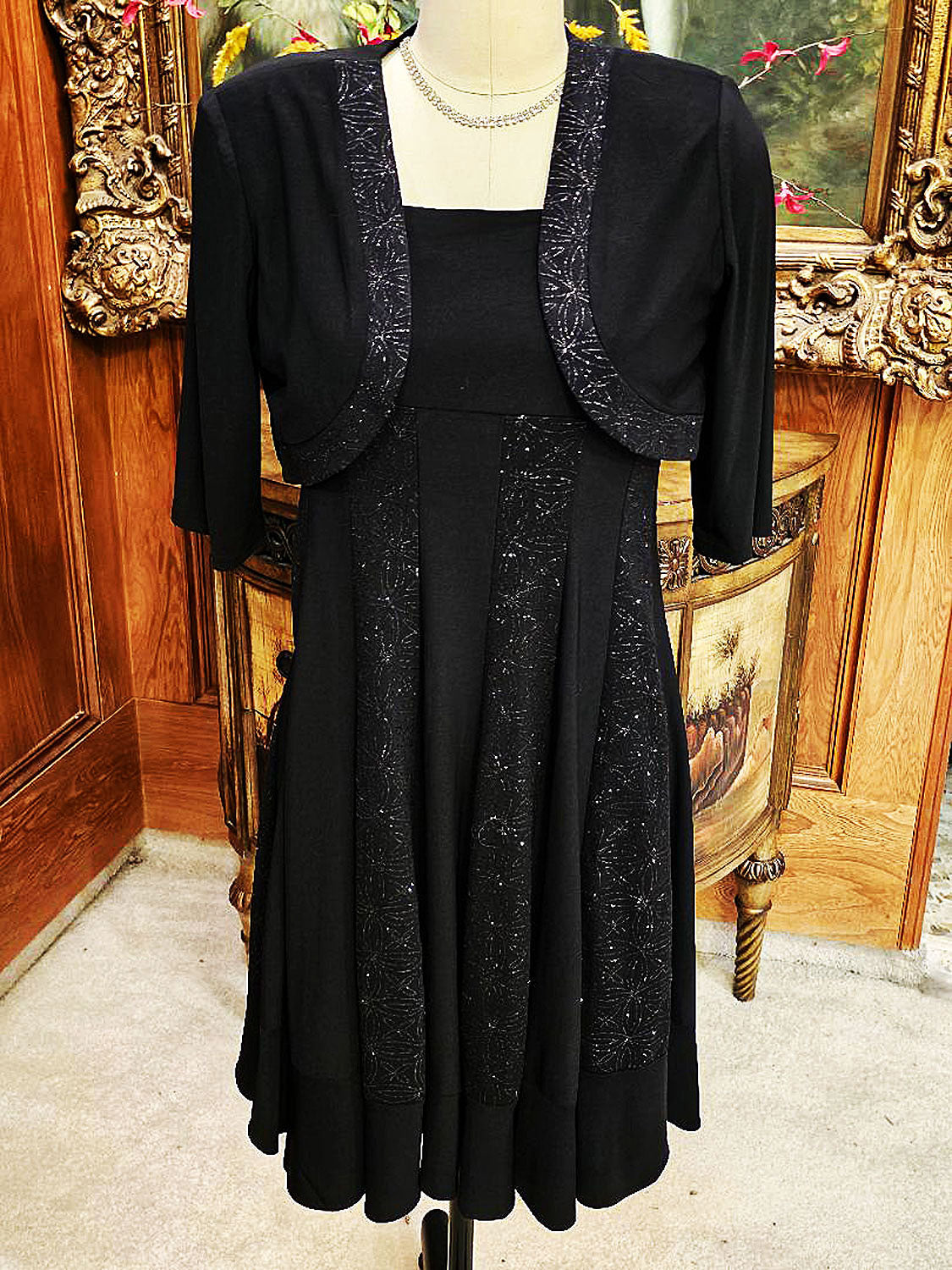
vintage cocktail dress

vintage cocktail dress R & M RICHARDS SPARKLY COCKTAIL DRESS WITH BOLERO JACKET - WORN ONCE F – Vintage Clothing & Fashions

Sale price$19.75 Regular price$21.94
Save 10%

Pay in installments of $5.49 with ShopPay, AfterPay and Klarna

Shipping Estimate
USA
  • USA
  • CAN

Ships within 48 hours · Estimated delivery Oct 16 - Oct 21

Promo Codes Available:

For Your Every Summer RSVP, with Code: SUMMER15

Description

vintage cocktail dress R & M RICHARDS SPARKLY COCKTAIL DRESS WITH BOLERO JACKET - WORN ONCE F – Vintage Clothing & FashionsA beautifully tailored R & M Richards twopiece cocktail dress set with a touch of sparkle that makes it perfect for any special occasion. The matching bolero jacket adds an elegant finish, giving the set a polished, eveningready look. The dress features a flattering silhouette with subtle shimmer throughout the fabric. The bolero jacket provides just the right amount of coverage while keeping the overall look sophisticated and feminine. This set was

A beautifully tailored R & M Richards two‑piece cocktail dress set with a touch of sparkle that makes it perfect for any special occasion. The matching bolero jacket adds an elegant finish, giving the set a polished, evening‑ready look.

The dress features a flattering silhouette with subtle shimmer throughout the fabric. The bolero jacket provides just the right amount of coverage while keeping the overall look sophisticated and feminine. This set was worn only once for about an hour and is in excellent condition.

A stunning, show‑stopping look that captures the perfect balance of sparkle, elegance, and unforgettable glamour.

By:  R & M Richards from Dillards

Size:  8 but go by the measurements for a good fit

Approximate Measurements – This means the measurements of the item listed – not of your own figure. You must be a few inches smaller than the measurements shown.

Bolero Jacket

Bust: Measured seam to seam in back 19-1/4  - the front is supposed to remain open so the dress under it can be seen.  It is a bolero (not a closed jacket) and the fronts of the bolero are not supposed to close but remain open so the dress under it can be seen.

Shoulder to shoulder:  16-1/8

Sleeve from neck:  18

Length in back: 14-1/2

Dress

Bust: 34 - 36 - maybe a bit more - will stretch because of the spandex in the dress

Waist:  16 - 17

Hips:  Full

Length: 38 - 39

Care:  Hand wash

Fabric: Poly & Spandex

Condition:  Very good - worn only for an hour one time 

 _________________________________
All photos & text are copyrighted with the library of congress & the sole property of Midnight Glamour & cannot be duplicated or copied in any manner & will be prosecuted if used.

 _____________________________________________________


Care Instructions

We examine each item carefully and note any imperfections, but unless an item is said to be new, please don't expect it to be perfect & even some new items have small imperfections. I will always state in the description if there are any imperfections & I never do repairs but leave them to others who are better able to do them than me as that is not my expertise.

Please remember that unless specified all items have been used and will show varying signs of use or wear. We always list the obvious imperfections to the best of our abilities. However, some slight imperfections that will not show or affect wearing or using the item may slip by or not be considered worth mentioning.

Vintage nightgowns & peignoirs may be delicate so I do not wash them in the machine. I wash them in lukewarm water with Woolite or some other mild soap, then rinse & hang dripping wet in the shower.

Since these are vintage items, a bit of extra care needs to be taken with them so they remain beautiful & I definitely would never put a vintage nightgown or a peignoir in the dryer as it would ruin it.

The items are sold as we find them. We do not dry clean, launder, alter or repair vintage clothing and they should be cleaned or washed upon arrival. Please make your selection carefully & check the measurements as there is no return on clothing or other items.


Shipping Notes
  • Free Standard Shipping on $100+ Orders to the USA.
  • Except Preorder products are shipped in 48 hours.
  • Delivery to the USA:
  1. Standard Shipping : 3-10 business days
  • If time is of the essence, please consider selecting expedited delivery for faster service.
Exchange/Return Notes
  • We offer a 30-day return/exchange service after receiving.
  • Final sale items are not eligible for returns or exchanges.
  • To process your return/exchange, please contact us at [email protected]
  • Please click here for more details>>> Return & Exchange Policy
SKU: 93105067220

Discover Niche Categories That Outsell vintage cocktail dress

Top-Converting Item to Boost Your Average Order

4.4 ★★★★★
Based on 8 reviews
Sort
Highest Rating
Newest First
Oldest First
Product Reviews
J
Verified Purchase
James H. Lee
Draper, US
★★★★★ 5
Painful but excellent exploration of racist ideas in American history
Format: Kindle
Professor Kendi's fine study, which deservedly won a National Book Award, illuminates in a new way the history of racism in the US. Focusing on ideas rather than government policy, he documents the tenacity of an outlook that has stained the 400 year history of the American people. He begins with a simple, and I think unimpeachable, definition of racism: any argument or idea that attributes to an entire ethnic group intellectual or moral superiority or inferiority. Racists invariably explain these differences between ethnic groups as a product of biology, in an effort to shelter behind a scientific patina ideas that cannot survive rigorous scientific investigation. He organizes the book around five American thinkers, Cotton Mather, Thomas Jefferson, Frederick Douglass, W.E.B. Dubois, and Angela Davis. In each section, he also discusses the ideas of contemporaries of these individuals, dividing people into one of three groups: segregationists (racists who blamed blacks for their own plight); assimilationists (whites and even some blacks who attributed inequality partially to environment but still accepted the racist idea that all blacks shared some responsibility for discrimination); antiracists, who rejected the notion that any type of inferiority could be associated with all African Americans. Kendi has written an angry book, as would any author sensitive to the devastating impact of America's original sin. He shows how racist ideas, like the villain in contemporary horror movies, never suffer a final defeat. As soon as one explanation for alleged racial differences falls out of favor, a different one emerges from the (so far) undrainable swamp of prejudice to take its place. This resiliency demonstrates that racism does not stem from ignorance, but reflects the self-interest of those who benefit from the privileges conferred by supression of ethnic equality. The author's anger does not target any specific group. Few of his subjects (including himself) escape unscathed from his sharp analysis. Probably the most surprising revelation of this book is the extent to which even fierce defenders of black equality sometimes accepted some of the insidious ideas of racism and blamed African Americans for the discrimination they experienced. Thus the real target of Professor Kendi's anger is racism itself, the pervasiveness of which does not exempt even black Americans from its influence. Even this fine work of scholarship is not, in my opinion, free of flaws. In his evaluation of historical figures, he seems to judge them by their conformity to our values and standards. To judge Abraham Lincoln and Frederick Douglass for their failure to measure up to this generation's views of racism may accurately pinpoint some of the shortcomings especially in Lincoln's attitudes. But to criticize a 19th century president, caught in the impossible pressures of a savage civil war for having mixed motives in his emancipation policy displays a willful refusal to evaluate his behavior according to the context of the times in which he lived. (Absurd comments to the effect that Lincoln was "scared to death" when Lee threatened Washington during his invasion of the north in 1862 reveal more about Kendi than they do about the president.) But even if I have correctly identified flaws in the book, this is an important and exceptionally fine work of scholarship, which anyone concerned about the future of race relations in the US should read.
WAS THIS REVIEW HELPFUL?YesReportShare
Reviewed in the United States on August 8, 2017
S
Verified Purchase
Stephanie
Omaha, US
★★★★★ 5
Essential reading
Format: Audiobook
I wish I’d learnt this history decades ago. This book illuminates how the world has, for many of us, come to be seen through a white supremacist lens. It provides religious, political, technological, sociological context over centuries and Millenia. It explains the justifications used to treat our fellow humans as ‘less than’ - the sort of thinking that we in the ‘western’, white, colonial world have inherited, that persists through literature, philosophy and mythology, and that continues to fuel bigotry and oppression today. Eye opening. Can’t recommend more highly (book, kindle, audiobook).
WAS THIS REVIEW HELPFUL?YesReportShare
Reviewed in the United States on January 27, 2026
M
Verified Purchase
Martin Firestein
Cuba, US
★★★★★ 5
Perhaps too ambitious for its own good
Having just finished Dr. Kendi's magnum opus on the history of American racism, I can confidently say that this is a very ambitious work. It attempts to describe the political, social, economic, philosophical, and cultural development of racist ideas throughout American history while at the same time, offering biographical sketches of 5 Americans who were/are representative of their time and place (Cotton Matther/Colonial America, Jefferson/Revolutionary era, William Garrison/Civil War and Reconstruction Era, W.E.B. DuBois/Jim Crow era, and Angela Davis/Civil Rights and Black Power era). Perhaps it's a bit too ambitious, though. The amount of ground the book tries to cover prevents it from being able to cover anything in great detail. Thus, the biographies of the 5 individuals are incomplete, and the racist or assimilationist ideas in each time period are discussed superficially. Dr. Kendi's book also jumps around a lot from one subject to another, which can be a bit jarring or disrupt the flow of the narrative. Don't get me wrong. The book does a very good job explaining how a lot of what has passed for antiracism in US history was really assimilationist thinking, and it also convincingly argues that racism and racist policies flow from the political, economic, or social advantages that one group gains by the persecution of the other. However, I am left with the distinct impression that Dr. Kendi should've narrowed his focus to something that could've been more manageable. Perhaps he should've focused exclusively on the difference between antiracism vs assimilation. Perhaps instead of attempting biographies of 5 individuals, he should've devoted each chapter (or section) of the book to discussing the racist or assimilationist ideas of that time period, and how they developed or changed over time. Overall, my best advice would be to get this book and read it, because it's very timely with what's going on right now in America, but for those areas that aren't covered in a lot of detail, I would try to supplement it with other literature.
WAS THIS REVIEW HELPFUL?YesReportShare
Reviewed in the United States on July 28, 2020
T
Verified Purchase
Taylor
Louisville, US
★★★★★ 4
Interesting and important read, but less objective than I expected.
Format: Hardcover
I feel this book has received higher review ratings than it probably deserves. Yet, it's still an overall good read and it discusses an important societal issue of U.S. history. This review will include both positive and negative feedback of this book. The author, Ibram Kendi, has done a great job at making this book accessible to readers. It's not overly infused with academic jargon. The chapters are also quite short, which makes it easier to read. The substance of the book is pretty informative too. Kendi's frequent usage of quotes really exposes the racist attitudes and ideas that were (and still are) present in American society. Although this book contains an abundance historical quotes, many of them lack sufficient explanation and context. As a student of history, I appreciate deeper, rounded discussions of historical figures. I felt that Kendi mostly includes short bits of statements from historical figures, then hastily shows how those statements equal racism in the person being discussed. I guess Kendi's style is OK. It just doesn't quite feel dedicated to historians craft. Another, less important critique is about the book title's usage of the term "Definitive." I'm surprised that this work was labeled as definitive. To be definitive, it would need to include racial histories of ALL ethnic/racial groups throughout both the American colonial and U.S. eras. Alternatively, this book's title may have been more appropriate as "The Definitive History of Racist Ideas Towards Peoples of sub-Sarahan African Descent in America." Overall, I'm glad I purchased and read this book. It boldly explains certain sides of history that much of our society has missed. I did not grow up in a "racist" household. Yet, this book helped me reflect on my own attitudes, which have been influenced by racist ideas to some degree. I hope others (especially other Americans) can read this book with an open heart and mind.
WAS THIS REVIEW HELPFUL?YesReportShare
Reviewed in the United States on August 12, 2018
J
Verified Purchase
John M. DeMarco
Lexington, US
★★★★★ 5
The REAL American History
Bearing 511 pages of text supported by nearly 70 pages of footnotes, Ibram X. Kendi’s Stamped From the Beginning (Bold Type Books, 2017) is, for me, not an “alternative” American history but THE American history. Kendi, founding director of the Boston University Center for Antiracism Research, makes a convincing argument—which he emphasizes in his other books and public speaking—that, contrary to conventional assumptions, racist policies drive racist thinking and not the other way around. And, Kendi adds, it’s economic, political, or cultural self interests that give birth to such policies and motivate their rejection when new circumstances demand it. In making his case, Kendi patiently and passionately traces the development, implementation, and adaptations of three racial dynamics across the history of the U.S.: 1. Segregation: Blaming Black people themselves for racial disparities, and therefore denying them the privileges 2. enjoyed by white Americans 3. Assimilation: Blaming Black people and racial discrimination for racial disparities, and demanding Black people change their behavior in order to experience less racism Antiracism: Pointing to racial discrimination and policies while defending Black people’s right to be themselves In addition, Kendi structures this narrative across five lengthy sections, each centered on the impact of a specific, influential “tour guide” and their contemporaries: 1. Cotton Mather, early America’s greatest preacher and intellectual, and a staunch promoter of racist policies and ideas 2. Thomas Jefferson, primary author of the Declaration of Independence, and America’s first Secretary of State, second Vice President, and third President, who held contradictory views amid incongruous political and personal actions 3. William Lloyd Garrison, an influential publisher who opposed slavery but embraced assimilationist ideas 4. W. E. B. DuBois, a towering Black intellectual who gradually shifted from assimilation to antiracism 5. Angela Davis, one of the best known Black scholars and antiracist activists still alive today When you’re done reading Stamped From the Beginning, you’ve gained a new framework for noticing and examining race and its interrelated justice issues. Current racial events take on a richer meaning, with their nuances and complexities more tangible than before. Other books on racial justice help to reinforce this framework and further develop a reader’s embryonic skills for noticing racism within themselves, others, policies, and systems—and doing something about it. To grow increasingly fluent in Black history is to awaken from the slumber of an incomplete, biased, and often false American narrative that’s been drilled into most of our minds since we were young children. Since racism remains very much alive today, waking up is crucial and, from my experience, invigorating and teeming with possibilities for a more purposeful life.
WAS THIS REVIEW HELPFUL?YesReportShare
Reviewed in the United States on August 15, 2020

recommand products