Pay in installments of $7.10 with
 ,
,
 and
and

Shipping Estimate
USA
- USA
- CAN
- USA
- CAN
Ships within 48 hours · Estimated delivery Jul 30 - Aug 4
 Promo Codes Available:
For Your Every Summer RSVP, with Code: SUMMER15
Description
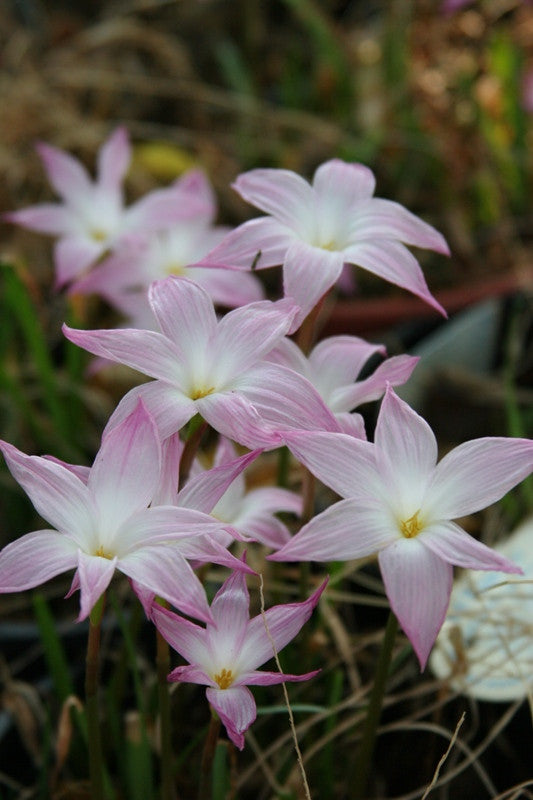
large pink and white lily Zephyranthes Labuffarosa Pink Rain lilyThis rain lily seems to have a personality all of its own. For our gardens in Texas, it performs more like our other fall bloomers (schoolhouse lilies, red spider lilies, Sternbergia, etc.) in that it often blooms on naked stalks in the late summer and fall as the cooler temperatures and rains appear. When planted in the ground, the foliage appears quickly after and lasts until a hard frost knocks it down. These blooms produce an abundance of color in
This rain lily seems to have a personality all of its own. For our gardens in Texas, it performs more like our other fall bloomers (schoolhouse lilies, red spider lilies, Sternbergia, etc.) in that it often blooms on naked stalks in the late summer and fall as the cooler temperatures and rains appear. When planted in the ground, the foliage appears quickly after and lasts until a hard frost knocks it down. These blooms produce an abundance of color in the fall when most things are dying back or giving out after a long summer!
How do you pronounce 'Labuffarosa'? La-boofa-rose-uh. Now, forgive me for not knowing the exact way to spell that out phonetically, but I hope that at least stops you from saying "la buff-uh." How we say it is closely related to where and how the bulb was discovered, and this is a great opportunity read more below about its discovery in Mexico by John Fairey and Carl Schoenfeld from Yucca Do Nursery. This is an interesting story, so be sure to read below.
What makes the 'Labuffarosa' unique? Be sure to click on the link and look at our rain lily page to see the obvious difference in rain lily bloom colors and style, but there are also other differences. These are best understood by comparing and contrasting the differences between the Zephyranthes 'Labuffarosa' and the large pink traditional Zephyranthes grandiflora.
1. Blooms on a Z. Labuffarosa are varying shades of light pink to almost white while the blooms on a Z. grandiflora are a dark, rich pink.
2. The Z. Labuffarosa begins to bloom in the summer occassionally but really begins it show in August/September and blooms well into the fall while the Z. grandiflora begins to bloom in June and by September the blooms are finishing up.
3. The foliage on the Z. Labuffarosa is dormant in the summer (requiring less water) but starts growing in the fall and lasts to the first frost, whereas the Z. grandiflora is thick and full in the summer (requiring some irrigation or ample rain).
Summary Table:
| Trait | Zephyranthes 'Labuffarosa' | Zephyranthes grandiflora | Habranthus robustus |
|---|---|---|---|
| Flower Color | Soft, blended pink | Bright, vivid pink | Pale/medium pink |
| Shape | Upright, symmetrical | Broad, open | Tilted, asymmetrical |
| Height | 6-9 in | 6-10 in | 10–14 in |
| Foliage | Fine, grassy | Wider, strap-like | Thick, upright |
| Bloom Habit | Rain or watering | Rain triggers | Rain, often before foliage |
| Bonus | Refined, floriferous | Showy, bold | Wild look, graceful |
We would encourage you to experience these differences personally by having both planting in your garden together! Not only would you start to enjoy the variability rain lilies bring to your garden, but you would also extend the season of color of these pinks bring to your garden.
Soil: This bulb does great planted in rocky or sandy soil. It has been known to grow in volcanic rock. If you have clay soil, simply add in some organic material, and this bulb should work great for you too. If you are going to plant this in a pot, be sure that the pot has good drainage and stays regularly watered during its growing season in later summer through early winter.
Sun: This is where the Z. 'Labuffarosa' really shines. This bulb can do well wherever you plant her. She will perform best in almost full sun. however, she does well in some summer shade also (give her at least 6 hours a day. That means you can plant her under trees that will lose their leaves in the winter or as a walkway border in full sun. When you look at the pictures, you notice that the blooms appear in everything from full sun to almost full shade. That's because the blooms, which appear in September, are planted under deciduous trees like live oaks or pecans where the foliage can collect all of the winter sun it needs. We have our row at the farm planted under a grove of post oak trees not far from one of our ponds.
Plant and Water: Plant the bulbs with about 2-3 inches of soil above them. You can plant the bulbs about 3 inches apart, but we think they look best in a clump together. Try planting 2 bulbs together in a hole. These rain lilies multiply quickly. They really require very little care after planting. You may just want to weed around them once in a while. That is another thing to love about plants that flourish in the fall...the weeds aren't as many. Make sure that your bulbs are not in standing water in the summer, but other than that they will do just fine.
Blooms: These small bulbs pack large blooms. In late August or September, after the fall rains begin, little shell-pink blooms will pop out of the ground. The bloom is only 6-12" tall, but they will draw one's eyes with their bright color when most bulbs have already quit producing. The blooms will open their petals to about the size of a half dollar. The bulbs will continue to produce blooms 2-3 days after each rain all the way until the first frost of November.
After the blooms: Little tufts of foliage appear. The foliage is a glossy green that looks attractive next to the wintery landscape. The foliage will last all winter if there is not a hard freeze. The foliage will die back with the first warm weather of the year (if a freeze has not sent it into dormancy), and the bulb will be dormant during the hot summer months. Be sure not to cut the foliage off too soon as the bulb needs the nutrients and sun energy that the foliage collects to get it through the summer.
In Pots: The bulb does great in containers! Sometimes you just want a fall pop of color on your porch or back patio. These diminutive blooms and greenery act as great fillers in larger containers with other plants - remember that pots want thrillers, fillers, and spillers. Keep in mind though that you may need to water your bulbs more often if they are in a container than if they are in the ground. In a pot, the Z. labuffarosa often sends up its foliage first, especially when:
-
You have been watering it regularly.
-
Temperatures are warm (above 70°F).
-
The bulbs are established (not newly planted)
**If you're keeping the pots dry and waiting for a "rain trigger," they may mimic in-ground behavior. But steady water = early foliage.
Animals: Like the other bulbs in the Amaryllis family, these bulbs and foliage are resistant to deer and other animals, but deer and rabbits will eat the flowers occasionally. This bulb attracts several beneficial animals. Butterflies, bees, and hummingbirds enjoy these rain lilies very much.
What is the correct name for the ‘Labuffarosa’ rain lily?
Names: Can I offer a disclaimer first? We are not botanists. Naming plants is a science and is important. It can be confusing and tedious for many of us, and I will try to keep this narrative superficial and keep us out of the botanical weeds. My goal is to make this fun and entertaining. Why fun and entertaining? We remember better when something is fun and entertaining and there is a great story to tell here, a story that mentions many personalities and big names of modern plant explorers. These pioneers have done much to write about, discover, breed, and promote rain lilies for us all to love!
First there are many genus names for rain lilies, but let’s focus on Zephyranthes. Zephyr = Greek god of the west wind and “anthros” = flower. So to begin with, we have the flower of the god of the west wind, and you can read more about rain lilies on wikipedia here. Now let’s tackle the species name, or specific epithet, of this particular rain lily. The lines between the species name (in italics and all lower case) and cultivar name (single quotation marks and NOT italicized) are blurred. Some literature has a species name of Z. labufarosea (Thad Howard) and others have a cultivar name of ‘Labuffarosa’ (Scott Ogden) or ‘Labuffarosea’ (Pacific Bulb Society). Note there are two “f”s in those cultivar names and one ends with “rosa” and the other with “rosea.”
To summarize the common names, we could use the many common references we hear from sophisticated to very straight forward. Such as:
- La Buffa Group
- Labufarosea hybrids
- Pink rain lilies
- Pink Zephyr lilies
- Pink fairy lilies
- La Buffa Rosa
On our website, we will use Z. ‘Labuffarosa’ and use Scott Ogden’s “Garden Bulbs for the South” as our authority for the name. As a side note, on our printed materials that I have had for over 15 years such as our tags, you will see my second preference, Z. labufarosea.
The Origin Story of the ‘Labuffarosa’ Pink Rain Lily:
Why is Z. labufarosea our second naming choice? I’m glad you asked! Many times, plants are named based on where they are found, and this bulb was found on a plant hunting expedition in an isolated mountain range south of the Texas border in Mexico? Really? Yes!
Have you ever heard of the San Carlos Mountains in Mexico (aka Sierra de San Carlos) in the state of Tamaulipas, Mexico? Want to hear a song that brings a flavor of the region to your ears? Want to see a picture of the mountains? Would you like to hear about Texas native plantsman, Lynn Lowrey, helping two adventurous plant explorers John Fairey and Carl Schoenfeld start what would become over 100 plant expeditions into Mexico? Here, we’ll take a brief dive into Thad Howard’s book “Bulbs for Warm Climates” and look at Scott Ogden’s book “Garden Bulbs for the South.” We’ll also briefly explore the Pacific Bulb Societies page of the Z. ‘Labuffarosea’ group as well.
So, back briefly to where the bulb was found by John Fairey and Carl Schoenfeld from Yucca Do Nursery. It is important because for “commemorative” naming pronunciation rules, the scientific name should be generally be pronounced as the language of the person or place would pronounce it in that area. These were found near La Bufa Mountain, which would be pronounced “boof-uh.” I’m also making an assumption that La Bufa Mountain is referring to Bufa el Diente peak in the Sierra de San Carlos Mountains. Based on this fact, even with the spellings of two “f”s (i.e. ‘Labuffarosa’), I believe the pronunciation should still be la-boof-uh.
Let’s look at some quote about where the plant was found.
From Plant Delights Nursery, where Tony Avent and crew also sell the bulb here “This naturally-occurring hybrid rain lily was discovered by Yucca Do Nursery in 1990 at 4,000' in Tamaulipas, Mexico.”
This would coincide with other plant discoveries now grown at The John Fairey Garden , such as Salvia microphylla 'San Carlos Festival' that was “Collected in La Bufa, San Carlos Mountains, Tamaulipas, Mexico in 1992 and introduced in 1997.”
Thad Howard says in his book on page 53: "In Tamaulipas, a form has been found that is intermediate between C. [Cooperia] pedunculata and a pink native Zephyranthes. It was given the quaint identification of Z. labufarosea for commercial reasons, but the name has no scientific merit. It is obviously a natural hybrid, and has its own characteristics. The name Labufa (not "labuffa") suggests the mountain on which it is found, and rosea suggests the color of the flower. Thus the name could be translated as "the pink mountain." - Howard, T. (2001). Bulbs for Warm Climates. University of Texas Press.
The Pacific Bulb Society does a great job here with a brief description and a look into other selections : “Zephyranthes 'Labuffarosea' (syn. Z. sp. 'Labuffarosa') was found and collected by Carl Schoenfeld (owner of Yucca Do Nursery) and John Fairey (owner of Peckerwood Garden) in the Sierra Chiquita in the state of Tamaulipas, Mexico. The large flowers open in the afternoon and are variable from white to pink, also bicolors. Z. drummondii, Z. traubii and an unknown pink Z. species are found growing in the same area and Z. 'Labuffarosea' is suspected to be a natural hybrid of these species. Zephyranthes sp. 'Labuffarosea' (sometimes spelled as 'Labuffarosa' or 'Labuffarosae') is an unsubscribed species (or natural hybrid) that is widespread in cultivation. It is similar to Z. grandiflora, but the leaves are dark green leaves and the flowers open rather flat with very broad tepals.”
Lastly, we read from Scott Ogden on page 31 in his book: “In the neighboring state of Tamaulipas, John Fairey and Carl Schoenfield discovered another interesting rain lily. This undescribed species occurs in both pink and white editions and has a long blooming season…In the wild they are often seen clinging to crevices of volcanic rocks along with clusters of succulent hen-and-chicks (Echeveria runyonii). Thhe discoverers of this lovely plant have nicknamed their find Zephyranthes sp. ‘Labuffarosa’, the pink rain lily of La Buffa.” - Ogden, S. (2007). Garden Bulbs for the South 2nd ed. Timber Press.
If we were to distill all of this, the "San Carlos Mountains" probably refers to Sierra de San Carlos, also known as the Sierra Chiquita, which is an isolated mountain range in the state of Tamaulipas, Mexico (https://en.wikipedia.org/wiki/Sierra_de_San_Carlos). La Bufa Mountain probably refers to "Bufa El Diente." The Sierra de San Carlos has a semi-arid climate with hot summers and mild winters. This would explain why the Z. ‘Labuffarosa’ has done so well for us on the Southern Bulb farm in Texas in a spot where it is dry in the summer, and blooms/grows as fall comes along.
If you have a second to read about plant hunting adventures, I highly recommend reading this brief history of The John Fairey Gardens, as the early flower hunting adventures of Lynn Lowrey, John Fairey, and Carl Schoenfeld are related (https://jfgarden.org/about/):
“In 1988, five years after the tornado, John and Carl were invited by Lynn Lowrey to join him on a plant expedition trip to the Sierra Madre Oriental Mountains in northern Mexico to collect seeds and cuttings from rare and endangered plants.”
As they traveled south of the border, you can almost imagine hearing music such as this, named "La Sierra De San Carlos" a Song by Juan Villarreal y Ramiro Cavazos.
As the music, dancing, and regular life went on, your backdrop were the tips of this isolated mountain range, featuring Bufa El Diente peak. Every plant has a story, and we hope you plant this story in your garden life as well.
(Photo of Bufa El Diente By Comisión Mexicana de Filmaciones from México D. F., México - Sierra Chiquita, CC BY-SA 2.0, https://commons.wikimedia.org/w/index.php?curid=66038449 Sierra Chiquita with the isolated "tooth-like" Bufa El Diente protruding on the right. photographed 1 November 2010)
Remember you're planting a story, and these bulbs are for a lifetime!
Shipping Notes
- Free Standard Shipping on $100+ Orders to the USA.
- Except Preorder products are shipped in 48 hours.
- Delivery to the USA:
- Standard Shipping : 3-10 business days
- If time is of the essence, please consider selecting expedited delivery for faster service.
Exchange/Return Notes
- We offer a 30-day return/exchange service after receiving.
- Final sale items are not eligible for returns or exchanges.
- To process your return/exchange, please contact us at [email protected]
- Please click here for more details>>> Return & Exchange Policy