Pay in installments of $5.13 with
 ,
,
 and
and

Shipping Estimate
USA
- USA
- CAN
- USA
- CAN
Ships within 48 hours · Estimated delivery Jul 30 - Aug 4
 Promo Codes Available:
For Your Every Summer RSVP, with Code: SUMMER15
Description
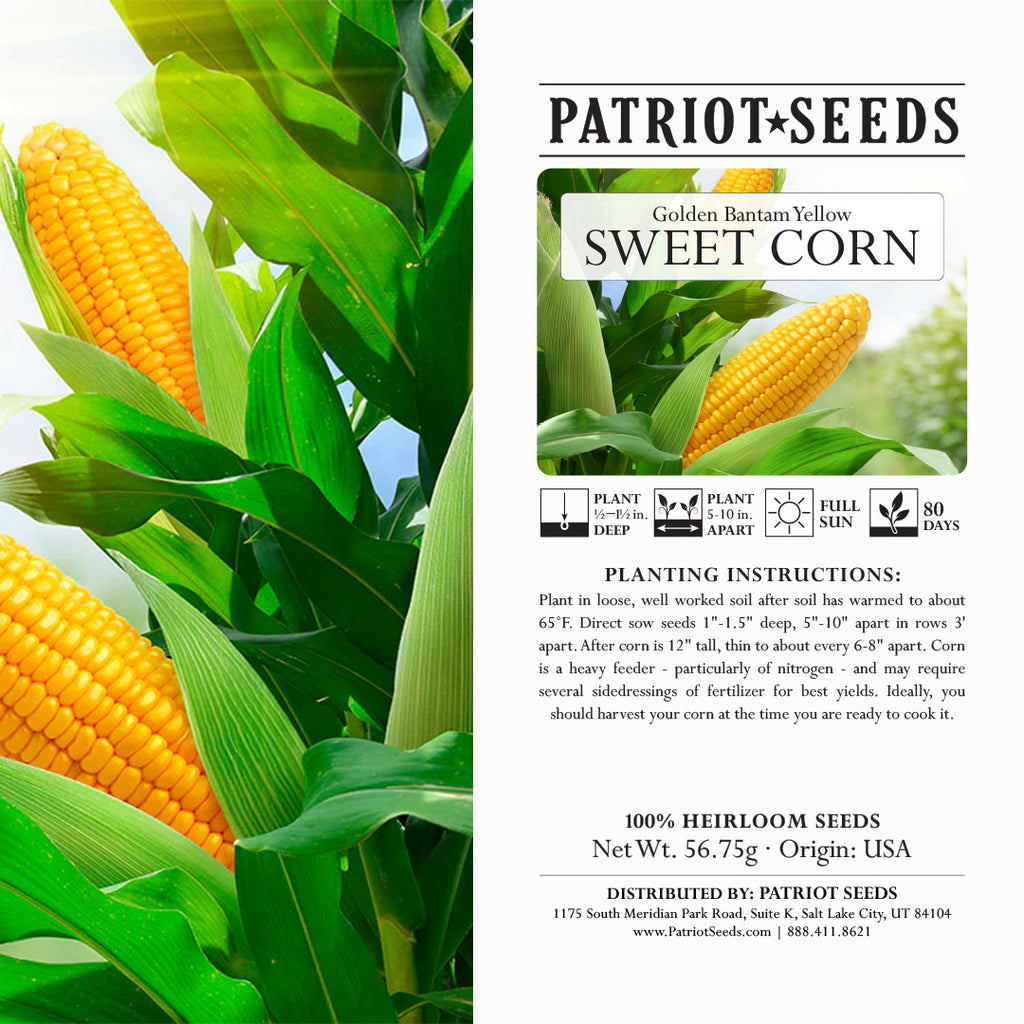
sweet corn seeds for planting Heirloom Golden BantamGolden Bantam Yellow Sweet Corn (56. 75g): Golden Bantam is an old time favorite. The plant yields lots of ears up to 7" long. This is the sweet corn that made us fall in love with sweet corn! Average: 80 days. Detailed planting instructions: Corn requires rich, fertile soil. Add compost or well rotted manure in fall. Consider planting a legume cover crop the season before corn to help meet the nutrient needs of this heavy feeder. Make first planting
Golden Bantam Yellow Sweet Corn (56.75g):Golden Bantam is an old time favorite. The plant yields lots of ears up to 7" long. This is the sweet corn that made us fall in love with sweet corn! Average: 80 days.
Detailed planting instructions:
Corn requires rich, fertile soil. Add compost or well rotted manure in fall. Consider planting a legume cover crop the season before corn to help meet the nutrient needs of this heavy feeder. Make first planting after last frost date. Soil should be at least 65 F for fast germination. (Corn will not germinate if soil temperature is less than 55 F.) To speed increase in soil temperature, consider covering soil with black plastic for several weeks before planting. Plant seeds 1" deep and 4 to 6" apart in rows 30 to 36" apart. Thin to 8 to 12" spacing when plants are 3 to 4" tall. Increase seeding rates to ensure a good stand if soils are cold or you are using seed that has not been treated with fungicide. (Untreated seed has natural color. Treated seed is dyed).
To save space, you can intercrop corn with early-harvested cool-season crops. Corn plants have many roots close to the surface, so cultivate around them with care. You can hill soil up around the base of plants as they grow to bury small weeds in the row and give the corn a better foothold. After the soil has warmed, you can mulch corn to help suppress weeds and retain moisture. It is not necessary to remove suckers (side sprouts growing from the base of the plant). Studies show that removing them may actually reduce yields. Corn is a heavy feeder - particularly of nitrogen - and may require several sidedressings of fertilizer for best yields. Look for signs of nutrient deficiency. Purple-tinged leaves are a sign of phosphorus deficiency. Pale green leaves are a sign of nitrogen deficiency. For miniature or baby corn, plant seeds 2 to 4 inches apart and harvest as silks emerge from the ear, or harvest secondary ears from normally spaced plantings, allowing the main ear to fully mature. Also try hybrids specifically bred for early baby corn harvest.
Harvesting:
Of all the vegetables grown, corn is the one most often harvested too late. With corn, it is essential to pick it at the right time to get the best quality and flavor. Corn also starts to lose its quality quickly after it is harvested. Within 24 hours after being picked, most corn loses more than half its natural sugars by converting them to starch. Ideally, you should harvest your corn at the time you are ready to cook it.
Check sweet corn for ripeness when the the silks have turned brown but are still damp to the touch. Pull back the husk partially and puncture a kernel. If a clear liquid spurts out, the corn is not ready. If a milky liquid spurts out, it is ready and should be picked immediately! If no liquid emerges, the corn is past its prime. Beware, however, that though pulling back the husks is a reliable method of checking for ripeness, it does have a major disadvantage if the corn is still immature when you do the checking. Once you open an immature ear, it becomes susceptible to insect and other pests, as it continues to ripen. Attack by birds also becomes more likely. With a little experience and practice, you'll be able to judge the ripeness of corn fairly accurately, just by feeling the ends of the ears and not have to worry about that problem.
Saving Seeds:
To save corn seed choose the earliest and the best-developed corncobs you can find. Cover them with a large enough paper bag to be able tie the top off to keep the bugs and grubs out. Do not use a plastic bag as the cob needs to breathe. Allow the cob to develop and dry out on the stalk as long possible. To store the cobs, remove them from the bag, pull back the husks, and hang in a dry area away from bugs or rodents, or you will end up with a dried out corncob with no seed. When the cobs are fully dried out, carefully break-off the seed, store in a paper bag, and keep in a cool place (the bottom of the fridge is a good spot) until springtime and you want to sow it.
Shipping Notes
- Free Standard Shipping on $100+ Orders to the USA.
- Except Preorder products are shipped in 48 hours.
- Delivery to the USA:
- Standard Shipping : 3-10 business days
- If time is of the essence, please consider selecting expedited delivery for faster service.
Exchange/Return Notes
- We offer a 30-day return/exchange service after receiving.
- Final sale items are not eligible for returns or exchanges.
- To process your return/exchange, please contact us at [email protected]
- Please click here for more details>>> Return & Exchange Policy
4.3 ★★★★★
Based on 21 reviews
Sort
Product Reviews
★★★★★ 5
"When you're dealing with the wolf,
Format: Paperback
you have to speak the language of the wolf." - Henry Austin, Deacons for Defense
This is truly a lost history of the civil rights movement that author Lance Hill has found under the layers upon layers of mainstream narratives which conveniently dictate false truths that - when repeated enough - become larger than life.
Following the organized self-defense philosophy espoused by Robert F. Williams in Monroe, N.C., a small group of men in Jonesboro, Louisiana, founded an organization that had great influence in the civil rights movement of the mid-1960s. The success the Deacons had in defeating the KKK and other haters on the streets by standing up, moving forward and staring them down with guns loaded brought a new sense of empowerment in demanding that justice truly be served today.
Hill explains how he became aware of the Deacons and then began his quest to research the history. Initially founded to protect civil rights workers, the Deacons' influence in the Deep South grew with a regional organizing campaign in Louisiana, Mississippi and Alabama, along with chapters being founded in several Northern cities.
The success and expansion of the program brought interest from the FBI, coverage by an oftentimes adverse media and linkage - oftenetimes quite temporary - with a number of revolutionary organizations.
But through the comparatively brief time the Deacons operated - about four years - Hill successfully argues that the organization forced the federal government to aggressively enforce the 1964 Civil Rights Act and was the bridge to the Black Power movement that emerged later in the decade.
The Deacons' legacy continues, as former members have strongly stated over the years that the group has never actually gone away. And, as Hill writes, "Finally, there is something inspiring in a story of people who stood up to injustice when everyone around them was afraid. That is a fable that will always serve us well."
The Deacons for Defense lives in the souls of those who do their part on a daily basis to bring real justice to this country.
WAS THIS REVIEW HELPFUL?YesReportShare
Reviewed in the United States on January 9, 2007
★★★★★ 5
Great history of a politically incorrect civil rights movement
Format: Paperback
This is the true story of African Americans who choose not to turn the other cheek and wait for Martin's Dream to come true. Instead, they take up arms to protect themselves and their children from the present predations of racist, sadistic creeps. Very inspiring. There's a good movie from it, same name, starring Forest Whitaker.
WAS THIS REVIEW HELPFUL?YesReportShare
Reviewed in the United States on September 19, 2010
★★★★★ 4
An Obscure Facet of the Civil Rights Movement
Format: Paperback
The Deacons for Defense story has been buried since the mid sixties. The reasons for this loss are many. The Deacons don't fit the stereotype promulgated by the orthodox civil rights leaders and historians, nor does it particularly fit with the "conservative" historian view that anti-black violence largely was confined to a few terrible but soon overcome incidents [overcome with support of the Feds and the Press]. This book shows how pervasive the violence was and how the African-American Community especially the men, were scarred by the violence, and reluctant to join with the non-violent philosophy of the orthodox movement , as it destroyed their sense of manhood. The author does stretch at times to support his themes, especially the class differences between the Deacons and the mainstreamers, but this story is strong and should be better known. One amazing thing, with all of the hoopla about gun control, I'm surprised the NRA doesn't push the Deacon's story, as it does support the notion of an armed citizen being effective in countering an oppressive government. One can only surmise that the NRA supporters are also supporters of the repression in these instances. Ironic [but I digress].
WAS THIS REVIEW HELPFUL?YesReportShare
Reviewed in the United States on February 10, 2013
★★★★★ 5
This details what the average citizen may need to do when the local or state law enforcement won't protect your rights and what
Format: Paperback
If you are a second amendment supporter or if you are an African-American who wonders "What does all this second amendment stuff mean to me anyway?", you need to read this book. This doesn't take place in 'ancient' American history when only those on the frontiers needed to keep arms for hunting and protection or for the gentleman walking through 18th or early 19th century America, this is from America, the 1960's. This details what the average citizen may need to do when the local or state law enforcement won't protect your rights and what it is like to live, as a minority, during that type of time (and 'minority' may change as the winds of political strength changes). The movie about the same topic gives you only a taste. Enlarge your mind.
WAS THIS REVIEW HELPFUL?YesReportShare
Reviewed in the United States on January 21, 2017
★★★★★ 5
This is really a great read for individuals wanting to increase their knowledge of ...
There was so much information in this book that has never been bought to light. This is really a great read for individuals wanting to increase their knowledge of the Black Power Movement.
WAS THIS REVIEW HELPFUL?YesReportShare
Reviewed in the United States on April 20, 2016
recommand products
Evenflo Feeding Classic Glass Twist Bottles, 8 Ounce (Pack of 6),Clear – Bunique Express
25.74
Evenflo Balance + Glass Wide Neck Baby Bottles
26.15
Evenflo Revolve360 Slim 2-in-1 Rotating Car Seat with SensorSafe
22.67
Evenflo Balance + Glass Wide Neck Baby Bottles
22.52
Evenflo Eat & Grow™ 4-Mode High Chair
29.80